Chinese Writing Paper
Free printable tian zi ge paper, 田字格 (tián zì gé), and five other practice grids. Print or save a crisp PDF in color or black and white, A4 or US Letter, no sign-up.
Print at 100% (Actual size), not Fit to page, so every box keeps its size.
Ready-made PDFs
One page, red lines, with a name line. Pick a box size to download.
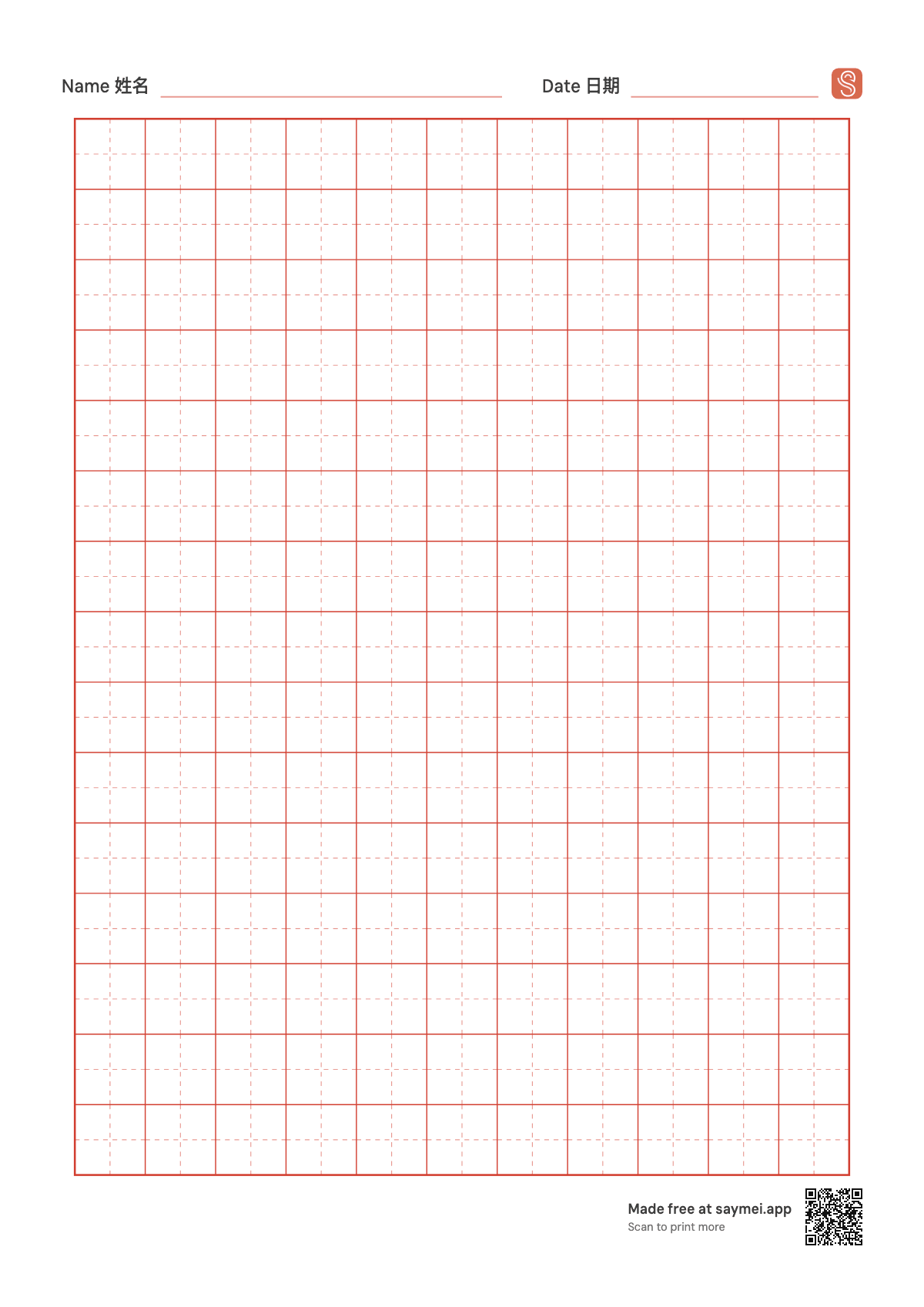
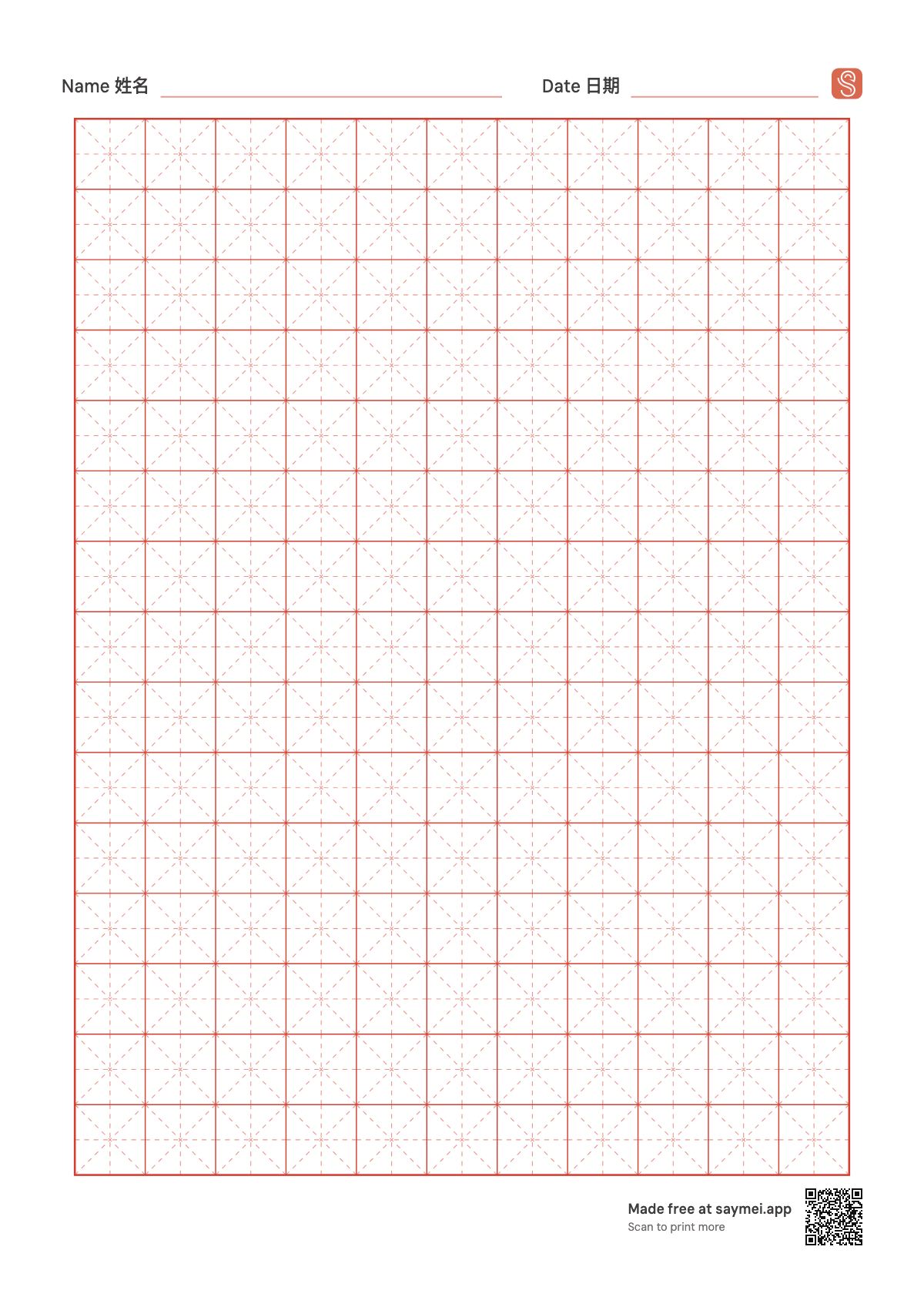
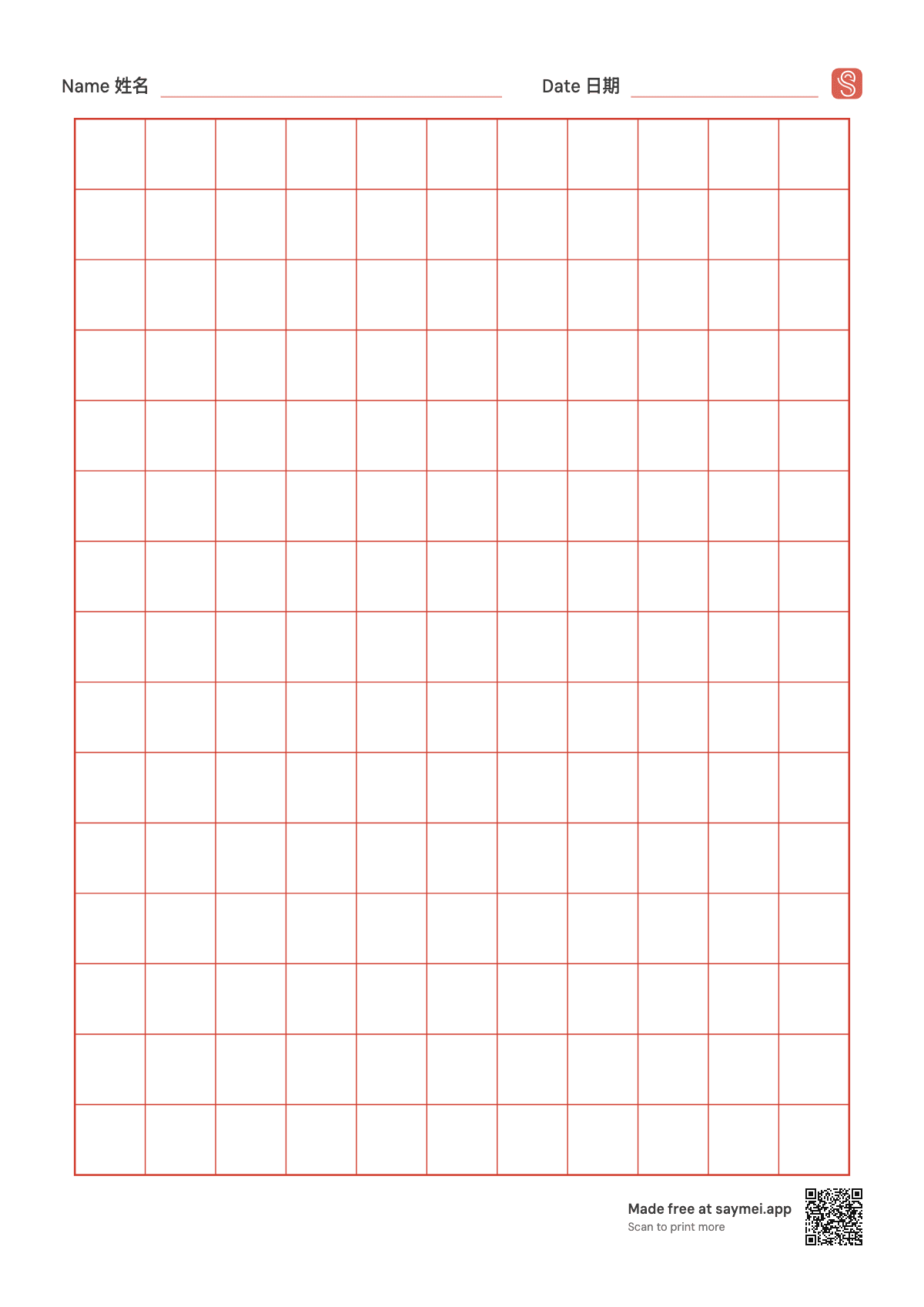
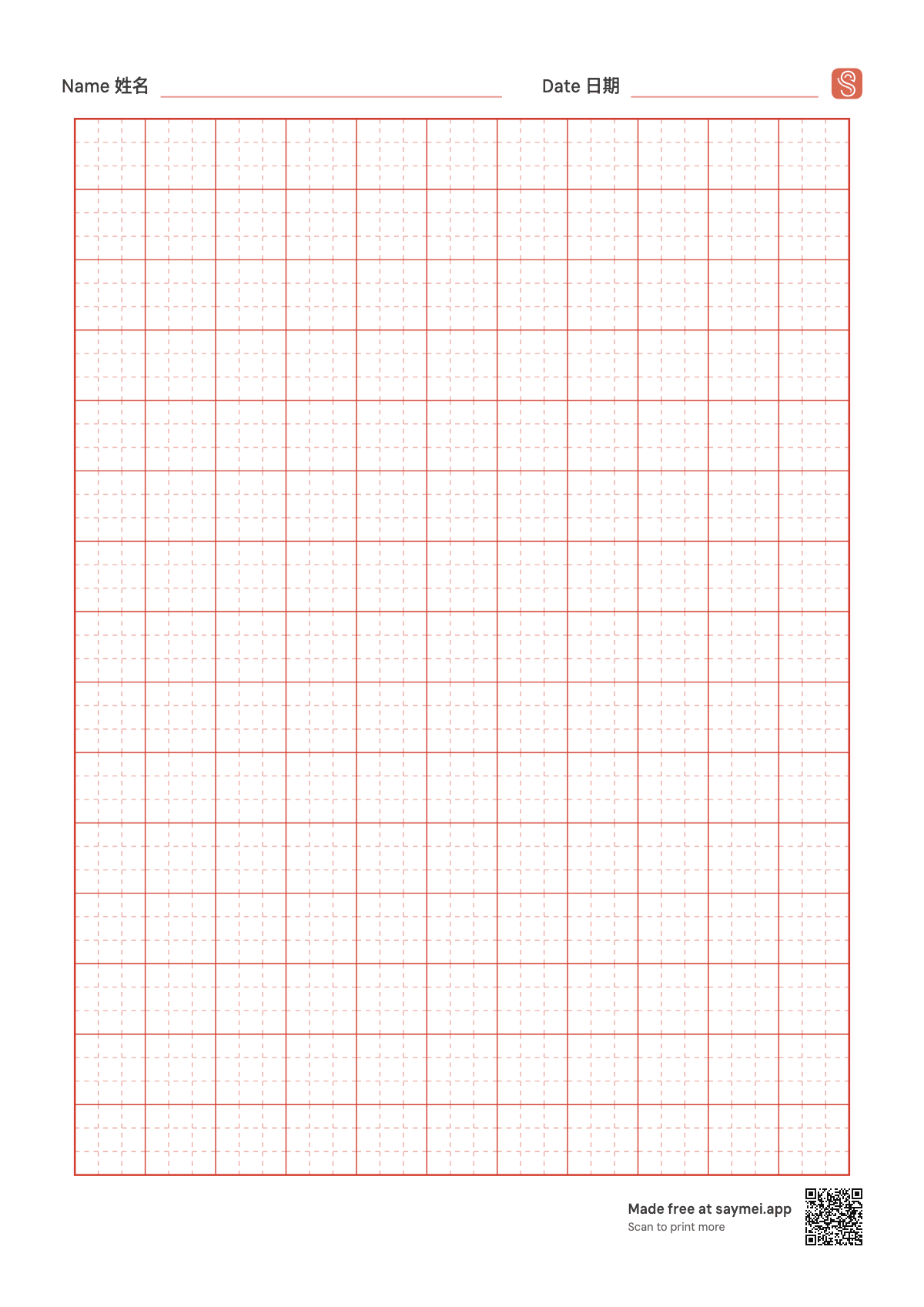
Which paper should I print?
Chinese practice paper puts guide lines inside every box. They show where each stroke goes, so characters keep the same size and balance. Schools start with more guides and take them away as handwriting settles.
- Field grid, 田字格 (tián zì gé): A dashed cross splits each box into four, like the character 田 (tián, field). Best for: Everyday handwriting and beginners. It's the grid in the 田字格本 (tián zì gé běn) exercise books Chinese primary schools use. Also called tian zi ge paper, field grid, Chinese squared paper.
- Rice grid, 米字格 (mǐ zì gé): The cross plus two diagonals, like 米 (mǐ, rice). Best for: Calligraphy and tracing. The diagonals help you angle slanting strokes such as 撇 (piě) and 捺 (nà). Also called mi zi ge paper, rice grid.
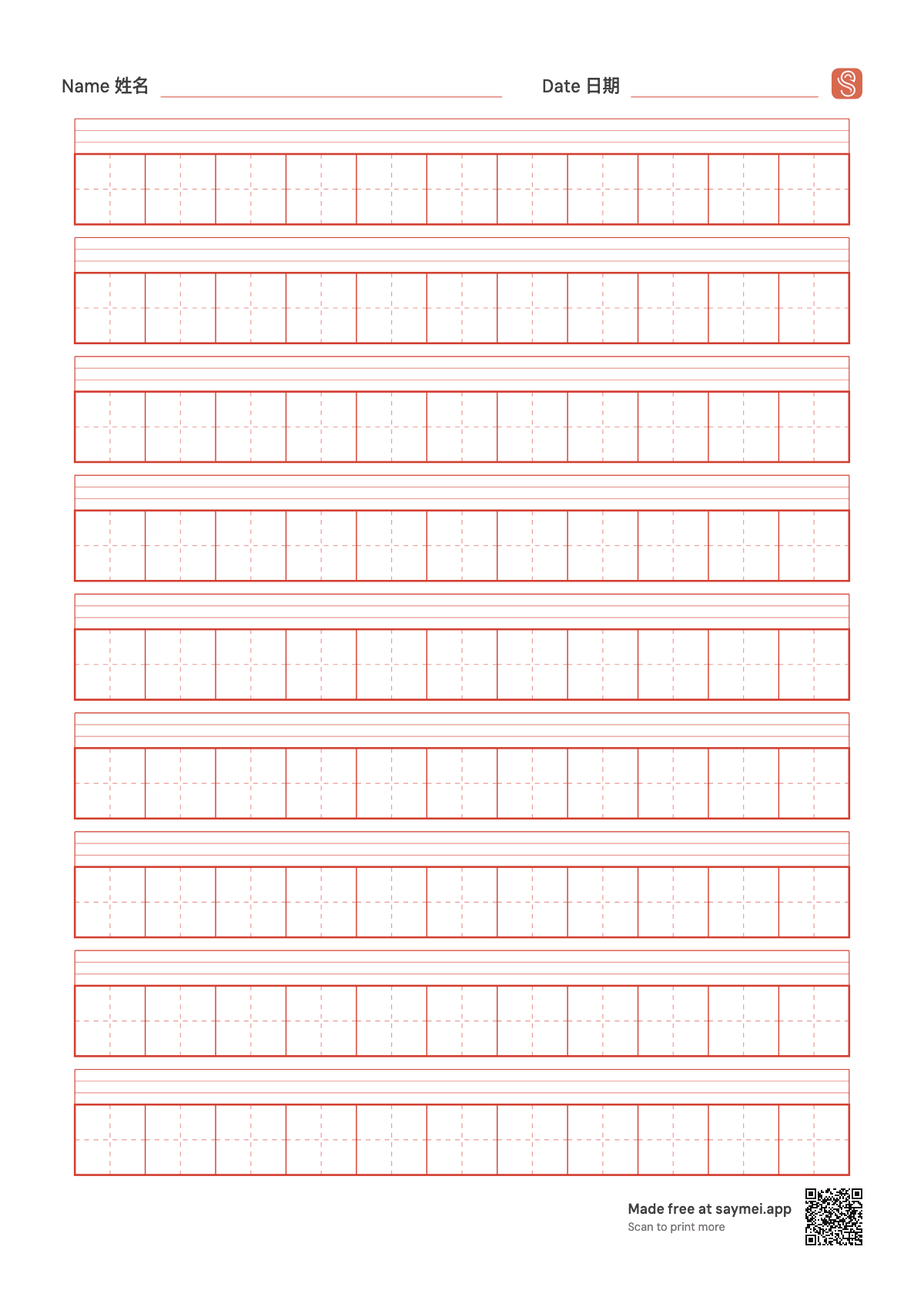
- With pinyin, 拼音田字格 (pīnyīn tián zì gé): Four lines for pinyin sit on top of every row of field-grid boxes. Best for: Young learners who write each character with its pinyin, as Chinese first graders do. Also called pinyin tian zi ge, 四线三格 (sì xiàn sān gé) lines.
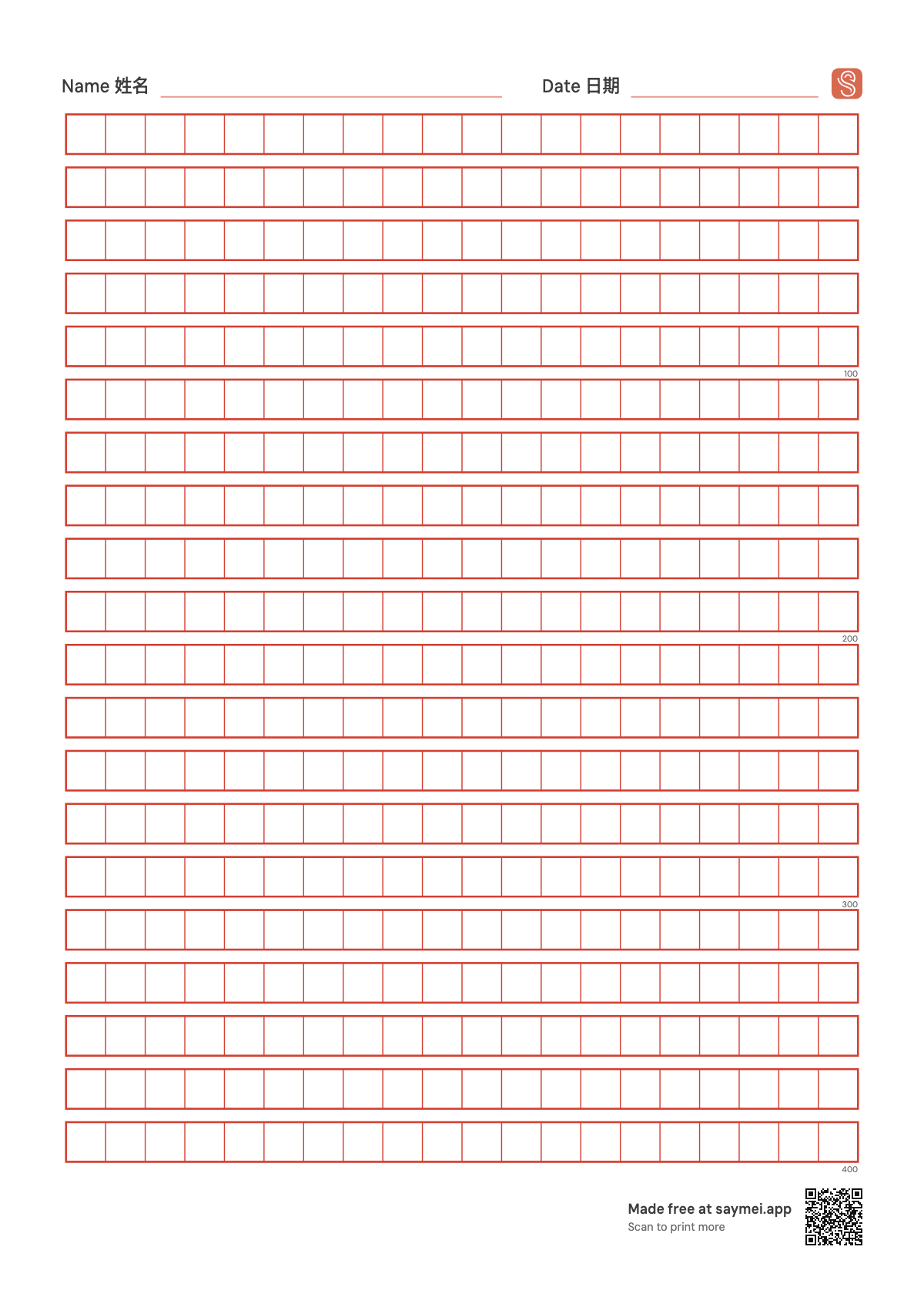
- Composition, 作文纸 (zuòwén zhǐ): 20 rows of 20 small squares, 400 in all, with a gap between rows. One character or punctuation mark per square. Best for: Essays, diaries and 作文 (zuòwén) homework. Also called 原稿纸 (yuángǎo zhǐ), Chinese manuscript or essay paper.
- Nine-square, 井字格 (jǐng zì gé): Two lines each way cut the box into nine cells, like 井 (jǐng, well). Best for: Proportion drills in pen calligraphy: fill the center cell with the body of the character. Also called 九宫格 (jiǔ gōng gé), nine-palace grid.
- Plain squares, 方格 (fāng gé): Boxes with no guide lines. Best for: Dictation, 听写 (tīngxiě), and writing once your characters keep their shape without help. Also called 方格纸 (fāng gé zhǐ), square grid paper.
Not sure? Print the field grid. Move to the rice grid when you care how strokes look, and to plain squares once your characters hold their shape. This is practice paper: brush calligraphy uses thin 宣纸 (xuānzhǐ) instead.
How to write in a 田字格 (tián zì gé)
The center lines mark where a character divides. Which rule applies depends on how the character is built.
- Left–right characters split at the vertical line (左右结构 zuǒyòu jiégòu). One part sits left of the vertical center line and one right, and the left part is drawn narrower than it would be alone. In 好 (hǎo), 女 (nǚ) takes the left half and 子 (zǐ) the right.
- Top–bottom characters split at the horizontal line (上下结构 shàngxià jiégòu). The top part sits above the horizontal center line and the bottom part below it. In 早 (zǎo), 日 (rì) sits on top and 十 (shí) hangs below, its vertical stroke on the vertical line.
- One-piece characters balance on the center point (独体字 dútǐzì). Characters made of one piece, like 人 (rén), 大 (dà) and 小 (xiǎo), are centered on the point where the lines cross. Boxed characters such as 国 (guó) fill all four quarters but never touch the walls.
Leave a little space on every side: a character that touches the box is too big, and one that fits in a quarter is too small.
Box size, printing and GoodNotes
Pick a box size
Large 20 mm boxes suit children and first characters. Medium 16 mm matches most 田字格本 (tián zì gé běn) exercise books. Small 12 mm fits 300 boxes on an A4 page for adults practicing lots of characters.
Print at 100%
In the print dialog choose 100% or Actual size, not Fit to page, so the boxes keep their size. A4 and US Letter both print square boxes; a Letter page is shorter, so it fits a row fewer.
Use it on an iPad
Download the PDF, up to 10 pages, and import it into GoodNotes, Notability or any note app that opens PDFs. Each page becomes a sheet you can write on with a stylus.
What to write first
Chinese first graders start with short characters that sit cleanly in a box. Write one row per character and say each one aloud. Tap a character to hear it.
- 一 yī, one
- 二 èr, two
- 三 sān, three
- 十 shí, ten
- 人 rén, person
- 大 dà, big
- 小 xiǎo, small
- 上 shàng, up, above
- 下 xià, down, below
- 口 kǒu, mouth
- 日 rì, sun, day
- 月 yuè, moon, month
- 山 shān, mountain
- 水 shuǐ, water
- 火 huǒ, fire
- 木 mù, tree, wood
- 田 tián, field
- 中 zhōng, middle
- 天 tiān, sky, day
- 好 hǎo, good
- 早 zǎo, early, morning
- 国 guó, country
For teachers: grid words and how schools use them
Words for the parts of the box
- 横中线 héng zhōngxiàn: the horizontal center line
- 竖中线 shù zhōngxiàn: the vertical center line
- 中心点 zhōngxīn diǎn: the center point where the lines cross
- 左上格 zuǒ shàng gé: the top-left quarter
- 右上格 yòu shàng gé: the top-right quarter
- 左下格 zuǒ xià gé: the bottom-left quarter
- 右下格 yòu xià gé: the bottom-right quarter
- 田字格本 tián zì gé běn: a 田字格 (tián zì gé) exercise book
- 生字本 shēngzì běn: a new-character practice book
- 练字 liànzì: to practice handwriting
What it sounds like in class
- 横画写在横中线上。 Hénghuà xiě zài héng zhōngxiàn shàng.: Write the horizontal stroke on the center line.
- 这个字要写在中心点上。 Zhè ge zì yào xiě zài zhōngxīn diǎn shàng.: This character should sit on the center point.
- 字不要写出格。 Zì bú yào xiě chū gé.: Don't let the character run outside the box.
How Chinese schools use the grids
- Grades 1–2
- Every new character goes into a 田字格本 (tián zì gé běn); homework is 生字 (shēngzì), new characters, copied line by line.
- Pinyin
- First graders learn pinyin on four-line 四线三格 (sì xiàn sān gé) paper, then write characters with pinyin on 拼音田字格 (pīnyīn tián zì gé).
- Tracing books
- 描红 (miáohóng) workbooks print faint red characters inside 米字格 (mǐ zì gé) so the diagonals show where strokes start and end.
- Grades 3 and up
- Children move to plain 方格本 (fānggé běn) squares, write essays on 400-square 作文纸 (zuòwén zhǐ), then use lined paper.
Common questions
What is Chinese writing paper called?
It's usually called 田字格 (tián zì gé), or tian zi ge paper: squares split into four by a dashed cross, like the character 田 (tián, field). The cross shows where each stroke sits. Exercise books of it are 田字格本 (tián zì gé běn). It isn't 宣纸 (xuānzhǐ), the thin rice paper used for brush calligraphy.
田字格 (tián zì gé) or 米字格 (mǐ zì gé): which should I use?
Use 田字格 (tián zì gé) for everyday handwriting and 米字格 (mǐ zì gé) for calligraphy. The rice grid adds two diagonals, which help you angle slanting strokes such as 撇 (piě) and 捺 (nà). Most learners start on the field grid and move to plain squares once their characters keep their shape.
Is there Chinese writing paper with pinyin lines?
Yes. Pick With pinyin to print 拼音田字格 (pīnyīn tián zì gé): four lines for pinyin sit on top of every row of field-grid boxes, the layout Chinese first graders use. Write the pinyin on the four lines and the character in the box underneath it. Large and medium boxes suit young children best.
What is Chinese composition paper, and how many squares does it have?
Chinese composition paper, 作文纸 (zuòwén zhǐ) or 原稿纸 (yuángǎo zhǐ), has 400 squares: 20 rows of 20, with a gap between rows. Each character and each punctuation mark takes one square, so the count shows how long an essay is. The PDF here marks every 100 squares in the margin.
What box size should I print for kids and adults?
Large 20 mm boxes suit young children and first characters. Medium 16 mm boxes match most 田字格本 (tián zì gé běn) exercise books, and small 12 mm boxes fit 300 on an A4 page for adults practicing lots of characters. Whatever the size, leave a little space around each character.
Is this Chinese writing paper free to print for my class?
Yes. Print as many copies as you like, with no account, email or watermark. Choose A4 or US Letter, then print at 100% or Actual size, not Fit to page, so every box keeps its size. Each sheet has a small footer and a QR code that reopens the same paper.
Can I use this paper in GoodNotes or Notability?
Yes. Download the PDF, up to 10 pages long, and import it into GoodNotes, Notability or any note app that opens PDFs; each page becomes a sheet you can write on with a stylus. Pick the paper and box size first, because the PDF keeps the layout you chose.
Keep going
- Worksheet Generator: Type any words. Print a tracing worksheet with stroke order.
- HSK 1 writing workbook: Every HSK 1 word on ready-to-print tracing pages.
- Pinyin Chart: Hear every Mandarin sound before you write it in pinyin.
Say the characters you just wrote. Mei Lin is SayMei's AI tutor. Your first lesson is free, no card needed. Start a free lesson.