Best AI apps to learn Chinese: 9 tutors compared
Speak, SuperChinese, Talkpal, ChatGPT, Gemini and four more AI tutors, compared on speaking, tones, free use and price.

Nine AI tutors now speak Mandarin.
If you want to practise speaking Mandarin with an app, this guide compares nine AI tutors on what they correct, what they cost and who each one suits.
Key takeaways
- Choose a course or a partner first. Course-led tutors plan each lesson; conversation apps and assistants let you steer.
- Free speaking practice is real. Gemini Live costs nothing, and ChatGPT and Talkpal have limited free plans.
- The cheapest minutes aren't from tutors. ChatGPT Go allows up to three hours of voice a day for $8.
- No app has shown it can check your tones. Five of the nine say they correct or assess pronunciation, and we found no public test of any.
- Only two follow HSK levels. SayMei and SuperChinese organise their lessons by HSK level.
- SayMei wins one goal. It's the cheapest way to get spoken lessons sorted by HSK level, and it loses on free time, minutes and scores.
Pick the tutor that fits your goal
It depends on one choice more than any other: do you want a course that tells you what to say next, or a partner you steer yourself? Course-led tutors, such as Speak, SuperChinese and SayMei, plan the lesson. Conversation apps such as Talkpal, Langua and Pingo, and general assistants such as ChatGPT and Gemini, give you more open talk and less structure.
Here's our pick for each goal:
| Your goal | Our pick | A month |
|---|---|---|
| A speaking course from zero |  Speak Speak | $17.99 |
| A full Chinese course with an AI tutor |  SuperChinese with CHAO SuperChinese with CHAO | $24.99 |
| Talk freely and get corrected |  Talkpal Talkpal | $19.99, or 10 minutes a day free |
| Free conversation |  Gemini Live, or ChatGPT Voice's limited free plan Gemini Live, or ChatGPT Voice's limited free plan | Free |
| Hours of speaking for little money |  ChatGPT Go ChatGPT Go | $8 for up to 3 hours a day |
| Lessons that follow HSK levels, on a budget |  SayMei SayMei | $5.99 for 200 minutes |
Sources: each app's website, help pages or US App Store listing, checked 6 and 7 October 2026. We didn't create accounts or subscribe, so what an app says it does is reported as its claim.
In our view, none of these is the best at everything. Speak and SuperChinese teach, Talkpal and the assistants talk, and SayMei sits between: short lessons with a plan, in a browser.
To weigh your budget and device too, use our picker. It sorts the nine apps with the same 12 checks for each:
Which AI tutor fits you?
Pick a goal, a budget and a device: the nine apps re-sort by the same 12 checks, each taken from the app's own pages. All 12 are in the checklist.
Monthly budget
Where you'll practice
Order
9 apps fit
Match 1. $19.99 a month
Voice chat: Yes Corrections: Yes Pronunciation: Yes Free speaking: Yes

Price and minutes don't line up
The cheapest plan with AI conversation costs anything from nothing to $24.99 a month, and the allowance behind the price varies more than the price does. We listed the cheapest way into each app:
| App | Price a month | AI speaking you get |
|---|---|---|
| Gemini Live | Free | Limits not published |
| ChatGPT Voice | Free; Go $8; Plus $19.99 | Limited; up to 3 hours a day on Go and Plus |
| Talkpal | Free; Premium $19.99 | 10 minutes of basic chat a day; unlimited on Premium |
| SayMei | $5.99 | 200 minutes a month, unused minutes roll over; 100 more for $2.99 |
 Duolingo Duolingo | Super from $9.99 | A limited Video Call for most new subscribers |
| Pingo AI | From $14.99 | "Unlimited conversations" (vendor's wording) |
| Speak | $17.99 | Not stated |
 Langua Langua | $19.99; Unlimited $29.99 | Calls up to 30 minutes a day; no cap on Unlimited |
| SuperChinese (CHAO) | $24.99 | Not stated |
Sources: each app's section below. Ordered by the cheapest way in, at monthly-billed US prices, checked 7 October 2026. "A day" means a rolling 24 hours for ChatGPT.
Three options are free to keep using: Gemini Live, ChatGPT's limited free voice and Talkpal's daily ten minutes. The dedicated tutors' entry plans cost $14.99 to $24.99 a month on monthly billing.
SayMei is the exception at $5.99, with a cap of 200 minutes. Top tiers, such as Langua Unlimited and Speak Premium Plus, cost more.
Longer plans and top tiers change the picture. Here are the other plans worth knowing:
| App | Other plans |
|---|---|
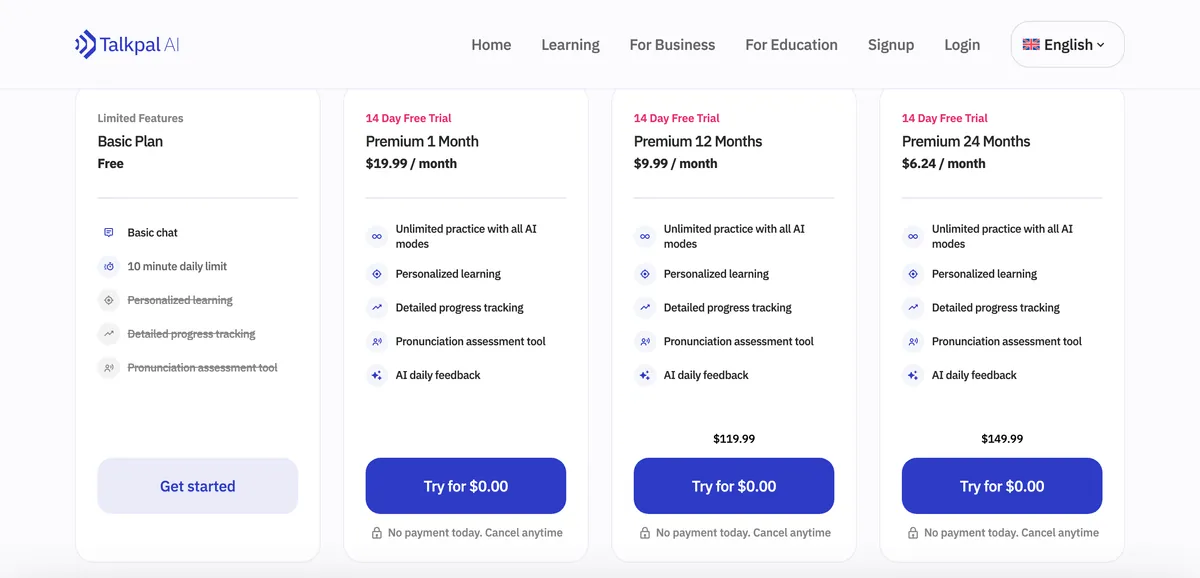
| Talkpal | $9.99 a month on 12 months, $119.99 in all; $6.24 a month on 24 months, $149.99 in all |
| Langua | Standard $12.50 a month billed yearly; Unlimited $16.67 billed yearly. The trial needs a card: 5 days on monthly billing, 7 on yearly |
| Speak | $83.99 a year; Premium Plus $39.99 a month |
| SuperChinese | CHAO $129.99 a year on SuperChinese's site, $109.99 on the App Store; the course alone, PLUS, $11.99 a month |
| Pingo AI | The App Store also lists $17.99, $83.99 and $99.99, without naming durations |
| Duolingo | The App Store also lists Super at $12.99 and $79.99–$119.99, without naming durations, and no Max price |
Sources: each app's website and US App Store listing, checked 7 October 2026.
If you use every minute you pay for, SayMei works out at 3 cents a minute. Langua's Standard plan, used to its daily cap, is about 2.2 cents a minute.
ChatGPT Go's cap allows far more talking for $8. Cheap minutes only help if you use them, though, and the apps differ much more in what happens during those minutes.
Can an AI app check your Chinese tones?
Not reliably, as far as anyone has shown in public. Five of the nine say they correct or assess your pronunciation, SayMei included, and we found no public test of any of those claims. General voice assistants are the weakest judges.
The problem is how speech recognition works: it turns your voice into the most likely words. Say buy, 买, with a falling tone and you've said sell, 卖.
A strict recognizer writes 卖 and you notice the slip. A recognizer that leans on context may write 买 anyway, because "I want to buy" is the likelier sentence, and your mistake disappears from the transcript.
So a correct transcript doesn't prove your tone was right. OpenAI says plainly that ChatGPT's voice transcripts aren't verbatim records.
In a September 2026 test, Hacking Chinese uploaded the same native teacher's recording to ChatGPT several times.
Separate chats rated it between 6.5 and 8.5 out of ten, and re-uploads produced invented errors and an invented "improvement". That test used uploaded files, not live voice, but it shows the model guessing.
Here's what the dedicated apps claim. We haven't tested any of it:
- Pingo AI says it gives "instant feedback on tone accuracy, pronunciation, and sentence structure".
- Speak puts a pronunciation lesson in every unit of its Chinese course. It starts tones with soup, 汤; sugar, 糖; lie down, 躺; and scalding, 烫.
- SuperChinese uses speech recognition to check that you "pronounce words in the right tone".
- Talkpal includes a pronunciation assessment tool on Premium, not on its free plan.
- SayMei corrects tones inside the conversation and gives no scores. Our free Tone Checker records one word and draws your pitch next to the target shape, so you can see a wrong tone for yourself.
Use an AI app to get lots of speaking done, and train your ear separately: tone-pair drills like our free tone-pair trainer, and a human ear now and then. Our guide to learning Chinese tones as an adult explains why listening practice comes first.
The 9 AI apps, one by one
We list them in alphabetical order. Each section says who the app suits, who should skip it, and what it costs. Screens shown in other languages are labeled with the course they come from.
ChatGPT Voice
Up to three hours of open conversation a day for $8, with no course and no reliable pronunciation feedback.
ChatGPT's voice mode works on the web, iOS and Android. Its Live option listens while it talks, so you can interrupt it like a person.
On the free plan, Live voice is "limited", and the limits may change. Go allows three hours a day with GPT-Live-1 mini, and Plus three hours with the full GPT-Live-1.
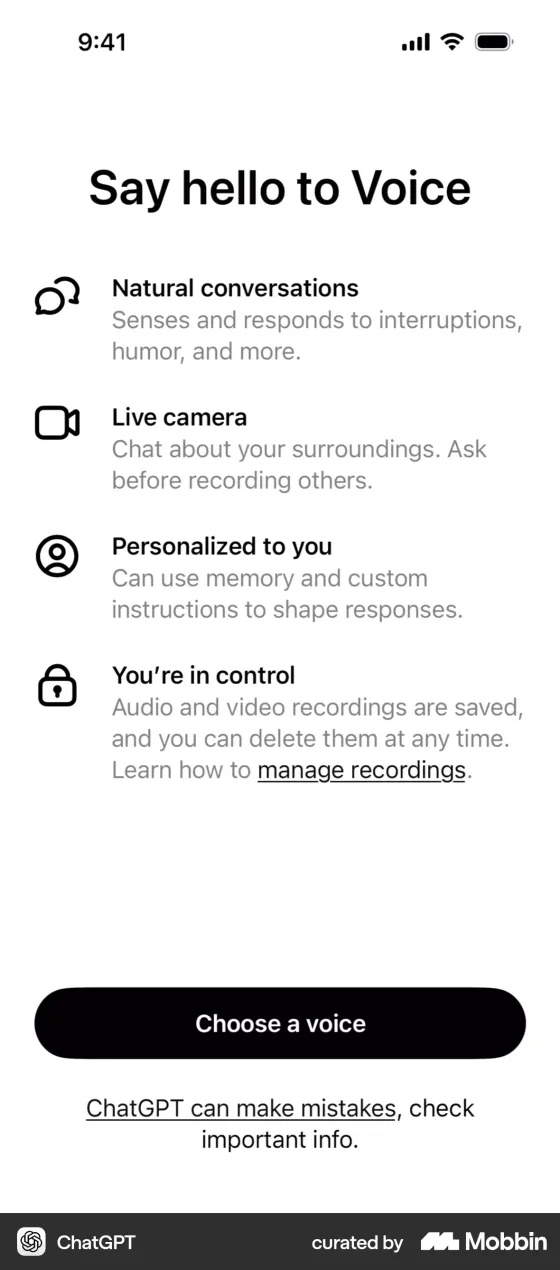
It does what you ask, which is the strength and the catch. Ask it to speak only Mandarin at HSK 2, correct one mistake after each answer and show pinyin under its replies, and it will try.
Set your voice language to Chinese under Settings, Voice, Language so it hears you better. Nothing builds on the last session unless you build it.
- Pick it if: you want hours of conversation for little money and you're happy to plan your own practice.
- Skip it if: you want a course, or you need to know whether your tones are right.
- Price: free with limits, or Go at $8.00 a month, on the US App Store.
Duolingo Video Call
Worth using if you already pay for Duolingo; not a reason to start. Video Call is a spoken call with one of Duolingo's animated characters.
In January 2026, Duolingo listed it for Max subscribers learning nine languages, Chinese included, on iOS.
On its August 2026 earnings call, Duolingo said most new Super subscribers now get a limited version. Existing Super subscribers will get it "over the next few months", Max keeps unlimited calls, and Max may be phased out.
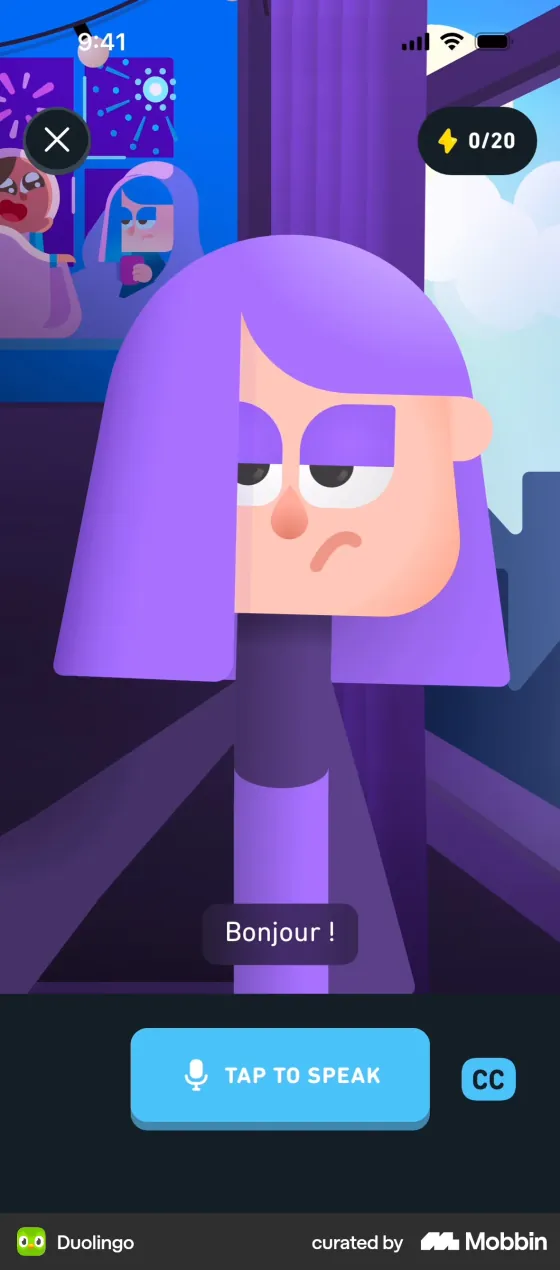
After a call, Duolingo shows the conversation with tips on what to say instead, at least in its French course. The Chinese course around it uses Simplified characters and Duolingo's own units rather than HSK levels.
We couldn't confirm that Video Call works for Chinese on Android. Our guide Is Duolingo good for learning Chinese? covers the rest of the course.
- Pick it if: you're on Super or Max, use an iPhone and want a short spoken check-in after lessons.
- Skip it if: you need tone feedback, practice on Android, or want HSK-based lessons.
- Price: Super from $9.99 a month on the US App Store, which doesn't name durations.
Gemini Live
Our pick for free conversation, if you have a phone and a Google account.
Gemini Live is included in Google's free plan. You need a personal Google account and must be 13 or older, and it runs only in the Gemini mobile app, not on the Gemini website. The iPhone app advertises it too.
The Gemini app supports Chinese, Simplified and Traditional, and Live replies in whichever supported language you speak.
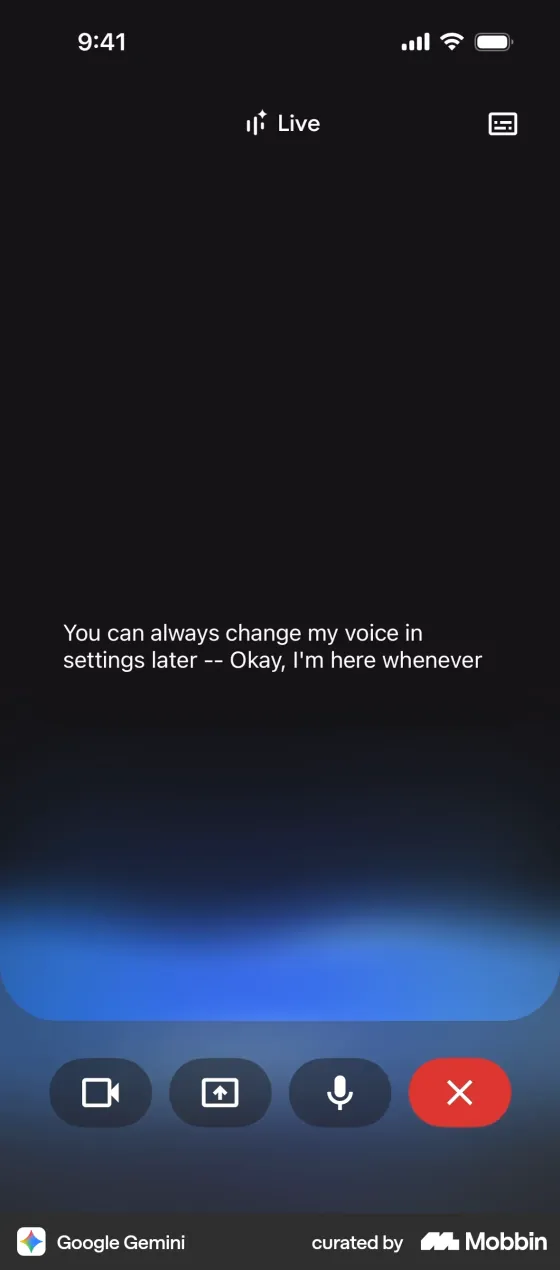
Like ChatGPT, it has no lesson plan and no correction mode; ask for corrections and it will try. Google doesn't publish how much Live you get on the free plan.
- Pick it if: you want free speaking practice on your phone and can steer the conversation.
- Skip it if: you want structure, corrections without asking, or to practise on a laptop.
- Price: free; paid Google AI plans aren't needed for Live.
Langua
The one to choose if you want a say in how you're corrected. Langua's Chinese tutor uses voices cloned from native speakers, has a hands-free call mode, and lets you pick written or spoken, subtle or explicit corrections.
It offers Simplified and Traditional, and a guided conversation course for A1 and A2 learners. It doesn't advertise any pronunciation scoring.
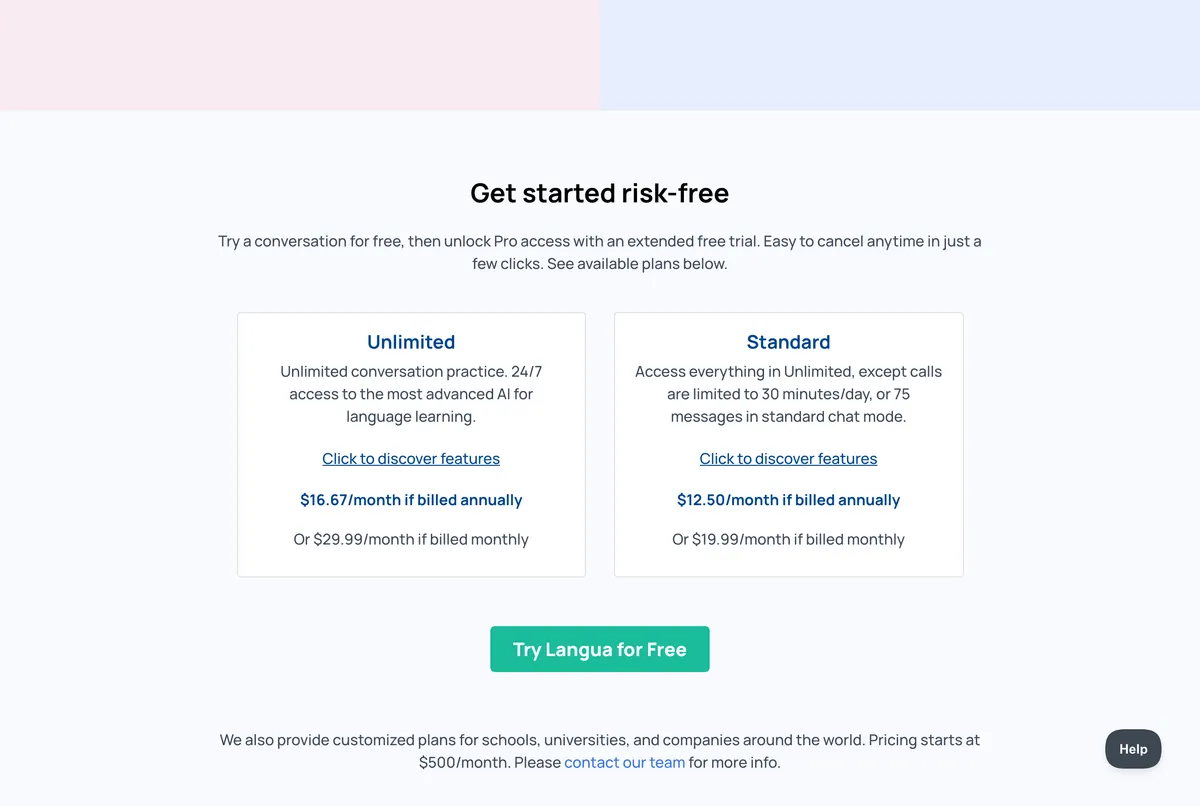
You can try one conversation free. After that, the trial needs a card, with a 30-day money-back guarantee on web subscriptions.
The Standard plan caps calls at 30 minutes a day or 75 messages; Unlimited has no cap.
- Pick it if: you're past the beginner stage, want long conversations, or read Traditional characters.
- Skip it if: you want pronunciation scores, a full course, or a trial without entering a card.
- Price: Standard $19.99 a month on Langua's site, less if billed yearly.
Pingo AI
A phone-first role-play tutor that says it checks your tones. Pingo starts beginners on pinyin and the four tones, then moves to role-plays, and builds a plan around your goals and level.
It covers 25+ languages, and full conversation practice needs a Pingo Pro subscription after a free trial.
When we searched the US App Store for "learn chinese ai" on 6 October 2026, Pingo came first.
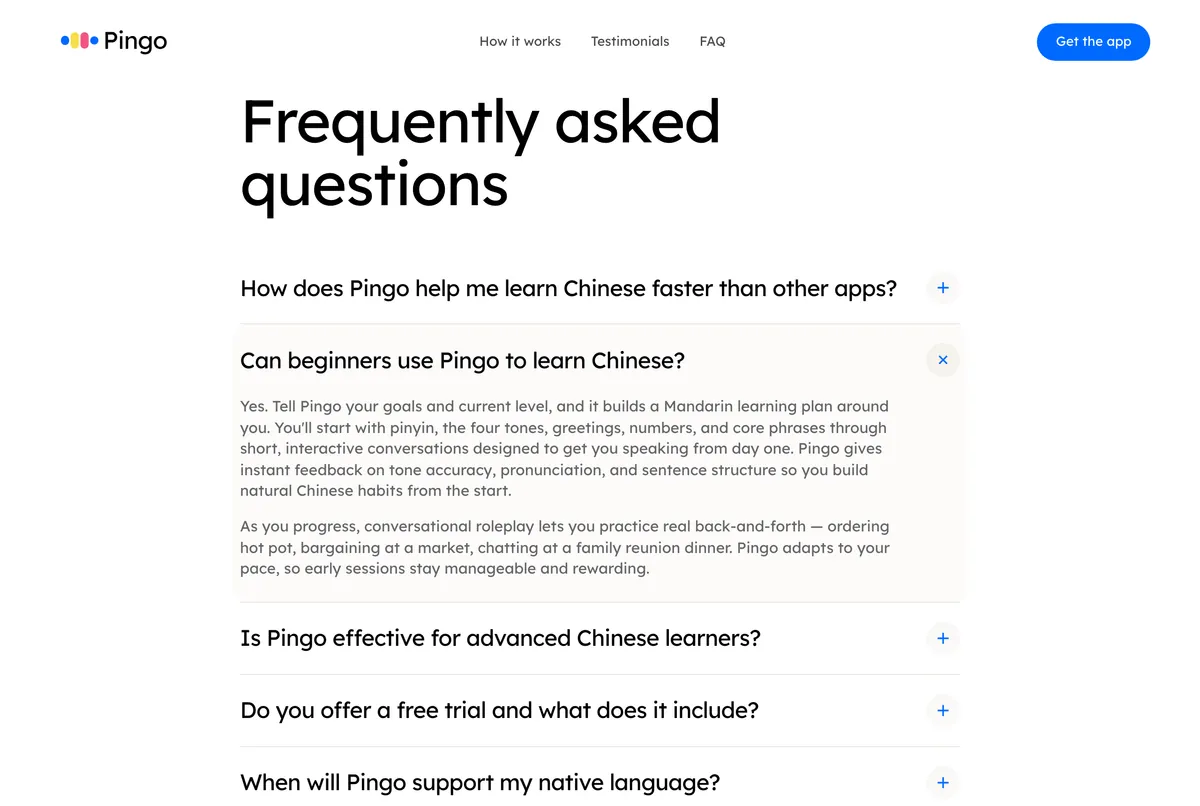
- Pick it if: you practise on your phone and want role-plays with tone feedback, as claimed.
- Skip it if: you want to practise in a browser, follow HSK levels, or need tone feedback that's been tested.
- Price: Pingo Pro from $14.99 on the US App Store, which doesn't name durations.
SayMei
Our lessons: short spoken lessons with an AI teacher, ordered by HSK level, in a browser, for $5.99 a month.
Mei Lin teaches 1,800+ lessons across HSK 1 to 6. SayMei's HSK word lists and flashcard decks follow the HSK 3.0 exam syllabus published in November 2025.
Each takes 5 to 10 minutes and is built on one grammar point, and the library includes roleplays and debates.
She answers in real time and corrects your tones and grammar as you go, while a transcript runs on screen in pinyin, characters or both. Since 4 October 2026, lessons can also show Traditional characters, as our Simplified vs Traditional guide explains.
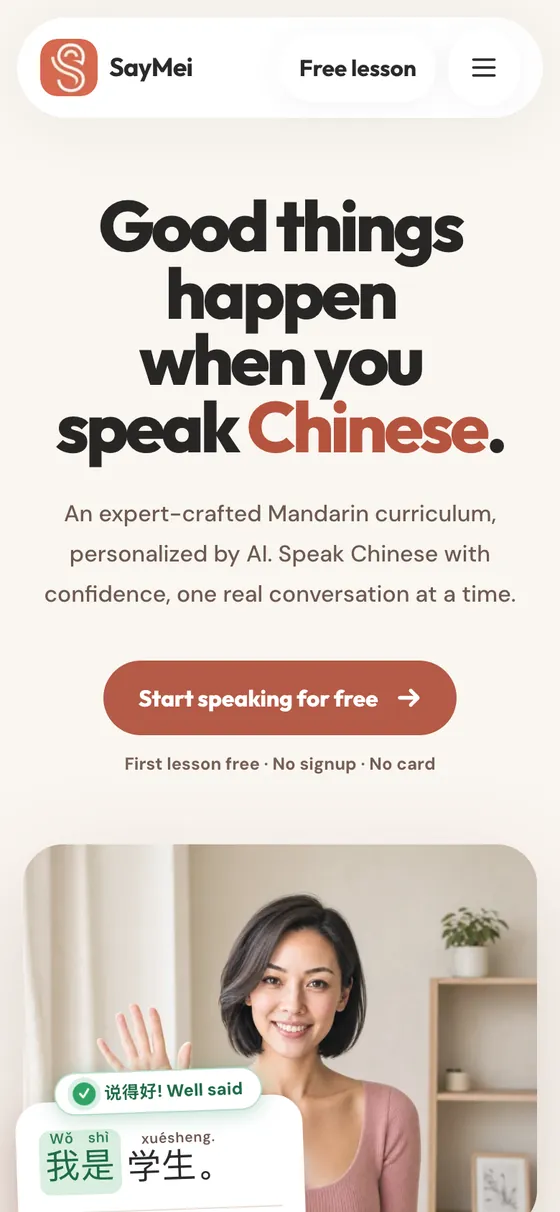
The first lesson is free, up to 10 minutes, with no account, card or download, and a free account adds a second lesson.
After that, a 7-day trial with 100 minutes needs a card.
In first lessons, learners take a median of 26 speaking turns in 10 minutes, by our count.
- Pick it if: you want spoken lessons with a plan behind them, sorted by HSK level, without installing anything or spending much.
- Skip it if: you need offline practice, an app, pronunciation scores, or lots of free speaking time.
- Price: $5.99 a month for 200 minutes, and 100 extra minutes for $2.99.
Where SayMei falls short:
- Free practice runs out fast. Two free lessons, then a card-backed trial. Gemini Live is free, ChatGPT has a limited free voice, and Talkpal gives 10 minutes a day.
- Fewer minutes for the money. 200 minutes a month is about 6½ minutes a day. ChatGPT Go and Langua's Standard plan both allow far more.
- Long plans can be cheaper elsewhere. Talkpal's 24-month plan works out at $6.24 a month for unlimited practice.
- No scores. Corrections happen inside the conversation, with no pronunciation score afterwards. Speak, SuperChinese, Talkpal and Pingo all advertise pronunciation feedback or assessment.
- No app. SayMei runs in the browser only, so there's no offline mode and no App Store ratings to judge it by.
- Older HSK 5–6 lessons. Our 2026 rewrite covered the HSK 1–4 lessons, not HSK 5–6.
- No writing course. Character writing is printable sheets, not an in-app course.
Speak
A speaking-first course with an AI tutor, new to Mandarin. Speak launched Chinese in June 2026, covering beginner to intermediate "today, with more on the way".
Each unit has a pronunciation-focused lesson, then simulated conversations where you use the words to complete a task. The course runs to B1 for now.
Speak says real-time pronunciation feedback is core to the app, and its App Store listing promises feedback on pronunciation and grammar.
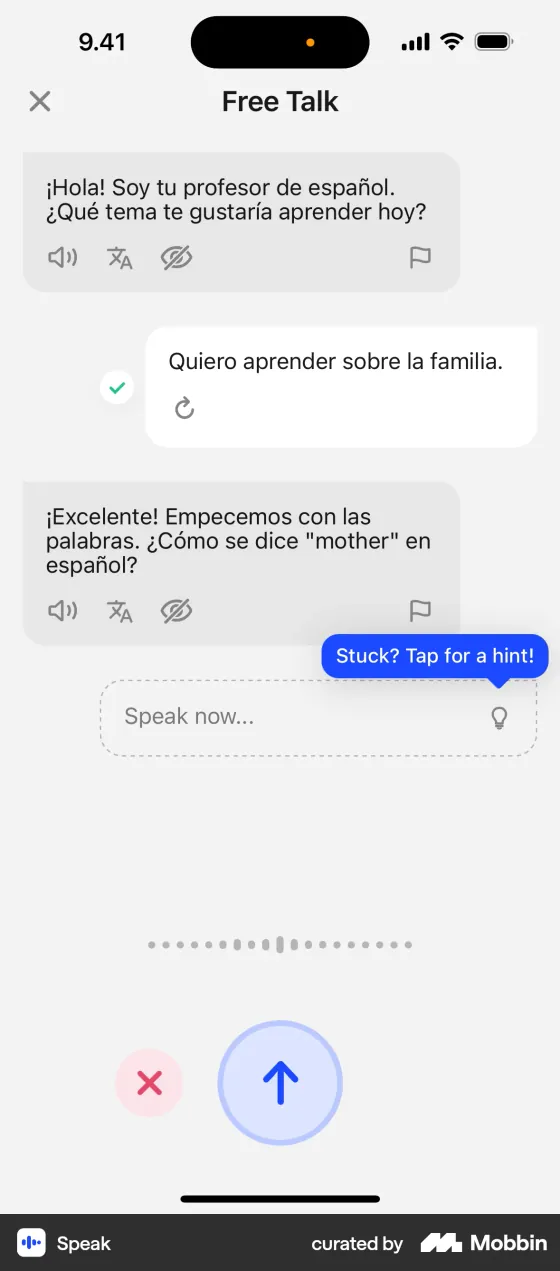
Both paid plans include the course, situational roleplays, Speak Tutor and review; Premium Plus adds unlimited custom lessons and a personalized plan, says Speak's help page. Its separate Pronunciation Coach was listed for English learners only.
Speak teaches Simplified Chinese, lists apps for iOS, Android and the web, and offers a 7-day free trial but no free plan.
- Pick it if: you're starting from zero and want a course that has you speaking from the first lesson.
- Skip it if: you're past B1, want HSK labels or Traditional characters, or want something free.
- Price: Premium $17.99 a month, or $83.99 a year.
SuperChinese with CHAO
The only app here that pairs an HSK-based Chinese course, with character writing, with an AI conversation tutor. The tutor costs extra.
SuperChinese's course runs "from zero to HSK 5" on its site, and its App Store listing says 400+ lessons in 9 levels.
It teaches pinyin and character writing, checks your tones with speech recognition, and added offline lessons in April 2026.
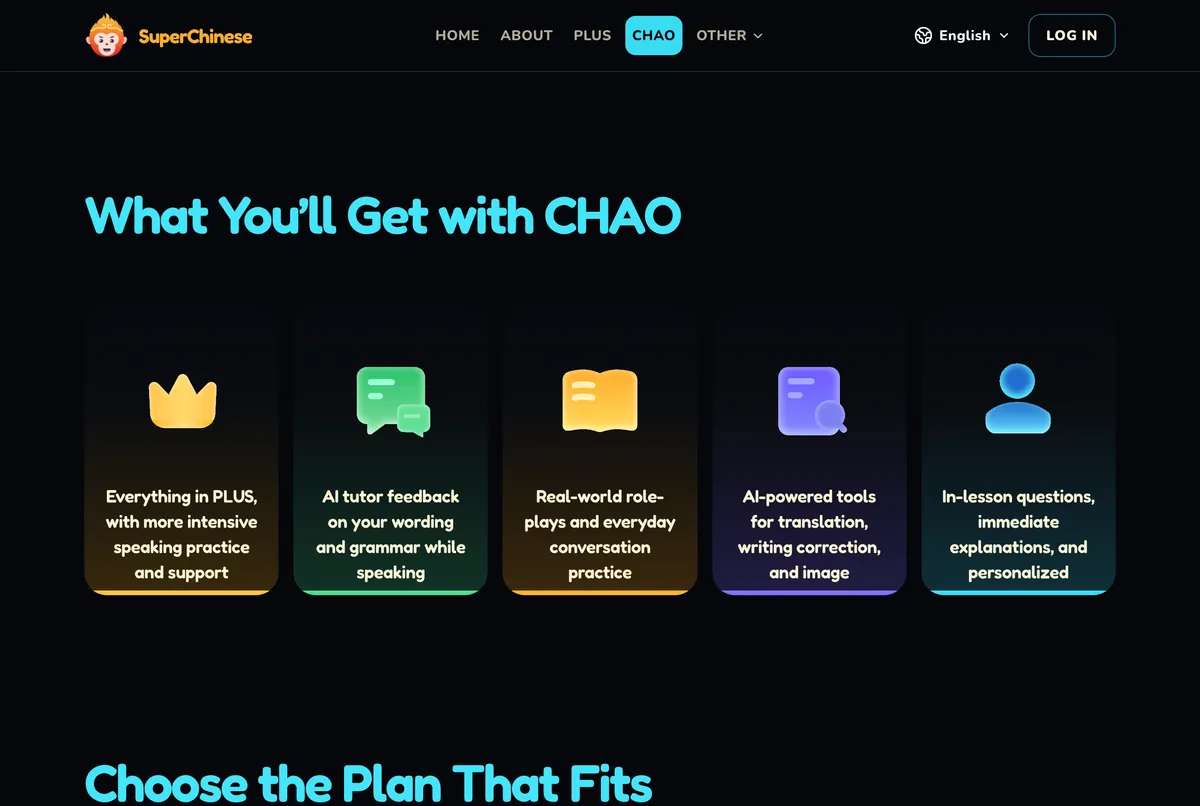
CHAO is the AI tutor: it responds to your Chinese, keeps the conversation going and gives feedback on your wording and grammar while you speak, with role-plays. It's a separate subscription at $24.99 a month, with no free trial mentioned.
Reviews on Reddit are mixed. A June 2026 thread complained about CHAO's explanations, and another user said it has no Traditional option.
- Pick it if: you want one app for the course, the characters and AI conversation, and you'll pay for both.
- Skip it if: you want to practise in a browser, read Traditional characters, or keep costs low.
- Price: CHAO $24.99 a month; the course alone, PLUS, is $11.99.
Talkpal
A general AI conversation app, and the only dedicated tutor here with a free plan you can keep using.
The free plan gives basic chat for 10 minutes a day; personalized learning, progress tracking and pronunciation assessment are crossed out on it. Premium adds unlimited practice in every mode, a pronunciation assessment tool and daily AI feedback, after a 14-day free trial.
Talkpal covers 130+ languages, Chinese included, with call mode, roleplays, debates and character chats. It runs on the web, iOS and Android.
It isn't built around Chinese: there's no Chinese course or HSK path on its pages, just practice modes and lifestyle courses.
- Pick it if: you want to try daily practice for free, or unlimited practice on a long plan.
- Skip it if: you want a Chinese curriculum or HSK levels.
- Price: Premium $19.99 a month on Talkpal's site, or much less on a long plan.
Four more apps we left out
Four more come up when people ask about AI and Chinese. We left them out of the main list for these reasons:
| App | Why it isn't in the main list |
|---|---|
| Praktika | Avatar tutors, and its App Store listing includes Chinese. But its homepage doesn't list languages, and it appeared in none of the ten Chinese-learning roundups we read. Premium is $9.99 a month on the App Store |
| Gliglish | The other AI tutor you can try without an account: its guest page offers Chinese for China and for Taiwan, with 10 free minutes a day. Its pronunciation scores cover American English only, its iPhone app has 2 ratings, and Plus is $29 a month |
| HelloChinese | The course chatbots recommend most often. Its App Store images now advertise "Practice Speaking with AI", but nothing on the listing says what that covers, as the FAQ explains |
| Pimsleur | Its AI Conversation Coach is for Spanish and French only. Its Mandarin course has Voice Coach pronunciation feedback across 5 levels of 30 half-hour lessons |
Sources: each app's US App Store listing, checked 7 October 2026.
If one of these suits you better, it's worth a look, but none changes our picks.
A human tutor hears what apps miss
An AI tutor is cheaper and always available. A good human tutor hears your tones reliably and keeps you coming back.
Here's what the two biggest tutor marketplaces list for Chinese:
Sources: each marketplace's Chinese tutor page, checked 6 October 2026.
For the price of one or two tutor sessions, an AI app gives you a month of daily practice.
Our suggestion is daily AI practice for volume, and a tutor every week or two to check tones and fix habits. Our guide to how to speak Chinese covers what the research says about practice and feedback.
Add a dictionary and something to read
An AI tutor gives you speaking time. You'll also want a dictionary and something to read.
Pleco is a free Chinese dictionary app with paid add-ons, such as a $29.99 bundle.
For reading, Du Chinese offers 3,000+ graded readings at six levels. Our comparison of Chinese graded readers and story apps covers the alternatives.
For tones, the free tone-pair trainer drills the two-syllable combinations that trip learners up.
How we compared
We compared what each app publishes about itself; we didn't test the apps hands-on. Where an app says it does something, we report the claim.
We picked the AI tutors and voice assistants that answer engines and Chinese-learning roundups name most often for this question, plus Speak, which added Mandarin in June 2026. Courses that don't describe an AI tutor, such as HelloChinese, come up only where people ask about their AI features.
Our sources are each app's website, help pages and US App Store listing. Prices are US list prices; App Store and web prices sometimes differ, and we give both where they do.
App screenshots come from Mobbin's library of real app screens. Mobbin had no Chinese-course captures for these apps, so captions name the course shown. We captured the website images without signing in.
We didn't test tone and pronunciation accuracy, response speed, voice quality or how well each app adapts to your level.
SayMei facts come from our own pages. The speaking-turns figure comes from aggregate lesson data for 1,790 learners, with its method in How to speak Chinese.
We started from the apps chatbots name. Here's how often each one came up in 238 chatbot answers to app-choice and speaking questions:
Sources: our sample of chatbot answers, 6 October 2026, with web search on.
The checklist has all 12 checks for all nine apps, with the source behind each one and the ranking rule:
The checklist behind the picker
Twelve checks for nine apps, from each app's own pages, checked 7 October 2026. Best match for each goal, with no budget or device limit: Talk freely and get corrected: Talkpal. A speaking course that starts from zero: Speak, SuperChinese with CHAO. A full Chinese course with an AI tutor: SuperChinese with CHAO. Lessons that follow HSK levels: SayMei, SuperChinese with CHAO. Practice speaking for free: ChatGPT Voice, Gemini Live, Talkpal. Feedback on pronunciation and tones: SuperChinese with CHAO.
| App | Voice chat | Corrections | Pronunciation | Course | HSK levels | Chinese only | Pinyin | Writing | Traditional | Free speaking | No account | Browser | Price a month |
|---|---|---|---|---|---|---|---|---|---|---|---|---|---|
| ChatGPT Voice | Yes | Only if you ask | No | No | No | No | Only if you ask | No | Only if you ask | Yes | Not stated | Yes | Free |
| Duolingo Video Call | Yes | Yes | Not stated | Yes | No | No | Yes | Not stated | No | No | No | No | From $9.99 |
| Gemini Live | Yes | Only if you ask | No | No | No | No | Not stated | No | Partly | Yes | No | No | Free |
| Langua | Yes | Yes | No | Partly | No | No | Not stated | No | Yes | No | Not stated | Yes | From $19.99 |
| Pingo AI | Yes | Yes | Yes | Partly | No | No | Yes | No | Not stated | No | Not stated | No | From $14.99 |
| SayMei | Yes | Yes | Partly | Yes | Yes | Yes | Yes | No | Yes | No | Yes | Yes | From $5.99 |
| Speak | Yes | Yes | Yes | Yes | No | No | Yes | Not stated | No | No | Not stated | Yes | From $17.99 |
| SuperChinese with CHAO | Yes | Yes | Yes | Yes | Yes | Yes | Yes | Yes | Not stated | No | Not stated | No | From $24.99 |
| Talkpal | Yes | Yes | Yes | Partly | No | No | Not stated | No | Not stated | Yes | Not stated | Yes | From $19.99 |
✓ yes · ◐ partly, or only if you ask · ✗ no · ? not stated on the app's pages. Each app gets the same 12 checks, filled in from its own website, help pages or US App Store listing (checked 6–7 October 2026). We didn't test the apps hands-on. Your budget and device filter the list. Apps that meet more of the goal's must-haves come first, then those that meet more of its extras; ties are listed alphabetically. Prices are monthly-billed US list prices for the plan that includes AI conversation. Each mark's source is linked in that app's section and under Sources.
What to do next
- Decide what you want corrected. Tones, grammar and wording point you to different apps.
- Start with a free option. A week of Gemini Live or ChatGPT's free voice shows whether you'll really talk every day.
- Then pay for the one you'd miss. Pick a course if you want a plan, or a conversation app if you'd rather steer.
- Check your tones another way. Pair any app with a tone drill and, now and then, a human ear.
Or start today with a free first lesson with Mei Lin, no account needed.
FAQ
Can ChatGPT teach you Chinese?
It's a patient conversation partner, not a course. ChatGPT's voice mode handles open conversation in Mandarin, and Go allows up to three hours a day for $8. It has no lesson plan, and OpenAI says voice transcripts aren't verbatim, so it can miss pronunciation mistakes.
In one test with uploaded recordings, it rated the same native speaker anywhere from 6.5 to 8.5 out of ten. Use it for practice, not for checking tones.
What is the best free AI app to learn Chinese?
For open conversation, Gemini Live: it's included in Google's free plan, in the Gemini mobile app. ChatGPT's free plan has limited voice, and Talkpal's free plan gives 10 minutes of basic chat a day. None of them follows a course. SayMei's first lesson is a free 10-minute structured lesson with no account, and a free account adds a second, but ongoing practice needs a paid plan.
Which AI tutors follow HSK levels?
Two of the nine. SayMei's 1,800+ lessons are organized by HSK level, from HSK 1 to 6, and its word lists follow the HSK 3.0 exam syllabus published in November 2025.
SuperChinese's course runs from zero to HSK 5, with its CHAO tutor sold separately at $24.99 a month. Speak uses European CEFR levels, beginner to B1, and Langua has a guided course for A1 and A2. The others don't follow levels at all.
Is Speak good for learning Chinese?
For beginners who want to speak from the start, it's built for exactly that, with limits. Speak added Mandarin on 2 June 2026, covering beginner to B1, with a pronunciation lesson in every unit and simulated conversations.
It teaches Simplified Chinese only, has no free plan beyond a 7-day trial, and costs $17.99 a month. Learners past intermediate will run out of content for now.
Does HelloChinese have an AI tutor?
Not one it describes. Its App Store images now advertise "Practice Speaking with AI", but nothing on the listing says what that covers. The listing's text advertises speech recognition that corrects your pronunciation, HSK-based courses, handwriting, Simplified and Traditional characters, and offline use.
One Reddit user reported optional AI conversation lessons in Premium in September 2026. Premium is $11.99 a month or $69.99 a year. Our HelloChinese vs SuperChinese guide compares the two courses in depth.
Is SuperChinese's CHAO worth paying for?
If you already like SuperChinese's course, CHAO adds what it lacks: spoken conversation with feedback on your wording and grammar, and role-plays. It costs $24.99 a month and includes everything in PLUS, or $129.99 a year on SuperChinese's site.
User reviews are mixed. Cheaper ways to practise speaking include ChatGPT Go at $8 and SayMei at $5.99, as well as Talkpal and Pingo.
Does Duolingo have AI conversation practice for Chinese?
Yes: Video Call, a spoken call with an animated character. Duolingo listed it for Chinese learners on iOS with a Max subscription in January 2026, and said in August 2026 that most new Super subscribers get a limited version, with unlimited calls on Max. We couldn't confirm Android support for Chinese, and Duolingo doesn't say whether Video Call checks tones.
Which AI Chinese tutor shows pinyin during conversations?
SayMei shows a running transcript in pinyin, characters or both, and you choose. Speak and SuperChinese teach pinyin in their lessons, Pingo starts beginners on it, Duolingo lessons have a pinyin setting, and ChatGPT shows its replies as text you can ask to include pinyin. Langua, Talkpal and Gemini Live don't say whether they show pinyin. Langua and SayMei can also show Traditional characters.
Sources
Checked 7 October 2026 unless noted.
SayMei (our pages)
- SayMei homepage: lessons across HSK 1–6, 5 to 10 minutes each
- Free first lesson: 1,800+ lessons; no account, card or download; transcript; corrections
- Pricing: $5.99 for 200 minutes; trial; Boost
- Lesson library: lessons by HSK level, 1 to 6; corrections inside the conversation
- HSK word lists: the HSK 3.0 exam syllabus (November 2025), checked 8 October 2026
The apps
- Speak, "Chinese now available on Speak" (2 June 2026); speak.com; Speak Help, Premium vs Premium Plus (updated 7 November 2025); Speak on the App Store
- SuperChinese CHAO; superchinese.com (6 October); SuperChinese on the App Store
- Talkpal pricing; Talkpal on the App Store
- Langua AI Chinese tutor; Langua on the App Store
- Pingo, learn Chinese; Pingo AI on the App Store
- Duolingo blog, "Video Call with Falstaff" (14 January 2026) (6 October); Duolingo Q2 2026 earnings call, 5 August 2026 (transcript on Webull); Duolingo on the App Store
- OpenAI Help, ChatGPT Voice; ChatGPT on the App Store
- Google, Gemini Live requirements; Gemini app languages (6 October); Google AI plans (6 October); Gemini on the App Store
- Praktika on the App Store; Gliglish on the App Store; HelloChinese on the App Store; Pimsleur on the App Store
- italki Chinese tutors and Preply Chinese tutors (6 October); Pleco on the App Store; Du Chinese
Tests and reports
Methods
This guide draws on public pages read on 6 and 7 October 2026: each app's website, help pages and US App Store listing, the test and the forum threads linked above, and SayMei's own pages. App screens come from Mobbin's library of real app screens; website images are public pages captured without signing in. No app was tested hands-on, and every vendor claim is reported as a claim. The speaking-turns figure comes from aggregate SayMei lesson data (no transcripts, no personal data; every published number covers at least 50 learners). The chatbot answers were sampled on 6 October 2026 from app-choice and speaking questions, with web search on. The Mandarin examples were checked against the CC-CEDICT dictionary. If you spot a mistake, tell us: we fix errors.