Mandarin Tones Chart & Tone Pairs
Hear the 4 tones, then train your ear on all 20 tone pairs.
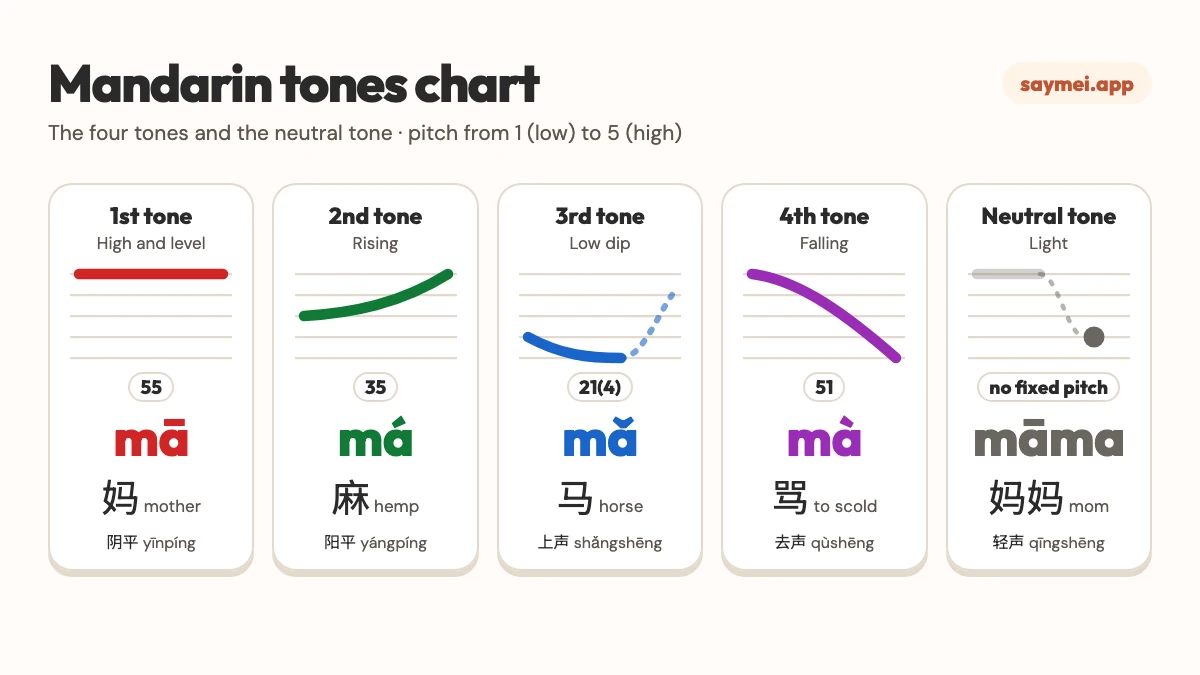
Mandarin tones chart
| Tone | Pitch | Example | Chinese name |
|---|---|---|---|
| 1st tone High and level | 55 | mā 妈 mother | 阴平 yīnpíng |
| 2nd tone Rising | 35 | má 麻 hemp | 阳平 yángpíng |
| 3rd tone Low dip | 21(4) | mǎ 马 horse | 上声 shǎngshēng |
| 4th tone Falling | 51 | mà 骂 to scold | 去声 qùshēng |
| Neutral tone Light | No fixed pitch | māma 妈妈 mom | 轻声 qīngshēng |
Pitch numbers run from 1 (low) to 5 (high).
20 tone pairs
| 1st | 2nd | 3rd | 4th | Neutral | |
|---|---|---|---|---|---|
| 1st | kā fēi 咖啡 coffee | huān yíng 欢迎 welcome | kāi shǐ 开始 begin | shēng rì 生日 birthday | mā ma 妈妈 mom |
| 2nd | míng tiān 明天 tomorrow | xué xí 学习 study | píng guǒ 苹果 apple | chí dào 迟到 arrive late | míng zi 名字 name |
| 3rd | lǎo shī 老师 teacher | lǚ xíng 旅行 travel | nǐ hǎo 你好 hello | kǎo shì 考试 exam | jiě jie 姐姐 older sister |
| 4th | dàn gāo 蛋糕 cake | liàn xí 练习 practice | diàn yǐng 电影 movie | zài jiàn 再见 goodbye | bà ba 爸爸 dad |
Each pair has 20 real words, 400 in all, with audio and a 1-minute ear quiz.
How to read the Mandarin tones chart
Each tone is a movement of pitch, drawn on a scale from 1, the lowest note you speak comfortably, to 5, the highest. The 1st tone stays high and level (55). The 2nd rises from the middle (35). The 3rd drops low (21) and only climbs back up (214) on its own or at the end of a phrase, so inside most words it is simply low. The 4th falls fast from top to bottom (51). The neutral tone has no pitch of its own: it is short and light, and lands wherever the tone before it leaves off, as in 妈妈 (māma). Copy the shape, not an exact note. To hear any syllable in all four tones, open the Pinyin chart.
Why practice tone pairs
Most Chinese words have two syllables, and tones bend into each other: the end of one shapes the start of the next. So the pairs chart crosses every starting tone with every ending. Four starting tones times five endings gives 20 patterns, not 25, because a neutral syllable never starts a word. Learners mix up the 2nd and 3rd tones most, as in 牛奶 (niúnǎi, 2→3) and 旅行 (lǚxíng, 3→2), and the one-minute quiz shows which pairs your ear confuses. When you can hear a pattern, say it: the free Tone Checker records one word and compares your pitch shape with the target.
How tones change in real speech
- 3 + 3: the first syllable rises, so 你好 (nǐ hǎo) is said ní hǎo (third tone sandhi rules).
- 3 before 1, 2 or 4: the 3rd stays low and skips its rise, as in 老师 (lǎoshī).
- Neutral endings: fairly low after the 1st, as in 妈妈 (māma); mid after the 2nd, as in 朋友 (péngyou); high after the 3rd, as in 我们 (wǒmen); and lowest after the 4th, as in 爸爸 (bàba).
一 (yī) and 不 (bù) change too. Paste a phrase into the checker on Tone Sandhi Rules to see every change.
Play it in a game
Panda Tone Toss
Hear a word, then toss the panda to its tones. Play Panda Tone Toss
Common questions
What are the four tones in Mandarin?
Mandarin has four main tones plus a light neutral tone. Tone 1 is high and level: 妈 (mā, mother). Tone 2 rises: 麻 (má, hemp). Tone 3 dips low: 马 (mǎ, horse). Tone 4 falls sharply: 骂 (mà, to scold). The neutral tone is short and unstressed, like the second syllable of 妈妈 (māma, mom).
What is a Mandarin tone pair?
A tone pair is the pitch pattern of two syllables said together, such as tone 1 followed by tone 4 in 音乐 (yīnyuè, music). Most Mandarin words have two syllables, and the end of the first tone shapes how the second begins, so practicing pairs trains the transitions that single-syllable drills leave out.
How do I practice Mandarin tones?
Practice in pairs, not single syllables. Pick a pattern in the chart to hear its word, then copy the whole word without a pause between the syllables, listening for the direction of each tone rather than an exact pitch. Use Next word for new examples of the same pattern. Learners mix up tones 2 and 3 most, so give extra time to pairs that combine them.
Why does this chart have 20 cells instead of 25?
Every word here starts with one of the four full tones, and the second syllable can be any full tone or neutral, so the chart has 4 × 5 = 20 patterns, each with 20 real words: 400 in all. Neutral tone only appears second because its pitch depends on the syllable before it.
Does every third tone dip and rise?
No. Before tones 1, 2 and 4, a third tone usually stays low and skips the rise, as in 老师 (lǎoshī, teacher). Before another third tone it rises instead, so 你好 (nǐ hǎo) sounds like ní hǎo; the Tone Sandhi Checker explains that change. The full dip and rise is easiest to hear on its own or at the end of a phrase.
Is the neutral tone a fifth tone?
Not really. Textbooks sometimes call it the fifth tone, but it has no fixed pitch shape of its own. A neutral syllable is short and unstressed, and its pitch depends on the tone before it: fairly high after tone 3, as in 我们 (wǒmen, we), and low after tone 4, as in 谢谢 (xièxie, thanks).
Does the tone pair trainer record my voice?
No. Tone Pairs is listen-and-copy practice: it plays each word with an animated pitch line and never records you. To check one word with your own voice, use the free Tone Checker. To practice tones in real conversation, try a lesson with Mei Lin, SayMei's AI tutor, who corrects your tones as you speak. Your first lesson is free.
Keep going
- Tone Checker: Record a word and compare your tone shape.
- Pinyin Chart: Hear any syllable in all four tones.
- Tone Sandhi Rules: Hear how tones change when two words meet.
Say your tone pairs out loud with Mei Lin
Mei Lin is an AI tutor. Your first lesson is free. No card or account needed. Try a free lesson