Online Chinese courses compared: what you pay, and how much you speak
We checked 11 online Chinese courses and classes on 16 Oct 2026, from Coursera and Yoyo to GoEast: prices, HSK levels, and what an hour of speaking costs.

Most online Chinese courses sell you videos to watch. The classes that let you speak cost several times more, and in a full group you may talk for five minutes an hour.
This guide is for you if you want a Chinese course with a plan, not just an app, and want to know what you'll pay and how much you'll actually speak.
We read 14 course providers' own price pages in mid-October, without signing up or buying anything. Eleven options made our comparison, and Methods explains the three we left out.
Key takeaways
- Most online Chinese courses are videos. Six of the 11 options we compared include no live conversation at all.
- Self-paced courses cost a few hundred dollars a year. Chinese Zero to Hero and Yoyo Chinese's lifetime plan are paid once and kept.
- Live classes cost several times more. A year of one group class a week starts at about $700.
- Groups are the dearest way to buy speaking time. In a full class, your own share of the talking may be five minutes an hour.
- Check which HSK a course teaches. The exam's new syllabus starts in December, and most course pages don't say which one they follow.
- The best value is a mix. A self-paced course for structure plus daily speaking practice costs less than most classes.
Pick the course that fits your goal
No course is best at everything. Here's our pick for each goal, at the price on its own page:
Conversation from zero, at your own pace
- Our pick
- Yoyo Chinese, Learn plan
- Price, checked 16 Oct 2026
- $19.99 a month, $143.88 a year or $299 once
One course per HSK level, paid once
- Our pick
- Chinese Zero to Hero
- Price, checked 16 Oct 2026
- $40–87 a level; $180 for HSK 1–4
Lots of listening, at every level
- Our pick
- ChinesePod
- Price, checked 16 Oct 2026
- $29 a month
The lowest monthly price
- Our pick
- ChineseClass101
- Price, checked 16 Oct 2026
- $4–23 a month on a 24-month plan
A certificate from a university course
- Our pick
- Coursera: Peking University's Chinese for Beginners
- Price, checked 16 Oct 2026
- Coursera Plus, $59 a month or $399 a year
Live classes on a fixed timetable
- Our pick
- GoEast online group course
- Price, checked 16 Oct 2026
- $1,248 for 16 weeks, plus $99 for materials
Speaking practice most days
- Our pick
- SayMei
- Price, checked 16 Oct 2026
- $5.99 a month
Sources: each provider's own price page, in US dollars, checked 16 October 2026.
Our advice: if you can only buy one thing, buy the course you'll open every day. Then add someone, or something, to talk to.
Eleven options side by side
We put each option's own pages side by side. Live speaking means talking in real time with a teacher, classmates or an AI teacher:
Coursera: Chinese for Beginners, Peking University
- Price, checked 16 Oct 2026
- Coursera Plus, $59 a month or $399 a year; financial aid for some learners
- Format
- Video course, 7 modules
- Levels
- Beginner
- HSK
- Not mentioned
- Live speaking
- None; a speaking game in VR or on a desktop
- Certificate
- Yes, paid
edX: MandarinX Chinese for Beginners
- Price, checked 16 Oct 2026
- $268 for two courses; $241.20 with the 10% discount shown on 16 Oct
- Format
- Video courses, about 3 months
- Levels
- Beginner
- HSK
- HSK 1 preparation; the syllabus isn't named
- Live speaking
- None
- Certificate
- Yes, paid
Yoyo Chinese
- Price, checked 16 Oct 2026
- $19.99 a month, $143.88 a year or $299 once; 75+ lessons free
- Format
- Video lessons, flashcards and quizzes
- Levels
- Beginner to upper intermediate
- HSK
- Not made for the HSK, it says
- Live speaking
- None
- Certificate
- Not mentioned
ChinesePod
- Price, checked 16 Oct 2026
- $29 a month, after a 14-day trial
- Format
- Video and audio lessons
- Levels
- Six levels, Newbie to Advanced
- HSK
- Not mentioned
- Live speaking
- None
- Certificate
- Not mentioned
ChineseClass101
- Price, checked 16 Oct 2026
- $4, $10 or $23 a month on a 24-month plan
- Format
- Audio and video lessons
- Levels
- Not stated on its price page
- HSK
- Not mentioned
- Live speaking
- None; Premium PLUS adds a teacher's feedback on your pronunciation
- Certificate
- Not mentioned
Chinese Zero to Hero
- Price, checked 16 Oct 2026
- $40–87 a level, paid once; $180 for HSK 1–4
- Format
- Video lessons
- Levels
- HSK 1 to 9
- HSK
- A course per level, used with the HSK Standard Course books
- Live speaking
- None
- Certificate
- Not mentioned
Mandarin Blueprint
- Price, checked 16 Oct 2026
- Starter levels free; Fluency Lab $2,000 to join, then a subscription it doesn't publish
- Format
- Video course, app and coaching
- Levels
- 88 levels, up to advanced
- HSK
- Its own curriculum
- Live speaking
- 30 minutes a week with a tutor, in Fluency Lab
- Certificate
- Not mentioned
GoEast online group course
- Price, checked 16 Oct 2026
- $1,248 for 16 weeks, plus $99 for materials
- Format
- Live classes on Zoom, twice a week
- Levels
- Beginner to HSK 4
- HSK
- Levels named after HSK 1 to 4
- Live speaking
- Yes, usually 2 students, at most 4
- Certificate
- Not mentioned
LTL Flexi Classes
- Price, checked 16 Oct 2026
- $10.50–14 a class, billed every 4 weeks
- Format
- Live group classes, round the clock
- Levels
- Levels of 50 classes, from A1
- HSK
- Not mentioned
- Live speaking
- Yes, up to 5 students
- Certificate
- Not mentioned
italki group classes
- Price, checked 16 Oct 2026
- $12–30 a class
- Format
- Live group classes
- Levels
- A1 to C2
- HSK
- Some are exam preparation
- Live speaking
- Yes, 2 to 6 students
- Certificate
- Not mentioned
SayMei
- Price, checked 16 Oct 2026
- $5.99 a month for 200 minutes with Mei Lin
- Format
- Spoken lessons with an AI teacher, in the browser
- Levels
- HSK 1 to 6
- HSK
- Follows the November 2025 syllabus
- Live speaking
- Yes, one-to-one with an AI teacher
- Certificate
- No
Sources: each provider's pages, linked in Sources. LTL Flexi's price comes from our tutors guide, checked five days earlier. "Not mentioned" means the pages we read don't say. Udemy, Hutong School and That's Mandarin are left out: Methods explains why.
We see two patterns. The self-paced courses are cheap but silent. The live options let you speak, but they cost more every month.
Live classes cost several times more than videos
The biggest price gap isn't between brands. It's between watching and talking.
Most self-paced courses cost $100–400 for a year, and two of them you can buy once and keep. Here's a first year on each option, at the prices we read:
A year of live classes costs several times a year of videos
Cost of a first year, US dollars, at each option's prices on 16 October 2026
| Option | US$ a year | What that buys |
|---|---|---|
| SayMei Premium | 72 | 12 months, with 200 minutes a month with Mei Lin |
| ChineseClass101 Premium | 120 | A year at its 24-month plan's rate |
| Yoyo Chinese, Learn | 144–240 | Billed yearly, or month by month |
| Chinese Zero to Hero | 180 | The HSK 1–4 courses, paid once and kept |
| edX, MandarinX beginners | 241–268 | Two courses, with or without the 10% discount shown |
| ChinesePod Premium | 348 | 12 months |
| Coursera Plus | 399–708 | Billed yearly, or month by month |
| LTL Flexi group classes | 728 | One class a week |
| italki group classes | 1,196 | One class a week at the median price |
| Mandarin Blueprint, Fluency Lab | 2,000+ | The joining fee; the subscription after month one isn't published |
| GoEast group courses | 3,435 | Three 16-week courses, two classes a week, with materials |
Sources: each provider's price page; LTL Flexi's from our tutors guide.
A self-paced course buys you a plan for a few hundred dollars a year. What it can't buy is someone who answers when you speak.
Most courses never make you speak
Six of the 11 options include no live conversation. You can repeat after a video, but nobody answers you or hears your tones.
Some still promise speaking. Peking University's Coursera course says it "focuses on speaking skills", yet the conversation practice it describes is a bonus game. We think that's the biggest gap in self-paced learning, and it's easy to miss when you buy.
Where you can speak, the class price hides how little of the hour is yours. In one-to-one lessons, students did 44% of the talking in a large study of online tutoring.
In a model class for eight beginners of Chinese, all the students together spoke for 41% of the time. Split that among a class of five, and your share is about 8%.
In a class that size, your turn might be one sentence: I went hiking at the weekend, 我周末去爬山了 wǒ zhōumò qù páshān le.
Here's what an hour of your own speaking costs on each option that includes it:
Group classes are the dearest way to buy speaking time
US dollars per hour of your own speaking: the price of an hour's class divided by your share of the talk
| Option | US$ per hour you speak | How we priced it |
|---|---|---|
| SayMei Premium | 4 | All 200 minutes used; you speak 44% of the time |
| One-to-one tutor, italki median | 45 | $20 an hour; you speak 44% of the time |
| LTL Flexi group class | 51–171 | $10.50–14 a class, 2 to 5 students |
| italki group class | 78–439 | $16–30 an hour, 2 to 6 students |
| GoEast group course | 164–329 | $33.68 an hour with materials, 2 to 4 students |
Source: our calculation from the prices in this guide. Ranges run from 2 students at the lowest price to a full class at the highest; students share 41% of a class's talk. Nobody has measured talk time with an AI teacher, so SayMei uses the one-to-one share. The italki tutor median is from our tutors guide.
By our count, a group class is the most expensive way to buy speaking time. Buy one for the teacher, the timetable and the company, and get your speaking minutes somewhere else.
The AI figure survives a stingier assumption: if you spoke for only a quarter of a SayMei lesson, an hour of your speaking would still cost about $7. One caveat: no AI tutor has published a test of how well it hears tones, SayMei's included.
Video courses: pick the teacher you'll keep watching
Self-paced courses differ less in price than in teaching style. Our tip: choose the one whose lessons you'd still watch on a tired Tuesday evening.
- Yoyo Chinese teaches in English through short videos, from zero to upper intermediate. Its Learn plan adds flashcards and quizzes, and over 75 lessons are free. Its money-back guarantee lasts a week and covers only your first purchase on its website.
- Chinese Zero to Hero sells one video course per HSK level, which you buy once and keep. You use it with the HSK Standard Course textbooks, sold separately, and the bundle page promises your money back within 30 days. For speaking, it suggests a language-exchange partner.
- ChinesePod has over 4,000 lessons in six levels, each built around a short dialogue. It suits learners past the basics who want lots of listening.
- ChineseClass101 costs the least a month if you commit for two years. Its Premium PLUS plan adds a teacher who grades your work and gives feedback on your pronunciation. Every plan has a 60-day money-back guarantee.
- Mandarin Blueprint teaches characters through memory stories, in its own curriculum of 88 levels, and its starter levels are free. Its Fluency Lab adds a weekly half-hour with a tutor, but costs $2,000 to join. It doesn't publish the price after that, and asks you to book a call.
Here are Yoyo Chinese's plans as its price page shows them, with yearly billing selected:
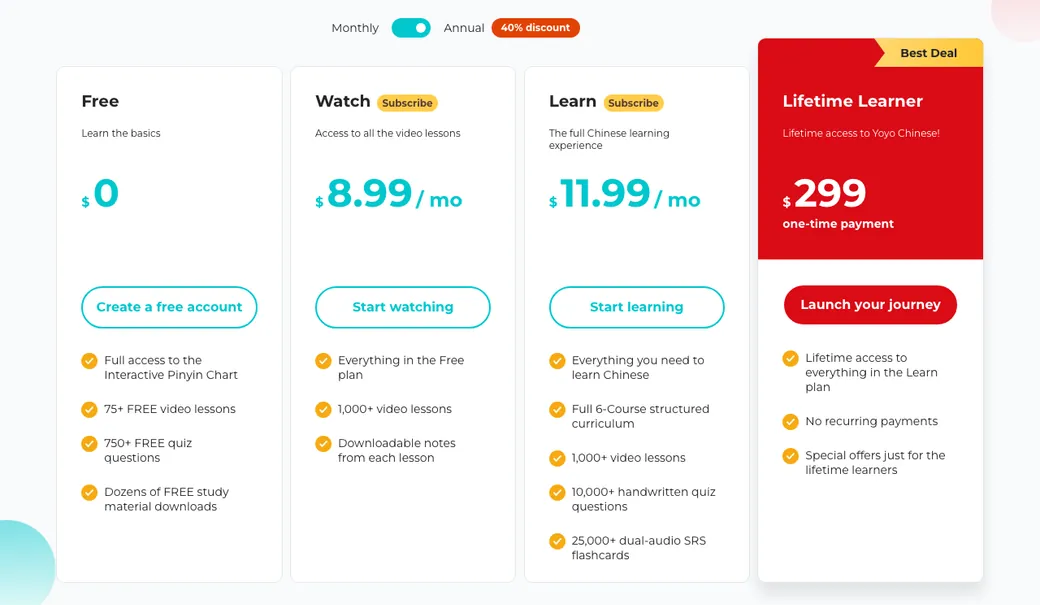
If you're unsure, start on a free tier and pay monthly. Buy a lifetime plan only once you've kept the habit for a month or two.
University platforms sell a certificate, not conversation
Coursera and edX host Chinese courses from universities and schools. Both sell you a certificate when you finish, and in the courses we read, neither gives you anyone to talk to.
Coursera. Peking University's Chinese for Beginners has about 1.5 million learners enrolled. It teaches pronunciation and everyday phrases, not characters, in about 20 hours:
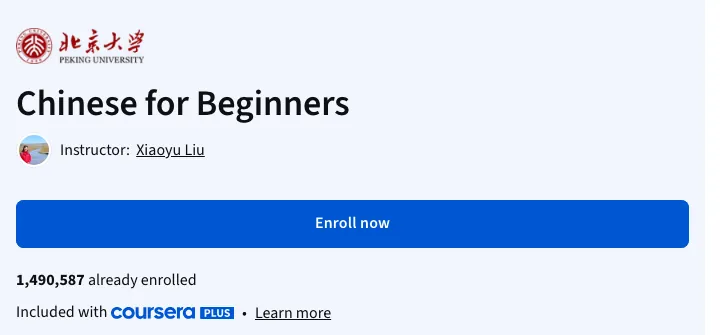
Coursera's page says you buy the certificate track when you enrol, through Coursera Plus or the course itself. Some learners can start with a free trial or apply for financial aid.
edX. Its Chinese courses come from MandarinX, in four certificate programs. The beginners' program pairs two courses over about three months and prepares you for HSK 1, for $268. edX says most of its courses can be audited free.
A course certificate shows you finished a course. It isn't a language qualification: for that, employers and universities look for an HSK score.
Live classes buy you a teacher and a timetable
Live online schools cost the most. In return, you get a teacher who corrects you, classmates, and a reason to show up.
GoEast. This school in Shanghai runs 16-week group courses on Zoom. You get two 75-minute classes a week, usually with one classmate. It teaches from beginner to HSK 4, and you can try a class free or pay in four monthly instalments.
LTL's Flexi Classes. These are hour-long group classes that run round the clock, for up to five students. The free trial week turns into a paid plan unless you cancel.
italki. It sells single group classes for two to six students. When we looked, its public listing showed 20 Mandarin classes, all from two teachers. You can cancel up to a day ahead for a credit refund.
Preply. As far as we could find, it sells Chinese lessons one-to-one only. Our guide to online Chinese tutors compares it with italki.
GoEast's price page shows how the cost per week falls as you commit to more courses:
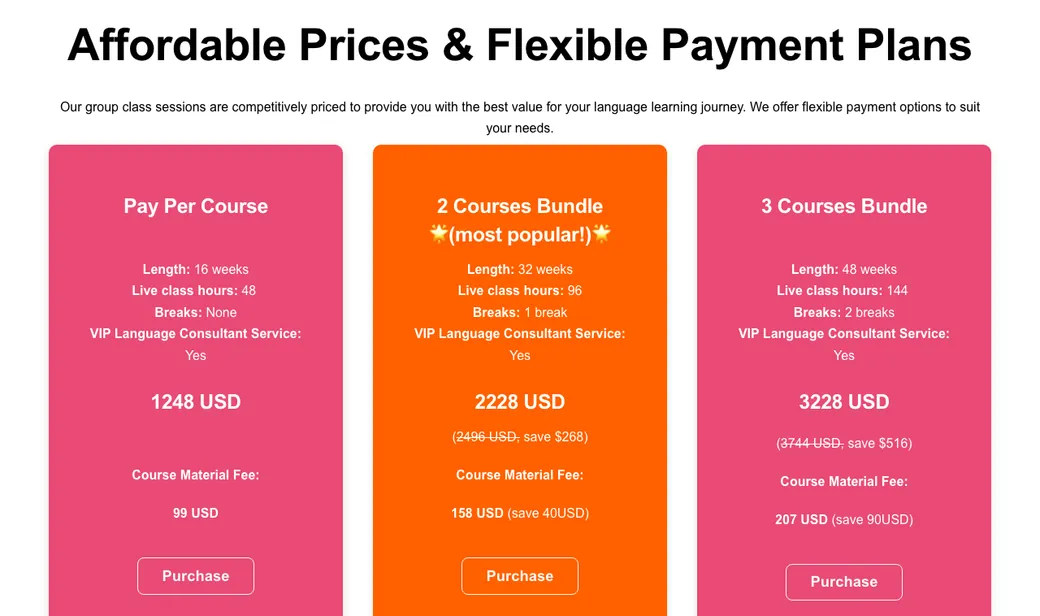
We think a class works best if you'd skip practice on your own. If you need speaking minutes more than structure, a one-to-one tutor gives you more of them for less.
Check which HSK a course teaches
If the HSK, 汉语水平考试, is your goal, ask which syllabus a course follows. The exam switches to its new syllabus from the 13 December 2026 sitting.
The new syllabus asks for more words at every level up to HSK 6, so courses built for the old exam leave gaps. Our guide to HSK books found that older books cover only about 60% of the new word lists. HSK 3.0 explained shows the changes level by level.
Most course pages we read don't name a syllabus. Chinese Zero to Hero builds its HSK 1 to 6 courses on the HSK Standard Course books, which were written for the old exam. MandarinX's HSK 1 program doesn't say which syllabus it uses.
So learn from any course you like, but check your words against the new lists before you book the exam. Our guide to free HSK practice tests links the official papers.
Where SayMei fits, and where it doesn't
SayMei gives you spoken Mandarin lessons with Mei Lin, your AI teacher, for HSK 1 to 6. It isn't a video course, so it fits best next to one. It can also replace a group class you'd take only to speak.
Premium is $5.99 a month for 200 minutes with Mei Lin, and you can start free. Here's where we think it fits:
- The cheapest speaking time here. About $4 an hour of your own speaking, on the same assumptions as the classes above.
- Nothing to book. You start a lesson when you have ten minutes, at any hour.
- The new syllabus. Its lessons follow the November 2025 HSK syllabus.
And here's where it loses:
- No trained human ear. Its tone feedback has no published accuracy test, like every AI tutor's.
- No video lectures. If you like a teacher explaining grammar on screen, a course like Yoyo Chinese does that better.
- No certificate or classmates. Nobody is expecting you on Tuesday evening.
- Capped minutes, browser only. Premium gives you 200 minutes a month, and there's no phone app.
What to do next
- Start on a free tier. Use a week of free lessons before you pay for anything.
- Buy one course, not three. Pick the teaching style you'll actually open every day.
- Add speaking from week one. A video can't hear you, so book a tutor, find a partner or talk with an AI teacher.
- Check the syllabus before the HSK. Make sure your course's word lists match the new exam.
- Pay monthly first. Commit to a year or a lifetime plan once the habit sticks.
When you're ready to talk, try a lesson with Mei Lin.
FAQ
What is the best online Chinese course?
It depends on how you learn. For conversation from zero, Yoyo Chinese explains each lesson in English, from $11.99 a month billed yearly. For one course per HSK level that you buy once, Chinese Zero to Hero charges $180 for HSK 1 to 4. For a timetable and a teacher, GoEast's live group course meets twice a week. Whichever you pick, add speaking practice, because most courses include none.
Are there free online Chinese courses?
Yes, several start free. Yoyo Chinese has over 75 free video lessons, Chinese Zero to Hero a free introductory course, and Mandarin Blueprint its first few levels. ChineseClass101 has a free account with the first lessons of each path. Coursera and edX let you try courses, but their certificates cost money. A language exchange is the free way to practise speaking.
How much does an online Chinese course cost?
Most self-paced courses cost a few hundred dollars a year; ChinesePod, for example, is $29 a month. A few, like Chinese Zero to Hero, you buy once and keep. Live classes cost several times more: one group class a week on LTL's Flexi Classes comes to about $730 a year.
Can you get a certificate from an online Chinese course?
Yes, from Coursera and edX. Peking University's Chinese for Beginners gives one through Coursera Plus, at $59 a month, and MandarinX's beginners' program on edX costs $268. These show you finished a course. They aren't language qualifications: for one that employers and universities recognise, take the HSK exam. SayMei doesn't give certificates.
Are online group Chinese classes worth it?
For structure and company, often yes. For speaking time, they're the dearest option. GoEast usually puts two students in a class, LTL's Flexi up to five and italki up to six, so you may speak for only a few minutes an hour. By our count, an hour of your own speaking costs at least $51 in a group, against about $45 with a median italki tutor.
Which online Chinese courses follow the new HSK syllabus?
Few say. The exam moves to its new syllabus on 13 December 2026, with more words at every level up to HSK 6. Chinese Zero to Hero builds on the HSK Standard Course books, written for the old exam, and MandarinX's HSK 1 program doesn't name its syllabus. SayMei's lessons follow the new one. Check any course against the new word lists before the exam.
Is Yoyo Chinese or ChinesePod better?
They suit different learners. Yoyo Chinese is a structured course that explains Chinese in English, from zero to upper intermediate, at $19.99 a month. ChinesePod is a library of over 4,000 dialogue lessons in six levels, at $29 a month, and suits learners who want lots of listening. Neither includes live speaking, so add a tutor or a partner.
Can you learn to speak Chinese with an online course alone?
Not with a video course alone. Six of the 11 options we compared include no live conversation, so nobody hears your tones or answers you. Add speaking practice: a language partner is free, a median italki tutor costs about $20 an hour, and an AI teacher costs less again. A group class works too, but it's the dearest way to buy speaking time.
Sources
Checked 16 October 2026 unless noted. No accounts were created, and nothing was booked or bought.
Self-paced courses
- Coursera: Chinese for Beginners, Peking University; Coursera Plus
- edX: Chinese courses; MandarinX Chinese for Beginners: Essentials & HSK Prep
- Yoyo Chinese: pricing and home page, including its FAQ
- ChinesePod: pricing and home page
- ChineseClass101: pricing
- Chinese Zero to Hero: prices and HSK 1–4 bundle
- Mandarin Blueprint: home page and Fluency Lab terms
Live classes
- GoEast: online group classes
- LTL: Flexi Classes, prices checked 11 October 2026
- italki: Chinese group classes and group class rules
- Left out: Udemy's Chinese courses, Hutong School online, That's Mandarin online
SayMei and research
- SayMei pricing
- Our guide to online Chinese tutors, for italki's median tutor price, read 11 October 2026
- Demszky, D., Wang, R., Geraghty, S. & Yu, C. (2024). Does feedback on talk time increase student engagement? LAK '24; EdWorkingPaper 23-891.
- Guo, X., Yang, W. & Guo, Y. (2025). Analyzing teacher–student verbal interaction in elementary Chinese comprehensive class. Behavioral Sciences 15(4), 429.
Methods
- Prices. On 16 October 2026 we read each provider's public pages in US dollars, logged out, without creating accounts or starting trials. Yoyo Chinese's page shows yearly billing first; its month-by-month prices are in the page's own plan data.
- Reused figures. LTL Flexi's prices and italki's median one-to-one price, $20 from 783 teachers, come from our tutors guide, checked 11 October 2026.
- italki group classes. We read its public Chinese group-class listing once: 21 classes, including one Cantonese class for children, which we left out. Hourly prices use each class's length.
- Left out. Udemy's course pages showed our browser a bot check instead of a price. Hutong School publishes no online prices. That's Mandarin lists small-group classes from RMB 132 for 45 minutes but doesn't say whether that's per student, or how big the group is.
- Mandarin Blueprint. Its pricing page leads to a sales call. The $2,000 joining fee comes from its Fluency Lab terms, which don't give the subscription price.
- A year. Twelve months of each subscription, one-off courses once, and live classes at the pace shown in the chart.
- Speaking time. Talk shares come from published studies, not from these companies: 44% one-to-one, and 41% of a class shared among its students. Ranges run from 2 students at the lowest price to a full class at the highest. GoEast's 48 class hours last 50 minutes each, and its price includes the $99 materials fee. Nobody has measured talk time with an AI teacher, so SayMei uses the one-to-one share.
- Screenshots. Ours, of public pages, taken logged out on 16 October 2026, with site menus and floating widgets hidden.
- Limits. Prices change, sales come and go, and some prices vary by country. If you spot a mistake, tell us: we fix errors.