The best apps to learn Chinese, by goal
One app for each job: the best Chinese course, dictionary, flashcard, reading, handwriting and speaking apps for your goal, with prices checked in October 2026.


Ask four AI chatbots for the best app to start Chinese, and you'll hear the same three names. They're good apps, but none of them does the hardest job well: getting you to speak.
If you're an adult teaching yourself Mandarin, this guide gives you one app for each job and what it really costs.
Key takeaways
- One app can't do every job. Courses teach, dictionaries explain, flashcards hold words, and speaking needs a partner.
- You can start for nothing. Duolingo, Pleco and Anki are free on Android, and Gemini Live gives you free spoken practice.
- If you pay for one thing, pay for the course. HelloChinese is the fullest beginner course we found, and its yearly plan costs under $6 a month.
- Your goal decides the rest. HSK candidates want SuperChinese, readers want Du Chinese, and handwriting needs Skritter.
- Speaking is the gap most apps leave. Free AI chat gets you talking; a tutor or a spoken course is what corrects you.
- SayMei wins one job. It's the cheapest way to get spoken lessons sorted by HSK level, and the wrong pick for most other jobs.
Your stack depends on your goal
Most learners need three or four apps, one for each job. Which ones depends on what you want Chinese for.
Say you want to read, have 20 minutes a day and won't spend a cent. You'd get Mandarin Bean for stories, Pleco to look words up and Anki to keep them.
At 30 minutes a day, every goal's stack fits under $20 a month. Here's what we'd pick, next to a version that costs nothing:
Start from zero
- Our pick
- HelloChinese, Pleco, Anki, SayMei
- A month
- $17.98
- Free version
- Duolingo, Pleco, Anki, Gemini Live
Speak and understand
- Our pick
- Speak, Pleco, Anki
- A month
- $17.99
- Free version
- Gemini Live, Duolingo, Pleco, Anki
Pass an HSK exam
- Our pick
- SuperChinese, Anki, Pleco, SayMei
- A month
- $17.98
- Free version
- Duolingo, Anki, Pleco, Gemini Live
Read Chinese
- Our pick
- Du Chinese, Pleco, Anki
- A month
- $14.99
- Free version
- Mandarin Bean, Pleco, Anki
Write characters
- Our pick
- Skritter, Pleco, Duolingo
- A month
- $14.99
- Free version
- Skritter's free decks, Pleco, Duolingo
Get by on a trip
- Our pick
- Pimsleur, Pleco, Gemini Live
- A month
- $19.95
- Free version
- Duolingo, Gemini Live, Pleco
Sources: each app's website or US App Store listing, checked 7 October 2026. Our picks at a budget of $25 a month, billed monthly; Anki's iPhone app is a one-off $24.99.
Start with the free version if you're not sure you'll stick with it. Once you've studied for a few weeks, pay for the one app you open most.
Your week won't look like ours, so build your own. Pick a goal, the time you have each day and a budget:
Build your Chinese app stack
Pick a goal, the time you have each day and a budget. You get one app for each job, what it costs a month and why. Prices checked 7 October 2026.
Time a day
Budget a month
Billing
$29.98 a month · 3 apps · $12.83 a month if you pay yearly

Course · 14 min a day
$11.99 a month
The fullest beginner course: HSK-based units, handwriting, speech recognition, Simplified or Traditional, offline.

Dictionary · As needed
Free
The dictionary learners recommend most: free, offline, with handwriting input. Look words up as you meet them.

Notice that every budget keeps every job. Money buys a better app for a job, never a job you'd otherwise skip.
Chatbots agree on three apps
We asked ChatGPT, Claude, Gemini and Perplexity for the best app for a beginner, and for the best free one, with web search on. Three apps came up in almost every answer.
Here's how often each app was named in their 34 answers:
Source: our sample of answers to "best app to learn Mandarin for a complete beginner" and "best free app to learn Chinese". Method under How we compared.
The chatbots are right about the core. Learners on r/ChineseLanguage say the same thing: start with a course, then add Pleco, flashcards and a reader.
Further down the list, SuperChinese and Pimsleur each came up in roughly a third of answers. SayMei came up in none.
What the answers skip is the job none of those three does well, which is speaking. And when we asked what a full set costs, one answer offered a range of about $20 to $50 a month, not a price.
Our tool adds up the real prices instead, for your goal and your budget.
Start free, then pay for one app
Every goal has a stack that costs nothing. The free tools aren't toys, either: Pleco and Anki stay useful long after your first course.
Most core jobs have a strong free option. Here's what $0 gets you in the apps people use most:
| App | Free | Paid |
|---|---|---|
| Duolingo | The whole course, with ads | Super, from $9.99 a month |
| HelloChinese | The first lessons | $11.99 a month |
| Pleco | Two dictionaries, offline | Add-ons, $29.99 once |
| Anki | Everything but the iPhone app | $24.99 once on iPhone |
| Mandarin Bean | Every graded reading | $49 a year, no ads |
| Gemini Live | Spoken conversation | Not needed |
| HelloTalk | Chats with native speakers | VIP, $12.99 a month |
Sources: each app's website or US App Store listing, checked 7 October 2026.
Paying buys polish and structure, not access. Here's what each goal costs at 30 minutes a day, from the free stack to our top pick for every job:
Every goal has a free stack; top picks cost $18–43 a month
US dollars a month at 30 minutes a day: the free stack on the left, our top pick for every job on the right
| Goal | US$ a month | Top pick for every job |
|---|---|---|
| Speak and understand | 0–17.99 | Speak, Pleco, Anki |
| Write characters | 0–26.98 | Skritter, HelloChinese, Pleco |
| Start from zero | 0–29.98 | HelloChinese, Speak, Pleco, Anki |
| Read Chinese | 0–32.99 | Du Chinese, Hack Chinese, Pleco |
| Get by on a trip | 0–37.94 | Pimsleur, Speak, Pleco |
| Pass an HSK exam | 0–42.99 | SuperChinese CHAO, Hack Chinese, Pleco |
Sources: prices as in the stack table above, billed monthly. The tool shows the stacks in between.
If you'll pay for one app, make it the one that plans your learning: the course, or your reader once you're past the basics.
Once you've chosen it, the billing matters too. Most paid apps cost far less per month on a yearly plan, but you pay up front for an app you might drop. Here's the same app on its two plans:
A yearly plan cuts a third to nearly two thirds off
US dollars a month on each app's yearly and monthly plans, checked 7 October 2026
| App | Paid yearly | Paid monthly |
|---|---|---|
| SuperChinese | $5.00 | $11.99 |
| HelloChinese | $5.83 | $11.99 |
| Speak | $7.00 | $17.99 |
| The Chairman's Bao | $7.33 | $11.00 |
| Skritter | $8.33 | $14.99 |
| SuperChinese CHAO | $9.17 | $24.99 |
| Du Chinese | $10.00 | $14.99 |
| Talkpal | $10.00 | $19.99 |
| Hack Chinese | $12.00 | $18.00 |
Sources: each app's website or US App Store listing. Yearly price divided by 12.
So try before you commit. Hack Chinese gives you 21 days free without a card, and Speak and Skritter give you 7.
Pay monthly for the first month, then switch to yearly if you're still opening the app every day. Yearly plans renew on their own, so set a reminder before the year is up. SayMei has no yearly plan.
Courses: HelloChinese first, Duolingo for free
A course decides what you learn next, so you don't have to. For most beginners the best one is HelloChinese, and the best free one is Duolingo.
HelloChinese
The fullest beginner course we found. Its units follow the HSK levels and mix listening, speech recognition and handwriting. It teaches Simplified or Traditional characters and works offline, its App Store listing says.
The free part is small. On r/ChineseLanguage, one learner finished it "in a matter of days", and another hit the paywall after about four levels.
- Pick it if: you're starting from zero and want one course that covers everything.
- Skip it if: you need it free, or you want to study in a browser.
- Price: Premium is $11.99 a month or $69.99 a year.
 Duolingo
The most complete free course we found. Duolingo's Chinese course teaches Simplified characters, and we found its words cover most of HSK 1 to 4.
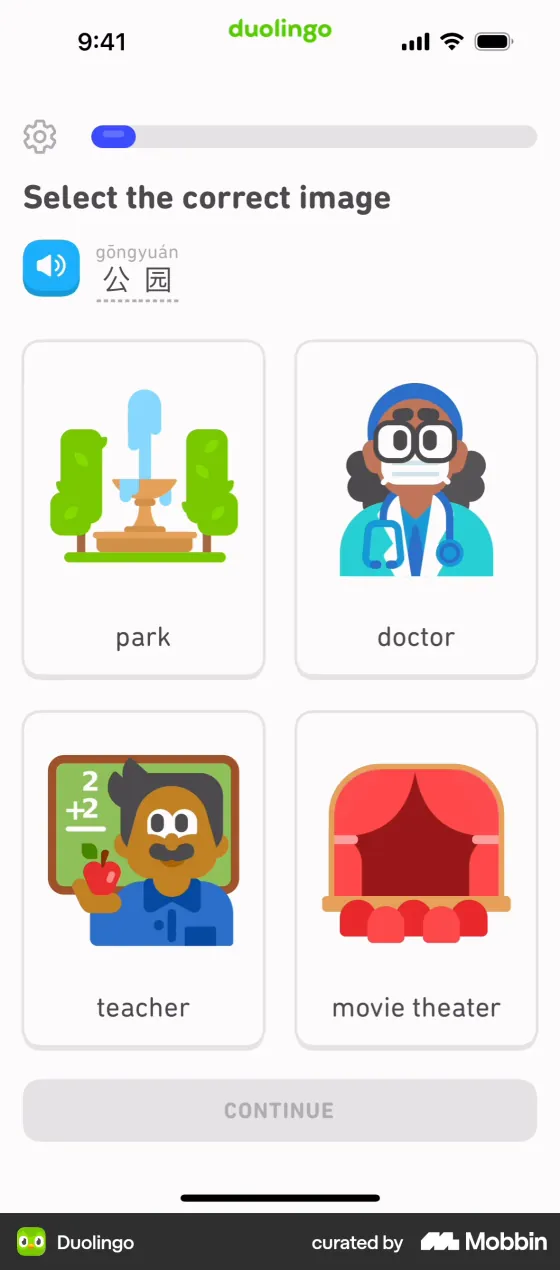
It's weak where Chinese is hard. Most answers are picked rather than recalled, speaking means reading a line aloud, and none of the screens in our review trains tones.
- Pick it if: you want a free daily habit to build around.
- Skip it if: you want HSK levels, Traditional characters or real speaking practice.
- Price: free with ads; Super removes them, from $9.99 a month.
 SuperChinese
The course that runs furthest up the HSK levels. Its main course goes from zero to HSK 5, and every line you say gets a pronunciation score, marked character by character.
The CHAO plan adds role-plays with an AI tutor on top of the same course. Our HelloChinese vs SuperChinese guide compares the two courses in depth.
- Pick it if: you're aiming at an HSK level beyond the basics.
- Skip it if: you need Traditional characters, which its pages don't mention, or a browser version.
- Price: PLUS is $11.99 a month; CHAO, with the AI tutor, is $24.99.
 Pimsleur
The pick for a trip. Pimsleur's Mandarin course is 30-minute audio lessons that you answer out loud, hands-free and offline. It starts with survival phrases.
It's built for listening and speaking, not reading and writing, so it suits travellers more than future readers. Our Pimsleur Mandarin review goes deeper.
- Pick it if: you want some spoken Chinese before a trip.
- Skip it if: you want to read and write.
- Price: $19.95 a month for one language on its website, after a free trial.
Pleco and Anki: free tools you'll keep
Two free apps outlast every course: a dictionary and a flashcard app. Install them on day one.
Pleco
Pleco is the dictionary learners recommend most, and its core is free. It comes with two dictionaries, handwriting input for characters you can't type, and audio. Once it's set up, it works offline.
Look up a word, and Pleco shows the tone that changes its meaning: buy, 买, is one tone away from sell, 卖.
The paid add-ons are one-off purchases. The Basic Bundle costs $29.99 and adds camera look-up, flashcards and stroke-order animations.
 Anki
Anki
Anki is the free flashcard app that learners on r/ChineseLanguage keep recommending. It shows each card just before you'd forget it, and you can download shared HSK decks instead of making your own.
It's free on computers, the web and Android, and the official iPhone app is $24.99 once. The real cost is your time, because you choose and set up the decks yourself. Our guide to Anki and the Chinese flashcard apps compares it with Pleco, Skritter and Hack Chinese.
Hack Chinese
If you'd rather pay than set things up, Hack Chinese estimates the words you already know, then teaches the HSK words you don't. It's $18 a month, or $12 billed yearly.
It runs in a phone browser, with no app. It doesn't teach handwriting, and it says plainly that you can't become fluent with it alone.
Start with Pleco and Anki. Pay for Hack Chinese only if setting up Anki is what stops you.
Reading: Du Chinese, or Mandarin Bean for free
Graded readers turn words you've drilled into words you understand. They're stories written for your level, with audio and a tap-to-translate dictionary.
Du Chinese is the reader we'd start with: more than 3,000 stories and articles, each with native audio. A beginner story such as "I'm a Cat" uses just 150 characters.
It costs $14.99 a month, and some lessons are free, says its pricing page.
If you'd rather spend nothing, Mandarin Bean keeps all its graded readings free, with audio recorded by Chinese teachers. For the news at your level, The Chairman's Bao costs $11 a month.
We compare the reading apps side by side in our full guide to Chinese graded readers and story apps, our own SayMei Stories among them.
Start reading earlier than feels comfortable. Our guide to learning Chinese through stories explains what the research says about learning from them.
Handwriting needs its own app
Course apps let you trace characters, but writing from memory is a separate skill. Spotting 谢, the "thank" in thank you, is easy. Writing its 12 strokes in order, from memory, is not.
Skritter is built for that job. You write each character on the screen, and it grades every stroke as you go. Its decks follow the HSK levels, the new HSK 3.0 lists included.
It costs $14.99 a month, and guest accounts keep a few decks free.
Two free extras help. Pleco animates the stroke order of 500 characters for free, and our worksheet generator prints practice sheets for any word, such as character, 字.
You may need less handwriting than you think. By HSK 6, the new syllabus asks you to read about 1,940 characters but write only 700, as our HSK 3.0 guide explains.
Speaking is where apps fall short
Course apps have you read lines aloud. Answering a waiter who asks 几位, "how many of you?", takes something that talks back: an AI tutor or a person.
Here's what each kind of speaking practice costs:
Talking back is free; being taught to talk costs money
Each line is one app; a bar runs from its free plan to its paid one. CHAO is SuperChinese's AI tutor plan. Checked 7 October 2026.
What speaking you get ↑
Talk with a person
- HelloTalk $0
- italki, weekly $86.67
Talk with an AI
- Gemini Live $0
- SayMei $5.99
- ChatGPT Go $8
- Speak $17.99
- CHAO tutor $24.99
Read lines aloud
- Duolingo $0
- HelloChinese $0–11.99
- SuperChinese $0–11.99
None
- Pleco, Anki $0
- Du Chinese $0–14.99
US dollars a month →
Sources: italki at the median Chinese teacher's $20 an hour, from our read of its directory; other prices from each app's website or US App Store listing.
Free conversation is easy to find. Gemini Live talks with you in Mandarin in Google's phone app, and HelloTalk pairs you with native speakers. Neither plans a lesson or corrects you unless you ask.
Structured speaking costs money. Speak is a speaking-first course from zero to B1, SuperChinese CHAO adds role-plays to its HSK course, and SayMei gives you spoken lessons sorted by HSK level.
A tutor on italki costs far more, but a trained ear hears tone habits that apps miss. One caveat: we found no public test showing that any AI app reliably checks your tones.
We compare nine AI tutors in the best AI apps to learn Chinese, and human tutors in online Chinese tutors compared.
Where SayMei fits, and where it doesn't
Our lessons: short spoken lessons with an AI teacher, in your browser. SayMei leads on one job, and it's the wrong pick for several others.
It's the cheapest way to get spoken lessons sorted by HSK level: $5.99 a month for 200 minutes, as our pricing page shows.
Each lesson takes 5 to 10 minutes and practises one grammar point. Mei Lin plays the waiter or the hotel clerk, and corrects you as you go.
- Pick SayMei if: you want speaking practice that follows the HSK levels, cheaply, with nothing to install.
- Skip it if: you want a full course, a dictionary or free unlimited flashcards. HelloChinese, Pleco and Anki do those jobs better.
- Skip it if: you want hours of talk a day. 200 minutes is about 6½ minutes a day, and ChatGPT Go allows far more for $8.
- Skip it if: you need an app or offline use. SayMei runs only in a browser, and it gives corrections rather than pronunciation scores.
Some of what we make is free with no account. Our HSK vocabulary lists have every word with pinyin and audio, plus a CSV you can import into Anki.
Apps that didn't make our stack
A few well-known names didn't make the stack, for different reasons:
- ChineseSkill is close to HelloChinese, at $11.99 a month. Pick it if you want its separate Taiwan Mandarin or Cantonese course.
- LingoDeer teaches many languages, Chinese among them, from $14.99 a month. It costs more than HelloChinese and comes up far less often in recommendations.
- Talkpal, Langua, Pingo and Praktika are AI conversation apps, covered in our AI tutor comparison.
- Babbel doesn't teach Chinese. Its 14 languages don't include it.
We didn't review apps for children; they need their own comparison.
What to do next
- Pick your goal first. It decides which extras you need, so set it in the tool above.
- Install the free three. Duolingo or HelloChinese's free lessons, plus Pleco and Anki, cover the basics.
- Pay for one app after a few weeks. Choose the course or reader you open daily, and go yearly once you're sure.
- Start speaking in week one. Practise with free AI chat, and get corrected by a tutor or spoken lessons.
- Add the specialist your goal needs. Du Chinese to read, Skritter to write, SuperChinese for the HSK.
If speaking is your goal, compare the AI tutors side by side in our guide to the best AI apps to learn Chinese.
FAQ
What's the best free app to learn Chinese?
Duolingo is the most complete free course, and we found its words cover most of HSK 1 to 4. Pair it with Pleco, the free dictionary, and Anki, which is free on Android and computers. For speaking practice, Gemini Live is free in Google's phone app.
Is HelloChinese free?
Partly. The app and its first lessons are free, but the full course needs Premium, at $11.99 a month or $69.99 a year in the US. Learners on Reddit say they reached the paywall within the first few levels.
Can you learn Chinese with just one app?
You can start with one, but you'll outgrow it. Course apps are built around exercises and repeating lines, so they're light on real conversation, and none is a full dictionary. Even Hack Chinese says you can't become fluent with it alone, so add a dictionary, flashcards and speaking practice.
What's the best app for HSK preparation?
SuperChinese, if you want a course built around the levels: its main course covers HSK 1 to 5, and its vocabulary course goes on to HSK 7–9. Add Hack Chinese or a free Anki deck for the word lists. Practise the exam itself with official sample papers; our HSK exam guide has dates and formats.
Which apps teach Traditional Chinese?
HelloChinese, Du Chinese, Mandarin Bean and Pleco all switch to Traditional characters, and ChineseSkill has a separate Taiwan Mandarin course. SayMei's lessons can show Traditional characters too, but Duolingo's course for English speakers is Simplified only. Our guide to Simplified vs Traditional Chinese helps you choose.
Which Chinese learning apps work offline?
Pleco works fully offline once it's set up. HelloChinese, ChineseSkill and SuperChinese let you download lessons, Du Chinese offers offline study with Premium, and Pimsleur's lessons play offline after download. SayMei, Hack Chinese and Gemini Live work only online.
Is Anki good for learning Chinese?
Yes, if you don't mind setting it up: it's free on computers, the web and Android, and $24.99 once on iPhone. Download a shared HSK deck or import a word list, and Anki schedules each card just before you'd forget it. If you'd rather skip the setup, Hack Chinese handles HSK lists for $18 a month.
Does Babbel teach Chinese?
No. Babbel teaches 14 languages, and Chinese isn't one of them. If you like its short, structured lessons, try HelloChinese or SuperChinese, or Duolingo for something free.
How we compared
We compared what each app publishes about itself; we didn't test the apps hands-on. Where an app says it does something, such as checking your tones, we report that as its claim.
We chose the apps that chatbots, learner forums and Chinese-learning roundups name most often for this question. Then we sorted them into jobs: courses, readers, a dictionary, flashcards, handwriting, AI tutors and human tutors.
Prices are US list prices from each app's website or US App Store listing, read on 7 October 2026. They're for monthly billing unless we say otherwise, and yearly plans are shown per month.
For the chatbot sample, we asked ChatGPT, Claude and Gemini each question five times, and Perplexity twice, all with web search on. Then we counted every app each answer named. We also asked ChatGPT and Perplexity twice each what a full set of apps costs.
The stack tool gives each goal a list of jobs and the minutes a day each one gets. For every job it takes our first-choice app that fits what's left of your budget, and the last choice is always free. SayMei is priced by minutes, including the top-ups you'd need past 200 minutes a month.
We didn't test teaching quality, speech recognition, tone feedback or how well each app adapts to you.
Sources
Checked 7 October 2026 unless noted.
Courses
- HelloChinese on the App Store; hellochinese.cc
- Duolingo's Chinese course; Duolingo on the App Store; our review, Is Duolingo good for Chinese?
- SuperChinese FAQ; SuperChinese on the App Store
- Pimsleur Mandarin; Pimsleur on the App Store
- ChineseSkill on the App Store; LingoDeer on the App Store; Babbel
Dictionary and flashcards
- Pleco on the App Store; Pleco pricing and bundles; Pleco FAQ
- Anki downloads; AnkiMobile on the App Store; AnkiDroid on Google Play
- Hack Chinese pricing; Skritter; Skritter on the App Store
Reading
- Du Chinese pricing; Du Chinese on the App Store; Du Chinese, "I'm a Cat 1"; Mandarin Bean; The Chairman's Bao plans
Speaking
- Speak, "Chinese now available on Speak" (2 June 2026); Speak on the App Store
- Google, Gemini Live requirements; OpenAI, ChatGPT Voice; Talkpal pricing
- HelloTalk on the App Store; italki and Preply prices, from our tutors guide
SayMei (our pages)
Forums and chatbots
- r/ChineseLanguage threads: Duolingo vs HelloChinese vs SuperChinese; Best free Mandarin learning app; Any free apps to learn like HelloChinese (6 October)
- Chatbot answers sampled 6 October 2026 (ChatGPT, Claude, Gemini, Perplexity)
Methods
This guide draws on public pages read on 7 October 2026: each app's website and US App Store listing, the forum threads linked above, and SayMei's own pages. The Duolingo screen comes from Mobbin's library of real app screens. No app was tested hands-on, and every vendor claim is reported as a claim. The chatbot counts come from answers we sampled through each company's API with web search on. The Mandarin examples were checked against the CC-CEDICT dictionary, and the stroke count against the open Make Me a Hanzi character data. If you spot a mistake, tell us: we fix errors.