HSK writing workbook · HSK 2
HSK 2 Writing Workbook (Free PDF)
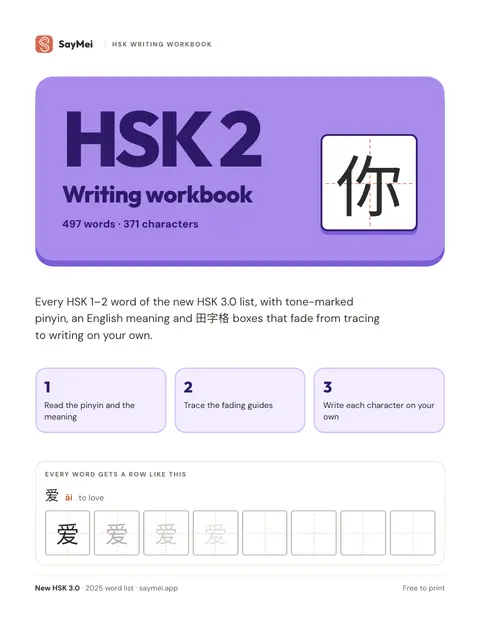
All 500 words of HSK 1–2 on the new HSK 3.0 (2025) list, with pinyin, English and 田字格 (tián zì gé) tracing boxes that fade from trace to write. Print it, then practice the same characters online.
- Words:
- 500 words · 371 characters (HSK 1–2)
- Format:
- PDF · 99 pages on A4 / 108 on US Letter
- Practice:
- Pinyin and English for every word · 田字格 (tián zì gé) boxes that fade from tracing to writing
- List:
- New HSK 3.0 (2025) word list · QR code on every page for online practice
- Price:
- Free · no sign-up · updated Oct 5, 2026
- Download the workbook: A4 PDF (99 pages, 6.4 MB) · US Letter PDF (108 pages, 6.6 MB)
Practice these characters online
All 500 HSK 1–2 words
| # | Word | Pinyin | English |
|---|---|---|---|
| 1 | 爱 | ài | to love |
| 2 | 吧 | ba | right? |
| 3 | 八 | bā | eight |
| 4 | 爸爸 | bàba | dad |
| 5 | 百 | bǎi | hundred |
| 6 | 白天 | bái tiān | daytime |
| 7 | 半 | bàn | half |
| 8 | 包子 | bāo zi | baozi |
| 9 | 杯子 | bēi zi | cup |
| 10 | 本 | běn | measure word for books; volume |
| 11 | 边 | biān | side |
| 12 | 病 | bìng | illness |
| 13 | 不 | bù | no |
| 14 | 不客气 | bú kè qì | you're welcome |
| 15 | 不要 | bú yào | don't! |
| 16 | 菜 | cài | vegetable |
| 17 | 茶 | chá | tea |
| 18 | 唱 | chàng | to sing |
| 19 | 超市 | chāoshì | supermarket |
| 20 | 车 | chē | car |
| 21 | 吃 | chī | to eat |
| 22 | 穿 | chuān | to wear |
| 23 | 出租车 | chūzūchē | taxi |
| 24 | 大 | dà | big |
| 25 | 打电话 | dǎ diàn huà | to make a telephone call |
| 26 | 大家 | dàjiā | everyone |
| 27 | 到 | dào | to reach |
| 28 | 大学 | dà xué | university |
| 29 | 大学生 | dà xué shēng | university student |
| 30 | 的 | de | of |
| 31 | 第 | dì | ordinal-number prefix |
| 32 | 店 | diàn | inn |
| 33 | 点 | diǎn | point; o'clock |
| 34 | 电话 | diàn huà | telephone |
| 35 | 电脑 | diànnǎo | computer |
| 36 | 电视 | diànshì | television |
| 37 | 电影 | diànyǐng | movie |
| 38 | 电影院 | diàn yǐng yuàn | cinema |
| 39 | 弟弟 | dì di | younger brother |
| 40 | 东西 | dōngxi | thing; object |
| 41 | 都 | dōu | all |
| 42 | 读 | dú | to read out |
| 43 | 对 | duì | right |
| 44 | 对不起 | duìbuqǐ | I'm sorry |
| 45 | 多 | duō | many |
| 46 | 多少 | duōshao | number |
| 47 | 读书 | dú shū | to read a book |
| 48 | 二 | èr | two |
| 49 | 儿子 | érzi | son |
| 50 | 饭 | fàn | cooked rice |
| 51 | 饭店 | fàndiàn | restaurant |
| 52 | 房间 | fángjiān | room |
| 53 | 非常 | fēicháng | very |
| 54 | 飞机 | fēijī | airplane |
| 55 | 分 | fēn | to divide |
| 56 | 分钟 | fēnzhōng | minute |
| 57 | 高兴 | gāoxìng | happy |
| 58 | 个 | gè | individual |
| 59 | 歌 | gē | song |
| 60 | 哥哥 | gē ge | elder brother |
| 61 | 给 | gěi | to supply |
| 62 | 公司 | gōngsī | company |
| 63 | 工作 | gōngzuò | to work |
| 64 | 狗 | gǒu | dog |
| 65 | 贵 | guì | expensive |
| 66 | 国 | guó | country |
| 67 | 还 | hái | still |
| 68 | 孩子 | háizi | child |
| 69 | 汉语 | hànyǔ | Chinese language |
| 70 | 汉字 | hàn zì | Chinese character(s) |
| 71 | 号 | hào | ordinal number |
| 72 | 好 | hǎo | good |
| 73 | 好吃 | hǎochī | tasty |
| 74 | 好看 | hǎo kàn | good-looking |
| 75 | 好听 | hǎo tīng | pleasant to hear |
| 76 | 好玩儿 | hǎo wánr | fun; interesting |
| 77 | 和 | hé | and |
| 78 | 喝 | hē | to drink |
| 79 | 很 | hěn | very |
| 80 | 后 | hòu | back |
| 81 | 回 | huí | to return; go back |
| 82 | 会 | huì | can |
| 83 | 火车 | huǒ chē | train |
| 84 | 几 | jǐ | how much |
| 85 | 家 | jiā | home |
| 86 | 见 | jiàn | to see |
| 87 | 件 | jiàn | item |
| 88 | 叫 | jiào | to be called; to call |
| 89 | 饺子 | jiǎozi | dumpling |
| 90 | 家人 | jiā rén | family member |
| 91 | 鸡蛋 | jīdàn | (chicken) egg |
| 92 | 姐姐 | jiě jie | elder sister |
| 93 | 今年 | jīn nián | this year |
| 94 | 今天 | jīntiān | today |
| 95 | 九 | jiǔ | nine |
| 96 | 觉得 | juéde | to think that ... |
| 97 | 开 | kāi | to open (transitive or intransitive) |
| 98 | 开车 | kāi chē | to drive a car (or train etc) |
| 99 | 看 | kàn | to see |
| 100 | 看病 | kàn bìng | to visit a doctor |
| 101 | 看见 | kànjiàn | to see |
| 102 | 课 | kè | subject |
| 103 | 可以 | kěyǐ | can |
| 104 | 口 | kǒu | mouth |
| 105 | 块 | kuài | piece; yuan (informal) |
| 106 | 来 | lái | to come |
| 107 | 老师 | lǎoshī | teacher |
| 108 | 了 | le | Used after a verb to indicate perfective aspect (action completion). |
| 109 | 冷 | lěng | cold |
| 110 | 里 | lǐ | in; inside |
| 111 | 两 | liǎng | two |
| 112 | 零 | líng | zero |
| 113 | 六 | liù | six |
| 114 | 吗 | ma | Final interrogative particle, forming yes/no questions. |
| 115 | 卖 | mài | to sell |
| 116 | 买 | mǎi | to buy |
| 117 | 妈妈 | mā ma | mama |
| 118 | 忙 | máng | busy |
| 119 | 猫 | māo | cat |
| 120 | 没关系 | méiguānxi | it doesn't matter |
| 121 | 妹妹 | mèi | younger sister |
| 122 | 没事 | méi shì | it's not important |
| 123 | 没有 | méi yǒu | haven't |
| 124 | 们 | men | plural marker for pronouns, and nouns referring to individuals |
| 125 | 面包 | miànbāo | bread |
| 126 | 面条儿 | miàn tiáor | noodles |
| 127 | 米饭 | mǐfàn | (cooked) rice |
| 128 | 明年 | míng nián | next year |
| 129 | 明天 | míngtiān | tomorrow |
| 130 | 名字 | míngzi | name (of a person or thing) |
| 131 | 那 | nà | (pronoun) that (referring to persons, things or situations) |
| 132 | 哪 | nǎ | how |
| 133 | 那边 | nà biān | there |
| 134 | 那个 | nà ge | that one |
| 135 | 哪个 | nǎ gè | which |
| 136 | 那里 | nà lǐ | there |
| 137 | 哪里 | nǎ lǐ | where? |
| 138 | 男 | nán | Man |
| 139 | 男朋友 | nán péng yǒu | boyfriend |
| 140 | 那儿 | nàr | there |
| 141 | 哪儿 | nǎr | where? |
| 142 | 那些 | nà xiē | those |
| 143 | 哪些 | nǎ xiē | which ones? |
| 144 | 呢 | ne | particle indicating that a previously asked question is to be applied to the preceding word (What about ...?, And ...?) |
| 145 | 能 | néng | can |
| 146 | 你 | nǐ | you (the person spoken to or written to) |
| 147 | 你好 | nǐ hǎo | hello |
| 148 | 年 | nián | year |
| 149 | 你们 | nǐ men | you (plural) |
| 150 | 您 | nín | you (usually singular, may be plural) |
| 151 | 牛奶 | niúnǎi | cow's milk |
| 152 | 女 | nǚ | woman; (only of humans in Standard Chinese) female |
| 153 | 女儿 | nǚ'ér | daughter |
| 154 | 女朋友 | nǚ péng yǒu | girlfriend |
| 155 | 女士 | nǚshì | lady |
| 156 | 朋友 | péngyou | friend |
| 157 | 便宜 | piányi | cheap; inexpensive |
| 158 | 漂亮 | piàoliang | beautiful; pretty |
| 159 | 苹果 | píngguǒ | apple |
| 160 | 七 | qī | seven |
| 161 | 前 | qián | front |
| 162 | 钱 | qián | money |
| 163 | 千 | qiān | thousand |
| 164 | 起床 | qǐchuáng | to get out of bed |
| 165 | 请 | qǐng | to ask |
| 166 | 请问 | qǐng wèn | excuse me |
| 167 | 去 | qù | to go |
| 168 | 去年 | qùnián | last year |
| 169 | 热 | rè | hot |
| 170 | 人 | rén | person |
| 171 | 认识 | rènshi | to know |
| 172 | 日 | rì | sun |
| 173 | 三 | sān | Three |
| 174 | 上 | shàng | upper |
| 175 | 上班 | shàngbān | to go to work |
| 176 | 商店 | shāngdiàn | store |
| 177 | 上课 | shàng kè | to go to class |
| 178 | 上午 | shàngwǔ | morning |
| 179 | 上学 | shàng xué | to go to school |
| 180 | 少 | shǎo | few |
| 181 | 谁 | shéi | who |
| 182 | 生病 | shēngbìng | to fall ill |
| 183 | 什么 | shénme | what? |
| 184 | 十 | shí | ten |
| 185 | 事 | shì | matter |
| 186 | 是 | shì | to be (followed by substantives only) |
| 187 | 时候 | shíhou | time |
| 188 | 时间 | shíjiān | (concept of) time |
| 189 | 手机 | shǒujī | cell phone |
| 190 | 书 | shū | book |
| 191 | 书店 | shū diàn | bookstore |
| 192 | 睡 | shuì | to sleep |
| 193 | 水 | shuǐ | water |
| 194 | 水果 | shuǐguǒ | fruit |
| 195 | 睡觉 | shuìjiào | to go to bed |
| 196 | 说 | shuō | to speak |
| 197 | 说话 | shuōhuà | to speak |
| 198 | 四 | sì | four |
| 199 | 岁 | suì | year |
| 200 | 他 | tā | he |
| 201 | 它 | tā | it |
| 202 | 她 | tā | she |
| 203 | 太 | tài | too; extremely |
| 204 | 他们 | tā men | they |
| 205 | 它们 | tā men | they |
| 206 | 她们 | tā men | they |
| 207 | 天 | tiān | day |
| 208 | 天气 | tiānqì | weather |
| 209 | 听 | tīng | to listen to |
| 210 | 听见 | tīng jiàn | to hear |
| 211 | 同学 | tóngxué | classmate |
| 212 | 外 | wài | outside |
| 213 | 外边 | wài biān | outside |
| 214 | 玩 | wán | to play |
| 215 | 晚 | wǎn | evening |
| 216 | 晚饭 | wǎn fàn | evening meal |
| 217 | 晚上 | wǎnshang | evening |
| 218 | 喂 | wèi | hey |
| 219 | 问 | wèn | to ask |
| 220 | 问题 | wèntí | question |
| 221 | 我 | wǒ | I |
| 222 | 我们 | wǒmen | we |
| 223 | 五 | wǔ | five |
| 224 | 午饭 | wǔ fàn | lunch |
| 225 | 下 | xià | down |
| 226 | 下雨 | xiàyǔ | to rain |
| 227 | 下班 | xià bān | to finish work |
| 228 | 下课 | xià kè | to finish class |
| 229 | 想 | xiǎng | to think (about) |
| 230 | 先生 | xiānsheng | Mr.; sir |
| 231 | 现在 | xiànzài | now |
| 232 | 小 | xiǎo | small |
| 233 | 小朋友 | xiǎo péng yǒu | child; kid (used to refer to a child, or by an adult to address a child, or, in Taiwan, to refer to sb's own child) |
| 234 | 小时 | xiǎoshí | hour |
| 235 | 小学 | xiǎo xué | elementary school |
| 236 | 小学生 | xiǎo xué shēng | primary school student |
| 237 | 下午 | xiàwǔ | afternoon |
| 238 | 写 | xiě | to write |
| 239 | 些 | xiē | classifier indicating a small amount or small number greater than 1: some, a few, several |
| 240 | 谢谢 | xièxie | to thank |
| 241 | 喜欢 | xǐhuan | to like |
| 242 | 新 | xīn | new |
| 243 | 星期 | xīngqī | week |
| 244 | 星期日 | xīng qī rì | Sunday |
| 245 | 星期天 | xīng qī tiān | Sunday |
| 246 | 休息 | xiūxi | rest |
| 247 | 学 | xué | to learn |
| 248 | 雪 | xuě | Snow |
| 249 | 学生 | xuésheng | student |
| 250 | 学习 | xuéxí | to learn |
| 251 | 学校 | xuéxiào | school |
| 252 | 要 | yào | to want |
| 253 | 也 | yě | also |
| 254 | 一 | yī | one |
| 255 | 一半 | yí bàn | half |
| 256 | 一点儿 | yīdiǎnr | a little bit |
| 257 | 衣服 | yīfu | clothes |
| 258 | 医生 | yīshēng | doctor |
| 259 | 一下 | yíxià | briefly; once |
| 260 | 一些 | yì xiē | some |
| 261 | 医院 | yīyuàn | hospital |
| 262 | 椅子 | yǐzi | chair |
| 263 | 有 | yǒu | to have |
| 264 | 有的 | yǒu de | (there are) some (who are...) |
| 265 | 有些 | yǒu xiē | some |
| 266 | 有一点儿 | yǒu yì diǎn ér | a bit |
| 267 | 雨 | yǔ | to rain |
| 268 | 元 | yuán | yuan; basic monetary unit |
| 269 | 月 | yuè | moon |
| 270 | 再 | zài | again |
| 271 | 在 | zài | to exist |
| 272 | 再见 | zàijiàn | goodbye |
| 273 | 早 | zǎo | early |
| 274 | 早饭 | zǎo fàn | breakfast |
| 275 | 早上 | zǎoshang | early morning |
| 276 | 怎么 | zěnme | how? |
| 277 | 怎么样 | zěnmeyàng | how? |
| 278 | 找 | zhǎo | to try to find |
| 279 | 这 | zhè | (pronoun) this |
| 280 | 这边 | zhè biān | this side |
| 281 | 这个 | zhè ge | (pronoun) this |
| 282 | 这里 | zhè lǐ | here; this place |
| 283 | 真 | zhēn | really |
| 284 | 正在 | zhèngzài | to be in the process of (doing sth) |
| 285 | 这儿 | zhèr | here |
| 286 | 这些 | zhè xiē | these |
| 287 | 只 | zhǐ | classifier for birds and certain animals, one of a pair, some utensils, vessels etc |
| 288 | 知道 | zhīdào | to know |
| 289 | 中国 | zhōngguó | China |
| 290 | 中文 | zhōngwén | Chinese language |
| 291 | 中午 | zhōngwǔ | noon |
| 292 | 中学 | zhōng xué | middle school |
| 293 | 中学生 | zhōng xué shēng | middle-school student |
| 294 | 住 | zhù | to live |
| 295 | 桌子 | zhuōzi | table |
| 296 | 字 | zì | letter |
| 297 | 坐 | zuò | sit |
| 298 | 做 | zuò | to make |
| 299 | 做饭 | zuò fàn | to prepare a meal |
| 300 | 昨天 | zuótiān | yesterday |
| 301 | 啊 | a | interjection of surprise |
| 302 | 爱好 | ài hào | to like |
| 303 | 白色 | bái sè | white |
| 304 | 班 | bān | class |
| 305 | 帮 | bāng | help |
| 306 | 帮忙 | bāng máng | to help |
| 307 | 包 | bāo | package |
| 308 | 本子 | běn zi | book |
| 309 | 比 | bǐ | Belgium |
| 310 | 笔 | bǐ | writing brush |
| 311 | 别 | bié | Don't |
| 312 | 不好意思 | bù hǎo yì sī | to feel embarrassed |
| 313 | 不错 | bú cuò | correct |
| 314 | 长 | cháng | long |
| 315 | 车站 | chē zhàn | rail station |
| 316 | 出 | chū | to go out |
| 317 | 床 | chuáng | bed |
| 318 | 出国 | chū guó | to go abroad |
| 319 | 出来 | chū lái | to come out |
| 320 | 出门 | chū mén | to go out |
| 321 | 出去 | chū qù | to go out |
| 322 | 词 | cí | word |
| 323 | 次 | cì | next in sequence |
| 324 | 从 | cóng | from |
| 325 | 从小 | cóng xiǎo | from childhood |
| 326 | 错 | cuò | wrong |
| 327 | 打 | dǎ | to hit |
| 328 | 打车 | dǎ chē | to take a taxi (in town) |
| 329 | 打开 | dǎ kāi | to open |
| 330 | 但 | dàn | but |
| 331 | 但是 | dàn shì | but |
| 332 | 得 | dé | to obtain |
| 333 | 地 | de | earth |
| 334 | 等 | děng | to wait for |
| 335 | 地铁 | dìtiě | underground railway |
| 336 | 动 | dòng | (of sth) to move |
| 337 | 懂 | dǒng | to understand |
| 338 | 饭馆 | fàn guǎn | restaurant |
| 339 | 飞 | fēi | to fly |
| 340 | 高 | gāo | high |
| 341 | 告诉 | gàosu | to press charges |
| 342 | 高中 | gāo zhōng | senior high school |
| 343 | 跟 | gēn | heel |
| 344 | 个子 | gèzi | stature |
| 345 | 公交车 | gōng jiāo chē | public transport vehicle |
| 346 | 过 | guò | to cross |
| 347 | 过来 | guò lái | to come over |
| 348 | 过年 | guò nián | to celebrate the Chinese New Year |
| 349 | 过去 | guò qù | (in the) past |
| 350 | 还是 | háishi | still (as before) |
| 351 | 黑色 | hēi sè | black |
| 352 | 红茶 | hóng chá | black tea |
| 353 | 红色 | hóng sè | red (color) |
| 354 | 后面 | hòumiàn | the back |
| 355 | 画 | huà | to draw |
| 356 | 花 | huā | flower |
| 357 | 坏 | huài | bad |
| 358 | 回来 | huí lái | to come back |
| 359 | 回去 | huí qù | to go back |
| 360 | 间 | jiān | gap |
| 361 | 教 | jiāo | teach |
| 362 | 教室 | jiàoshì | classroom |
| 363 | 机场 | jīchǎng | airport |
| 364 | 记得 | jìdé | to remember |
| 365 | 介绍 | jièshào | to introduce (sb to sb) |
| 366 | 进 | jìn | to go forward |
| 367 | 近 | jìn | near |
| 368 | 经常 | jīngcháng | frequently |
| 369 | 进来 | jìn lái | to come in |
| 370 | 进去 | jìn qù | to go in |
| 371 | 机票 | jī piào | plane ticket |
| 372 | 就 | jiù | to approach |
| 373 | 酒店 | jiǔ diàn | wine shop |
| 374 | 咖啡 | kāfēi | (loanword) coffee |
| 375 | 开始 | kāishǐ | to begin |
| 376 | 开学 | kāi xué | (of a student) to start school |
| 377 | 考 | kǎo | to beat |
| 378 | 考试 | kǎoshì | to take an exam |
| 379 | 可能 | kěnéng | might (happen) |
| 380 | 快 | kuài | rapid |
| 381 | 快乐 | kuàilè | happy |
| 382 | 快要 | kuài yào | nearly at the point of (doing sth) |
| 383 | 裤子 | kùzi | trousers |
| 384 | 篮球 | lán qiú | basketball |
| 385 | 累 | lèi | tired |
| 386 | 离 | lí | leave |
| 387 | 里面 | lǐ miàn | mian4 |
| 388 | 楼 | lóu | floor |
| 389 | 路 | lù | road |
| 390 | 绿茶 | lǜ chá | green tea |
| 391 | 绿色 | lǜ sè | the color green |
| 392 | 路上 | lù shàng | on the road |
| 393 | 旅游 | lǚyóu | trip |
| 394 | 慢 | màn | slow |
| 395 | 每 | měi | each |
| 396 | 没意思 | méi yì si | boring |
| 397 | 门 | mén | door |
| 398 | 门口 | mén kǒu | doorway |
| 399 | 门票 | mén piào | ticket (for theater, cinema etc) |
| 400 | 面 | miàn | face |
| 401 | 名 | míng | name |
| 402 | 拿 | ná | take |
| 403 | 奶茶 | nǎi chá | milk tea |
| 404 | 奶奶 | nǎinai | (informal) grandma (paternal grandmother) |
| 405 | 那么 | nà | like that |
| 406 | 男孩儿 | nán háir | boy |
| 407 | 那样 | nà yàng | that kind |
| 408 | 鸟 | niǎo | bird |
| 409 | 女孩儿 | nǚ háir | girl |
| 410 | 旁边 | pángbiān | side |
| 411 | 跑 | pǎo | to run |
| 412 | 跑步 | pǎobù | to run |
| 413 | 票 | piào | ticket |
| 414 | 前面 | qiánmiàn | ahead |
| 415 | 起来 | qǐlái | to get up |
| 416 | 晴 | qíng | clear |
| 417 | 球 | qiú | ball used for playing games |
| 418 | 妻子 | qīzi | wife |
| 419 | 让 | ràng | to yield |
| 420 | 肉 | ròu | meat |
| 421 | 商场 | shāng chǎng | shopping mall |
| 422 | 上来 | shàng lái | to come up |
| 423 | 上面 | shàng miàn | on top of |
| 424 | 上去 | shàng qù | to go up |
| 425 | 上网 | shàngwǎng | to go online |
| 426 | 生日 | shēngrì | birthday |
| 427 | 身体 | shēntǐ | the body |
| 428 | 时 | shí | time |
| 429 | 事情 | shìqing | affair |
| 430 | 手 | shǒu | hand |
| 431 | 手表 | shǒubiǎo | wristwatch |
| 432 | 书包 | shū bāo | schoolbag |
| 433 | 舒服 | shūfu | comfortable |
| 434 | 送 | sòng | to send |
| 435 | 虽然 | suī rán | although |
| 436 | 所以 | suǒ yǐ | therefore |
| 437 | 疼 | téng | (it) hurts |
| 438 | 题 | tí | topic |
| 439 | 踢 | tī | to kick |
| 440 | 条 | tiáo | strip |
| 441 | 跳舞 | tiàowǔ | to dance |
| 442 | 头 | tóu | head |
| 443 | 外国 | wài guó | foreign country |
| 444 | 外面 | wài miàn | outside (also pr. for this sense) |
| 445 | 完 | wán | to finish |
| 446 | 万 | wàn | ten thousand |
| 447 | 忘 | wàng | to forget |
| 448 | 往 | wǎng | to go (in a direction) |
| 449 | 网上 | wǎng shàng | online |
| 450 | 位 | wèi | position |
| 451 | 为什么 | wèishénme | why? |
| 452 | 洗 | xǐ | to wash |
| 453 | 下来 | xià lái | to come down |
| 454 | 下面 | xià miàn | below |
| 455 | 笑 | xiào | laugh |
| 456 | 小孩儿 | xiǎo háir | child |
| 457 | 小时候 | xiǎo shí | in one's childhood |
| 458 | 下去 | xià qù | to go down |
| 459 | 姓 | xìng | family name |
| 460 | 姓名 | xìng míng | full name |
| 461 | 洗手间 | xǐshǒujiān | toilet |
| 462 | 希望 | xīwàng | to hope |
| 463 | 眼睛 | yǎnjing | eye |
| 464 | 颜色 | yánsè | color |
| 465 | 药 | yào | leaf of the iris |
| 466 | 药店 | yào diàn | pharmacy |
| 467 | 爷爷 | yéye | (coll.) paternal grandfather |
| 468 | 一会儿 | yíhuìr | a moment |
| 469 | 已经 | yǐjīng | already |
| 470 | 阴 | yīn | Yin |
| 471 | 因为 | yīn wèi | because |
| 472 | 一起 | yìqǐ | (in) the same place |
| 473 | 意思 | yìsi | idea |
| 474 | 游 | yóu | swim |
| 475 | 右 | yòu | right |
| 476 | 有意思 | yǒu yì | interesting |
| 477 | 右边 | yòubian | right side |
| 478 | 有时候 | yǒu shí hòu | sometimes |
| 479 | 游泳 | yóuyǒng | swimming |
| 480 | 鱼 | yú | fish |
| 481 | 远 | yuǎn | far |
| 482 | 运动 | yùndòng | to move |
| 483 | 站 | zhàn | station |
| 484 | 丈夫 | zhàngfu | husband |
| 485 | 着 | zhe | to wear (clothes) |
| 486 | 这么 | zhè | so much |
| 487 | 正 | zhèng | straight |
| 488 | 这样 | zhè yàng | this kind of |
| 489 | 周 | zhōu | week |
| 490 | 准备 | zhǔnbèi | preparation |
| 491 | 自己 | zì jǐ | oneself |
| 492 | 走 | zǒu | to walk |
| 493 | 走路 | zǒu lù | to walk |
| 494 | 最 | zuì | most |
| 495 | 左 | zuǒ | left |
| 496 | 左边 | zuǒbian | left |
| 497 | 足球 | zú qiú | soccer |
How to use it
- Read each word's pinyin and meaning, and say it once out loud.
- Trace the grey guides: they fade box by box, so each copy asks a little more of you.
- Write the word on your own in the empty boxes, then scan the page's QR code to practice its strokes online.
Common questions
Is the HSK 2 workbook free to download?
Yes. Every volume is a free PDF in A4 or US Letter, with no account or email needed. The page picks the paper used in your country and one tap switches it. Each printed page also has a QR code that opens online practice for the words on that page.
What is in the HSK 2 writing workbook?
Every HSK 1–2 word on the new HSK 3.0 (2025) list: 500 words that use 371 different characters, on one printable PDF. Each word gets tone-marked pinyin, an English meaning and 田字格 (tián zì gé) boxes whose guides fade from tracing to writing on your own.
Is this the official HSK Standard Course workbook?
No. It is SayMei's own handwriting workbook, built from the official 2025 HSK word list for HSK 1–2. It has no textbook lessons, audio or reading exercises; every page is writing practice for the words themselves, so it works alongside whichever HSK course or textbook you use.
Can I print copies for my class?
Yes. Print as many copies as you like — it's free. Print whole volumes or just the pages your class needs; for an answer key or a dictation page, type the words into the worksheet generator and add them in More options.
Does the workbook show stroke order?
No. To keep 500 words compact, the workbook leaves out stroke diagrams. Practice these characters online to watch, trace and recall each one's strokes, or type up to 20 words into the worksheet generator with Stroke order set to Guide.
Can I print a smaller set of HSK 2 words?
Yes. The Library has ready-made HSK 2 packs of about ten words each, grouped by topic, or you can type up to 20 of your own words into the worksheet generator. A short set you can finish in one sitting is easier to review than a whole volume.
Keep going
HSK 3 writing workbook · HSK 1 writing workbook · Customize this workbook · Chinese writing grid paper · Browse all 103 workbooks · HSK 2 lessons with Mei Lin
HSK 2 worksheet packs by topic
Greetings & Names · Daily Routine & Home · Family & Loved Ones · Food & Meals · Ordering & Paying · Shopping & Stores · Directions & Getting Around · Buses, Bikes & Trains
Word list: the 2025 HSK 3.0 syllabus (Center for Language Education and Cooperation); transcription by krmanik/HSK-3.0, CC BY-SA 4.0. Updated Oct 5, 2026.