World classic, retold in simple Mandarin
Hansel and Gretel: The Candy House
糖果屋
Hansel and Gretel: The Candy House (糖果屋, Tángguǒ wū) is a fairy tale by Brothers Grimm, retold in simple Mandarin as a 4-chapter story with audio for learners at about HSK 2 (Elementary).
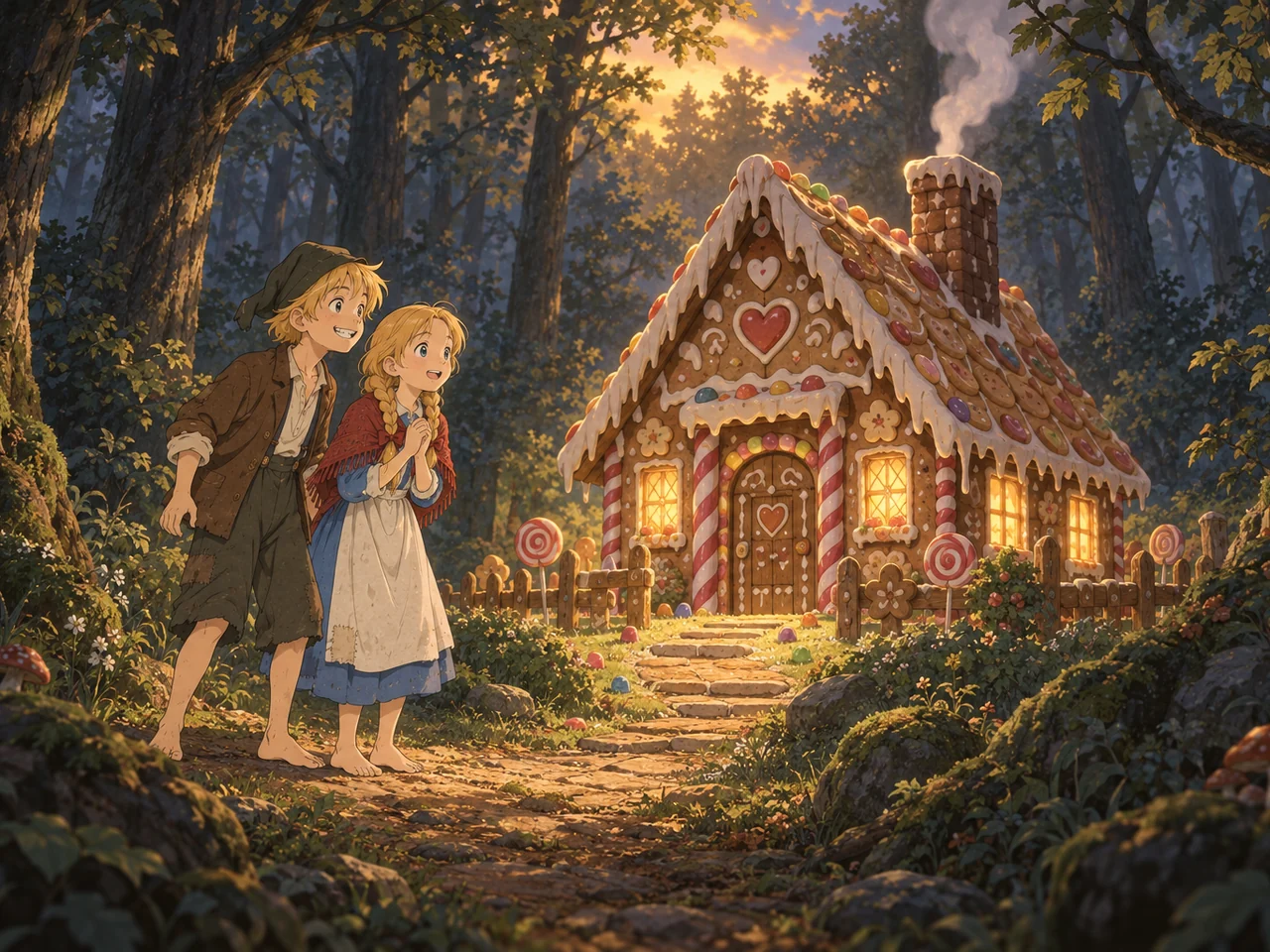
Retold from the Brothers Grimm: in a year of hunger, Hansel and Gretel are lost in the forest and find a little house made of bread and sugar. The old woman inside wants to eat Hansel, and only Gretel can outwit her.
Meet the voices
- Narrator · 旁白 — Tells the Grimms' old tale plainly and warmly, like a grandfather by the fire.
- Gretel · 格莱特 — Hansel's little sister, soft-spoken and quick to cry, who notices everything and turns out to be the bravest of them all.
- Hansel · 汉赛尔 — Gretel's big brother, cheeky and always hungry, who always has a plan until the witch locks him up.
- Stepmother · 后妈 — The children's stepmother, sharp and cold, who would rather lose two children than share the last of the bread.
- Father · 爸爸 — A poor woodcutter who loves his children but is too weak to stand up to his wife.
- The Witch · 巫婆 — A very old woman with red eyes and a sharp nose, who built a house of bread and sugar to catch hungry children.
4 chapters, one journey
Chapter 1: The White Pebbles
白石头
In a year with no bread, Hansel and Gretel hear their stepmother's plan to leave them in the forest. But Hansel has a plan too, and it starts with a pocketful of white pebbles.
Free to read
Chapter 2: The House of Sweets
甜甜的房子
The stepmother has a new plan, and this time the door won't open. Lost for three days, Hansel and Gretel follow a snow-white bird to a very strange little house.
SayMei Stories
Chapter 3: The Witch's Cage
巫婆的笼子
A kind old granny takes the starving children in, with warm milk, sweet pancakes and two little white beds. But Gretel notices something strange about her eyes.
SayMei Stories
Chapter 4: Gretel's Clever Plan
格莱特的办法
The oven is hot, and the witch wants Gretel to climb inside and check it. Now it's the little sister's turn to have a plan.
SayMei Stories
Key words in Hansel and Gretel: The Candy House
Behind the story
Hansel and Gretel comes from the Brothers Grimm, who printed it in 1812 in the first volume of their Children's and Household Tales and kept reworking it in later editions. This retelling keeps the Grimms' famous moments: the white pebbles, the breadcrumbs the birds eat, the little house in the woods, the witch's oven, and the white duck that carries the children across the water.
In Chinese the story is widely known as 糖果屋, “The Candy House,” after its most famous scene. The children's names are spelled several ways in Chinese; this book uses 汉赛尔 and 格莱特. Like Snow White, it belongs to 格林童话, the Grimms' tales, which are among the most familiar foreign stories on Chinese children's bookshelves.
Did you know?
- In the Grimms' own words, the little house is built of bread and roofed with cake, and its windows are made of clear sugar. The gingerbread and candy came later, in retellings.
- In the Grimms' first edition, the woman who wants to leave the children in the forest is their own mother. Later editions made her a stepmother, 后妈 (hòumā) in everyday Chinese.
- Engelbert Humperdinck turned the tale into an opera, first staged in Weimar in 1893 with Richard Strauss conducting. In German-speaking countries it is still a favorite at Christmas time.