Chinese alphabet: why there isn't one, and what to learn instead
Chinese has no alphabet; it writes characters. Learners use pinyin instead. See every letter A to Z, Mandarin's 400 syllables, tone marks, zhuyin and typing.

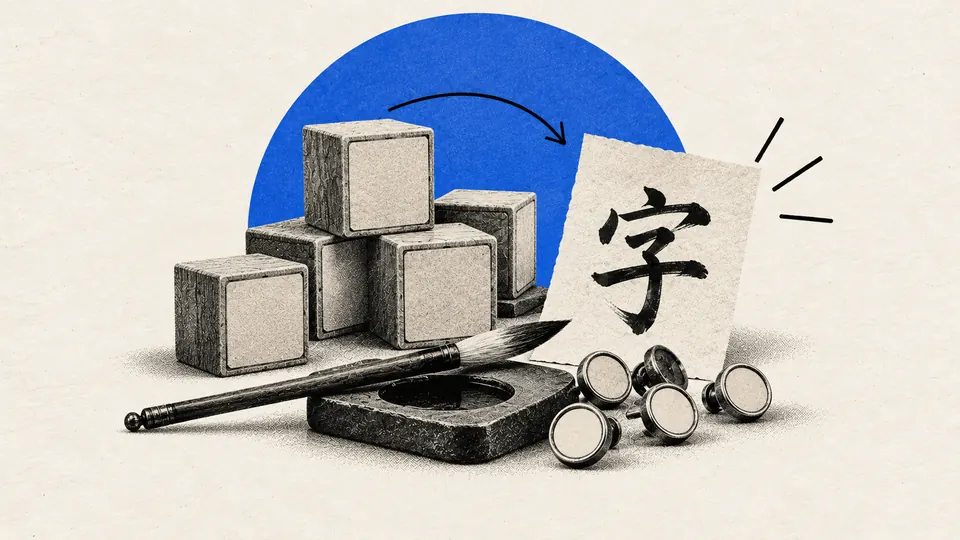
Search for the Chinese alphabet and you'll find neat A to Z charts of Chinese characters. They're made up. Chinese doesn't have an alphabet at all.
This guide is for you if you're starting Chinese, or just curious. You'll see what the letters are, how they map to English, and what to learn first.
Key takeaways
- Chinese writes characters, not letters. Each character is a syllable with a meaning, so there's nothing to spell.
- Pinyin is the alphabet you'll actually use. China adopted it in 1958 to write Mandarin's sounds in Latin letters.
- Most pinyin letters read like English, but seven don't. The letters c, e, i, q, u, x and z will trip you up first.
- Mandarin has only about 400 syllables. Tones turn them into about 1,300, and a few dozen do half the talking.
- Pinyin can't replace characters. Dozens of characters on the HSK lists can share one syllable, so the text would be ambiguous.
- The A to Z "Chinese alphabet" charts are made up. Their characters were picked for their looks or their sound, not their meaning.
Does Chinese have an alphabet?
No. An alphabet writes sounds with letters, and readers build words from them. Chinese writes with characters, and each character stands for one syllable that already carries a meaning.
Take good, 好. You can't split it into an h, an a and an o. The whole character is the syllable, and the meaning comes with it. That's the core of the system: one character, one syllable, one unit of meaning.
There's no fixed set of characters to learn either. Unicode lists more than 100,000. In our guide to how many characters you need, we counted how far real reading takes you: about 2,500 cover almost all of the news.
So when people ask about the Chinese alphabet, they usually mean one of three things:
- Characters, the real writing system, 汉字.
- Pinyin, the Latin-letter spelling learners use, 拼音.
- Zhuyin, also called bopomofo, the sound symbols Taiwan's schools teach, 注音符号.
Most learners start with pinyin, and so does this guide. It's the closest thing Chinese has to an alphabet, and you'll lean on it for months.
Pinyin is the alphabet you'll actually use
Pinyin is a way to spell Mandarin's sounds with Latin letters. China's legislature approved the Scheme for the Chinese Phonetic Alphabet in February 1958. In 1982, the international standards body adopted it as the world standard for romanising Chinese, ISO 7098.
Pinyin doesn't replace characters. It sits beside them. You'll meet it in textbooks, dictionaries, children's books and learning apps, and you'll type with it.
Every pinyin syllable has the same three parts:
- An initial, the consonant at the start. The scheme lists 21, from b to s.
- A final, the rest of the syllable: a vowel, or a vowel ending in n or ng. The scheme's table has 35.
- A tone, marked over the main vowel.
So hǎo is the initial h, the final ao and the third tone. Some syllables have no initial at all, like love, 爱.
That small kit is the whole system. Our pinyin chart lays out every possible combination in one grid, with audio for each.
How many letters are in the Chinese alphabet?
If you mean pinyin, the official answer is 26. The 1958 scheme opens with a full Latin alphabet, A to Z, just like English. Then it adds a note: v is only for spelling foreign words, minority languages and dialects.
In practice, Chinese words use 25 of those letters. We converted 33.5 million words of Chinese film and TV subtitles into pinyin and counted every letter. The letter v never appeared, because no standard Mandarin syllable is spelled with it.
Pinyin adds one letter English doesn't have: ü, a u with two dots. Even that one is rare on the page. The dots are written only after n and l, as in woman, 女, and green, 绿. After j, q, x and y, the same sound is written as a plain u.
The scheme even gives each letter a Chinese name, spelled in zhuyin. They aren't the English names. B is "bê", Q is "qiu", R is "ar" and W is "wa".
So the honest count is 25 English letters plus ü. If you came here asking how many characters are in Chinese, that's a different number, and it's in the tens of thousands.
Pinyin from A to Z, letter by letter
Most pinyin letters do what English readers expect. The ones that don't are the reason beginners mispronounce words they've read correctly.
We graded every letter by one test: if an English speaker reads it the English way, how close do they get? Here's the whole alphabet:
Letter · Verdict · In pinyin
a
Close
"ah", as in father: eight, 八. In ian and yan it's nearer the e of yes: sky, 天.
b
Like English
b, as in boy: not, 不.
c
Reads wrong
ts, as in cats: dish, 菜. Never a k or an s.
d
Like English
d, as in day: big, 大.
e
Reads wrong
On its own, an "uh": to drink, 喝. In ie and üe, it's the e of yes; in ei, the a of day.
f
Like English
f, as in fan: to fly, 飞.
g
Like English
Always hard, as in go: older brother, 哥. Also the last letter of every ng ending.
h
Close
A rougher h, from further back: good, 好. Also the second letter of zh, ch and sh.
i
Reads wrong
"ee" in you, 你. After z, c, s, zh, ch, sh or r, it's a buzz, not "ee": to be, 是.
j
Close
Near the j of jeep, with the tongue tip down: home, 家.
k
Like English
k, as in kite: to look, 看.
l
Like English
l, as in let: to come, 来.
m
Like English
m, as in mum: mum, 妈.
n
Like English
n, as in no: to take, 拿. It also ends syllables, alone or in ng.
o
Close
"aw", as in bo and wo: I, 我. In ao it's "ow", and in ou it's "oh".
p
Like English
p, with a puff of air: to run, 跑.
q
Reads wrong
Near the ch of cheese, tongue tip down: seven, 七. Never "kw".
r
Close
Between the r of run and the s of pleasure: person, 人.
s
Like English
s, as in see: three, 三.
t
Like English
t, with a puff of air: he, 他.
u
Reads wrong
"oo", as in food: road, 路. After j, q, x or y, it's really ü: to go, 去.
v
Not used
Only for foreign words and dialects. On a keyboard, you type it for ü.
w
Like English
w, as in we: five, 五. It starts syllables that begin with u.
x
Reads wrong
Near the sh of she, tongue tip down: west, 西. Never "ks" or "z".
y
Like English
y, as in yes: one, 一. It starts syllables that begin with i or ü.
z
Reads wrong
ds, as in kids: at, 在.
ü
Not in English
"ee" with rounded lips: woman, 女. Written with dots only after n and l.
zh, ch, sh
Reads wrong
j, ch and sh with the tongue tip curled up: middle, 中; to eat, 吃; ten, 十.
Sources: spellings and letter use from the 1958 scheme; sound values from Lee and Zee, 2003. The verdicts are our grouping, and English comparisons are approximate.
Thirteen letters read just like English, and five more get you close. The seven that read wrong, plus ü and the zh group, are where to spend your first week.
This table tells you what each letter stands for. For how to actually make the hard sounds, with tongue diagrams and sound pairs, our pronunciation guide goes letter by letter.
Pinyin uses the letters very differently
The letters are the same as English, but the mix isn't. Pinyin leans hard on a handful of letters and almost ignores some of English's favourites.
We counted every letter in the pinyin of 46.7 million syllables of subtitles. Then we set them beside the letters of English books, from Peter Norvig's count of Google Books. Here's how often each letter turns up:
Sources: our count over SUBTLEX-CH, spelled the official way; English from Norvig's letter counts. How we counted.
The shape of Mandarin explains the gaps. Syllables end only in a vowel, n or ng, so n and g pile up. The pairs zh, ch and sh push h up. Meanwhile t, the second most common letter in English, is about seven times rarer in pinyin.
The rare English letters flip, too. You'll write z about 35 times as often in pinyin as in English, and x and j are everywhere. So don't let them slow you down: in pinyin, they're everyday letters.
Mandarin has about 400 syllables
English syllables come in endless shapes, like strengths. Mandarin uses about 400. That's the single biggest reason a pinyin chart fits on one page.
We checked every one-character entry in CC-CEDICT, the open Chinese–English dictionary. All 403 syllables in our pinyin chart turn up in it. So do 14 rare extras, mostly interjections like hm, sound words and dialect words.
Tones multiply that set. Here's how the count grows:
Source: our count of CC-CEDICT, release of 29 November 2025. Standard syllables: the 403 in SayMei's pinyin chart. How we counted.
Notice the gap at the bottom. About a fifth of the possible syllable-and-tone pairs never occur, so you won't need to learn them.
That's good news for your ear. A set of about 1,300 sounds is small enough to learn completely, and the chart is the place to do it.
A few dozen syllables do half the talking
Not all 400 syllables pull equal weight. A small core turns up constantly, because the most common words are short and say the same few sounds.
Counting tones, the top five in our subtitles were wǒ, I; de, mostly the possessive; shì, mostly the verb to be; nǐ, you; and le, a grammar particle. Here's how many syllables it takes to cover what people say on screen:
Source: our count over SUBTLEX-CH, with pinyin by word. How we counted.
So the last hundred syllables are rare, and the first hundred are everywhere. Get those common ones sounding right, and most of what you say will too.
This is also why a first lesson in speaking can come early. You don't need the whole chart before you talk; you need the syllables in nǐ hǎo and xièxie, and the rest can follow.
Tone marks are part of the spelling
A pinyin syllable without its tone mark is only half spelled. Mandarin has four tones plus a light, neutral one, and each can change the word.
The 1958 scheme gives each tone a mark, placed over the main vowel. The neutral tone gets no mark at all. Here's the scheme's own example:
- First tone, high and level: mum, 妈.
- Second tone, rising: hemp, 麻.
- Third tone, low: horse, 马.
- Fourth tone, falling: to scold, 骂.
- Neutral tone, light and short, no mark: the question word, 吗.
Two smaller marks matter, too. The apostrophe splits syllables that could run together, like the city of Xi'an, 西安 Xī'ān. The dots on ü stay only where the u alone would be ambiguous.
You'll also see tones written as numbers: ma1, ma2. China's keyboard standard, GF 3006-2001, uses 1 to 4 for the tones and 5 for the neutral tone. Dictionaries and flashcard apps often do the same.
Hearing and saying tones is its own skill, and it takes practice. Our guide on how to learn Chinese tones covers that part.
Why Chinese isn't written in pinyin
If pinyin can spell every syllable, why keep the characters? Because one syllable can mean dozens of different things, and on paper the characters tell them apart.
We took the 3,088 characters on the new HSK reading lists and grouped them by syllable. On average, about eight share each syllable when you ignore tones. Even with the tone, it's nearly three. Here are the most crowded:
Sources: our count of the reading lists in the new HSK syllabus, with main readings checked against CC-CEDICT. How we counted.
Look at jī alone. It can be machine, 机; chicken, 鸡; or a small table, 几. In speech, context and longer words sort them out. On paper, the characters do it at a glance.
So pinyin is a tool for learning and typing, not a replacement. You'll lean on it at the start, then use it less and less as characters take over. Our guide on how to read Chinese maps that switch.
Taiwan teaches zhuyin, not pinyin
Learners in Taiwan meet a different system first: zhuyin, often called bopomofo after its first four symbols. It was created in 1913 and released in 1918, decades before pinyin.
Zhuyin does the same job as pinyin with its own symbols, drawn from parts of old characters. Taiwan's Ministry of Education calls it a requirement in elementary school, and it's printed beside characters in children's books.
Here's how the two compare:
| Pinyin | Zhuyin | |
|---|---|---|
| Symbols | Latin letters, plus ü | 37 of its own |
| Where you'll see it | Mainland China, most courses | Taiwan's schools and books |
| Example: good, 好 | hǎo | ㄏㄠˇ |
| First tone | Marked: mā | Left unmarked |
| Neutral tone | Left unmarked | A dot |
| Typing | Letter keys | Its own keyboard layout |
Sources: the 1958 pinyin scheme; Taiwan's Manual of the Phonetic Symbols of Mandarin Chinese; the Unicode Bopomofo chart.
Of the 37 symbols, 21 match pinyin's 21 initials one for one, and 16 cover the vowels and endings. One plus: nobody reads zhuyin with English habits, because none of it looks like English.
Should you learn it? Only if you'll study in Taiwan, read Taiwanese children's books, or take a Taiwan-based course. Taiwan also writes Traditional characters, which our guide to Simplified and Traditional Chinese explains. For the accent itself, see the Taiwan section of our guide to Chinese dialects and accents.
Characters are built from strokes and parts
Characters may look like pictures, but they're built from a small kit of parts. That's what you learn instead of an alphabet.
Each character is written with strokes, the lines you draw in a set order. Strokes form parts, and the same parts turn up again and again. Many characters pair a part for meaning with a part for sound.
Mum, 妈, is a good example. On the left sits woman, 女, for the meaning. On the right sits horse, 马, there only for its sound. In our radicals guide, we found about half the characters on the HSK 1 to 4 lists are built this way.
The sound part is a hint, not a spelling, though. It gave the right syllable only about two times in five in our count. That's why you can't sound out a new character the way you'd sound out a new English word.
So learn characters as you'd learn faces: by their parts, inside words you already know. Our guide on how many characters you need shows how far each few hundred take you.
The A to Z "Chinese alphabet" charts are made up
Those charts that turn A to Z into Chinese characters aren't Chinese. They come in two kinds, and neither means anything to a Chinese reader.
The first kind picks characters for their sound. One chart that East Asia Student picked apart spelled the name Hugh as seven characters, letter by letter: 艾尺伊吾吉艾尺 ài chǐ yī wú jí ài chǐ. To a Chinese reader, that's a string of unrelated syllables.
The second kind picks characters for their shape. The maker of one such app admits as much: the characters look like the letters, "not in sound". To show how that goes, we made our own small chart. We picked seven characters that look like Latin letters and checked what each really says:
| Looks like | Character | What it really says |
|---|---|---|
| A | 卂 | To fly fast, an old word |
| B | 乃 | So, then |
| D | 刀 | Knife |
| H | 卄 | Twenty |
| P | 尸 | Corpse |
| R | 尺 | Ruler |
| W | 山 | Mountain |
Our own illustration: we chose these seven characters, and they aren't copied from any published chart. Meanings and readings from CC-CEDICT; the app's own description from Chinese Alphabet by Good Characters.
Spell PAW with these and you've written corpse, fly fast, mountain. Fine for a puzzle, terrible for a tattoo.
If you want your name in Chinese, it's done by sound, syllable by syllable, the way the language borrows any foreign name. Anna becomes 安娜. A teacher or a tutor can pick characters that sound right and mean something pleasant.
Typing Chinese means typing pinyin
Nobody types Chinese with a keyboard of thousands of characters. You type the pinyin, and the computer offers the characters that match.
Here's how it works on any phone or computer:
- Add a pinyin keyboard. In your language settings, it's usually called Pinyin or Simplified Chinese Pinyin.
- Type the syllables without tones. Type nihao and a short list appears, with hello, 你好, at the top.
- Pick the right character. Press the space bar or tap it. The list and the context sort out the tones for you.
- Type v for ü. That's China's keyboard standard, so woman, 女, is nv.
- Add numbers where a tool wants tones. Country, 国家, becomes guo2jia1.
Most people in China type this way. In iiMedia Research's 2014 survey of phone input-method users, about three in four chose pinyin as their main input. The survey is old, but we found no newer public figure. In Taiwan, the ministry notes, people also type with zhuyin.
Our workbook Type Your First Chinese Messages with Pinyin walks you through your first messages. It's free with a SayMei account.
Where SayMei fits, and where it doesn't
SayMei helps most at the start, when pinyin is new and you need to hear it and say it.
- Learning the sounds: our pinyin chart has all 403 syllables with audio, laid out the way this guide describes.
- Saying them out loud: the lessons with Mei Lin, your AI teacher, are spoken conversations, so you practise pinyin out loud as well as on the page.
- Reading with support: our graded stories show pinyin over the characters, so you can lean on it and then let it go.
- Converting text: the Chinese to pinyin tool adds tone-marked pinyin to any Chinese you paste in.
Here's where SayMei won't help much. The lessons teach standard mainland Mandarin with Simplified characters and pinyin, not zhuyin or Traditional characters, so they're the wrong fit if you're heading to Taiwan's schools. They also don't teach handwriting; for that, print our character worksheets. And if you need detailed correction of how you shape each sound, a human teacher watching your mouth still does it best.
What to do next
- Learn the seven letters that read wrong. Start with c, e, i, q, u, x and z, plus ü and the zh group.
- Learn tone marks with the letters. Treat a syllable without its tone as unfinished.
- Say the common syllables out loud. The most frequent few dozen will carry most of what you say.
- Set up a pinyin keyboard. Typing makes you spell every word, which fixes pinyin in your memory.
- Start meeting characters early. Pinyin is a bridge, so cross it with characters in hand.
Start with the pinyin chart: tap the seven letters that read wrong, and say each syllable back.
FAQ
What is the Chinese alphabet called?
There isn't a true Chinese alphabet. The closest thing is pinyin, 拼音, the official spelling of Mandarin in Latin letters that China adopted in 1958. Taiwan teaches zhuyin, or bopomofo, a set of 37 sound symbols. Chinese itself is written in characters, 汉字, and each character stands for a syllable with a meaning.
How many letters are in the Chinese alphabet?
Pinyin's official alphabet lists 26 letters, the same as English. In practice, Chinese words use 25 of them, because v is reserved for foreign words and dialects; in our count of subtitles it never appeared. Pinyin also adds ü. Characters are a separate question: there are tens of thousands, and a few thousand cover most reading.
Is pinyin the same as the Chinese alphabet?
Pinyin is what most people mean by the Chinese alphabet, but it isn't how Chinese is written. It spells the sounds of Mandarin in Latin letters, so learners can read pronunciation, look up words and type. Everyday Chinese text, from menus to novels, is written in characters, with pinyin only as a guide.
How many sounds are there in Chinese?
Mandarin has about 400 different syllables, and about 1,300 once you count tones. We found 403 standard syllables among the one-character entries of the CC-CEDICT dictionary, plus a few interjections and dialect words. A small core does most of the work: in film and TV subtitles, 33 syllables make up half of everything said.
Which letter is not used in Chinese pinyin?
The letter v. The 1958 pinyin scheme lists it but keeps it for foreign words, minority languages and dialects. It does have one everyday job: on a keyboard, you type v for ü. So to type woman, 女, you type nv, and your input method shows the character.
Can I write my name in the Chinese alphabet?
Not with an alphabet chart. The A to Z charts online swap each letter for a character that looks or sounds similar, which reads as nonsense in Chinese. Real Chinese names for foreigners are made by sound, syllable by syllable: Anna becomes 安娜. Ask a teacher to choose characters that sound right and mean something good.
Do Chinese people use pinyin?
Yes, mainly to type. In iiMedia Research's 2014 survey of phone input-method users in China, about three in four chose pinyin as their main input. People also meet it in school, dictionaries and children's books. But they read and write in characters, so pinyin is a tool for spelling sounds, not a second way of writing Chinese.
Should I learn pinyin or zhuyin?
Learn pinyin unless you're studying in Taiwan. Most courses, apps, dictionaries and textbooks outside Taiwan use pinyin, and it's what you'll type with on most keyboards. Zhuyin is worth learning if you'll attend a Taiwanese school or read Taiwanese children's books. Either way, the sounds are the same.
Sources
- National People's Congress (1958). Scheme for the Chinese Phonetic Alphabet, 汉语拼音方案 Hànyǔ Pīnyīn fāng'àn, with the resolution approving it; scanned copy on the Ministry of Education of China's website. http://www.moe.gov.cn/ewebeditor/uploadfile/2015/03/02/20150302165814246.pdf
- National Language Commission of China (2001). GF 3006-2001, keyboard representation of the pinyin scheme. https://zh.wikisource.org/wiki/GF_3006-2001_%E6%B1%89%E8%AF%AD%E6%8B%BC%E9%9F%B3%E6%96%B9%E6%A1%88%E7%9A%84%E9%80%9A%E7%94%A8%E9%94%AE%E7%9B%98%E8%A1%A8%E7%A4%BA%E8%A7%84%E8%8C%83
- Ministry of Education, Taiwan (2017). Manual of the Phonetic Symbols of Mandarin Chinese. https://language.moe.gov.tw/001/Upload/files/site_content/M0001/juyin/index.html
- Unicode Consortium. Bopomofo code chart, U+3100 to U+312F. https://www.unicode.org/charts/PDF/U3100.pdf
- MDBG. CC-CEDICT, release of 29 November 2025 (CC BY-SA 4.0). https://www.mdbg.net/chinese/dictionary?page=cc-cedict
- Cai, Q., & Brysbaert, M. (2010). SUBTLEX-CH: Chinese word and character frequencies based on film subtitles. PLoS ONE, 5(6), e10729. https://doi.org/10.1371/journal.pone.0010729
- Norvig, P. English letter frequency counts: Mayzner revisited. http://norvig.com/mayzner.html
- Center for Language Education and Cooperation (2025). New HSK syllabus. https://hsk.cn-bj.ufileos.com/3.0/%E6%96%B0%E7%89%88HSK%E8%80%83%E8%AF%95%E5%A4%A7%E7%BA%B21219.pdf
- Lee, W.-S., & Zee, E. (2003). Standard Chinese (Beijing). Journal of the International Phonetic Association, 33(1), 109–112. https://doi.org/10.1017/S0025100303001208
- iiMedia Research (2014). China mobile input method market report, first half of 2014. https://www.iimedia.cn/c400/37802.html
- East Asia Student (2012). Chinese alphabet nonsense. https://eastasiastudent.net/china/chinese-alphabet-nonsense/
- Good Characters, Inc. Chinese Alphabet, app description. https://iphoneaddict.fr/apps/references/chinese-alphabet-80.html
Methods
We counted three things: Mandarin's syllables, the letters pinyin uses, and how many HSK characters share each syllable.
- Syllables in the dictionary: every reading of every one-character entry in the CC-CEDICT release of 29 November 2025, with ü restored from the dictionary's u:. A syllable counts as standard when it's one of the 403 in SayMei's pinyin chart. Every one of the 403 turned up; the 14 extras were interjections, such as hm and hng, sound words, and colloquial or dialect syllables, such as den and kei. We skipped the dictionary's xx placeholder for characters with no Mandarin reading and its r for the erhua ending, which isn't a syllable on its own.
- Syllables people say: the 33.5 million words of the SUBTLEX-CH film and TV subtitle corpus, turned into pinyin word by word with the pinyin-pro library. For one-character words with more than one reading, such as 了 or liǎo, the corpus's part-of-speech counts chose the reading. A word like here, 这儿, counts as one syllable with an r. That gave 46.7 million syllables, the same conversion our pronunciation guide uses.
- Letters: every letter of those syllables, spelled the official way, so to go, 去, is qu and woman, 女, is nü. Tone marks are ignored. English shares come from Peter Norvig's count of 3.56 trillion letters in Google Books.
- HSK characters: the 3,088 characters to recognise in the new HSK syllabus, each under its main reading from the pypinyin library. A character with two readings counts once.
- The letter verdicts: our grouping. A letter is "like English" when an English reader's sound is close enough to be understood, "close" when it needs a small change, and "reads wrong" when the English reading gives a different sound.
Limits: subtitles are scripted speech, so news or novels would shift the letter shares a little. Main readings simplify characters with several readings. The 2014 input survey is old and covers phone users only.
Every other figure on this page comes from the sources above, checked on 27 October 2026. Every Mandarin example was checked against the CC-CEDICT dictionary.
If you spot a mistake, tell us.