Chinese radicals: the few dozen that unlock most characters
There are 214 Chinese radicals, but 22 file half the characters on the HSK 1–4 lists. Which to learn first, what they mean and how they combine, measured.

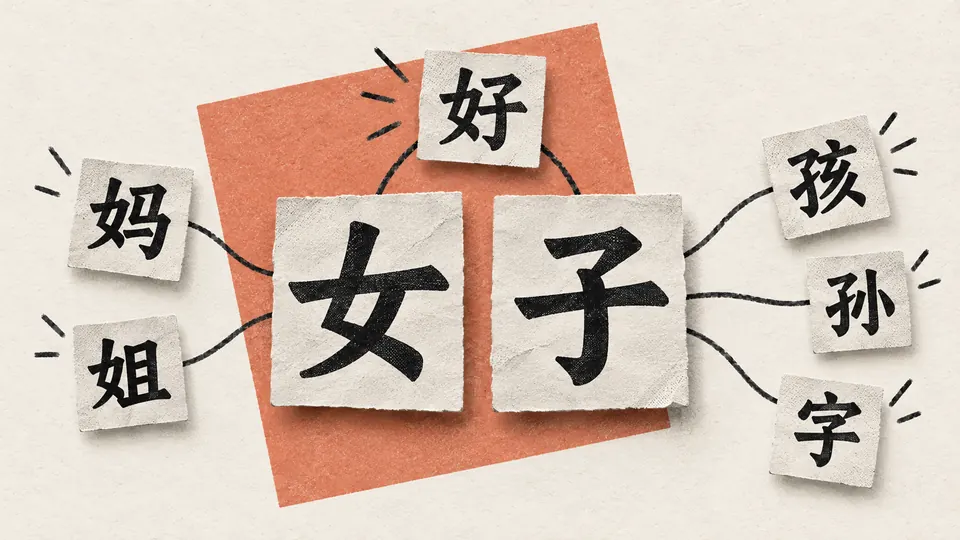
Chinese characters have been sorted under 214 radicals for over 300 years. You won't need most of them: a few dozen do nearly all the work in the characters you'll actually meet.
This guide is for you if you're learning to read Chinese and want to know which radicals are worth your time, what they really tell you, and how to use them.
Key takeaways
- You need a few dozen radicals, not 214. About 40 of them file two thirds of the characters on the HSK 1–4 lists.
- Some radicals are much better clues than others. The hand radical usually means an action; the grass radical often has nothing to do with plants.
- Radicals with related meanings form families. Water, fire and ice group together, and so do walk, foot and run.
- Sound parts help, but only some of the time. The sound part gives you the right syllable in about 2 characters out of 5.
- The radical usually sits on the left. When a character splits into a left and a right part, the radical is the left part about four times in five.
- Learn radicals inside characters, not from a list. Ten characters that share a radical teach you more than a chart of all 214.
Radicals are the parts a dictionary files characters under
A radical, 部首, is the part of a character a dictionary files it under. Every character has exactly one. Mum, 妈, is filed under woman, 女. Clear, 清, is filed under water.
Most radicals are also a hint at meaning. A mum is a woman, and clear water is still water. But a radical's first job is filing, so it isn't always a clue, and we measured how often it is.
The classic list has 214 radicals. It became standard with the Kangxi Dictionary of 1716, and Unicode still numbers radicals that way. China's official table of radicals, revised in 2022, keeps 201 main radicals.
Many radicals change shape when they squeeze into the side of a character. Here are the side forms you'll see most:
| Side form | Full form | Meaning | Example |
|---|---|---|---|
| 氵 | 水 | water | river, 河 |
| 扌 | 手 | hand | hit, 打 |
| 亻 | 人 | person | you, 你 |
| 忄 | 心 | heart | busy, 忙 |
| 讠 | 言 | speech | say, 说 |
| 纟 | 糸 | silk | red, 红 |
| 饣 | 食 | food | cooked rice, 饭 |
Seven side forms that file more than one in five of the HSK 1–4 characters. Source: radical forms and readings from Unicode's Unihan database; our count.
Speech, silk and food have a second, simplified side form, so 说 and its Traditional form 說 are filed under the same radical. I'd learn these side forms first: they're the shapes you'll see on every page.
You need a few dozen radicals, not 214
We looked up the radical of every character on the HSK 3.0 reading lists, using the radical numbers in Unicode's database. Only 177 of the 214 radicals turn up at HSK 1–4 at all.
We found them used very unevenly. Mouth, 口, files 55 characters by HSK 4, more than any other radical. Dozens of others file just one.
The biggest radicals are the ones you'd expect: mouth, person, hand, tree, water, heart and speech. Walk, silk and earth complete the top ten.
Here's how quickly the radicals add up if you learn them in order of how many characters they file:
A few dozen radicals file most of the characters you'll meet
Radicals ranked by how many HSK 1–4 characters they file. The top 22 file half of the 1,096 characters, and the top 41 file two thirds. In SayMei's graded stories, the same radicals cover a similar share of the text.
Cumulative share, learning radicals in order of how many HSK 1–4 characters they file (all 177 that appear)
- HSK 1–4 characters
- Text of SayMei's stories
| Top radicals | HSK 1–4 characters | Stories text |
|---|---|---|
| 5 | 21.1% | 20.5% |
| 10 | 33.5% | 30.9% |
| 20 | 48.4% | 48.5% |
| 30 | 58.1% | 54.3% |
| 40 | 66.4% | 61.0% |
| 50 | 72.9% | 66.2% |
| 100 | 90.4% | 93.1% |
| 177 | 100.0% | 99.7% |
Radicals from Unicode's Unihan database 18.0; characters from the HSK 3.0 reading lists (2025 syllabus); stories text: every character in SayMei's 166 graded books, 344,086 in all, counted each time it appears. A character counts as covered when you know its radical, not the character itself. Our count, 8 October 2026.
The curve climbs fast, then flattens. After about the first 50 radicals, each new one files only a handful of characters, so it isn't worth learning on its own.
Our graded stories tell the same story. In SayMei's 166 books, the top 25 radicals cover half of everything a reader sees on the page.
One caveat: knowing a character's radical isn't knowing the character. The radical narrows down the meaning, and you still learn each character. So I wouldn't learn the full list. Learn the top 40 well, and pick up the rest as you meet them.
Explore the radicals at your level
Pick your HSK level and tap a radical to see every character it files, with pinyin, a short meaning and a recording:
Radical explorer: what each radical builds at your level
Pick your HSK level and tap a radical to see every character it files, with pinyin and a recording. Water, 氵, files 39 characters by HSK 4.
Your HSK level
Radicals at HSK 1–4, by how many characters they file
water full form 水
- 水waterHSK 1
- 汉Han, ChineseHSK 1
- 没not haveHSK 1
- 漂part of 'pretty' · also piāoHSK 1
- 泳swimHSK 2
- 洗washHSK 2
- 游swim; tourHSK 2
- 求seek, ask forHSK 3
- 汽steamHSK 3
- 沙sandHSK 3
- 河riverHSK 3
- 法law; methodHSK 3
Radicals are the dictionary radicals in Unicode's Unihan database (version 18.0), counted over the HSK 3.0 reading lists (2025 syllabus); simplified forms such as 讠 count with their full form. Pinyin: Unihan, checked against the official word list and CC-CEDICT. Glosses are ours. "Meaning clue" compares how close in meaning a radical's characters are with random groups of characters (method under Methods). Recordings: SayMei's pinyin chart. These are the 214 Kangxi radicals that Unicode uses; mainland China's official 201-radical table numbers them differently and files some characters under other radicals (water is No. 85 here and No. 77 there).
Try water at HSK 1, then at HSK 4. You'll watch it grow from a few characters into a whole family: wash, 洗; sea, 海; swim, 游.
Then tap grass, 艹, and read its meanings. You'll see why we rate it a weak clue. If you meet a character and wonder where it's filed, type it into the box.
One note if you check another dictionary: we use the 214 Kangxi radicals, as Unicode and many dictionaries do. Mainland China's official table has 201 radicals, with its own numbering and its own rules for filing characters.
So some details won't match. Water is radical 85 here, but 77 in China's table. And China's table counts say, 曰, as a form of sun, 日, not as a radical of its own.
Some radicals are much better clues than others
Most radicals hint at meaning, but some hints are far better than others. We measured how closely the meanings of each radical's characters hang together, compared with random groups of characters.
The hand radical, 扌, came out as the most reliable clue we found. Nearly everything it files is something you do with your hands: hit, 打; push, 推; pull, 拉; wipe, 擦.
Grass, 艹, is one of the weakest. It should mean plants, and some of its characters do: tea, 茶, and flower, 花. But it also files blue, 蓝; fall, 落; and festival, 节.
Tree, 木, scored lower than we expected, too. It files tree, 树, but also cup, 杯, and machine, 机.
Meaning radicals also travel together in words. Many two-character words pair two characters with the same radical, because their meanings belong together:
- Swim, 游泳: both characters carry water.
- Take a bath, 洗澡: water again.
- Talk, 说话: both carry speech.
- Forest, 森林: both carry tree.
- Sisters, 姐妹: both carry woman.
On the HSK 1–6 word lists, about one two-character word in 20 pairs characters with the same radical. That's three times what chance would give.
We also measured which radicals mean similar things to each other. Here are the families that came out of the data:
Radicals with related meanings form small families
We compared the dictionary definitions of the characters under each of the 39 radicals that carry a clear meaning. Lines join radicals whose characters mean similar things; thicker lines, closer meanings. Coral circles mark the strongest meaning clues.
No close match: speech, 讠; flesh, 月; head, 页; vehicle, 车; enclosure, 囗; yawn, 欠; horse, 马.
Definitions from Unicode's Unihan database 18.0, turned into vectors with OpenAI's text-embedding-3-small model. Each radical's profile is the average of its HSK 1–6 characters. A line joins two radicals when each is among the other's two closest profiles, at a cosine similarity of 0.2 or more. Radicals included: at least 8 HSK 1–6 characters and a meaning focus clearly above chance (method under Methods).
These families are a ready-made study plan. Learn water, fire and ice together, and walk, foot and run together, and each one reminds you of the others.
Sound parts hint at the pronunciation, sometimes
About half the characters on the HSK 1–4 lists are built from two parts: a radical for meaning and a sound part for pronunciation. Mum, 妈, is woman plus horse, 马. The horse is there only for its sound.
The same sound part turns up in many characters, each with a different radical. Here are six of them, with the characters built on them:
One sound part, many characters
Six sound parts and the HSK 1–6 characters built on them. Each branch names the meaning part that makes the character. Pinyin in coral shares the sound part's syllable; grey pinyin doesn't.
马 5 of 5 share its syllable
巴 3 of 5 share its syllable
方 5 of 6 share its syllable
青 4 of 6 share its syllable
令 4 of 6 share its syllable
艮 2 of 6 share its syllable
Sound parts as labelled in Make Me a Hanzi; pinyin from Unicode's Unihan database, checked against CC-CEDICT. Up to six characters per family, from the HSK 3.0 lists (2025 syllabus).
Some families are faithful. Every character built on horse is still read ma, and only the tone changes. Others drift: 艮 gives you very, 很, and eye, 眼, which sound nothing alike.
We checked every sound-and-meaning character on the HSK 1–4 lists. Here's how often the sound part gives you the reading:
Source: our count. Sound parts as labelled in Make Me a Hanzi; readings from Unicode's Unihan database. "Rhymes" means the same final with a different first sound, like qīng and jīng.
That's close to what researchers find for common characters, about 35% regular. And the hint improves as you go on: a study of school Chinese found that the characters children learn first are less regular than the ones they learn later.
My advice: treat the sound part as a guess to check, never as the answer. It's most useful once you know a family, because then a new member is easy to place.
The radicals that combine most are worth learning first
Some radicals pair with far more sound parts than others, and those are the ones that keep paying off as your reading grows. Here are the ten that combine with the most different sound parts across the HSK 1–6 lists:
Source: our count over the HSK 3.0 reading lists (2025 syllabus), with sound parts as labelled in Make Me a Hanzi. At the side of a character, flesh looks like moon.
The list barely changes between beginner and advanced levels. Mouth, person, hand, tree, water, heart and speech file more than a quarter of the HSK 1–4 characters between them, so that's where I'd start.
Watch out for one trap on that list. At the side of a character, flesh, 肉, shrinks to a shape that looks exactly like moon, 月. In body words like face, 脸, and leg, 腿, that shape means flesh, not moon.
Look for the radical on the left
When you look a character up, start with its left side. Half of the HSK 1–4 characters split into a left and a right part, and in our count the radical is the left part about four times in five.
Characters that split into a top and a bottom are less predictable. The radical sits on top about as often as underneath. Grass, 艹, always sits on top, while heart in its full form, 心, sits underneath, as in think, 想.
You'll rarely use a paper radical index today, since phone dictionaries let you draw a character instead. But the radical still tells you where a character starts, and which family it belongs to.
Use radicals to remember new characters
Radicals turn a character from a picture into a short story, and stories are easier to remember. Here's the routine I'd use for every new character:
- Name its parts. Please, 请, is speech, 讠, plus green, 青.
- Give each part its job. Speech carries the meaning, because asking politely is speech. Green carries the sound.
- Link it to a family. Clear, 清; feeling, 情; and sunny, 晴, share the same sound part.
- Review it on a schedule. Flashcards with spaced repetition bring it back just before you'd forget it.
- Meet it in real text. Reading is where the character finally sticks.
One caveat: some radicals are only filing labels. One, 一, files east, 东, though east has nothing to do with "one". When there's no story, don't force one.
Read with pinyin on every character. SayMei's graded stories have pinyin, audio and an English line for every sentence, and chapter 1 of every book is free. Open the stories
What to do next
- Learn the seven big radicals first. Mouth, person, hand, tree, water, heart and speech, in their side forms.
- Use the explorer at your level. Tap each big radical and read through the characters it files.
- Study in families. Water, fire and ice belong together in your head, just as they do in the data.
- Check sound parts, don't trust them. Guess the reading from the sound part, then confirm it.
- Read every day. Radicals stick when you meet them inside real characters, again and again.
To see how many characters each goal takes, read our guide to how many Chinese characters you need.
FAQ
How many Chinese radicals are there?
The traditional list has 214 radicals, from the Kangxi Dictionary of 1716, and Unicode still numbers radicals that way. China's official table of radicals for simplified characters keeps 201 main radicals, plus extra forms such as the side forms. You'll see both numbers; this guide uses the 214, as Unicode does.
What are the most common Chinese radicals?
On the HSK 1–4 lists, the radicals that file the most characters are mouth, 口; person, 亻; hand, 扌; tree, 木; water, 氵; heart, 忄; and speech, 讠. Those seven file more than a quarter of the 1,096 characters. The explorer above ranks every radical at your level.
Do I need to learn all 214 radicals?
No. Only 177 radicals appear in HSK 1–4 characters at all, and about 40 of them file two thirds of those characters. The rest file a handful each, so you'll learn them faster by meeting them in real characters than by drilling a list.
What's the difference between a radical and a component?
A component is any part a character is built from. The radical is the one component a dictionary files the character under, usually the part that hints at its meaning. In please, 请, both speech and green are components, but only speech is the radical.
Do radicals tell you how to pronounce a character?
Not usually. The radical carries meaning; in about half of HSK 1–4 characters, a separate sound part hints at the reading. In our count of HSK 1–4 characters, the sound part gives you the right syllable about 2 times in 5, and the exact reading, tone included, about 1 time in 5.
How do you look up a character by its radical?
Find the radical, usually the left or top part, and count its strokes. Look it up in the dictionary's radical index, then count the strokes in the rest of the character to find the page. On a phone, it's quicker to draw the character with your finger.
Which radical has the most characters?
At HSK 1–4, mouth, 口, files the most characters: 55 of the 1,096. Across the HSK 1–6 lists, hand, 扌, takes the lead with 112 characters. Mouth files particles like the question word 吗, and verbs for things you do with your mouth, like eat, 吃.
Are radicals the same in simplified and traditional Chinese?
Mostly, yes. Both scripts use the same radicals, but some radicals have a simplified form: speech, 讠, in simplified, and 言 in traditional, and metal, 钅, and 金. Our guide to Simplified and Traditional Chinese explains the two scripts.
Sources
- Unicode Consortium. Unicode 18.0.0: the Unihan database and CJKRadicals.txt, 16 September 2026 (Unicode License v3). https://www.unicode.org/versions/Unicode18.0.0/ · Unihan documentation, UAX #38: https://www.unicode.org/reports/tr38/
- Center for Language Education and Cooperation (2025). New HSK syllabus. https://hsk.cn-bj.ufileos.com/3.0/%E6%96%B0%E7%89%88HSK%E8%80%83%E8%AF%95%E5%A4%A7%E7%BA%B21219.pdf
- Ministry of Education and National Language Commission of China (2009). Table of Chinese Character Radicals, GF 0011-2009 (汉字部首表): clause 5.4 and the table. http://www.moe.gov.cn/ewebeditor/uploadfile/2015/01/13/20150113090108815.pdf
- Ministry of Education and National Language Commission of China (2022). Revised Table of Chinese Character Radicals (汉字部首表), in force from 15 December 2022. https://www.gov.cn/xinwen/2022-11/24/content_5728500.htm
- Wikipedia: Kangxi radical. https://en.wikipedia.org/wiki/Kangxi_radical
- Shu, H., Chen, X., Anderson, R. C., Wu, N., & Xuan, Y. (2003). Properties of school Chinese: Implications for learning to read. Child Development, 74(1), 27–47. https://doi.org/10.1111/1467-8624.00519
- Zhang, H., Kim, S.-A., & Zhang, X. (2022). A comparative study of three measurement methods of Chinese character recognition for L2 Chinese learners. Frontiers in Psychology, 13. https://pmc.ncbi.nlm.nih.gov/articles/PMC8990832/
- Make Me a Hanzi, dictionary.txt (LGPL 3.0 or later). https://github.com/skishore/makemeahanzi
- CHISE IDS database (GPL 2.0 or later). https://github.com/chise/ids · cjkvi-ids. https://github.com/cjkvi/cjkvi-ids
- CC-CEDICT, MDBG, release of 8 October 2026 (CC BY-SA 4.0). https://www.mdbg.net/chinese/dictionary?page=cc-cedict
- OpenAI. text-embedding-3-small. https://platform.openai.com/docs/guides/embeddings
- SayMei Stories, 166 books and 812 chapters, 8 October 2026. /stories
Methods
We counted radicals over the HSK 3.0 reading lists and SayMei's graded stories, and measured how radicals combine and what they mean.
- Characters: the 1,096 characters on the HSK 1–4 reading lists of the 2025 syllabus, and the 1,940 on the HSK 1–6 lists for the explorer and the families.
- Radicals: each character's first radical in the Unihan database's radical-and-stroke field, with simplified forms such as speech, 讠, counted together with their full form. The six stroke radicals, like one, 一, file 41 of the HSK 1–4 characters.
- Coverage: radicals ranked by how many HSK 1–4 characters they file. For the stories, every character in all 166 books, 344,086 in all, counted each time it appears.
- Parts, sound and position: the first split of each character and its sound part, as labelled in Make Me a Hanzi. On 946 HSK 1–4 characters we could compare, its first split matched the CHISE database's exactly in three cases out of four. Readings are each character's main reading in Unihan; a sound part "rhymes" when its final matches.
- Meaning clues: each character's English definition in Unihan, turned into a vector with OpenAI's text-embedding-3-small model. A radical's score compares how close its characters are to each other with 1,000 random groups of the same size, as a z-score. We rate 5 or more as strong, 2 to 5 as clear and under 2 as weak, for radicals with at least 6 HSK 1–6 characters.
- Families: each radical's profile is the average of its characters' vectors. Two radicals are linked when each is among the other's two closest, at a cosine similarity of 0.2 or more.
- Same-radical words: two-character words on the HSK 1–6 word lists, compared with how often two radicals would match by chance.
- Explorer: pinyin is Unihan's main reading, checked against the 2025 syllabus word list and CC-CEDICT; we changed nine characters where learners meet another reading first, such as long, 长. Glosses are our own. Recordings come from SayMei's pinyin chart.
Each dataset's licence decides what we publish from it:
Unicode Unihan 18.0
- Licence
- Unicode License v3
- What we use
- Radicals, readings, definitions
- What this page publishes
- Each character's radical and reading, with Unicode's notice
Make Me a Hanzi
- Licence
- LGPL 3.0 or later
- What we use
- Parts and sound parts
- What this page publishes
- Counts and shares only
CHISE IDS and cjkvi-ids
- Licence
- GPL 2.0 or later
- What we use
- A cross-check of the parts
- What this page publishes
- One agreement rate
CC-CEDICT
- Licence
- CC BY-SA 4.0
- What we use
- A check of the pinyin
- What this page publishes
- Nothing copied
Unihan data is © 1991–2026 Unicode, Inc., used under the Unicode License v3.
Limits: a radical tells you a character's family, not the character itself. Sound-part labels follow one dataset, and some are disputed by scholars. Meaning scores depend on short English definitions, so treat them as a guide.
Every figure on this page comes from the sources above, checked on 8 October 2026. Every Mandarin example was checked against the CC-CEDICT dictionary.
If you spot a mistake, tell us.