How many Chinese characters do you need? We measured it
Unicode lists 101,997 Chinese characters, but you need far fewer. We measured how much 1,000 to 3,000 characters let you read: signs, menus, news and novels.

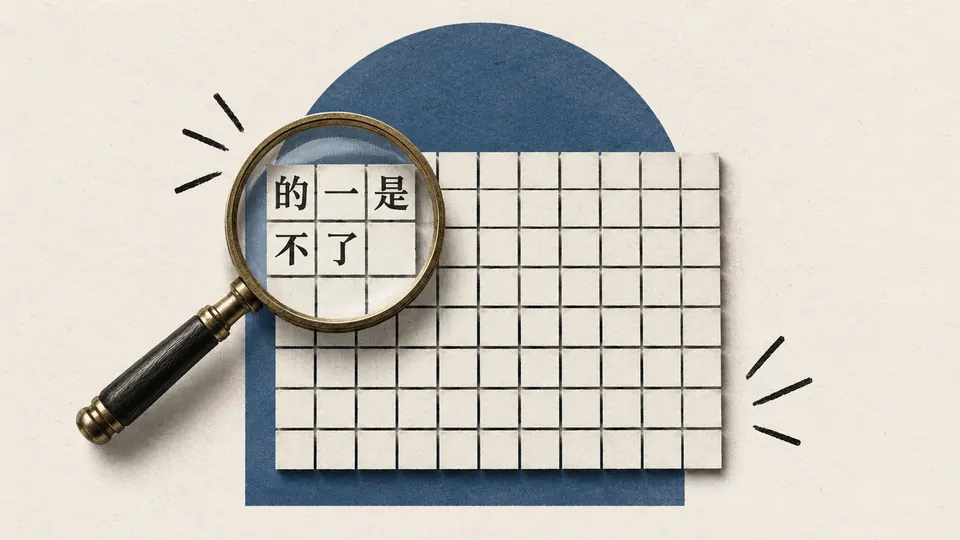
Chinese has more than 100,000 characters. You'll meet only a few thousand of them, and a few hundred do most of the work.
If you're learning Chinese and wondering how far your characters will take you, this guide gives you our counts for six kinds of text, a calculator for your own number, and a plan.
Key takeaways
- The famous total is misleading. Most of the 101,997 characters in Unicode are old, rare or variant forms that nobody reads.
- A thousand characters go a long way. They cover 94% of the characters in film and TV subtitles.
- News takes about 2,500. By then, almost every character in an article is one you know.
- Menus are a world of their own. A short list made for menus beats thousands of characters learned in the usual order.
- HSK 6 is roughly where news opens up. Its reading list covers about 95% of the characters in the news.
- Characters aren't words. You can know every character in a sentence and still miss what it says.
How many Chinese characters are there?
Unicode, the standard that puts text on every screen, now encodes 101,997 Chinese characters. We counted them in its newest release.
The big dictionaries are almost as large. The biggest printed one, the Zhonghua Zihai, lists more than 85,000.
Most of these are old forms, variant spellings of the same character, or one-off names of people and places. They're kept so old books and records can be typed, not because anyone reads them every day.
Unicode also counts Simplified and Traditional forms as separate characters. Study, 学, and its Traditional form, 學, count twice. Our guide to Simplified and Traditional Chinese explains the two scripts.
Here's how those totals compare with the characters people actually use:
Sources: our count of the Unicode 18.0 Unihan database; dictionaries via Wikipedia; Jun Da's Modern Chinese list; China's 2013 list, 2022 curriculum and literacy rule, linked below.
Even 193 million characters of modern writing use fewer than 10,000 different characters. That's the pool you're really drawing from, and you only need the top of it.
A thousand characters do most of the work
Characters are used very unevenly. A small core turns up constantly, and most of the rest almost never do.
You can see it in film and TV subtitles. The single most common character, I, 我, is about one character in every 23 that people say on screen.
Here's how much of the news, and of film and TV subtitles, the most common characters cover:
Sources: our counts over 5.1 million characters of Chinese Wikinews and the SUBTLEX-CH subtitle corpus. How we counted.
Notice how quickly the bars flatten. Past about 2,000 characters, each new one turns up so rarely that you'll learn it best by meeting it in real reading.
Percentages also hide how reading feels. Here's what each level means on the page:
- 90%: one character in 10 is new. That's study, not reading.
- 95%: one in 20. You can read with a dictionary close by.
- 98%: one in 50. You can usually guess the rest from context.
Reading research puts the comfort line for words at about 98%, as our guide to learning through stories explains. Characters aren't words, so here the lines only tell you how often you'd have to stop.
See what your number feels like
Pick how many characters you know, or your HSK level, and what you want to read. The calculator shows how much of that kind of text you'd recognise. It also masks the characters you wouldn't know yet in a real example:
How much of a menu, a sign or a novel could you read?
Pick how many characters you know, or your HSK level, and what you want to read. With 1,000 characters you'd know 85.1% of the characters in the news, but only 44.1% on a menu.
What you know
How many
What you want to read
85.1% of the characters in news
With 1,000 characters. About 1 character in 7 would be new to you.
95%: about 1,756 characters · 98%: about 2,366 characters, learned in everyday order. The lines on the bar mark 95% and 98%.
What that looks like: Chinese Wikinews, on the 2025 Sydney Marathon (CC BY 2.5)
2025年8月31日,□尼马拉松正式以世界马拉松大满□第□成员的身份亮相。
3 of 28 characters blanked out.
2025年8月31日,悉尼马拉松正式以世界马拉松大满贯第七成员的身份亮相。
2025 nián 8 yuè 31 rì, Xīní Mǎlāsōng zhèngshì yǐ Shìjiè Mǎlāsōng Dàmǎnguàn dì-qī chéngyuán de shēnfèn liàngxiàng.
On 31 August 2025, the Sydney Marathon made its debut as the seventh member of the World Marathon Majors. Source
| Goal | You'd know | 95% takes | 98% takes |
|---|---|---|---|
| News | 85.1% | 1,756 | 2,366 |
| TV and film | 94.0% | 1,111 | 1,668 |
| Stories | 92.8% | 1,239 | 1,919 |
| Novels | 86.6% | 1,927 | 2,704 |
| Signs | 79.2% | 1,895 | 2,601 |
| Menus | 44.1% | 3,793 | 4,551 |
"Everyday order" means characters ranked by how often they appear in SUBTLEX-CH, 46.8 million characters of film and TV subtitles; your textbook's order differs, so treat these as estimates. Coverage counts every character in each collection: Guangzhou's official sign list, Beijing's official menu guide, SayMei's 166 graded books, 8,789 Chinese Wikinews articles and five public-domain classics by Lu Xun, Lao She and Xiao Hong. Our counts, 7 October 2026.
Each blank box is a character you'd have to look up. Switch to your HSK level, too: some characters never turn up on any HSK list, like the second character of Sydney, 悉尼, so they stay blank at every level.
Then try the menu at 2,000 characters. It's the one goal that stays hard long after the news gets easy.
Every goal needs a different number
How many characters you need depends on what you want to read. We counted six kinds of text, from street signs to novels.
Here's how many characters each goal takes, if you learn them in everyday order:
Menus need the most characters; TV needs the fewest
Characters needed in everyday frequency order. Bar: from 95% to 98% of the characters in that kind of text.
| Goal | Characters for 95%–98% | Counted from |
|---|---|---|
| TV and film | 1,111–1,668 | 46.8 million characters of subtitles |
| Graded stories | 1,239–1,919 | SayMei's 166 graded books |
| News | 1,756–2,366 | Chinese Wikinews, 8,789 articles |
| Public signs | 1,895–2,601 | Guangzhou's official sign list, 3,267 signs |
| Novels | 1,927–2,704 | Five classics by Lu Xun, Lao She and Xiao Hong |
| Restaurant menus | 3,793–4,551 | Beijing's official menu guide, 1,986 dishes |
Sources: our counts; the six collections are described in How we counted.
What drives each number:
- TV and film need the fewest, because everyday talk keeps repeating the same characters.
- Graded stories stay close to that, since they're written for learners.
- News is full of names and places, like bay, 湾, in Taiwan, 台湾.
- Signs use a few characters you rarely see elsewhere. Don't, 勿, is on signs everywhere: please don't smoke, 请勿吸烟.
- Novels reach for rarer, more vivid characters, and for their heroes' names.
- Menus are packed with ingredients and cooking methods that everyday talk barely uses.
If you have one goal, aim at its number, not at a general target.
Menus and signs reward a short list
For menus and signs, learning the right few hundred characters beats learning thousands in the usual order.
Menus show this best. In everyday order, even 2,000 characters leave you knowing under three-quarters of what's on a menu. The gaps are the food itself: shrimp, 虾; duck, 鸭; pepper, 椒; steam, 蒸; crab, 蟹.
The single biggest gap is stir-fry, 炒. It's the most common menu character that everyday order leaves until after the first thousand.
So we tested the shortcut. We built a list from half the dishes in Beijing's menu guide and checked it against the other half. Here's what a list made for the goal saves you:
| To know 90% of the characters in | Everyday order | A list made for it |
|---|---|---|
| A menu | 2,808 | about 355 |
| Public signs | 1,442 | about 812 |
Source: our counts; median of 200 random half-and-half splits. How we counted.
If you're travelling soon, a few hundred menu characters will do more for you than another thousand from a general list.
What each HSK level lets you read
HSK 6's reading list gets you to about 95% of the characters in the news.
The new HSK has two character lists, one to recognise and a shorter one to write. Our guide to HSK 3.0's two character lists explains both. Many pages still quote the old exam's HSK 6 figure of about 2,600 characters. The new reading list for levels 1 to 6 has 1,940.
Here's how much of the news, and of novels, each level's reading list covers:
Sources: the new HSK syllabus; our counts over Chinese Wikinews and the five novels.
Below HSK 4, native text is study, not reading, and graded readers fill the gap. Our HSK word lists show every character and word, level by level.
Chinese children learn about 3,500 characters
China expects its pupils to recognise about 3,500 characters by the end of ninth grade. They learn to write fewer.
Here's the timeline in the 2022 national curriculum:
| By the end of | Recognise | Write |
|---|---|---|
| Grade 2 | 1,600 | 800 |
| Grade 4 | 2,500 | 1,600 |
| Grade 6 | 3,000 | 2,500 |
| Grade 9 | 3,500 | – |
Source: China's Ministry of Education, Chinese curriculum standard for compulsory education, 2022 edition. Each figure is "about"; the standard gives no writing target for grades 7 to 9.
So a Chinese second-grader is expected to recognise about as many characters as the HSK 5 list. The new exam's top band, HSK 7–9, lands between the grade 6 and grade 9 targets. That's a useful reality check on your own progress.
The legal bar for adult literacy is lower. A State Council rule on literacy, first published in 1988, counts town residents as literate at 2,000 characters, and farmers at 1,500.
You'll often read that educated Chinese adults know 8,000 characters. We couldn't find a study behind that number, so we don't repeat it as fact.
Knowing the characters isn't knowing the words
Characters are the building blocks, but you read in words. Three in four words on the HSK 1–6 lists are two characters long, and the pair often means something neither half suggests.
Take east, 东, and west, 西. Put them together and you get thing, 东西.
We checked how big this gap is in the news. With HSK 6's characters, you'd know about 95% of the characters. But only about 62% of the words are on the HSK 1–6 word list.
Almost a third of the words in our news count were made entirely of characters on that list, yet weren't words on it. Those are the words you can sound out but not understand.
So count characters to track your progress, but learn them inside words, and read a lot. Our guide on how to read Chinese shows how.
A plan for learning your characters
You don't need a target of 3,000 before you start reading. You need the right next few hundred, met many times.
- Pick one goal. Use the calculator to find the number that gets you to 95% of it.
- Learn characters inside words. Learn 东西, thing, as a word, not 东 and 西 as trivia.
- Read a lot of easy text. Graded stories bring the same characters back again and again, which is how they stick.
- Review on a schedule. Flashcards with spaced repetition show you each character again just before you'd forget it.
- Write less than you read. By HSK 6, the new exam asks you to recognise 1,940 characters but write only 700.
Read with pinyin on every character. SayMei's graded stories have pinyin, audio and an English line for every sentence, and chapter 1 of every book is free. Open the stories
What to do next
- Check your number. Try the calculator above with the goal you care about most.
- Make your goal's short list. For menus or signs, learn the characters that goal uses most, first.
- Read something easy today. One short graded story beats an hour of character lists.
- Learn words, not just characters. Every character you learn should arrive inside a word you can use.
If you want to practise writing too, print character practice sheets for the characters you're learning.
FAQ
How many Chinese characters are there in total?
Unicode, the standard behind every screen, now encodes 101,997 Chinese characters. Most are historical, rare or variant forms, kept so old texts and names can be typed. China's standard list for modern use has 8,105, and a few thousand of those cover almost everything you'll ever read.
How many characters do you need to read a Chinese newspaper?
About 2,400, in our count of Chinese news articles. That many characters, learned in frequency order, leaves one unknown character in 50. Knowing the characters isn't knowing the words, though, so you'll still meet words you can't read even when every character is familiar.
How many characters does the average Chinese person know?
There's no reliable count for adults. Schools aim for about 3,500 characters by the end of ninth grade, and the legal literacy line for town residents is 2,000. The often-quoted 8,000 for educated adults has no study behind it that we could find.
How many characters are in each HSK level?
The new HSK asks you to recognise 1,940 characters by HSK 6 and 3,088 by the top band, HSK 7–9, counting every level below. You write far fewer: 700 by HSK 6. Our HSK word lists show every character level by level, and the chart above shows what each level lets you read.
Is 2,000 Chinese characters enough?
For most reading, nearly. In our counts, the 2,000 most common characters cover over 96% of the characters in the news, and more of film and TV subtitles. Menus are the exception: they cover under three-quarters of a menu, so learn food characters on their own.
How many Chinese characters do you need to be fluent?
None, if fluent means speaking: you can speak Chinese well without reading a character. For reading, it means knowing nearly everything on the page: roughly 1,700 characters for TV subtitles and 2,400 for news. Speaking and reading are separate jobs, so plan time for both.
How many characters should I learn a day?
No study gives a best number. The arithmetic helps: at 10 new characters a day, you'd reach HSK 6's 1,940 in about six and a half months. Reviews take more time than new characters, so pick a pace you can keep, and learn each character inside a word.
Does Chinese have an alphabet?
No. Chinese is written with characters, each standing for a syllable with a meaning, not with letters. Learners use pinyin, the official spelling of Chinese sounds in Latin letters, to learn pronunciation. Our pinyin chart has every syllable with audio.
Sources
- Unicode Consortium. Unicode 18.0.0, released 16 September 2026, and the Unihan database 18.0.0. https://www.unicode.org/versions/Unicode18.0.0/
- Cai, Q., & Brysbaert, M. (2010). SUBTLEX-CH: Chinese word and character frequencies based on film subtitles. PLoS ONE, 5(6), e10729. https://doi.org/10.1371/journal.pone.0010729
- Da, J. (2004). Modern Chinese character frequency lists, Middle Tennessee State University. https://lingua.mtsu.edu/chinese-computing/statistics/char/list.php?Which=MO
- Chinese Wikinews, database dump of 1 October 2026 (CC BY 2.5). https://dumps.wikimedia.org/zhwikinews/
- Chinese Wikisource: Lu Xun, 呐喊, 彷徨, 故事新编; Lao She, 骆驼祥子; Xiao Hong, 呼兰河传. https://zh.wikisource.org/
- Beijing Municipal Government Foreign Affairs Office and Beijing Municipal Commerce Bureau (2007). 中文菜单英文译法 Zhōngwén càidān Yīngwén yìfǎ, Chinese menu English translation. https://wb.beijing.gov.cn/home/gjjwzx/gjjwyyhj/jsjz/202407/P020200207671403117281.doc
- Guangzhou Municipal Government Foreign Affairs Office (2018). English translation standards for public signs in Guangzhou. https://moodle.scnu.edu.cn/pluginfile.php/768521/mod_resource/content/0/%E5%B9%BF%E5%B7%9E%E5%B8%82%E5%85%AC%E5%85%B1%E6%A0%87%E8%AF%86%E8%8B%B1%E6%96%87%E8%AF%91%E6%B3%95%E8%A7%84%E8%8C%83%20%282018%20%E7%89%88%29.pdf
- Center for Language Education and Cooperation (2025). New HSK syllabus. https://hsk.cn-bj.ufileos.com/3.0/%E6%96%B0%E7%89%88HSK%E8%80%83%E8%AF%95%E5%A4%A7%E7%BA%B21219.pdf
- State Council of China (2013). Notice on the Table of General Standard Chinese Characters. https://www.gov.cn/zwgk/2013-08/19/content_2469793.htm
- Ministry of Education of China (2022). Chinese curriculum standard for compulsory education, 2022 edition. http://www.moe.gov.cn/srcsite/A26/s8001/202204/W020220420582344386456.pdf
- State Council of China (1988, revised 1993). Regulations on the elimination of illiteracy, article 7. Original text: State Council Gazette, 1988 No. 5, 15 March 1988. https://www.gov.cn/gongbao/shuju/1988/gwyb198805.pdf · revised text: https://www.fadada.com/article/Basics-003221
- Wikipedia: Kangxi Dictionary; Zhonghua Zihai. https://en.wikipedia.org/wiki/Kangxi_Dictionary · https://en.wikipedia.org/wiki/Zhonghua_Zihai
- SayMei Stories, 166 books, 6 October 2026. /stories
Methods
We measured how much of six kinds of text the most common characters cover, and how much each HSK reading list covers.
- What counts as a character: every Chinese character in the text. Digits, Latin letters and punctuation are left out.
- Everyday order: characters ranked by how often they appear in SUBTLEX-CH, 46.8 million characters of film and TV subtitles. Your textbook teaches in a different order, so treat our figures as estimates.
- Coverage: the share of all characters in a collection that belong to the set you know. A character that appears 100 times counts 100 times.
- News: 8,789 articles from the 1 October 2026 dump of Chinese Wikinews, converted to Simplified characters. Checked article by article, the median article at 2,000 characters comes out at 96.9%, close to the pooled 96.5%.
- Novels: Lu Xun's three story collections and Lao She's Rickshaw Boy and Xiao Hong's Tales of Hulan River, from Chinese Wikisource, converted to Simplified. They date from 1918 to 1940 and are public domain. Characters missing from the subtitle list altogether, mostly older printed forms, make up 0.2% of the total and count as unknown.
- Menus: the 1,986 Chinese dish names in Beijing's official menu-translation guide, written for the 2008 Olympics.
- Signs: the 3,267 sign texts in Guangzhou's official guide to public signs (2018). Where a sign has several wordings, each counts.
- Graded stories: all 166 SayMei books, 812 chapters, as of 6 October 2026.
- Short lists for menus and signs: we ranked characters on a random half of the dishes or signs and measured the other half, 200 times, and report the median.
- HSK lists: the reading and writing character lists in the new HSK syllabus, counted cumulatively.
- Words: news was split into words with the jieba segmenter, and words were checked against the HSK 1–6 word list.
- Unicode: every character with a radical-and-stroke value in the Unicode 18.0 Unihan database, the 12 unified characters in the compatibility block included.
Limits: coverage of characters isn't comprehension. Names, set phrases and grammar all matter, and our counts can't measure them. Jun Da's lists allow research use only, so we quote the figures they publish rather than building on them.
Every other figure on this page comes from the sources above, checked on 7 October 2026. Every Mandarin example was checked against the CC-CEDICT dictionary.
If you spot a mistake, tell us.