Chinese stories for beginners: the best free stories, by HSK level
We measured 704 free Chinese stories on 8 sites against the HSK word lists. The best free stories for each level, with audio, pinyin and real difficulty.


Every free Chinese story site promises stories at your level. We counted the words in 704 of them, and most ask for more than their label says.
This guide is for you if you know a few hundred Chinese words, up to about 2,000, and want free stories you can read this week. You'll get our picks for each HSK level, a finder for every story we measured, and what to listen for in the audio.
Key takeaways
- Two sites write within their labels. ChineseGradedReader.com and Read Mandarin stay at about 95% or better.
- Most "HSK 1" stories read like HSK 2. Elsewhere, about one word in six is above the label.
- Strict grading makes stories short. A typical free HSK 1 story is under 150 characters.
- The audio varies a lot, from teachers to a slow computer voice.
- Picture books are the hardest. A Level 1 picture book leaves about half its words beyond HSK 1.
- Our own free books need help. At HSK 1, you'd know about 7 words in 10.
How we measured 704 free stories
We picked eight sites that put graded stories on free public pages, with no sign-in. Then we read their stories: every one on six sites, and 20 per level on Read Mandarin and Literate Chinese.
For every story, we split the Chinese into words and looked each one up in the official HSK word lists of 2025. Names don't count.
The number on this page is simple: the share of a story's words you'd already know if you knew every HSK word up to your level. Reading researchers put comfortable reading at 95% to 98%, as our guide to the science of learning through stories explains.
Below about 90%, you'll lean on the pinyin and English in every line. That's fine, as long as you know it going in.
The best free stories at HSK 1
At HSK 1, you know 300 words. The easiest free stories are short, and some read more like dialogues than tales. These are the ones we'd start with:
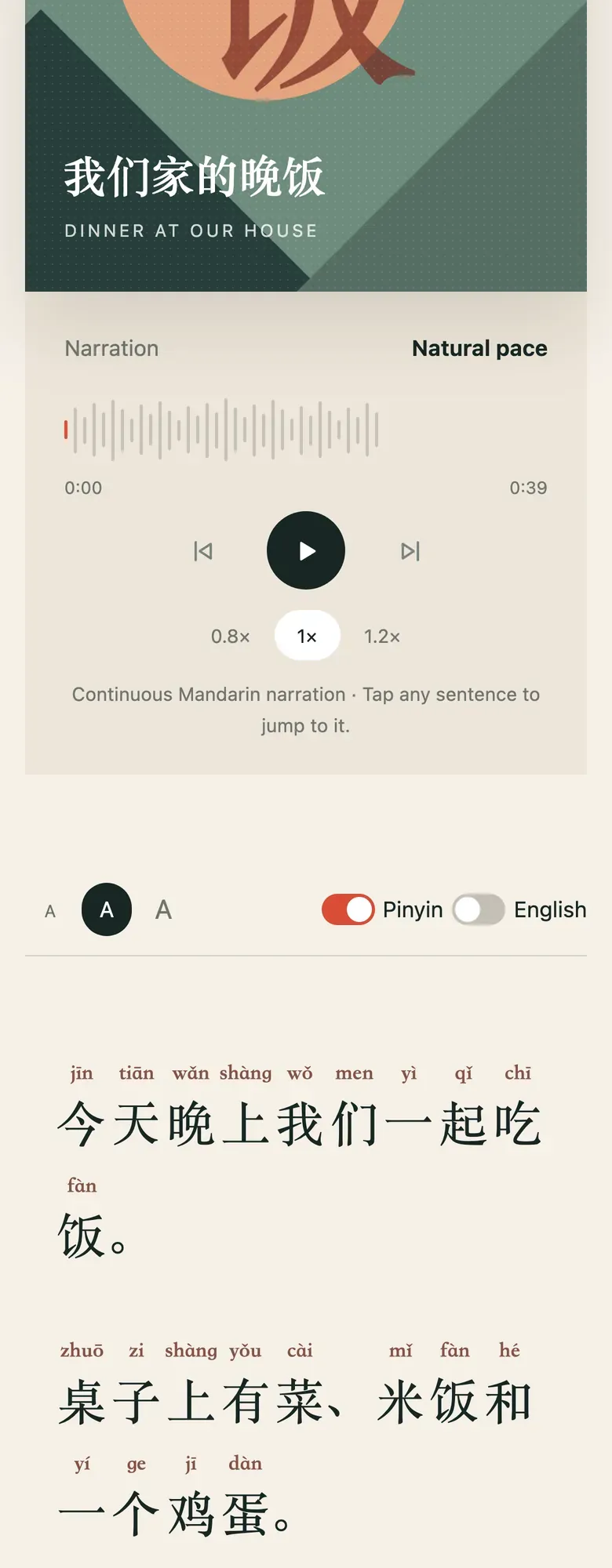
- Best first story: Dinner at Our House, Shanhai Story. Two children share the last egg. You'd know 95% of the words, and it's narrated.
- Every word at your level: What Time Is There a Doctor?, Coco. A mother phones a hospital until a doctor is free. All but one word is HSK 1, but there's no audio.
- Audio from a teacher: Buy Clothes, Mandarin Bean. A short shopping diary, with audio the site says its teachers record.
- A legend, with help: The Kitchen God, SayMei Stories. Three short chapters, free in full. You'd know about three words in four.
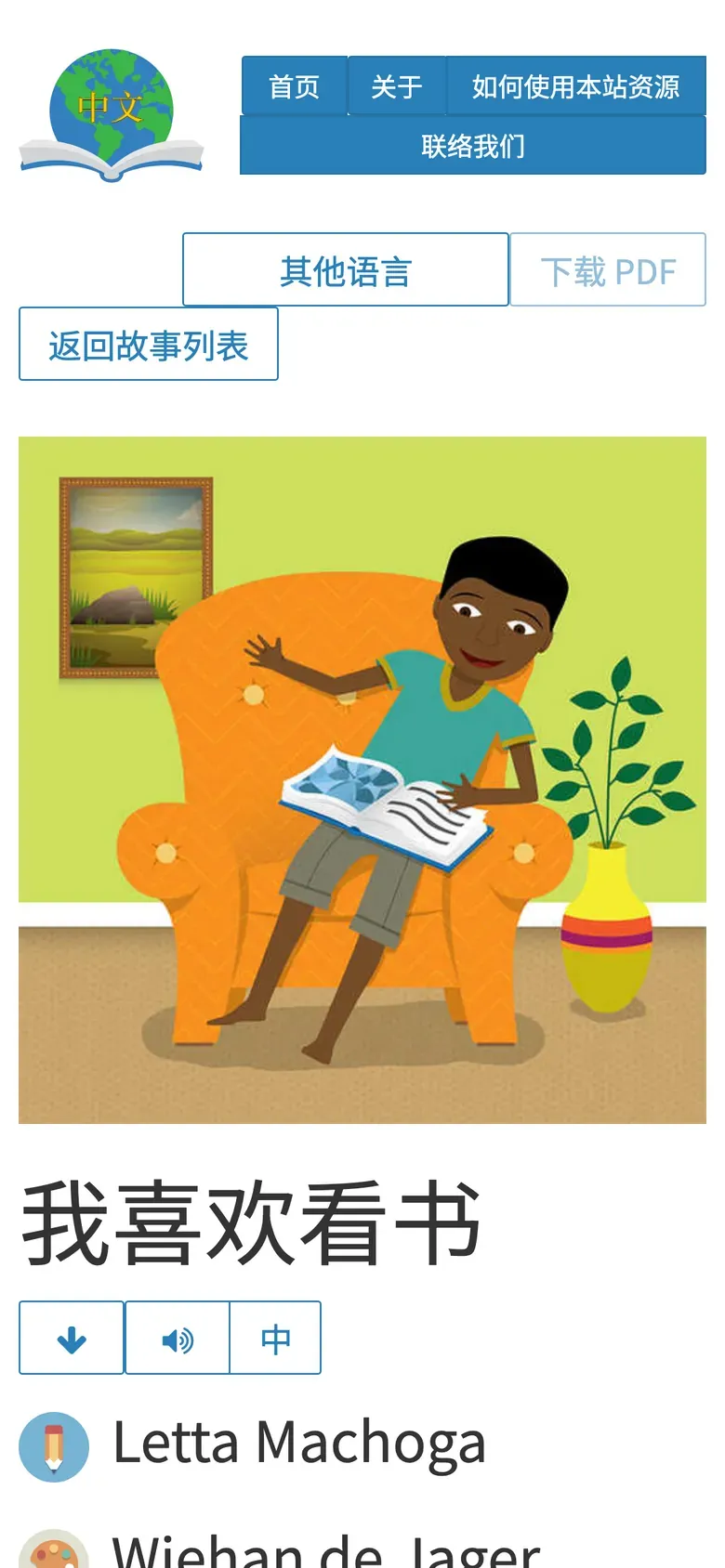
- A picture book to listen to: I Like to Read!, Global Storybooks. Eight illustrated pages, each read aloud.
For short daily reads, nearly every word of the HSK 1 pieces on Read Mandarin and ChineseGradedReader.com is on the list. Try Making a Phone Call and What Day Is It?, and read three or four in a sitting.
The best free stories at HSK 2
HSK 2 takes you to 500 words. Free stories start to have small surprises in them:
- Best story: Mom's Glasses, Shanhai Story. Everyone hunts for glasses that are on Mom's head. You'd know 94% of the words.
- Strictly at your level: Good Morning, ChineseGradedReader.com. A mother and daughter plan their day, in HSK 1 and 2 words only.
- Audio from a teacher: A Happy Day, Mandarin Bean. Two students spend a Saturday out. Every word is HSK 2 or below.
- A fairy tale, with help: Beauty and the Beast, SayMei Stories. Five chapters, free in full. You'd know about four words in five.
The best free stories at HSK 3
HSK 3 doubles your list to 1,000 words, and free stories begin to carry real feeling:
- Best story: An Old Photograph, Shanhai Story. A grandson finds his grandmother's lost friend. You'd know 94% of the words.
- A story with feeling: An Unforgettable Birthday, Read Mandarin. A lonely birthday, until colleagues bring cake. You'd know 97% of the words.
- A letter home: Xiaomei's Letter, Pinyora. A daughter writes home from Beijing. You'd know 96% of the words.
- Strictly at your level: The Menu, ChineseGradedReader.com. Two friends order dinner, in HSK 1 to 3 words only.
- A legend, with help: Chang'e and the Moon, SayMei Stories. Three chapters, free in full. You'd know 86% of the words.
The best free stories at HSK 4
HSK 4 is 2,000 words. This is where free graded stories get long enough to lose yourself in:
- Best story: The Last Dinner Before Moving, Shanhai Story. Neighbours throw a tenant a farewell dinner. You'd know 98% of the words.
- A parable: The Weight of a Glass of Water, Mandarin Bean. A teacher's lesson on stress. You'd know 92% of the words.
- Plain prose: Managing My Time, Read Mandarin. A to-do list shrinks to three things a day.
- A longer story: The Contest at the Table, Coco. A coach picks one boy for the team, for an unexpected reason.
- A classic, with help: The Hound of the Baskervilles, SayMei Stories. Eight chapters, free in full. You'd know 88% of the words.
Free graded stories thin out after HSK 4. For HSK 5 and up, our guide to Chinese story and news apps compares the paid libraries that go further.
Find a free story at your level
The finder holds all 870 stories we measured: the 704 free ones and our own 166 books. Pick your level, and it lists the easy reads first, taking turns between sites:
Find a free Chinese story at your level
Pick your HSK level. Easy reads come first, then stories to read with help, each with its length and audio. Short means under 150 characters.
Your level
Audio
Length
50 of the 870 stories give you 95% of the words or more at HSK 1. Easy reads first, taking turns between sites.
- Easy read
ChineseGradedReader.com · Labelled HSK 1
You'd know 100% of the words at HSK 1 · 145 characters
- Easy read
Read Mandarin · Labelled HSK 1
You'd know 100% of the words at HSK 1 · 68 characters
- Easy read
Literate Chinese · Labelled HSK 1
You'd know 100% of the words at HSK 1 · 44 characters
- Easy read
Pinyora · Labelled HSK 1
You'd know 100% of the words at HSK 1 · 34 characters
- Easy read
Coco · Labelled HSK 1
You'd know 99% of the words at HSK 1 · 126 characters
870 stories on nine sites, measured on 11 October 2026 against the 2025 HSK word lists, names left out. Easy read: 95% of the words or more at your level. With help: 85% or more, with pinyin and English at hand. A SayMei book counts all its chapters.
Each card links to the story on its own site. Within a site, the stories where you'd know the most words come first, and the longer one wins a tie, so you get more reading for the same effort.
Two sites write within their labels
A typical story on ChineseGradedReader.com or Read Mandarin uses words from its own HSK level or below, 95% of the time or more. On five other graded sites, it's closer to 83%: about one word in six is new. Our own books come out lower still.
Here's the share of words you'd know, for a typical story on each site, at the story's own level and one level up:
Two free sites stay within their labels; the rest need one level more
Median share of a story's words a reader would know, labels HSK 1–4, names left out
- 95–98%: comfortable reading
| Site | Stories | At the story's own level | One level higher |
|---|---|---|---|
| ChineseGradedReader.com | 85 | 98.2% | 100% |
| Read Mandarin | 80 | 95.2% | 98.5% |
| Pinyora | 78 | 84.9% | 94.6% |
| Mandarin Bean | 192 | 84.5% | 93.5% |
| Literate Chinese | 80 | 83.3% | 91.9% |
| Shanhai Story | 125 | 83.0% | 91.9% |
| Coco | 24 | 82.4% | 91.4% |
| SayMei Stories | 166 | 74.0% | 85.3% |
| Global Storybooks | 38 | 66.8% | 78.1% |
Source: our count, 11 October 2026, against the 2025 HSK syllabus. Global Storybooks uses levels of its own; we read its Level 1 as HSK 1, and so on.
The gap isn't the new HSK. About 95% of the words on the old lists sit at the same level or lower on today's, and today's lists are bigger. A story written strictly for the old HSK 2 would still score well.
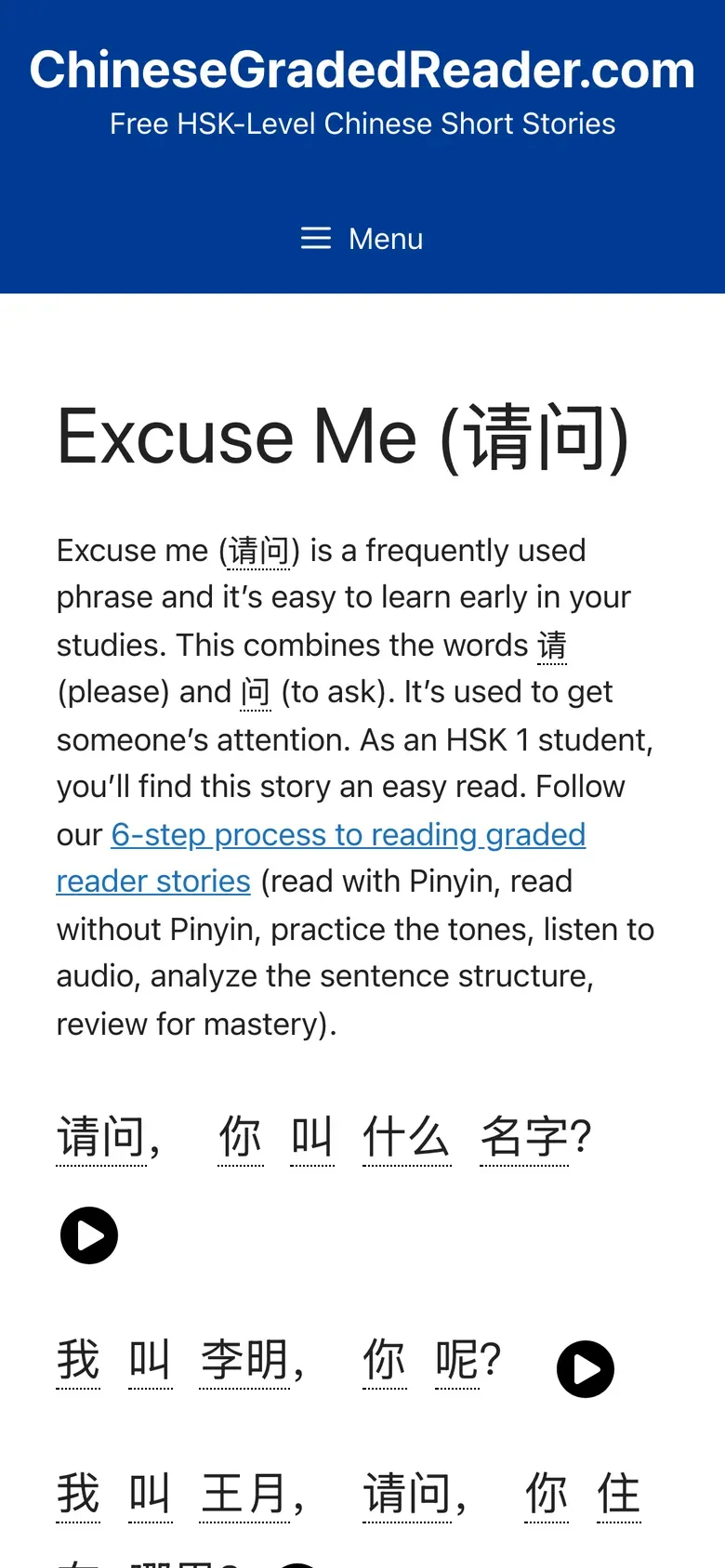
ChineseGradedReader.com gets there by design: it says it leaves out every word above a story's level. The trade-off is that many of its stories are short dialogues built around one phrase, closer to a textbook than a tale.
So if a site's HSK 2 shelf feels hard, it probably is. Go one level down on that site, or keep the pinyin on.
Free HSK 1 stories are a few lines long
Strict grading keeps stories short. A typical HSK 1 story on the free sites runs 50 to 130 characters.
Here's the median length of a level 1 story on each site:
Source: our count, 11 October 2026. A SayMei book has 3 to 10 chapters.
Short isn't bad: you can finish one over breakfast. But a plot needs room, and the longer stories are where you'll meet more new words.
Who reads the audio
All nine libraries offer audio somewhere, but only six put it on the free page, and the voices differ a lot. Here's what each one gives you, as its maker describes it or as we found it:
Shanhai Story
- Audio on the free page
- Every story, 0.8× to 1.2×
- Who reads it
- Not stated
Mandarin Bean
- Audio on the free page
- Every lesson
- Who reads it
- Chinese teachers, the site says
Global Storybooks
- Audio on the free page
- Every page
- Who reads it
- A narrator credited on each story
Read Mandarin
- Audio on the free page
- Every line, 0.5× to 1.25×
- Who reads it
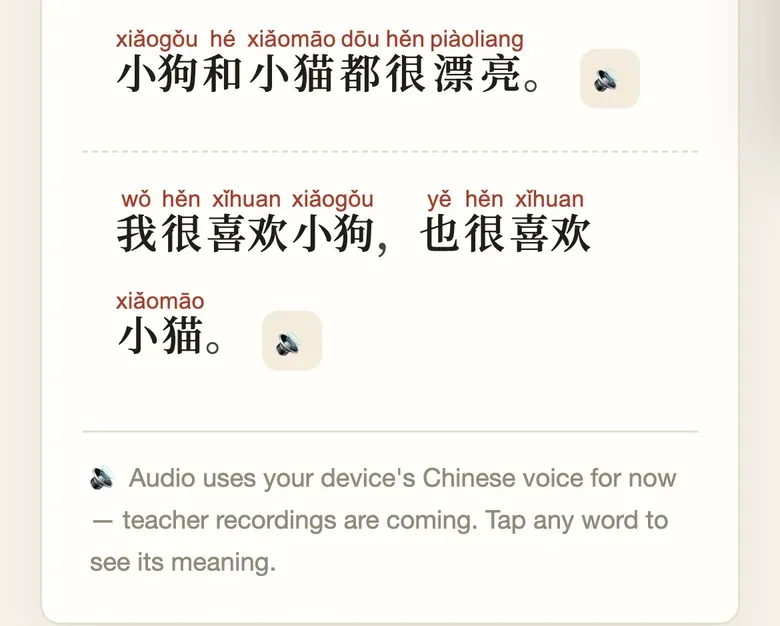
- Your device's Chinese voice, for now
ChineseGradedReader.com
- Audio on the free page
- Every line
- Who reads it
- A computer voice set to "very slow"
Pinyora
- Audio on the free page
- In its free app
- Who reads it
- Not stated
Literate Chinese
- Audio on the free page
- In its app
- Who reads it
- Native speakers, its site says
Coco
- Audio on the free page
- In its app
- Who reads it
- Beijing-accent audio, its listing says
SayMei Stories
- Audio on the free page
- Every line, 0.6× to 1.5×
- Who reads it
- A different voice for each character
Sources: each library's own pages and App Store listings, checked 11 October 2026. ChineseGradedReader.com's play buttons call a text-to-speech service. Read Mandarin says teacher recordings are coming.
Listen to one story before you commit to a site. The tones you copy come from whatever you hear most.
Picture books for children are the hardest
Global Storybooks is a lovely free library: 40 illustrated stories, each read aloud, under Creative Commons licences. But its books were written for children who already speak a language, not for learners of one.
Its easiest book by our count, I Like to Read!, asks again and again: "Who can I read to?"
我可以念给谁听呢?
Wǒ kěyǐ niàn gěi shéi tīng ne?
The verb there, "read aloud", 念, is an HSK 5 word. Picture books are full of everyday words like that, and of animals and farm life that the HSK lists leave for later.
So a typical Level 1 picture book leaves about half its words beyond HSK 1. The free library StoryWeaver adds 406 more picture books in Simplified Chinese, none of them listed with audio.
Use picture books for listening, with the pictures to carry you. Read them yourself once graded stories feel easy.
Nine free libraries, compared
Here's what each library gives you free, and what it charges for:
ChineseGradedReader.com
- Free to read
- 85 stories
- Levels
- HSK 1–3
- Paid extras
- None
Read Mandarin
- Free to read
- 419 readings
- Levels
- HSK 1–6
- Paid extras
- None
Mandarin Bean
- Free to read
- 900+ lessons
- Levels
- HSK 1–6+
- Paid extras
- Premium, $49 for a year
Shanhai Story
- Free to read
- 131 stories
- Levels
- HSK 1–5
- Paid extras
- None stated
Pinyora
- Free to read
- 102 stories
- Levels
- HSK 1–6
- Paid extras
- Pro for your own texts, price not stated
Literate Chinese
- Free to read
- 279 stories
- Levels
- HSK 1–6
- Paid extras
- App, $12.99 a month
Coco
- Free to read
- 24 stories
- Levels
- HSK 1–4
- Paid extras
- App, $14.99 a month
Global Storybooks
- Free to read
- 40 picture books
- Levels
- 5 levels of its own
- Paid extras
- None
SayMei Stories (ours)
- Free to read
- Chapters 1–2 of all 166 books, 8 books in full
- Levels
- About HSK 1–4
- Paid extras
- $2.99 a month
Sources: each library's pages and App Store listings, US prices, checked 11 October 2026. Mandarin Bean's Premium is a one-time payment that doesn't renew.
Two more come up often. HSKStory lets you read one story without an account and three with one, then charges $9.99 a month. We didn't measure LeNguia's 230 Mandarin stories, because its site asks automated readers to stay out of them.
Where SayMei Stories fits, and where it loses
SayMei Stories is our own library: 166 books in 812 short chapters, levelled from about HSK 1 to HSK 4. Most are Chinese legends and world classics. Every line has pinyin over the characters, an English translation and audio, and five questions follow each chapter.
A lot of it is free. Chapters 1 and 2 of every book open with no sign-up, and eight books are free in full, at least one per level. One more book is free each week, a different one every Monday, and a free account unlocks three more of your choice, with no card. Everything else costs $2.99 a month, after a free week.
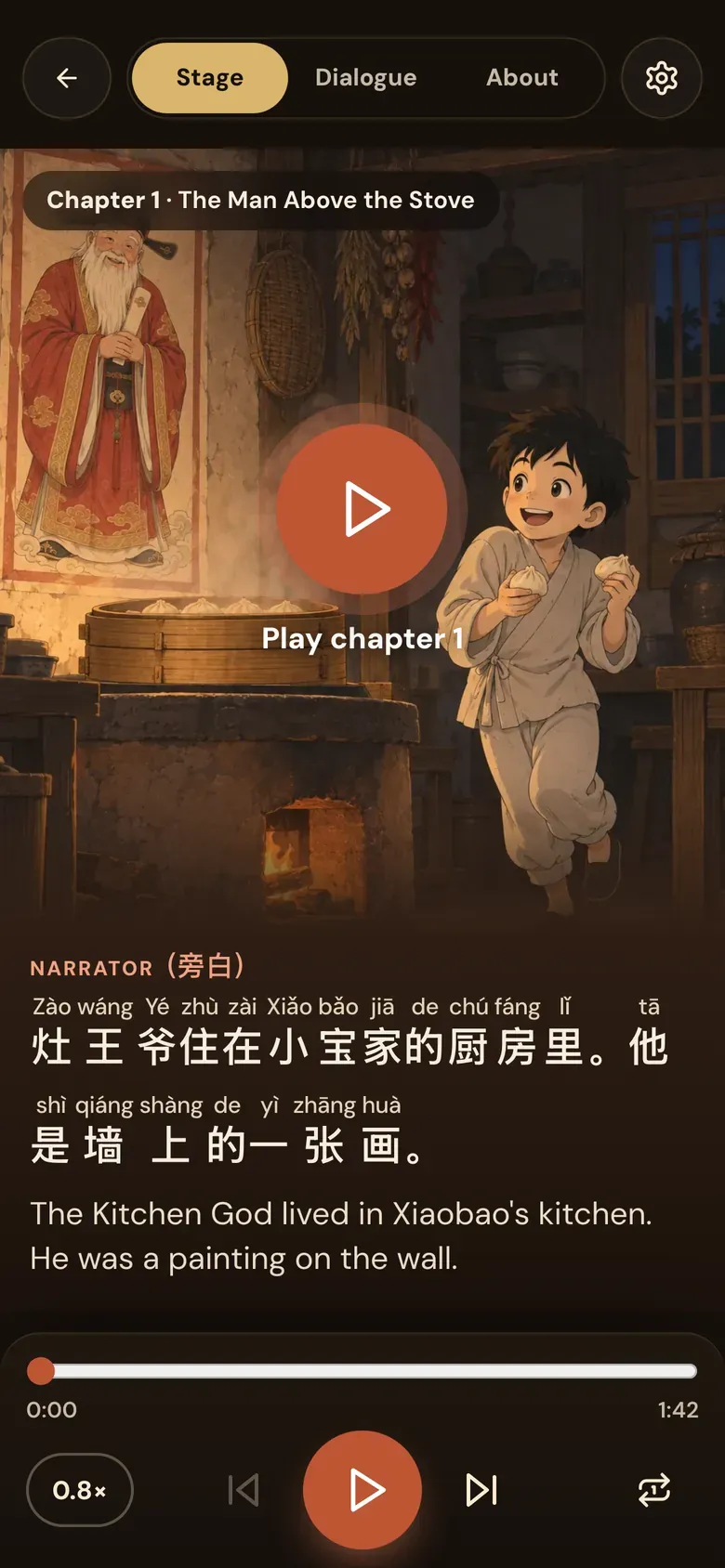
It wins on length and plot. A free book runs 3 to 8 chapters, the kind of story you'd retell to a friend, and the pinyin, English and audio are always there, so you can read above your level.
It loses on grading. Our books are the hardest for their labels of any graded library we measured. Here's the opening of The Kitchen God:
灶王爷住在小宝家的厨房里。他是墙上的一张画。
Zàowángyé zhù zài Xiǎobǎo jiā de chúfáng lǐ. Tā shì qiáng shàng de yì zhāng huà.
"The Kitchen God lived in Xiaobao's kitchen. He was a painting on the wall."
With only the HSK 1 words, "kitchen", 厨房, and "wall", 墙, are both new. That's why the help is always on. It also stops at about HSK 4, and it runs in a web browser, with no offline reading.
If you want stories you can read without help, start with the strict sites above. Come to ours when you want a long story and don't mind leaning on the pinyin.
How to read a story above your level
Most stories you'll want sit a little above your level. Here's the routine we'd use, from the research in our stories guide.
Listen first with the pinyin on, to get the plot. Then read it again in characters only, and look up only the words that block the story.
Keep five words for your flashcards, so the next story feels easier. When you rarely look anything up, move up a level.
What to do next
- Find your level in the finder. It sorts every story by the words you'd know.
- Start strict, then add plot. Short stories first, then longer ones.
- Listen before you read. A narrated story is easier on a first pass.
- Read one long story a week, with help.
Not sure of your level? The free Chinese level test tells you in about five minutes.
FAQ
Where can I read Chinese stories for free?
Eight sites put graded stories on free public pages with no sign-in: ChineseGradedReader.com, Read Mandarin, Mandarin Bean, Shanhai Story, Pinyora, Literate Chinese, Coco and Global Storybooks. Between them, they hold well over 1,000 stories. SayMei Stories gives away chapters 1 and 2 of all 166 of its books, plus eight books in full.
Are there free Chinese stories with pinyin and English?
Yes. Shanhai Story, Pinyora, Read Mandarin, Literate Chinese, Coco and ChineseGradedReader.com all show pinyin and a full English translation for free, and most let you hide them. Mandarin Bean shows pinyin and translates any word you tap; its full translations come with Premium. SayMei Stories has both on every line. Global Storybooks has neither on its Chinese pages.
Which free Chinese stories have audio?
Shanhai Story narrates every story, Global Storybooks reads every page aloud and Mandarin Bean says Chinese teachers record its lessons. Read Mandarin uses your device's Chinese voice for now, and ChineseGradedReader.com uses a slow computer voice. Pinyora, Literate Chinese and Coco keep audio for their apps. SayMei Stories has audio for every line.
Is there a free PDF of Chinese stories for beginners?
ChineseGradedReader.com has a Download PDF button on its story pages. SayMei's free workbook Five Beginner Mandarin Mini-Stories is a 28-page PDF of five short stories in characters and pinyin, free with a SayMei account. Mandarin Bean includes PDFs with Premium, at $49 for a year. Global Storybooks has no PDFs for its Chinese stories yet.
What Chinese stories can I read at HSK 1?
Start with stories where you'd know at least 95% of the words. By our count, Shanhai Story's Dinner at Our House and Coco's What Time Is There a Doctor? qualify, and so do most HSK 1 pieces on Read Mandarin and ChineseGradedReader.com. For a longer story, read SayMei's The Kitchen God, free in full, with the pinyin and English on.
Are children's books good for learning Chinese?
For listening, yes. For reading, not at first. Picture books are written for children who already speak the language, so a Level 1 book from Global Storybooks leaves about half its words beyond HSK 1. Graded stories, written to a word list, are far easier to read on your own. Come back to picture books once graded stories feel easy.
How do I know if a Chinese story is at my level?
Count the words you don't know. If more than about 1 in 20 is new, the story is above your level for easy reading, though fine with pinyin and English. Our finder shows that share for 870 stories. Some apps, such as Literate Chinese and Maayot, estimate your fit before you start, as our guide to story apps explains.
Sources
Story libraries, checked 11 October 2026:
- ChineseGradedReader.com: home, with its HSK 1, HSK 2 and HSK 3 stories
- Read Mandarin: home, about, and its HSK 1 to HSK 4 readings
- Mandarin Bean: home, Premium, terms and its story lessons
- Shanhai Story: stories, with its HSK 1 to HSK 5 shelves
- Pinyora: stories and about
- Literate Chinese: reading practice and its App Store listing
- Coco: stories and its App Store listing
- Global Storybooks: Chinese stories, with English titles from Storybooks Canada. I Like to Read! is by Letta Machoga, illustrated by Wiehan de Jager, translated by dohliam and read by Zhuo Sun, from the African Storybook, CC BY 3.0.
- Also: HSKStory pricing · LeNguia · StoryWeaver, whose public search lists 406 books in Simplified Chinese
SayMei: Stories · The Kitchen God · Five Beginner Mandarin Mini-Stories
Words and research
- Center for Language Education and Cooperation (2025). New HSK syllabus, with word lists for levels 1 to 9. https://hsk.cn-bj.ufileos.com/3.0/%E6%96%B0%E7%89%88HSK%E8%80%83%E8%AF%95%E5%A4%A7%E7%BA%B21219.pdf
- CC-CEDICT, release of 2 January 2026, CC BY-SA 4.0. https://www.mdbg.net/chinese/dictionary?page=cc-cedict
- jieba, Chinese word segmentation, MIT licence. https://github.com/fxsjy/jieba
- Hu, M. H.-c., & Nation, P. (2000). Unknown vocabulary density and reading comprehension. Reading in a Foreign Language, 13(1), 403–430. https://doi.org/10.64152/10125/66973
- Laufer, B., & Ravenhorst-Kalovski, G. C. (2010). Lexical threshold revisited. Reading in a Foreign Language, 22(1), 15–30. https://doi.org/10.64152/10125/66648
Methods
We measured 704 free stories on eight sites, and all 166 SayMei books, on 11 October 2026. We never signed in or went past a free limit, and we kept no story text: only counts, titles and links.
ChineseGradedReader.com
- Stories measured
- 85
- Which ones
- All, HSK 1–3
Read Mandarin
- Stories measured
- 80
- Which ones
- 20 per level, evenly spaced, of 317 at HSK 1–4
Mandarin Bean
- Stories measured
- 192
- Which ones
- Every lesson tagged "story" at HSK 1–4
Shanhai Story
- Stories measured
- 125
- Which ones
- All at HSK 1–4
Pinyora
- Stories measured
- 78
- Which ones
- All at HSK 1–4
Literate Chinese
- Stories measured
- 80
- Which ones
- 20 per level, evenly spaced, of 245 at HSK 1–4
Coco
- Stories measured
- 24
- Which ones
- All
Global Storybooks
- Stories measured
- 40
- Which ones
- All
SayMei Stories
- Stories measured
- 166
- Which ones
- Every book, all chapters
- Reading the pages: we read each public story page once, slowly, and took the Chinese sentences from it. Two sites turn scripted readers away, so we opened their pages in an ordinary browser instead. Mandarin Bean's lessons came from its public WordPress listing.
- Words: we split each sentence into words with the jieba segmenter, using its own dictionary plus every HSK word. A word counts as known at its level on the 2025 syllabus. A word that isn't listed counts as known when it splits into listed words, at the level of the hardest part: "go home", 回家, is 回 plus 家, both HSK 1.
- Basic forms that the 2025 syllabus prints only inside longer entries, such as "words", 话, take their level from the 2021 standard it's based on. Numbers count as HSK 1.
- Names of people, places and magic objects are left out, as most reading studies do. We used each site's own marking where it has one, and a list we checked by hand. Interjections and animal sounds, such as 汪汪, are left out too.
- A typical story is the median. Labels are each site's own, and some sites still use the old HSK.
- SayMei Stories is counted per book, all chapters together. Our stories guide measured the same books with the reader's own word splits; these medians land within about a point of it.
- A stricter rule, the one our songs guide used, counts a dictionary word like 回家 as new unless it's listed. It moves each site's median by 1.5 points or less and keeps the same order.
Limits: word splitting in Chinese is never perfect, and the HSK lists stand in for what a real learner knows, so treat each percentage as an estimate. Two sites are samples, not their whole libraries. Story lengths count Chinese characters, not words.
Every Mandarin example on this page was checked against the CC-CEDICT dictionary.
If you spot a mistake, tell us.