How to learn Chinese with ChatGPT (and other AI)
Copy-paste prompts for beginners and HSK 3, a weekly plan, and what ChatGPT, Gemini and Claude get wrong in Chinese: tones, pinyin and measure words.

A chatbot is the most patient Chinese partner you'll ever have. It's also an unreliable judge of your tones.
This guide is for you if you want to learn Chinese with a chatbot you already use, from your first words to about HSK 3. You'll get prompts to copy, a weekly plan and the checks that keep a chatbot honest.
We read the three companies' pricing and help pages on 16 October 2026, and the published tests of chatbots on Chinese tones, pinyin, measure words and corrections.
Key takeaways
- Talking is the best use. ChatGPT's cheapest paid plan allows up to three hours of voice a day, and Gemini Live costs nothing.
- Your prompt does the teaching. Tell the chatbot your level, how fast to speak and how to correct you, or it talks to you like a native speaker.
- It can't grade your tones. In one test, ChatGPT kept changing its score for the same native speaker's recording.
- Check pinyin and measure words. In published tests, no chatbot followed the pinyin rules every time, and GPT-4 often chose a different measure word from a native writer.
- Ask for the smallest fix. Chatbots tend to rewrite your sentence into theirs, which hides what you got wrong.
- A course plans; a chatbot waits. When you don't know what to practise next, a tutor or a course does that job.
Four jobs a chatbot does well
A chatbot is good at the parts of Chinese that need patience and volume. It never tires of your questions, and it's awake at any hour.
Here are the four jobs we'd give it:
- Conversation. Voice modes let you speak Mandarin out loud and interrupt, as you would with a person.
- Corrections. Paste what you wrote and get it back corrected, with a reason for each change.
- Reading at your level. It can write a short story with the words you know, on any topic you like.
- Explanations. Ask why 了 goes where it does, and get examples until it clicks.
Classroom research backs the conversation part. In an Austrian study of 28 high-school beginners, ChatGPT's voice mode could be held to simple, predictable exchanges. Many students found it motivating and low-stress.
They also met robotic intonation and glitches, and they needed their teacher when a conversation broke down. Reading has a similar catch: a 2026 study found plain prompting less reliable at hitting a reading level than a system built for the job.
So give a chatbot the jobs that reward repetition, and keep the judging for something, or someone, more reliable.
Pick the chatbot by the job
All three big chatbots speak Mandarin and read Chinese characters. They differ most in voice: where it works, how long you get and what it costs.
Here's what each offers a Chinese learner:
ChatGPT
- Free voice
- Limited, and the limits may change
- Cheapest paid plan
- Go, $8 a month: up to 3 hours of voice a day
- Best for
- Long voice conversations
Gemini
- Free voice
- Gemini Live, in the phone app
- Cheapest paid plan
- Google AI Plus, $4.99 a month
- Best for
- Free voice practice on your phone
Claude
- Free voice
- Yes, but languages other than English are in beta
- Cheapest paid plan
- Pro, $20 a month, or $17 billed yearly
- Best for
- Typed practice: corrections and explanations
Sources: the ChatGPT, Google and Claude pricing pages and help centres, in US dollars, checked Oct 16, 2026. ChatGPT counts voice over a rolling 24 hours.
A few settings make each one easier to learn with:
- ChatGPT. Set the voice language to Chinese under Settings, Voice, Language, which OpenAI says helps it understand you. Its Live mode listens while it talks, so ask it to wait until you've finished.
- Gemini. Live runs only in the Gemini phone app, not on the website. Turn on captions to read what it says, and you get a transcript when you end the chat.
- Claude. Voice mode works on every plan, but Anthropic says languages other than English are still in beta. Use Claude for typed practice.
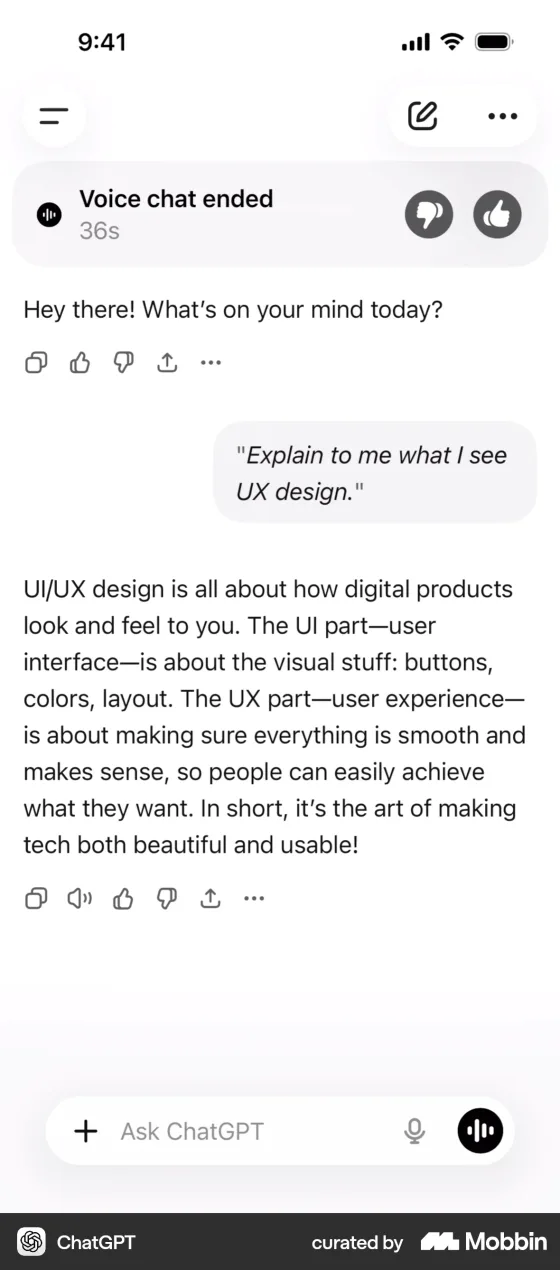
ChatGPT adds the transcript to your chat when a voice call ends. Read it back for words you missed:
Gemini Live can caption its replies as it speaks, which helps when you can't catch a word:

Start with whichever you already have. The prompt matters more than the brand.
It can't hear your tones
This is the big one. A chatbot can talk with you for hours, but it can't reliably tell you whether your tones were right.
Speech recognition turns your voice into the likeliest words. Say buy, 买, with a falling tone and you've said sell, 卖. A recognizer that leans on context may still write 买, because "I want to buy" is the likelier sentence.
OpenAI says its voice transcripts "are not verbatim records". So a correct transcript doesn't prove your tone was right.
Asking for a score doesn't help either. The writer Olle Linge uploaded one native Beijing teacher's recording to ChatGPT five times and asked it to rate the pronunciation:
Source: Hacking Chinese, 13 September 2026. The sentence was 麻烦你把盐递给我 máfan nǐ bǎ yán dì gěi wǒ, "please pass me the salt". The recording never changed.
ChatGPT also invented errors. It claimed trouble, 麻烦, has two rising tones, when its second syllable is neutral. Claude was the one tool in the test that said it couldn't judge pronunciation.
Train your ear another way. Record yourself and compare with a native speaker, drill tone pairs in our tone-pair trainer, and get a human ear now and then. Our free Tone Checker draws your pitch next to the target, so you can see a wrong tone for yourself.
Use the chatbot for speaking time, and something else to judge your tones.
Check pinyin and measure words
Chatbots write pinyin well enough to read along, but not reliably enough to memorise blind. A 2025 study of pinyin tools found general chatbots beat dedicated converters, yet none followed the official pinyin rules consistently.
The slips were in details learners copy: neutral tones, repeated syllables, punctuation and where one word ends. The neutral tone is the classic: thank you, 谢谢, ends on a light, toneless syllable, not xièxiè.
Ask for pinyin "word by word, with tone marks", and look up any word you'll learn in a dictionary such as Pleco. Our Chinese to pinyin converter gives a second opinion. In speech, 一 and 不 change tone, and the tone sandhi checker shows when.
Measure words are the other trap. In a 2025 fill-in-the-gap test, researchers hid the measure word in real sentences and asked each model to fill it:
Source: Zhang and colleagues, 2025. Only the writer's own word counted, so some answers marked wrong may also have worked.
A wrong measure word sounds odd at once. A book is 一本书, while 张 is for flat things such as paper. Learn each noun with its measure word, and check new ones in our Measure Word Finder.
Ask for the smallest fix
Chatbots spot mistakes well, but they over-correct. Ask one to fix your sentence and it often hands back a smoother sentence of its own, so you can't see what you got wrong.
In a 2024 study, GPT-4 corrected learners' sentences after being told to change as little as possible. It still changed more than the human editors did, and most of its edits weren't theirs:
Source: Lin, 2024, on sentences from the YACLC learner corpus, each corrected by several human editors. GPT-4 found about half the errors the editors fixed.
So say exactly what you want: real mistakes only, the smallest change and a reason for each. Prompt 5 below does that.
One caveat: these studies tested models from 2023 to 2025, and the chatbots you'll use today are newer. Nobody has published a retest on Chinese, so keep checking anything you'll memorise.
Prompts for beginners
Copy a prompt, change the words in brackets and paste it at the start of a chat. For voice, type it into the chat before you start talking, or read it out loud. To reuse one, save it in ChatGPT's custom instructions or as a Gem in Gemini.
1. The slow speaking partner
Be my Mandarin speaking partner. I'm a beginner at HSK 1. Speak slowly, in sentences of three to six words, using only HSK 1 words. Ask me one easy question at a time about [my family]. If I make a mistake, say my sentence back correctly, then ask your next question. If I say "English", repeat your last sentence in English. I pause a lot, so wait until I've finished.
Best for: your first conversations, by voice. Change the topic every day.
2. Five words and a quiz
Teach me five HSK 1 words about [food]. For each word, give the characters, the pinyin with tone marks, the English and one short example sentence with pinyin and English. Give every noun with its measure word. Then quiz me on one word at a time, and wait for my answer before you go on.
Best for: new words, typed. Check any word you'll keep in a dictionary.
3. The café role-play
Let's role-play in Mandarin. You're a server in a café in Beijing, and I'm a customer. Use only HSK 1 and 2 words, in short sentences. Start by greeting me. If I get stuck, give me the first word of an answer, not the whole sentence. After six turns, stop and tell me in English the two phrases I should learn.
Best for: real situations, by voice. Swap the café for a shop, a taxi or a hotel.
Prompts for HSK 3
At HSK 3 you can hold a conversation, so the prompts ask for more talk, fewer interruptions and a debrief at the end.
4. Talk, then debrief
Let's talk in Mandarin about [my last trip]. I'm at HSK 3. Use words up to HSK 3, and explain any harder word in simple Chinese. Keep each of your turns to two or three sentences, and ask me follow-up questions. Don't correct me while we talk. When I say "stop", list my three most important mistakes. For each, give my sentence, the corrected sentence in characters and pinyin, and a one-line reason in English.
Best for: longer conversations, by voice. ChatGPT shows its replies as text too, so you can reread the debrief.
5. The smallest fix
Correct this paragraph, which I wrote at HSK 3 level. Fix only real mistakes, and change as little as possible: don't rewrite for style. For each change, show my sentence, your fix and a one-line reason in English. If a sentence is already correct, say so. Finally, tell me the one mistake I make most. [Paste your paragraph]
Best for: writing practice. It guards against over-correction, and it works at any level.
6. A story at your level
Write a story of about 200 characters in simplified Chinese for an HSK 3 learner, about [a lost phone]. Use words up to HSK 3, plus no more than five new words. List the new words at the end with pinyin, English and a measure word where they take one. Then ask me three questions about the story in Chinese, one at a time.
Best for: reading. Paste the story into our Chinese to pinyin converter, which shows each word's HSK level, to see whether it kept to yours. For stories with pinyin over every character and English for every line, try SayMei Stories.
7. One grammar point
Explain the difference between 了 and 过 for an HSK 3 learner, in under 200 words. Give three pairs of example sentences with pinyin and English, and the most common learner mistake with each. Then give me five sentences to complete, one at a time, and check my answers.
Best for: grammar questions. Compare the answer with our grammar library.
8. The review list, for any level
Look back at this conversation. List every word and phrase I got wrong or didn't know, one per line, as: characters, pinyin with tone marks, English. No other text.
Best for: the end of any session. SayMei Flashcards can import a pasted list or a CSV file, and so can Anki.
A week of chatbot practice
Little and often works better than one long session, as decades of spacing research show. We'd aim for about fifteen minutes a day.
Here's a week that rotates the four jobs and leaves tones to a better judge:
Monday
- What to do
- Talk, then read the transcript
- Prompt
- 1, or 4 at HSK 3
Tuesday
- What to do
- Learn new words, with measure words
- Prompt
- 2
Wednesday
- What to do
- Write a few sentences and get the smallest fixes
- Prompt
- 5
Thursday
- What to do
- Read a short story out loud
- Prompt
- 6
Friday
- What to do
- Role-play a café, a shop or a taxi
- Prompt
- 3
Saturday
- What to do
- Turn the week's mistakes into flashcards
- Prompt
- 8
Sunday
- What to do
- Tones, without the chatbot
- Prompt
- Tone Checker and your own recordings
Source: our plan, built from the strengths and limits in this guide. Beginners can use prompt 2 at HSK 1 and prompt 6 at HSK 1 or 2.
Keep Saturday's list. It turns a week of chats into words you'll remember.
When a dedicated tutor beats a chatbot
A chatbot answers; a course decides. That difference matters once the novelty wears off.
Here are the signs you've outgrown a bare chatbot:
- You don't know what to practise next. A chatbot can remember facts about you, but it won't plan a syllabus unless you build one.
- You spend more time prompting than speaking. A dedicated tutor starts the lesson for you, at your level.
- You want an HSK path. Lessons sorted by level save you from guessing which words come first.
- You need your tones judged. A trained human ear is still the best check, and our guide to online Chinese tutors found the median italki teacher charges $20 an hour.
For app-by-app picks, our guide to the best AI apps to learn Chinese compares nine AI tutors on speaking, tones, free use and price. Our guide to how to speak Chinese covers the practice itself.
The chatbot stays useful either way. It's the cheapest extra speaking time you'll find.
Where SayMei fits, and where it doesn't
SayMei is ours, so weigh this section with that in mind. It teaches spoken Mandarin with Mei Lin, your AI teacher, in over 1,800 lessons across HSK 1 to 6.
Here's where it fits:
- It plans for you. Each lesson builds on your last one, at your level, so you never write a prompt.
- Corrections are built in. Mei Lin corrects your grammar and tones as you talk, and the transcript shows pinyin, characters or both.
- It's cheap for planned speaking. Premium costs $5.99 a month for 200 minutes, about 30 short lessons.
And here's where it doesn't:
- Fewer minutes than ChatGPT. ChatGPT Go allows up to three hours of voice a day for a little more money, and Gemini Live is free.
- No proof on tones. Like every AI tutor's, its tone feedback has no published accuracy test, so treat it as a hint, not a verdict.
- Browser only. There's no phone app and no offline mode.
- Not free for long. Depending on where you live, you start with a free lesson or a free week, and the free week needs a card.
What to do next
- Pick one chatbot and a daily time. The one you already have is fine.
- Save one prompt. Start every chat with your level and your rules.
- Check before you memorise. Look up pinyin and measure words in a dictionary, and test tones with a pitch tool or a person.
- Keep a mistake list. Turn it into flashcards once a week.
- Add a plan when you stall. A course or a tutor decides what comes next.
When you want lessons that plan themselves, try a lesson with Mei Lin.
FAQ
Can ChatGPT teach you Chinese?
It can be a patient partner and explainer, not a full course. ChatGPT's voice mode handles open conversation in Mandarin, and its Go plan allows up to three hours a day for $8. It doesn't plan lessons unless you ask, it can't reliably judge your tones, and it can slip on pinyin and measure words. Use it with a clear prompt, alongside a course or a tutor.
What is the best ChatGPT prompt for learning Chinese?
One that states your level, the task and the rules. For a beginner: "I'm at HSK 1. Speak slowly, in short sentences, using only HSK 1 words. Ask me one question at a time, and say my sentence back correctly when I make a mistake." Add pinyin with tone marks for typed practice, and ask for the smallest possible corrections.
Can ChatGPT check my Chinese pronunciation and tones?
Not reliably. In a September 2026 test by Hacking Chinese, ChatGPT rated one native speaker's recording anywhere from 7 to 9 out of 10 and invented tone errors. OpenAI says its voice transcripts aren't verbatim, so a correct transcript doesn't prove a correct tone. Record yourself, use a pitch tool such as our Tone Checker, and get a human ear now and then.
Is ChatGPT's pinyin accurate?
Mostly, but not always. A 2025 study of pinyin tools found chatbots beat dedicated converters, yet none followed the official rules consistently. The common slips were neutral tones, repeated syllables and where one word ends. Ask for pinyin word by word with tone marks, and check any word you'll memorise in a dictionary such as Pleco.
Is Gemini or ChatGPT better for learning Chinese?
For free speaking practice, Gemini: Gemini Live is included in Google's free plan, in the phone app. ChatGPT also works on the web, and its $8 Go plan allows up to three hours of voice a day. Both speak Mandarin, neither plans a course, and neither reliably judges tones. Try each for a week and keep the one you'll use daily.
Can I practise speaking Chinese with AI for free?
Yes. Gemini Live is part of Google's free plan, ChatGPT's free plan includes limited voice, and Claude's voice mode works on every plan, though its languages other than English are in beta. Free limits can change. For structured lessons, most AI tutors charge a monthly fee; SayMei's Premium is $5.99.
Can ChatGPT help me prepare for the HSK?
Yes, for practice: it can quiz vocabulary, explain grammar and write reading passages. Paste words from the official HSK 3.0 list rather than trusting its memory of which word sits at which level. The new exams start on 13 December 2026, and speaking becomes compulsory from HSK 3. For the format, see our HSK exam guide and the official practice papers.
How do I make ChatGPT speak slower in Chinese?
Ask it. OpenAI says you can ask ChatGPT to speak faster or slower, though there's no precise speed control. Ask for short sentences too, and for words from your level only. If it cuts in while you think, tell it at the start to wait until you've finished, and set the voice language to Chinese in Settings.
Sources
Checked 16 October 2026 unless noted. No accounts were created, and nothing was bought.
Chatbots
- ChatGPT pricing and ChatGPT Voice help
- Google AI plans, Gemini Live help and Gemini app languages
- Claude pricing and Claude voice mode help
- App screens: Mobbin's captures of the ChatGPT voice and Gemini Live iPhone apps
Research and tests
- Linge, O. (2026). No, ChatGPT can't analyse your Mandarin pronunciation. Hacking Chinese, 13 September 2026.
- Rovira-Esteva, S. (2025). Evaluating current tools for pinyin transcription: can customising a chatbot lead the way forward? International Chinese Language Education Communications 3(1), 1–26.
- Zhang, Z., Ma, J., Chersoni, E., You, J. & Feng, Z. (2025). From BERT to LLMs: comparing and understanding Chinese classifier prediction in language models. BlackboxNLP 2025.
- Lin, S. (2024). Evaluating LLMs' grammatical error correction performance in learner Chinese. PLOS ONE 19(10), e0312881.
- Renner, J., Yu, S. & Guder, A. (2026). ChatGPT Voice Mode in CFL beginner classrooms. Chinese as a Second Language Research 15(1), 45–68: 28 learners.
- Fang, D., Qiang, J. and colleagues (2026). LLM4CGDS: large language model-based agents for Chinese graded document simplification. Engineering Applications of Artificial Intelligence 169, 113905. Abstract read.
- Cepeda, N. J., Pashler, H., Vul, E., Wixted, J. T. & Rohrer, D. (2006). Distributed practice in verbal recall tasks. Psychological Bulletin 132(3), 354–380.
SayMei
- Pricing and home page
- Our guides to online Chinese tutors and the best AI apps to learn Chinese, for the italki median and SayMei's features
Methods
- Prices and features. Read from each company's public pricing and help pages on 16 October 2026, logged out, at US prices. Plans and limits change often, so check before you pay.
- Research. We read the full text of the measure-word and correction studies and of the Hacking Chinese test, and the published abstracts of the pinyin and graded-reading studies. The percentages in the charts are the studies' own figures, rounded.
- Prompts. We wrote the prompts around the vendors' guidance and the weak spots these studies found. Chatbots change between versions, so the same prompt can behave differently over time.
- Screenshots. The two app screens come from Mobbin's library of iPhone captures and are shown unedited. Both show English chats; we found none of Chinese practice.
- Limits. The research studies tested models from 2023 to 2025, older than today's; the Hacking Chinese test is from September 2026. If you spot a mistake, tell us: we fix errors.