Chinese idioms (chengyu): the most common ones and the stories behind them
The 100 most common Chinese idioms (chengyu), counted in 160 million characters of film, TV and news, plus the stories behind the famous ones.

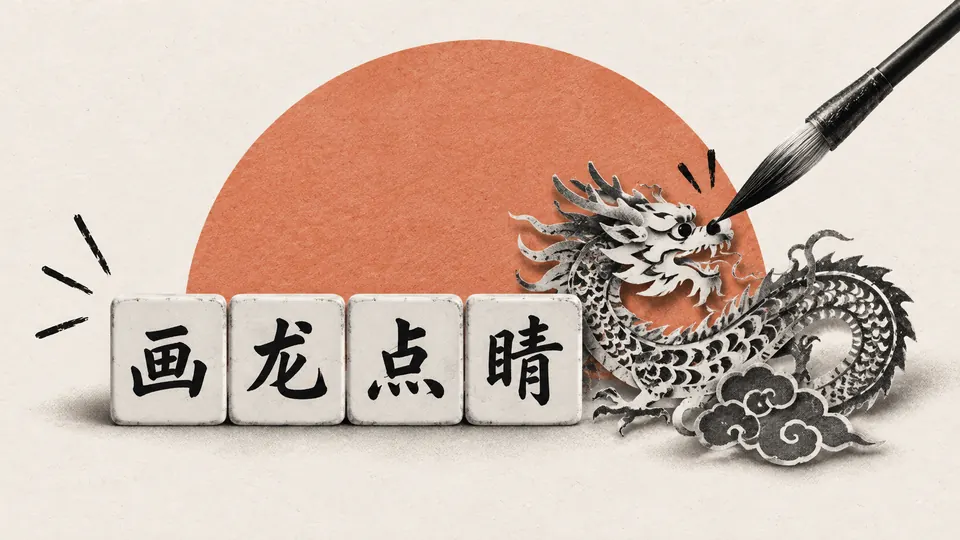
Most guides to Chinese idioms teach "draw a snake, add feet", 画蛇添足. In 16 million lines of Chinese film and TV subtitles, we found it three times.
This guide is for learners who want the idioms they'll actually hear and read. You'll get the list, an explorer for all 129 idioms we cover, and the old stories too, with the books they came from.
Key takeaways
- Famous isn't frequent. None of the idioms the top guides teach most often makes our top 100.
- Most common idioms have no story. They're plain pictures, like "one mould, one shape" for exactly alike.
- Speech and print prefer different idioms. "Thank goodness" fills film dialogue; "as everyone knows" lives in the news.
- A few hundred go a long way. The top 100 cover about a quarter of the idioms you'll meet.
- HSK saves them for the top levels. Most of our top 100 are HSK 7–9 words, and a third aren't on the list at all.
- The stories still matter. They're short and memorable, and most of the famous ones sit on HSK 3.0's top levels.
What is a chengyu?
A chengyu, 成语, is a set phrase, almost always four characters long. Many come from classical Chinese, so they pack a lot into very little.
Take "wait by the stump for a rabbit", 守株待兔. Word for word, it's "guard stump, wait rabbit". It means waiting for luck instead of working, and it points to a story more than two thousand years old.
Nobody agrees on how many there are. The open dictionary CC-CEDICT labels about 5,000 four-character entries as idioms.
Big Chinese idiom dictionaries list 30,000 or more. In one open copy, nearly every entry has exactly four characters.
Most of those you'll never meet. We checked each of CC-CEDICT's idioms against 160 million characters of real Chinese, and about one in five never showed up once.
One note on pinyin before the list. We show each character's dictionary tone, as CC-CEDICT does. In speech, 一 and 不 change tone, so 一模一样 is said yì mú yí yàng. Our tone sandhi checker shows how.
The 10 most common chengyu
The idioms Chinese speakers use most are plain descriptions. We counted every idiom in two big collections of real Chinese: 29,000 film and TV subtitle files, for speech, and a million news sentences, for writing. Then we ranked each idiom by how often it appears across both.
Here are the ten that came out on top:
Source: our count in OpenSubtitles 2018 and the Leipzig Chinese news corpus; geometric mean of the two rates. Method at the end.
Notice what's missing: animals, emperors and morals. You could guess most of these from their characters. Word for word, one of a kind, 独一无二, is "only one, no two".
That's good news. The idioms you need first are the easiest to learn.
Explore all 129 idioms
The explorer holds our top 100, plus the idioms behind SayMei's idiom stories and the ones popular lists like to teach. Search in English, characters or pinyin, then tap a card for a word-for-word gloss, an example sentence and the source.
Idiom explorer: the 100 most common, and the famous ones
Our top 100, plus the 29 idioms with famous stories or on popular lists (21 have a story). Search in English, characters or pinyin; tap a card for an example and the source.
Show
25 idioms
- #1wú lùn rú hé无论如何no matter whatNo story: a plain phrase, 'however it may be'.
- #2bù kě sī yì不可思议unbelievable; incredibleA Buddhist term for what lies beyond thought, from the Vimalakirti Sutra.
- #3nán yǐ zhì xìn难以置信hard to believeNo story: a plain description, 'hard to believe'.
- #4yǔ zhòng bù tóng与众不同out of the ordinary; differentNo story: 'different from everyone'.
- #5qián suǒ wèi yǒu前所未有unprecedentedNo story: 'never existed before'.
- #6bù kě bì miǎn不可避免inevitableNo story: a plain phrase, 'cannot be avoided'.
- #7yī mú yī yàng一模一样exactly alikeNo story: as if cast from the same mould.
- #8chéng qiān shàng wàn成千上万thousands upon thousandsNo story: counting up from thousands to tens of thousands.
- #9dú yī wú èr独一无二one of a kindNo story: 'only one, with no second'.
- #10wú néng wéi lì无能为力powerless to helpNo story: 'unable to do anything'.
- #11quán lì yǐ fù全力以赴to go all outNo story: 'set out with all your strength'.
- #12zhòng suǒ zhōu zhī众所周知as everyone knowsNo story: 'what all people know'.
- #13xiǎn ér yì jiàn显而易见obviousNo story: 'plain and easy to see'.
- #14yī wú suǒ zhī一无所知to know nothing at allNo story: 'not a single thing known'.
- #15pò bù jí dài迫不及待can't wait toNo story: 'too eager to wait'.
- #16mò míng qí miào莫名其妙baffling; for no reasonNo story: something so odd that nobody can explain it.
- #17bù zhī bù jué不知不觉without realizingNo story: 'without knowing or noticing'.
- #18lǐ suǒ dāng rán理所当然of course; taken for grantedNo story: 'only right and natural'.
- #19yī rú jì wǎng一如既往as alwaysNo story: 'the same as in the past'.
- #20yī wú suǒ yǒu一无所有to have nothing at allNo story: 'owning not a single thing'.
- #21chū rén yì liào出人意料surprisingGrew out of a phrase in the History of the Southern Dynasties: 'beyond people's expectations'.
- #22yǒu suǒ bù tóng有所不同to differ somewhatNo story: a plain phrase, 'somewhat different'.
- #23suí xīn suǒ yù随心所欲to do as you pleaseGrew out of Confucius: at seventy he could follow his heart's desire without overstepping the line.
- #24wú jiā kě guī无家可归homelessNo story: 'no home to go back to'.
- #25luàn qī bā zāo乱七八糟a complete messNo story: the numbers seven and eight just add to the jumble.
Rank: how often each idiom appears across film and TV subtitles and a news corpus, our count among about 5,000 idioms. Pinyin and meanings: CC-CEDICT; pinyin shows dictionary tones. HSK: the 2025 HSK 3.0 exam syllabus. Examples and word-for-word glosses are ours.
Famous idioms are rarely used
The idioms most guides teach first are some of the rarest. We read the 10 top search results for "chinese idioms" and "chengyu" and noted every idiom they list.
Here's how their favorites rank in our count:
| Idiom | Lists that include it | Our rank |
|---|---|---|
| 画蛇添足, overdoing it | 8 of 10 | 2,473 |
| 一箭双雕, two birds with one stone | 5 of 10 | 1,189 |
| 井底之蛙, a narrow view | 5 of 10 | 1,395 |
| 亡羊补牢, better late than never | 4 of 10 | 476 |
| 马马虎虎, so-so | 4 of 10 | 555 |
| 对牛弹琴, the wrong audience | 4 of 10 | 1,374 |
| 画龙点睛, the finishing touch | 4 of 10 | 1,970 |
Source: the 10 pages we read on 7 October 2026 (listed in Sources) and our count. Rank among about 5,000 idioms.
None of the idioms that three or more guides list makes our top 100. The closest is wholeheartedly, 一心一意, at number 221.
Meanwhile, most of our top 20 appear on none of the lists.
Why the gap? A story is more fun to teach than "hard to believe".
Learn the famous ones for culture and reading: they make great stories, and most sit on the HSK's top levels. Learn the frequent ones to understand what people say.
Some idioms are spoken, others written
Film dialogue and news share fewer idioms than you'd think. Only a quarter of the 100 most common idioms in our subtitles also make the news top 100.
Here's how eight common idioms split:
Some idioms live in conversation, others in print
Uses per million characters in film and TV subtitles and in news. Thank goodness fills film dialogue; as everyone knows lives in the news.
Film and TVNews
| Idiom | Film and TV | News |
|---|---|---|
| xiè tiān xiè dì谢天谢地thank goodness | 16.4 | 0.6 |
| yuán lái rú cǐ原来如此so that's it; I see | 11.2 | 0.3 |
| nán yǐ zhì xìn难以置信hard to believe | 31.5 | 3.5 |
| wú lùn rú hé无论如何no matter what | 27.8 | 11.5 |
| yǔ zhòng bù tóng与众不同out of the ordinary; different | 9.7 | 6.8 |
| qián suǒ wèi yǒu前所未有unprecedented | 4.0 | 13.8 |
| bù kě bì miǎn不可避免inevitable | 3.3 | 11.7 |
| zhòng suǒ zhōu zhī众所周知as everyone knows | 2.6 | 11.2 |
Source: our count in OpenSubtitles 2018 (122 million characters) and the Leipzig Chinese news corpus (38 million). Bars share one scale.
You'll hear thank goodness, 谢天谢地, all the time in films. In the news it barely exists. As everyone knows, 众所周知, runs the other way.
So match the idiom to the setting. In conversation, reach for the spoken ones. Save the newsy ones for essays and exam answers, where they sound right.
How many chengyu do you need?
Fewer than you'd fear. Idiom use is lopsided: a small group of idioms does most of the work.
Here's how much of all idiom use the most common ones cover:
Source: our count; idioms ranked as in the top-10 chart above.
The HSK agrees that idioms are advanced. In the 2025 HSK 3.0 exam syllabus, almost all four-character words sit in the top band, levels 7 to 9.
Here's where our top 100 land:
Source: the HSK 3.0 exam syllabus (CLEC, 2025), as parsed for our HSK 3.0 guide.
Some very useful idioms aren't on the list at all, including thank goodness, 谢天谢地, and so that's it, 原来如此.
A sensible plan: learn the top 25 around HSK 4 or 5. Then work through the top 100 by theme as you read more, and add the rest as you meet them. The HSK vocabulary lists show which ones the exam expects.
The stories behind the famous ones
The famous story idioms are old. Ten of the 18 that SayMei retells go back to the Warring States, before China was unified in 221 BC.
Here's when they were written down:
Sources: the original texts on Wikisource, linked in the explorer. The Strategies of the Warring States was compiled around the 1st century BC from older material.
Many began as arguments. A philosopher or an adviser told a quick, funny story to win a point, often in front of a king. Six of the best known:
- Wait by the stump for a rabbit, 守株待兔. A farmer sees a rabbit break its neck on a tree stump. He drops his plough and waits for another. None comes. From the Han Feizi.
- Draw a snake, add feet, 画蛇添足. Servants race to draw a snake for a cup of wine. The fastest adds feet, and loses, because snakes have none. From the Strategies of the Warring States.
- A frog in a well, 井底之蛙. A frog boasts about its little well to a turtle from the sea, until the turtle describes the ocean. From the Zhuangzi.
- The old man loses his horse, 塞翁失马. A lost horse comes back with another, the son breaks a leg riding it, and the broken leg keeps him out of a deadly war. Luck keeps flipping. From the Huainanzi.
- Play the lute to a cow, 对牛弹琴. A musician plays refined music to an ox, which keeps on grazing. From Mouzi.
- Spear and shield, 自相矛盾. A seller swears his spear pierces anything and his shield stops everything. Someone asks what happens if the spear hits the shield. From the Han Feizi. That's why 矛盾, "spear-shield", now means contradiction.
SayMei Stories retells all 18 in three short books at about HSK 1: the first, the second and the third. Every line has pinyin, an English translation and audio. The first story in each book is free to read.
Chengyu, proverbs and two-part sayings
"Chinese sayings" can mean four different things. Chengyu are only one of them.
Here's how to tell them apart:
Chengyu, 成语
- Example
- 守株待兔, wait by the stump for a rabbit
- How it works
- Four characters, often from an old text
Proverb, 谚语
- Example
- 活到老,学到老 huó dào lǎo, xué dào lǎo, never too old to learn
- How it works
- A whole sentence of folk wisdom
Two-part saying, 歇后语
- Example
- 泥菩萨过江,自身难保 ní púsà guò jiāng, zìshēn nán bǎo, a clay Buddha crossing a river can't save itself
- How it works
- A picture, then its punchline, often left unsaid
Everyday phrase, 惯用语
- Example
- 拍马屁, to flatter
- How it works
- Short and casual, like slang
Source: meanings and pinyin from CC-CEDICT.
If you want a proverb for a card or a speech, a 谚语 is usually what you're after. If you want to sound natural in conversation, the common chengyu and everyday phrases matter more.
Learn chengyu in phrases, not lists
Idioms stick best when you learn them the way people use them. Here's a routine that works:
- Start with the top 25. Open the explorer on "Top 25" and learn five a week.
- Learn each one with a partner phrase. Pair 难以置信 with 便宜得难以置信 piányi de nán yǐ zhì xìn, unbelievably cheap. You'll remember the phrase, not just the meaning.
- Say them out loud. Use one new idiom in a sentence about your own day. That's when it starts to belong to you.
- Notice them in shows. Once you know an idiom, you'll start hearing it in Chinese films and dramas.
- Read the stories for the famous ones. A story makes an old idiom unforgettable, and it's easier than memorizing a gloss.
One caveat: don't overdo it. Learners on forums such as Chinese-forums have long warned that forcing literary idioms into small talk can sound stiff. The everyday ones at the top of our list are safe.
What to do next
- Learn the top 25 first. They're the ones you'll meet most often.
- Keep the famous ones for stories. Read the tale behind each one; it's the best way to make an old idiom stick.
- Match idiom to setting. Spoken idioms for talking, newsy ones for writing.
- Practise out loud. An idiom you've said a few times comes back when you need it.
FAQ
How many chengyu are there?
No one has a fixed count. CC-CEDICT, the open Chinese–English dictionary, labels about 5,000 four-character entries as idioms. Large Chinese idiom dictionaries list 30,000 or more. In our count of film, TV and news text, about one in five of CC-CEDICT's idioms never appeared, so the number in real use is far smaller.
Are all chengyu four characters?
Almost all. In an open copy of a Chinese idiom dictionary with 30,895 entries, 96% have exactly four characters. A few have three, such as 莫须有, groundless, and some run to eight or more. Longer sayings, like 千里之行,始于足下 qiān lǐ zhī xíng, shǐ yú zú xià, "a journey of a thousand miles begins with one step", are usually counted as proverbs.
What is the most common chengyu?
In our count, 无论如何, no matter what, followed by 不可思议, unbelievable, and 难以置信, hard to believe. In film and TV subtitles alone, 难以置信 comes first: it turns up in about one film in five. In news, 前所未有, unprecedented, comes first.
Do Chinese people use chengyu in everyday speech?
Yes, mostly the plain ones. In film and TV dialogue we found one of these idioms about every 700 characters, roughly six per film or episode. The common spoken ones are everyday words like 难以置信, hard to believe. Literary idioms show up more in writing and speeches, and learners report they can sound stiff in casual talk.
Which chengyu are on the HSK?
Mostly the top levels. In the HSK 3.0 exam syllabus, nearly all four-character words sit in levels 7 to 9. A few common idioms come earlier: 一模一样, exactly alike, is an HSK 6 word. Of our top 100 idioms, 59 are HSK 7–9 words, and about a third aren't on the list at all.
What's the Chinese idiom for "kill two birds with one stone"?
There are three. The most common in our count is 一举两得, "one act, two gains". Next comes 一石二鸟, word for word the English saying. Then 一箭双雕, "one arrow, two eagles", the only one with a story: a general who shot down two eagles with a single arrow. None of the three makes our top 500.
What is the chengyu Wordle?
It's Handle, or 汉兜, a free browser game by developer Anthony Fu. You guess a four-character idiom in ten tries, with colour hints for each character, its tone and its pinyin. Its answer list stopped updating on 28 February 2023, so newer puzzles reuse past answers.
What's the difference between a chengyu and a proverb?
A chengyu is a fixed four-character phrase that works like a single word in a sentence, such as 一模一样, exactly alike. A proverb, 谚语, is a complete saying, usually longer and folksy, such as 活到老,学到老 huó dào lǎo, xué dào lǎo, "live to old age, learn to old age". Many chengyu come from old books; most proverbs come from everyday speech.
Sources
- CC-CEDICT, release of 7 October 2026 (MDBG; CC BY-SA 4.0). https://www.mdbg.net/chinese/dictionary?page=cc-cedict
- OpenSubtitles 2018, Chinese (Simplified) monolingual text, via OPUS (Lison & Tiedemann 2016). https://opus.nlpl.eu/OpenSubtitles/corpus/version/OpenSubtitles
- Leipzig Corpora Collection, zho_news_2007-2009_1M (CC BY; Goldhahn, Eckart & Quasthoff 2012). https://wortschatz.uni-leipzig.de/en/download
- Cai, Q. & Brysbaert, M. (2010). SUBTLEX-CH: Chinese word and character frequencies based on film subtitles. PLoS ONE 5(6): e10729. https://doi.org/10.1371/journal.pone.0010729
- chinese-xinhua idiom data (30,895 entries; MIT licence). https://github.com/pwxcoo/chinese-xinhua
- CLEC, HSK exam syllabus (2025), vocabulary lists. https://hsk.cn-bj.ufileos.com/3.0/%E6%96%B0%E7%89%88HSK%E8%80%83%E8%AF%95%E5%A4%A7%E7%BA%B21219.pdf
- Chinese Wikisource: Han Feizi, Zhuangzi, Mencius, Lüshi Chunqiu, Strategies of the Warring States, Huainanzi, Xin Xu, Liezi, Mouzi, Fengsu Tongyi, Book of Jin, the Nirvana Sutra, Record of Famous Painters, Su Shi, Records of the Grand Historian, Book of Han, History of the Northern Dynasties, Book of Songs, Book of Rites, Analects and others (checked 7 October 2026). https://zh.wikisource.org/
- The 10 search results we read on 7 October 2026: Chairman's Bao, GoEast Mandarin, LC Chinese School (two pages), NLS Norwegian, Pimsleur, StoryLearning, CLI (studycli.org), Travel China Cheaper and Wikipedia ("Chengyu").
- Jiao, L., Kubler, C. C. & Zhang, W. (2011). 500 Common Chinese Idioms: An Annotated Frequency Dictionary. Routledge.
- Handle (汉兜) by Anthony Fu: game and repository. https://handle.antfu.me/ and https://github.com/antfu/handle
- SayMei Stories and pricing (checked 7 October 2026). /stories/idiom-tales and /pricing
How we did this
Which idioms. We started from every entry in CC-CEDICT whose Simplified form has four characters and which the dictionary labels as an idiom: 5,032 entries. We added seven well-known four-character idioms that CC-CEDICT lists without the label, such as 马马虎虎 and 自相矛盾, for 5,039 in all. Strictly, a few of these are everyday set phrases rather than chengyu; 92 of our top 100 also appear in an open copy of a Chinese idiom dictionary.
Where we counted.
- Speech: the Chinese (Simplified) part of OpenSubtitles 2018, 29,074 subtitle files of films and TV episodes, with 16.3 million lines and 122 million Chinese characters.
- Writing: the Leipzig Corpora Collection's Chinese news corpus, one million sentences from news sites collected in 2007–2009, with 38 million characters.
How we counted. We searched for each idiom's four characters in a row, in Simplified or Traditional form, after removing spaces, so word boundaries couldn't hide a match. Matches were counted left to right without overlap.
How we ranked. For each idiom we took its rate per 10 million characters in each collection, added 0.5 to both, and took the geometric mean. That way an idiom has to be common in speech and in writing to rank high. The explorer also shows each idiom's rank in each collection on its own.
Earlier lists. A print frequency dictionary, 500 Common Chinese Idioms (Jiao, Kubler and Zhang, Routledge), has ranked idioms from Chinese and Taiwanese corpora since 2011. Ours is free, counts speech and writing separately, and links every story to its source text.
Checks. Our subtitle counts agree closely with SUBTLEX-CH, a separate subtitle word-frequency list from 6,243 films: across the 2,041 idioms it holds as words, the rank correlation was 0.88. The two collections agree much less with each other (0.50), which is why we combine them.
Stories and sources. We call an idiom a story idiom when its source tells a fable or an anecdote. For every story idiom and every idiom we trace to an old text, we read the passage on Chinese Wikisource and link it in the explorer. For the rest, we describe the image the characters paint and don't claim a source.
The lists we compared. We read the 10 top search results for "chinese idioms" and "chengyu" on 7 October 2026 and counted the four-character idioms each one lists. One more result blocked automated reading, so we left it out.
Limits.
- Subtitles are written for the screen, and many Chinese subtitles are translations of foreign films and series, so crime and action phrases are over-represented. The news corpus comes from 2007–2009.
- OpenSubtitles can hold more than one subtitle file for the same film.
- A four-character match can occasionally be part of a longer word.
- Example sentences and word-for-word glosses are ours, checked against CC-CEDICT, and haven't yet been reviewed by a native speaker.
Data. The idiom data behind the explorer, with counts, is shared under CC BY-SA 4.0 with the credits above.
Methods
This guide uses open dictionaries, corpora and classical texts, and every example was checked against CC-CEDICT and the linked sources. It has not yet been reviewed by a native Chinese speaker. If you spot a mistake, tell us: we fix errors.
We used no SayMei learner data and tested no apps.