Exams · AP® (about HSK 3-4)
AP® Chinese Story Narration and Email Response Practice: 10 Prompts with Model Answers
Five four-picture stories and five emails to answer, with plans, model answers and typing tips for the AP® Chinese writing tasks
- Level:
- AP® (about HSK 3-4)
- Format:
- Workbook · PDF · 22 pages · US Letter (prints on A4)
- Price:
- Free · free with a saymei account · updated Nov 4, 2026
Listening audio: play every track free, no account needed.
Download the free PDF: create a free SayMei account on this page, and we'll email you a copy too.
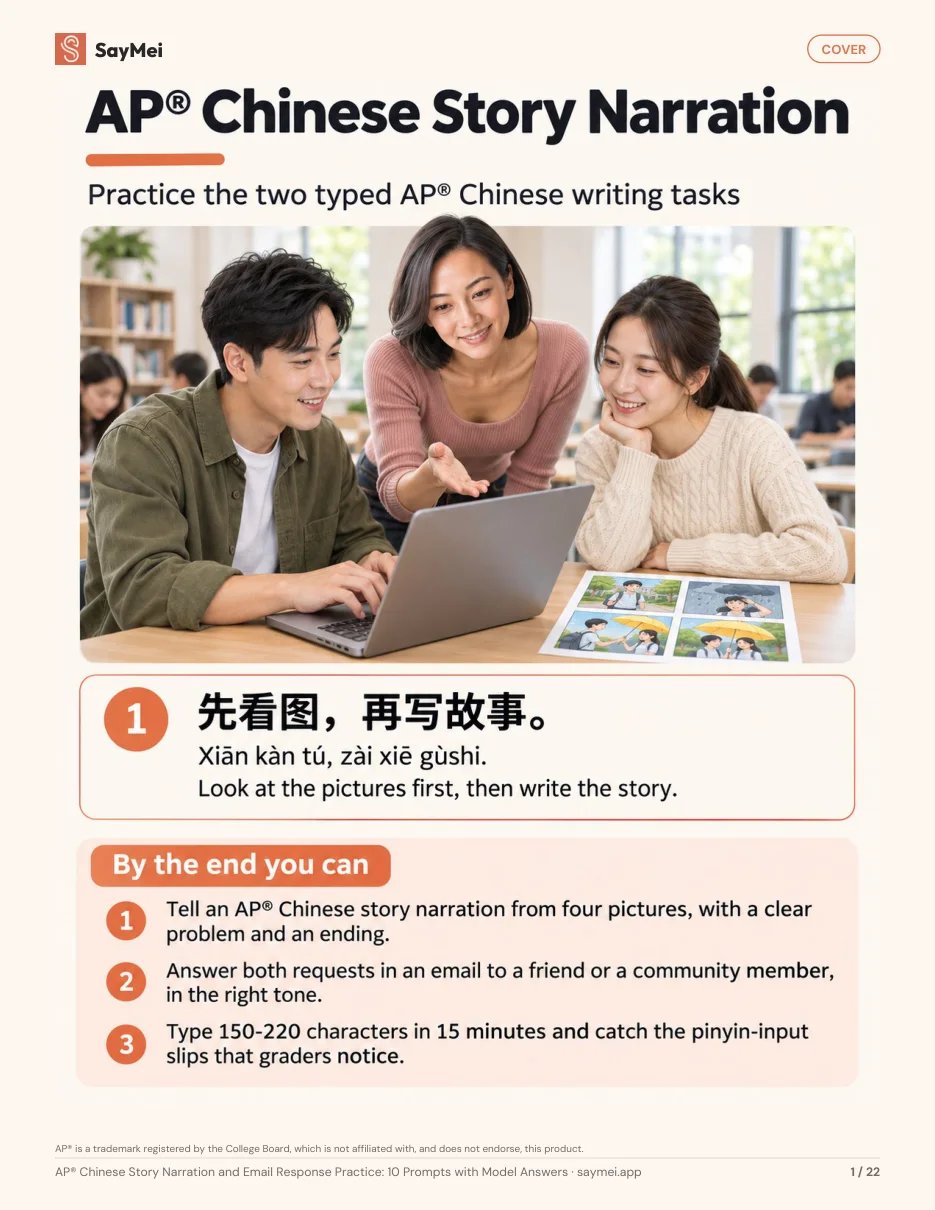
先看图,再写故事。 · Xiān kàn tú, zài xiě gùshi. · Look at the pictures first, then write the story.
By the end you can
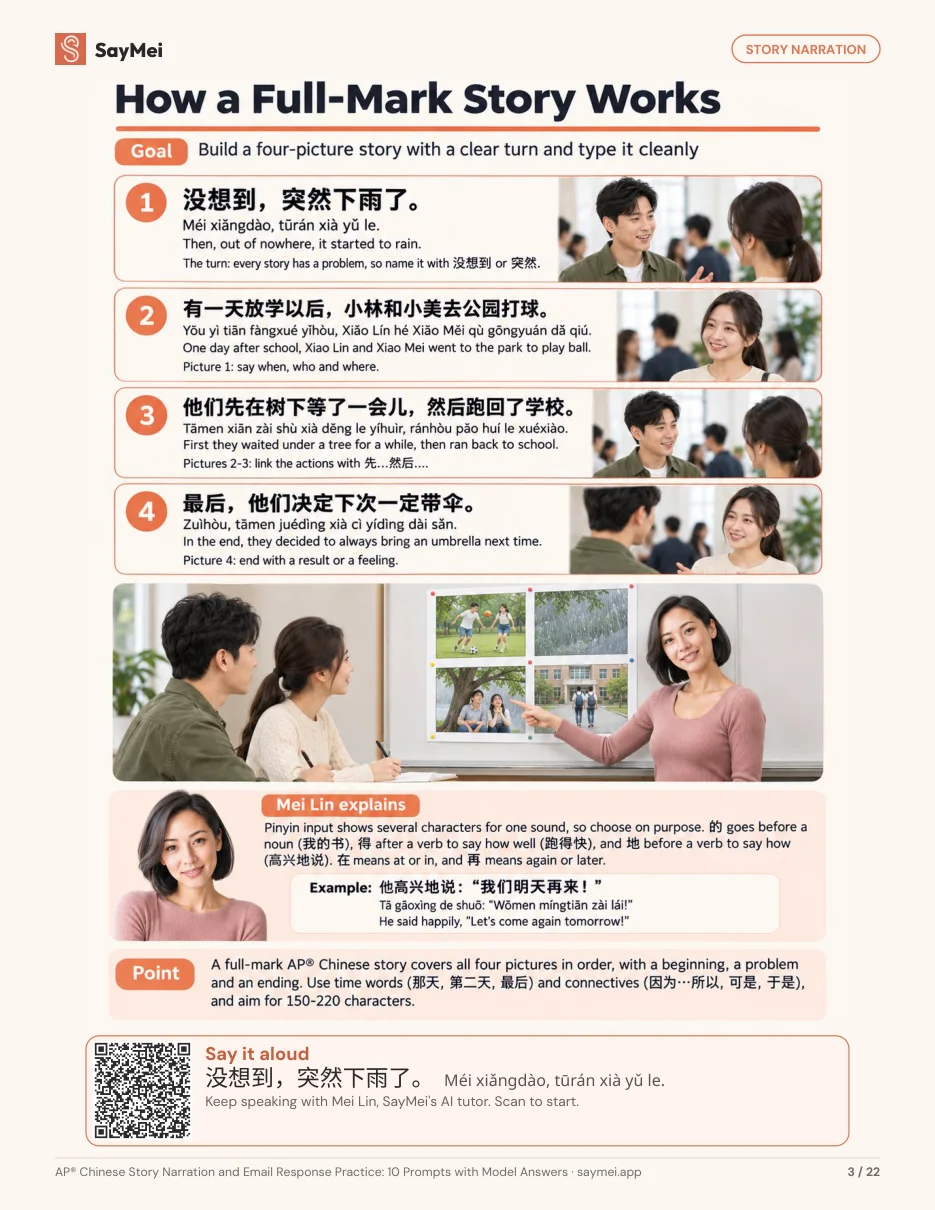
- Tell a story from four pictures with a clear turn. Open with when, who and where, name the problem with 没想到 or 突然, link the middle with 先…然后… and end with a result or a feeling.
没想到,突然下雨了。 · Méi xiǎngdào, tūrán xià yǔ le. · Then, out of nowhere, it started to rain. - Choose the right character when you type in pinyin. Pick 的, 得 or 地 on purpose, tell 在 from 再, and re-read once for sound-alike slips like 做/作 and 他/她.
他高兴地说:“我们明天再来!” · Tā gāoxìng de shuō: “Wǒmen míngtiān zài lái!” · He said happily, "Let's come again tomorrow!" - Narrate five four-picture stories. A birthday cake and a cat, a lost wallet, a phone that dies on a bike ride, a new classmate and a messy park, each with connective drills, an ordering drill and a model story.
今天是奶奶的生日。 · Jīntiān shì nǎinai de shēngrì. · Today is Grandma's birthday. - Answer both requests in an email. Build every reply in six steps: greeting, thanks, answer 1, answer 2 with a reason, one question back and a closing. Name each request before you answer it.
关于你的第一个问题,我觉得周六下午最好。 · Guānyú nǐ de dì-yī gè wèntí, wǒ juéde zhōuliù xiàwǔ zuì hǎo. · About your first question, I think Saturday afternoon is best. - Match the tone to the reader. Write to a friend with 你 and a relaxed tone, and to a teacher, librarian or community member with 您 in every line, then close with 祝….
祝你周末愉快! · Zhù nǐ zhōumò yúkuài! · Have a great weekend! - Reply to five emails from friends and community members. A friend choosing a summer camp, a teacher who needs Mid-Autumn volunteers, a friend coming to your school, a library manager asking for ideas and a friend whose grandma is moving in.
我想教小朋友做灯笼。 · Wǒ xiǎng jiāo xiǎopéngyou zuò dēnglong. · I'd like to teach the children to make lanterns. - Write 150-220 characters in 15 minutes. Think for two minutes, write for ten and check for three, then finish with one timed story and one timed email. Every model answer in the key is in that range.
先看图,再写故事。 · Xiān kàn tú, zài xiě gùshi. · Look at the pictures first, then write the story.
What’s inside
- Story narration: How a Full-Mark Story Works
- Story 1: Story 1: Grandma's Birthday Cake
- Story 2: Story 2: The Wallet in the Library
- Story 3: Story 3: The Phone Runs Out
- Story 4: Story 4: The New Classmate
- Story 5: Story 5: Cleaning Up the Park
- Email response: Answer Both Requests in an Email
- Email 1: Email 1: Which Summer Camp?
- Email 2: Email 2: Helping at Mid-Autumn
- Email 3: Email 3: A Friend Is Coming
- Email 4: Email 4: Ideas for the Library
- Email 5: Email 5: Grandma Moves In
- Checklist: Before Time Runs Out
- Final practice: One Timed Story, One Timed Email
How to use this book
One page a day, as the book suggests: read the pictures or the email, do the short drills, then set a 15-minute timer and type your answer before you look at the model in the key. That's about two weeks for the whole book.
- Day 1: How a story works. Page 3. Learn the four-picture plan, the words for the turn and the 的, 得, 地 rule.
- Days 2–6: Five stories. Pages 4 to 8, one a day. Type each story in 15 minutes, then tell it aloud in about a minute without notes.
- Day 7: How an email works. Page 9. Learn the six steps, and when to use 你 or 您.
- Days 8–12: Five emails. Pages 10 to 14, one a day. Copy out the two requests first, then type your reply in 15 minutes.
- Day 13: Check and run the clock. Learn the checklist on page 15, then write the timed story and email on page 16. The model answers are on pages 17 to 22.
Who it’s for
Students preparing for the AP® Chinese Language and Culture exam in the 2027 format, and their teachers, who want to practise the two typed tasks: story narration and the email response.
Before you start: Chinese at about HSK 3-4, and a computer or phone with pinyin or zhuyin input, since you type both answers. Every Chinese line is on the free audio.
Frequently asked questions
How long should my story and email be?
The book aims for 150 to 220 characters each, typed in 15 minutes, because story narration and the email response share 30 minutes on the AP® Chinese exam. Every model answer in the key is in that range.
Can I type with zhuyin instead of pinyin?
Yes. You type both answers with pinyin or zhuyin input, and the typing tips cover the slip both share: the right sound with the wrong character, like 的, 得 and 地 or 在 and 再.
Where are the model answers?
In the key on pages 17 to 22: a model story or email by SayMei for all ten prompts and the final timed pair, plus answers to every drill. Type your own answer before you look.
Is this workbook free?
Yes. The whole 22-page PDF is free, and you can look through its pages here before you download. There's no card and nothing to pay.
Do I need a SayMei account?
Yes, to download the PDF, and the account is free: sign up with Google, Apple or your email address. With it we email you a copy of the workbook, keep every workbook you download on your account on all your devices, save your place in the free online practice, and you can practise speaking with Mei Lin, SayMei's AI tutor.
How do I print it?
The PDF is US Letter size. On A4 paper, choose "Fit to page" (or "Scale to fit") in the print dialog so nothing is cut off. Print the whole workbook or only the pages you need; colour looks best, and black and white works too.
Can I print copies for my class?
Yes. Print as many copies as you like for your own class or family. To share it, send this page: everyone can download their own copy.
Keep going
AP® Chinese Speaking Practice: Project Presentation and Q&A (2027 Format) · AP® Chinese Listening Practice: 35 Questions in the 2027 Exam Format, with Audio · AP® Chinese Reading Practice: 35 Questions in the 2027 Exam Format, with Answers · GCSE Chinese Speaking Practice: Role Plays, Picture Tasks and Conversation Questions · More exam practice · Browse all 294 workbooks
AP® is a trademark registered by the College Board, which is not affiliated with, and does not endorse, this product.
Version 2026-11 · Updated Nov 4, 2026 · Report a correction