Conversation · Beginner (HSK 1–2)
Chinese Self-Introduction Worksheets (自我介绍): Introduce Yourself in Mandarin, with Model Introductions and Audio
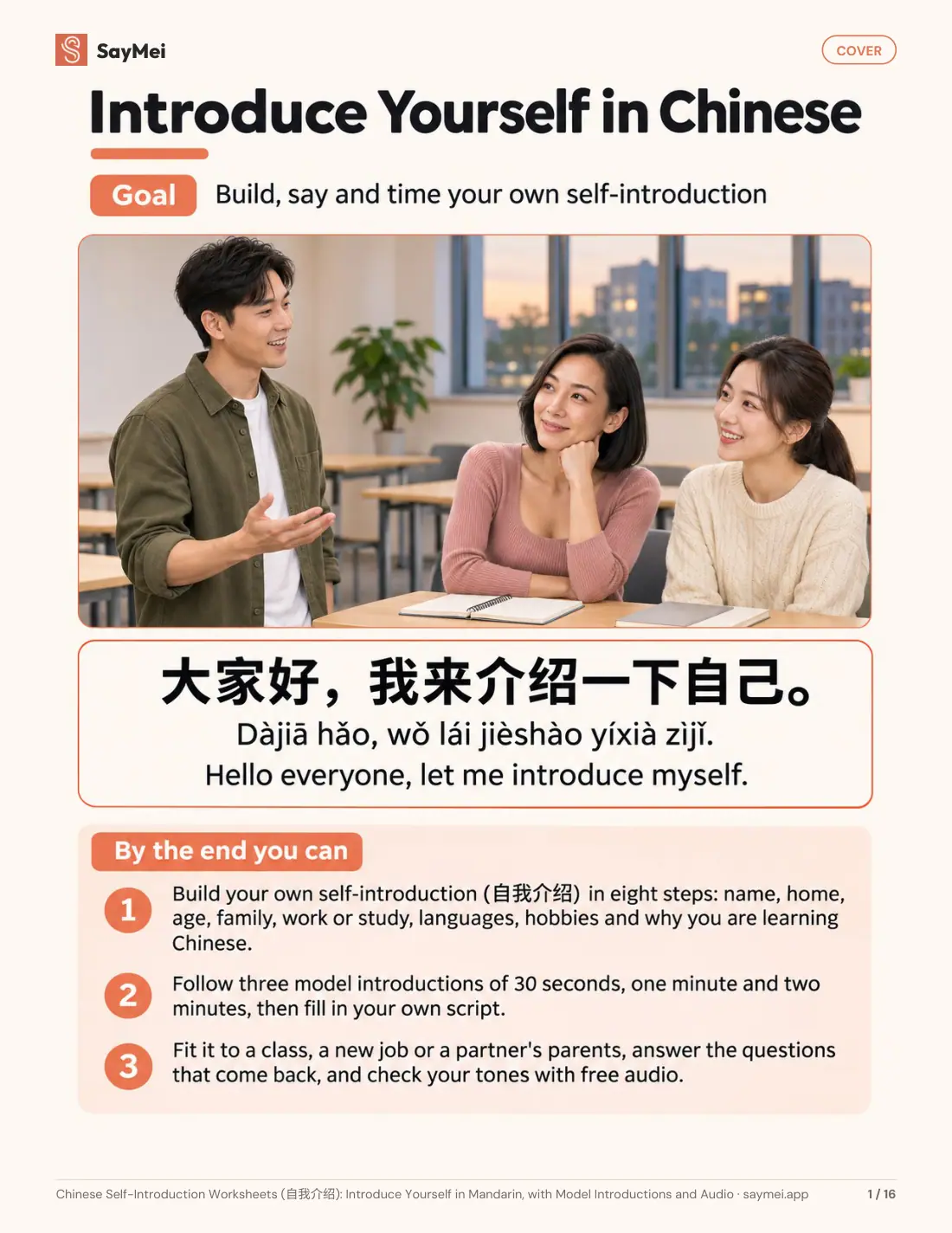
Build your own Chinese self-introduction (自我介绍) in eight steps, follow three model introductions of 30 seconds, one minute and two minutes, then fill in your script and check your tones with free audio.
- Level:
- Beginner · HSK 1–2
- Format:
- Workbook · PDF · 16 pages · US Letter (prints on A4)
- Price:
- Free · free with a saymei account · updated Nov 17, 2026
Listening audio: play every track free, no account needed.
Download the free PDF: create a free SayMei account on this page, and we'll email you a copy too.
大家好,我来介绍一下自己。 · Dàjiā hǎo, wǒ lái jièshào yíxià zìjǐ. · Hello everyone, let me introduce myself.
By the end you can
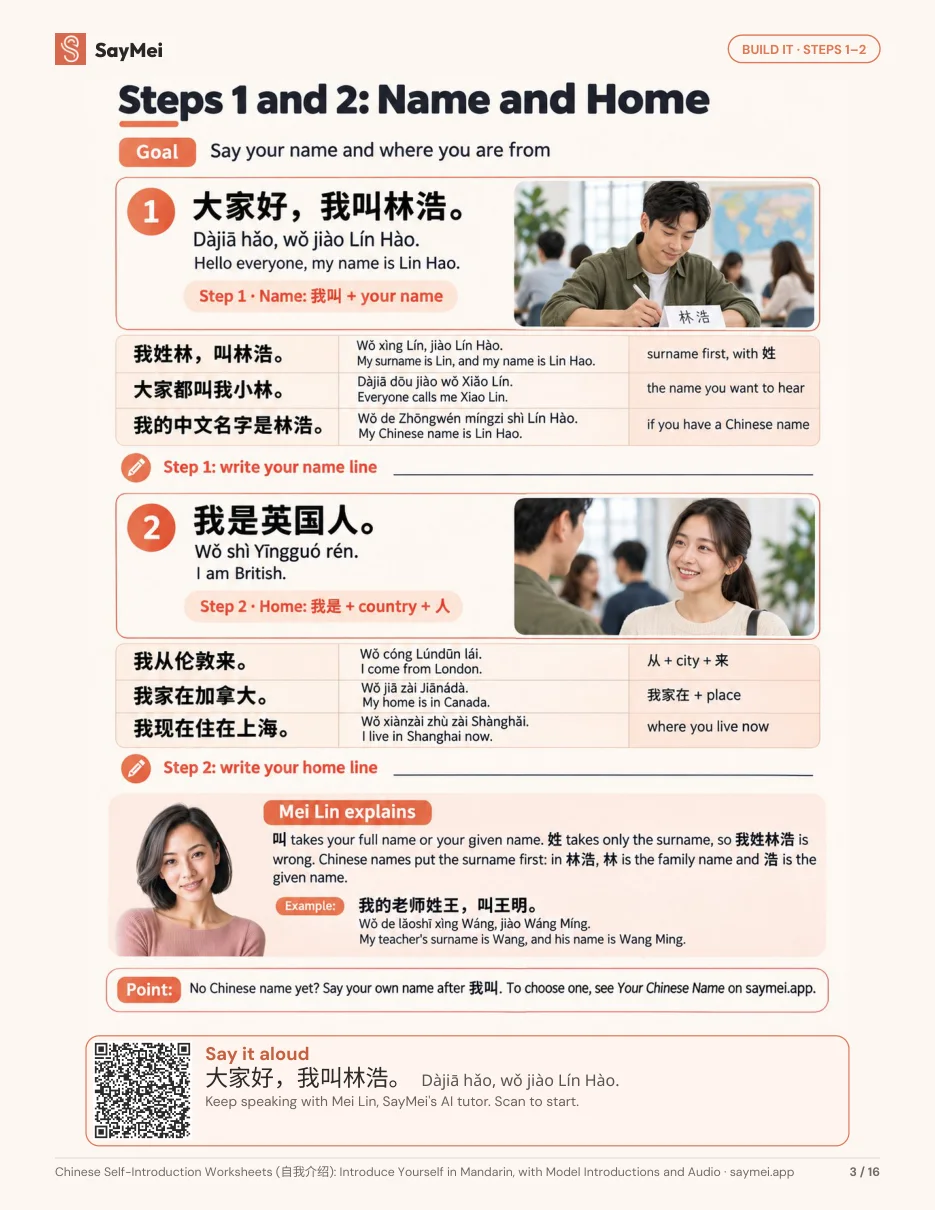
- Say your name and where you are from. Open with 大家好, give your name with 叫 or 姓, and say your country, your city or where you live now.
大家好,我叫林浩。 · Dàjiā hǎo, wǒ jiào Lín Hào. · Hello everyone, my name is Lin Hao. - Give your age, or keep it vague politely. Say 我今年 + number + 岁 with no 是, round it with 多 or 几, or leave it out the way many adults do.
我四十多岁了。 · Wǒ sìshí duō suì le. · I am in my forties. - Talk about your family, your work or your studies. Count your family with 口人, name who is in it, and say your job or where you study with 我是 and 在.
我家有四口人。 · Wǒ jiā yǒu sì kǒu rén. · There are four people in my family. - Say which languages you speak and what you like doing. Use 我会说 for languages, add how long you have learned Chinese, and give a hobby with 我的爱好是 or 我喜欢.
我的爱好是跑步。 · Wǒ de àihào shì pǎobù. · My hobby is running. - Explain why you are learning Chinese. Join a reason and a result with 因为 and 所以, or give the reason as a sentence of its own.
因为我想去中国,所以我学中文。 · Yīnwèi wǒ xiǎng qù Zhōngguó, suǒyǐ wǒ xué Zhōngwén. · I want to go to China, so I am learning Chinese. - Give a 30-second, one-minute or two-minute introduction. Three model introductions grow from five short sentences to ten longer ones, and a fill-in script puts your own lines in order.
很高兴认识大家! · Hěn gāoxìng rènshi dàjiā! · I am glad to meet you all! - Fit your introduction to class, work or a partner's parents. Change the opening and the closing for the room, and answer the questions people ask back, such as how long you have studied.
叔叔好,阿姨好! · Shūshu hǎo, āyí hǎo! · Hello, Uncle. Hello, Auntie. - Get the tones right before you speak. Six tone traps from real introductions: third tones in a row in 你好 and 我想, 一 as yí or yì, and 不 as bú before a fourth tone.
我不是老师。 · Wǒ bú shì lǎoshī. · I am not a teacher.
What’s inside
- Build it: Steps 1–2: Steps 1 and 2: Name and Home · Steps 3–4: Steps 3 and 4: Age and Family · Steps 5–6: Steps 5 and 6: Work and Languages · Steps 7–8: Steps 7 and 8: Hobbies and Why
- Model 1: 30 seconds: Model 1: A 30-Second Introduction
- Model 2: One minute: Model 2: A One-Minute Introduction
- Model 3: Two minutes: Model 3: Two Minutes, Part 1 · Two minutes, part 2: Model 3: Two Minutes, Part 2
- Fit the room: Formal or casual: Formal or Casual: Three Rooms · Questions back: Questions People Ask Back
- Your turn: Script: My Introduction: Fill-In Script · Say it aloud: Say It Aloud: Tone Traps · Marking sheet: Peer and Self Marking Sheet
How to use this book
Four short sessions take you from a blank page to a spoken introduction. Play the free audio, say each line back in the pause, and write your own line before you move on.
- Session 1: Build your eight lines. Work through pages 3 to 6. For each step, say the pattern and the three swaps with the audio, then write your own line.
- Session 2: Follow the three models. Say Model 1, Model 2 and Model 3 with the audio on pages 7 to 10, one sentence at a time, and notice which steps each speaker uses or leaves out.
- Session 3: Write and fit your script. Fill in the script on page 13, choose an opening and a closing for your room from page 11, and practise the follow-up questions on page 12.
- Session 4: Rehearse, time and mark. Check the six tone traps on page 14, time yourself at 30 seconds or one minute, then mark it with a partner on page 15.
Who it’s for
Adult and teen beginners who need to introduce themselves in Chinese in a class, at work or to new people, and teachers who want a ready first-week speaking task with models, a script and a marking sheet.
Before you start: You need pinyin and a few weeks of Chinese. Every line has pinyin and English, and the words are from new HSK levels 1 and 2 plus names of jobs, countries and languages.
Frequently asked questions
How do you introduce yourself in Chinese?
Start with 大家好 (hello everyone) for a group, give your name with 我叫, then add where you are from, what you do and one thing you like, and close with 很高兴认识大家. The worksheets build each of these lines step by step and show three complete model introductions.
Do I have to say my age in a Chinese self-introduction?
No. Teens in class usually give it, and adults often leave it out or keep it vague: 我三十多岁 means "I am in my thirties". Step 3 shows the straight answer and two vague ones, and page 12 shows a light reply when someone asks.
How long should a self-introduction be?
For a first class, 30 seconds is enough: five short sentences. The three models take about 30 seconds, one minute and two minutes at a steady beginner's pace, so you can choose the length your class or your exam asks for.
Can teachers use these worksheets in class?
Yes. Each page works as a single handout: four step pages for building lines, three models to read aloud, a fill-in script, and a marking sheet with six points scored 1 to 3 for peer or self marking.
How is this different from How to Introduce Yourself in Chinese?
That book is the two-way first conversation: trading names, asking back and follow-up questions. These worksheets are the one-person introduction you give to a class or a group, with a script, timed models and a marking sheet. Many learners use both.
Do I need a SayMei account?
Yes, to download the PDF, and the account is free: sign up with Google, Apple or your email address. With it we email you a copy of the workbook, keep every workbook you download on your account on all your devices, save your place in the free online practice, and you can practise speaking with Mei Lin, SayMei's AI tutor.
How do I print it?
The PDF is US Letter size. On A4 paper, choose "Fit to page" (or "Scale to fit") in the print dialog so nothing is cut off. Print the whole workbook or only the pages you need; colour looks best, and black and white works too.
Keep going
How to Introduce Yourself in Chinese: Phrases and Follow-Up Questions · Your First 14 Days of Spoken Mandarin · Chinese Listening Practice for Beginners: 30 Real-Life Audio Clips · Spoken Mandarin Days 31–60: A Month of Daily Speaking Practice · Browse all 367 workbooks
In these collections: Chinese Worksheets: Printable Packs with Answer Keys · Mandarin Conversation Workbooks · HSK 2 Chinese Workbooks · HSK 1 Chinese Workbooks
Version 2026-11 · Updated Nov 17, 2026 · Report a correction