HSK · HSK 1 (HSK 3.0)
HSK 1 Speaking Practice: 100 Sentences and Short Answers to Say Aloud, with Audio
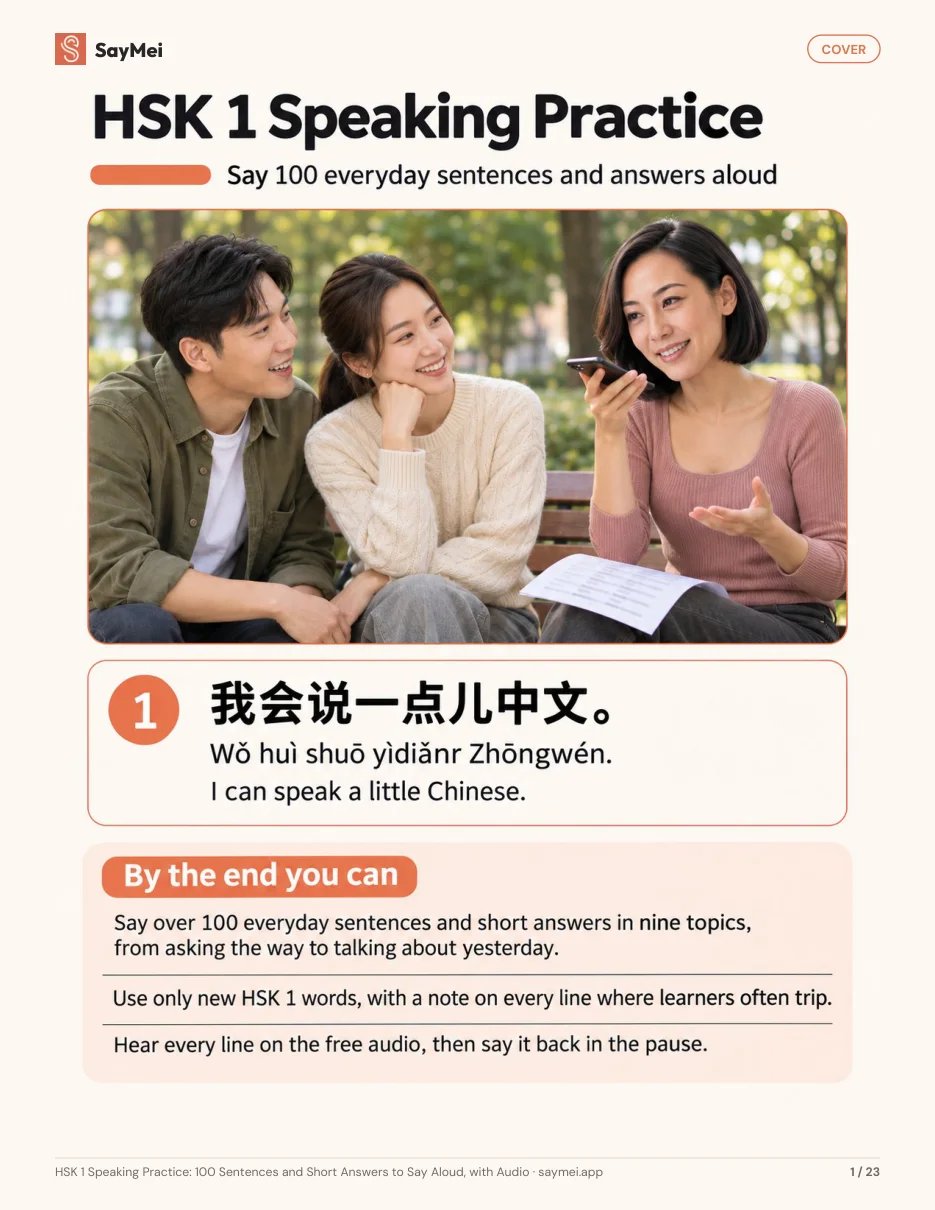
Over 100 everyday sentences and short answers to say aloud in nine topics, all in new HSK 1 words, with a note on every line where learners trip and free audio to say each one back.
- Level:
- HSK 1 (new HSK)
- Format:
- Workbook · PDF · 23 pages · US Letter (prints on A4)
- Price:
- Free · free with a saymei account · updated Nov 12, 2026
Listening audio: play every track free, no account needed.
Download the free PDF: create a free SayMei account on this page, and we'll email you a copy too.
我会说一点儿中文。 · Wǒ huì shuō yìdiǎnr Zhōngwén. · I can speak a little Chinese.
By the end you can
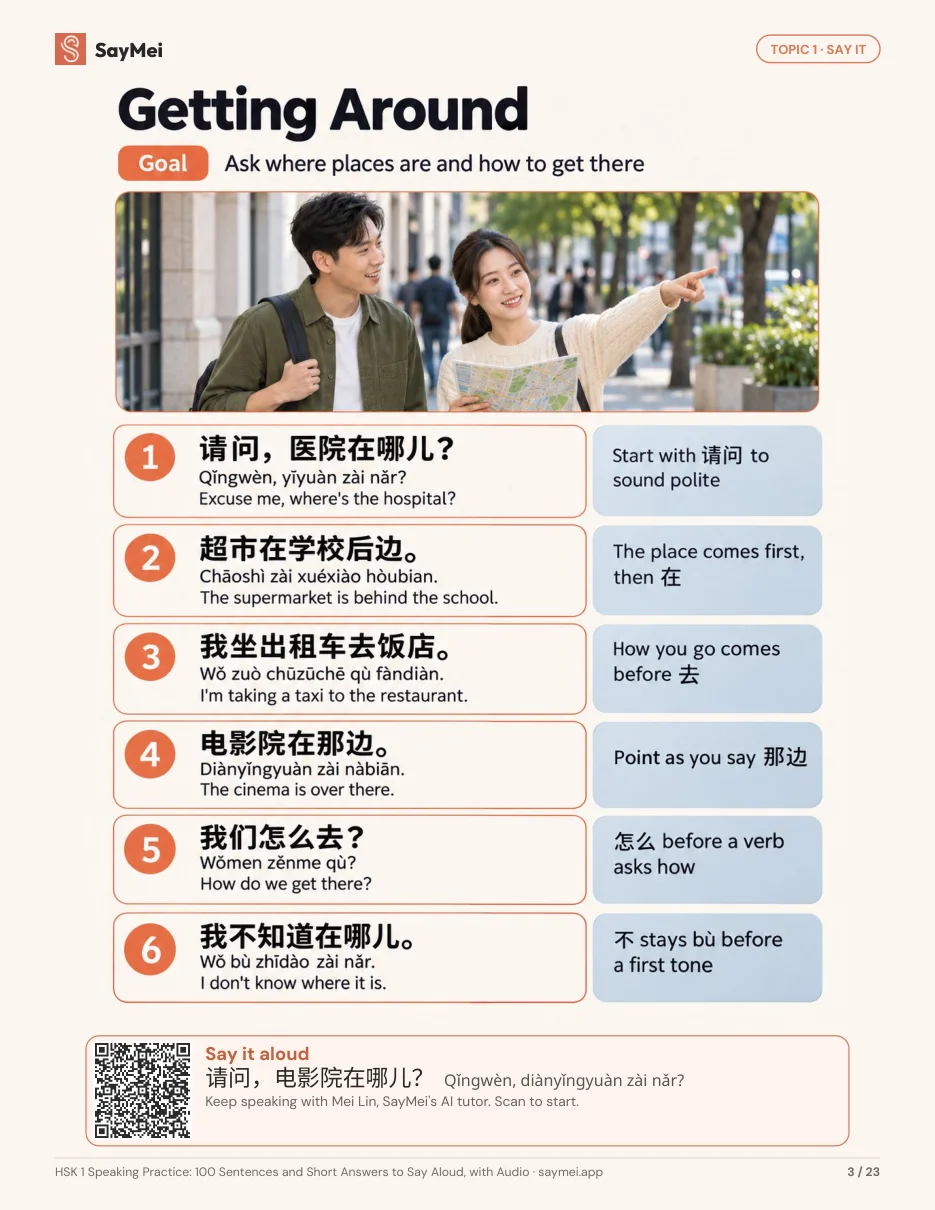
- Ask where places are and how to get there. Start with 请问, put the place before 在, and say how you go before 去: 我坐出租车去饭店.
请问,医院在哪儿? · Qǐngwèn, yīyuàn zài nǎr? · Excuse me, where's the hospital? - Order food and ask about prices. Order with 我要 and 两个, ask 这个多少钱, and say 太贵了 when it is too much.
我要两个包子。 · Wǒ yào liǎng gè bāozi. · I'd like two steamed buns. - Talk about the weather, the time and the date. Say 今天真热, ask 现在几点了 and answer with 两点半, putting the time before the verb.
现在两点半。 · Xiànzài liǎng diǎn bàn. · It's half past two. - Introduce yourself and take a phone call. Give your name with 叫, answer the phone with 喂, and ask for a number with 多少.
你的电话是多少? · Nǐ de diànhuà shì duōshao? · What's your phone number? - Say you're ill and what you need. Use 我生病了, 看病 and 休息, and hear how 了 shows a change.
我要去医院看病。 · Wǒ yào qù yīyuàn kànbìng. · I need to go to the hospital. - Talk about yesterday, likes and plans. Use 了 for what you did and 没 for what you didn't, then say what you like and want to do with 喜欢 and 想.
我昨天没上班。 · Wǒ zuótiān méi shàngbān. · I didn't go to work yesterday. - Get the tones right where learners trip. Each sentence has a note: 你好 and 我想 start with a rising tone, 不 becomes bú before a fourth tone, and 两 is used for two of something.
我不要鸡蛋。 · Wǒ bú yào jīdàn. · No egg for me.
What’s inside
- Topic 1: Say it: Getting Around · Ask and answer: Where Is It?
- Topic 2: Say it: Ordering Food and Drink · Ask and answer: What Would You Like?
- Topic 3: Say it: Prices · Ask and answer: How Much Is It?
- Topic 4: Say it: Weather · Ask and answer: Is It Cold?
- Topic 5: Say it: Times and Dates · Ask and answer: What Time?
- Topic 6: Say it: Names and Phone Calls · Ask and answer: Who Are You?
- Topic 7: Say it: Feeling Ill · Ask and answer: What's Wrong?
- Topic 8: Say it: Today and Yesterday · Ask and answer: What Did You Do?
- Topic 9: Say it: Likes and Plans · Ask and answer: What Do You Like?
- Self-check: Self-Check: Eight Questions
How to use this book
One topic a day takes about two weeks. Play the free audio, say each line back in the pause, then answer the questions about yourself before you look at the replies.
- Each day: One topic, two pages. Read the six Say It sentences and their notes, then say each one with the audio.
- Same day: Ask and answer. Cover the answers, answer the four questions aloud about yourself, then finish the two replies.
- Days 1–9: All nine topics. From Getting Around to Likes and Plans, one topic at a time.
- Day 10: Self-check. Answer the eight questions on page 21 aloud in full sentences, then compare with the model answers.
Who it’s for
Beginners working toward HSK 1, or who know some HSK 1 words but freeze when it's time to speak, and anyone looking for HSK 1 speaking practice with audio.
Before you start: Every word is from the new HSK 1 list, and every line has pinyin and English, so you can start in your first weeks of Chinese.
Frequently asked questions
Does it use only HSK 1 words?
Yes. Every Chinese line uses words from the new HSK 1 list (HSK 3.0, 2025 syllabus), so it fits beside any HSK 1 course.
How is it different from a course book?
It is only speaking: short sentences and answers to say aloud with the audio, with a note on each line where learners usually trip, and questions to answer about yourself.
Where is the audio?
On this book's page on saymei.app: scan the code on the how-to page. It reads every sentence and answer, then pauses so you can say it back.
Why is 不 sometimes written bú?
Before a fourth tone, 不 is said with a rising tone, so the pinyin shows bú as you'll say it, like 不要 bú yào. 一 is printed as said too, like 一个 yí gè.
Do I need a SayMei account?
Yes, to download the PDF, and the account is free: sign up with Google, Apple or your email address. With it we email you a copy of the workbook, keep every workbook you download on your account on all your devices, save your place in the free online practice, and you can practise speaking with Mei Lin, SayMei's AI tutor.
How do I print it?
The PDF is US Letter size. On A4 paper, choose "Fit to page" (or "Scale to fit") in the print dialog so nothing is cut off. Print the whole workbook or only the pages you need; colour looks best, and black and white works too.
Keep going
HSK 1 Reading Practice: Signs, Messages & Micro-Stories · HSK 1 Vocabulary Recall & Speaking Workbook · HSK 1 Guided Writing Workbook: Characters to Sentences · HSK 1 Mock Test: Practice Test in the New HSK Format · Browse all 340 workbooks
Version 2026-11 · Updated Nov 12, 2026 · Report a correction