HSK · HSK 5 (HSK 3.0)
HSK 5 Reading Practice 2: Cloze, Paragraph Order & Long Passages
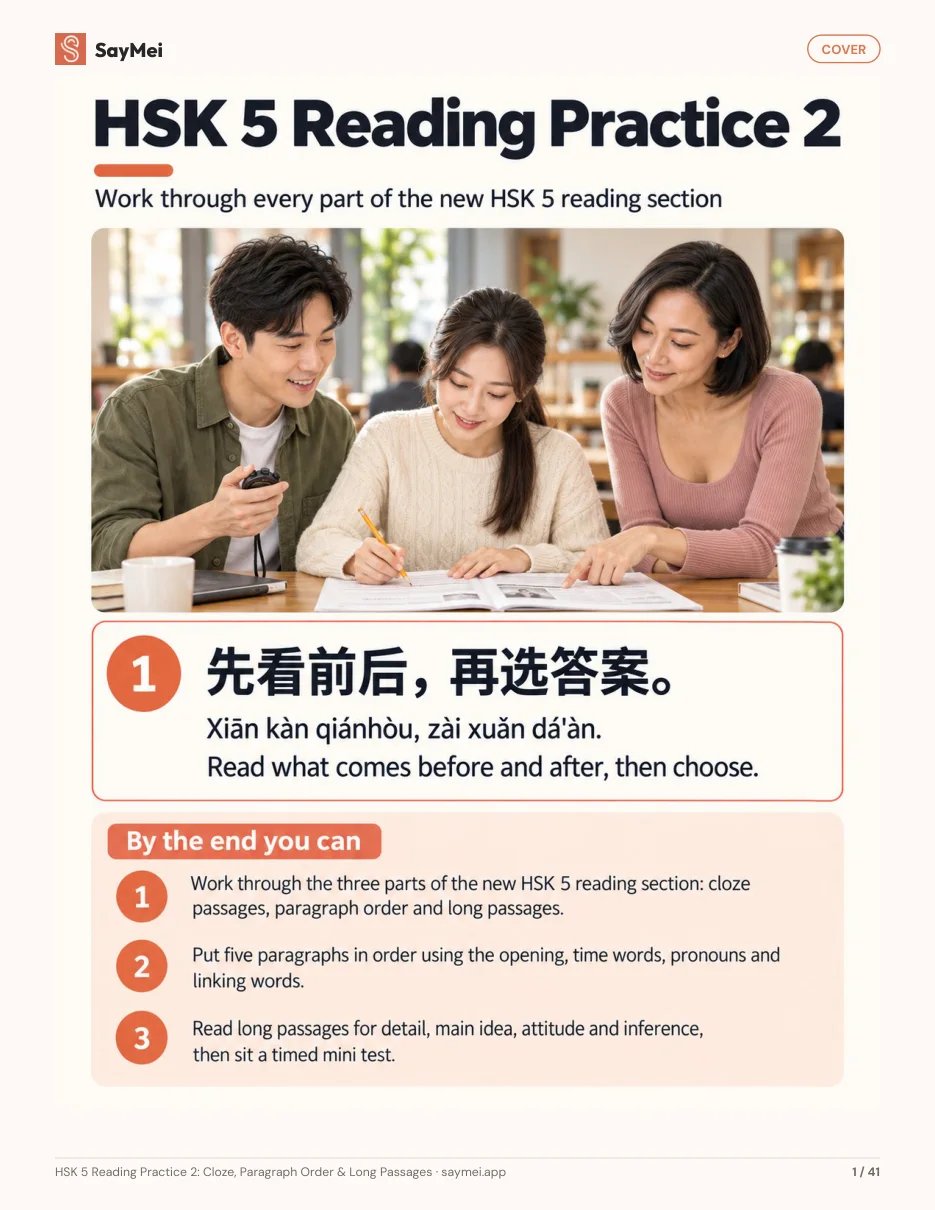
You choose cloze words by their partner word, put a tea farm's story back in order and read a two-page article on sleep and memory. For learners who read comfortably at HSK 4 level.
- Level:
- HSK 5 (new HSK)
- Format:
- Workbook · PDF · 42 pages · US Letter (prints on A4)
- Price:
- Free · free with a saymei account · updated Nov 1, 2026
Download the free PDF: create a free SayMei account on this page, and we'll email you a copy too.
先看前后,再选答案。 · Xiān kàn qiánhòu, zài xuǎn dá'àn. · Read what comes before and after, then choose.
By the end you can
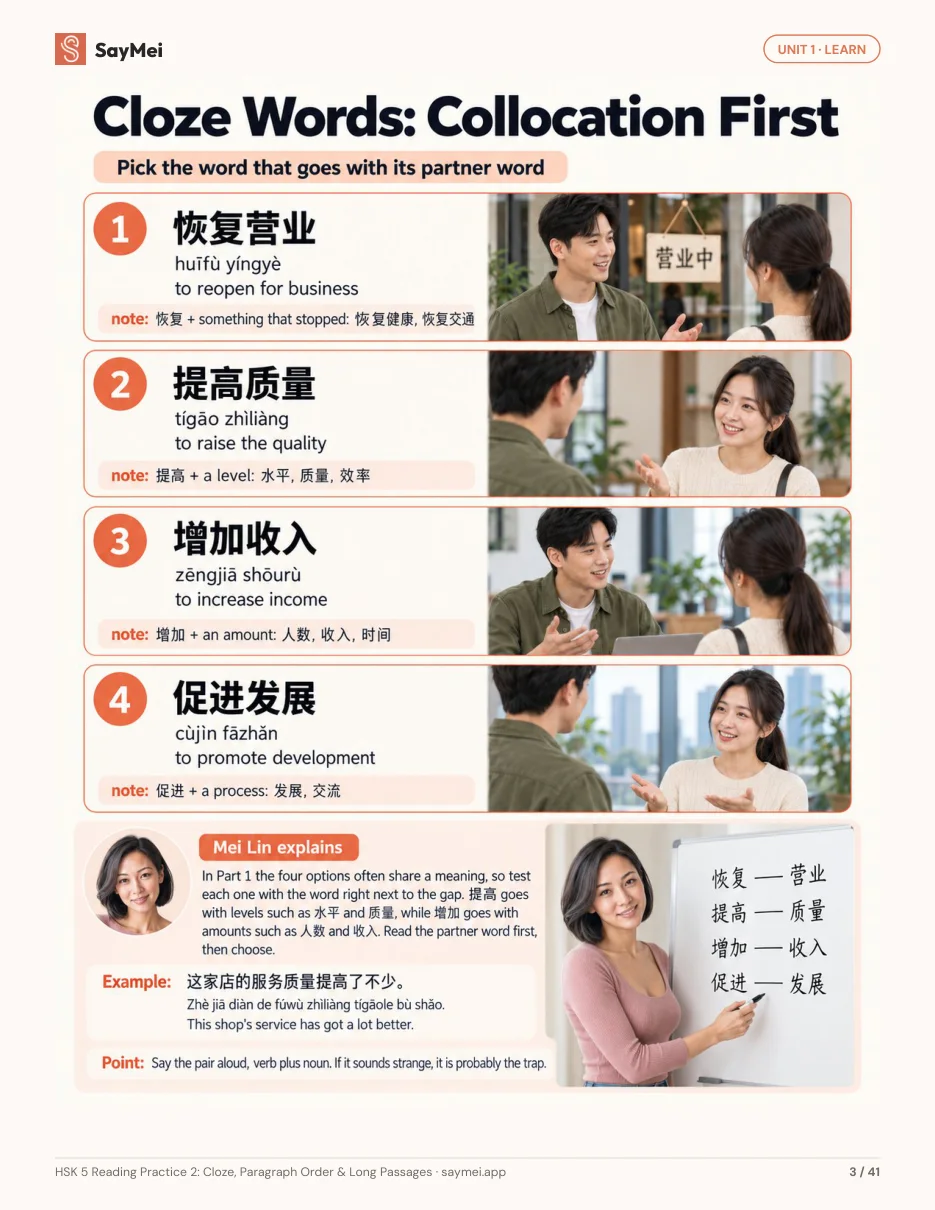
- Choose cloze words by the word they pair with. When four options share a meaning, test each with its partner word: 提高 goes with levels like 水平 and 质量, 增加 with amounts like 人数 and 收入.
提高质量 · tígāo zhìliàng · to raise the quality - Fill a sentence gap that fits both sides. Read the sentence before and after the gap. If the next one is an answer, the gap may be a question, and an option that only matches the topic is usually the trap.
有人问他为什么。 · Yǒu rén wèn tā wèi shénme. · Someone asked him why. - Find the opening paragraph and follow the links. The opening names the person or topic in full and never starts with 他, 这, 但是 or 于是. Practised on five paragraphs about a family tea farm that went online.
刚开始,老周不支持;如今,他家的茶卖到了全国各地。 · Gāng kāishǐ, Lǎo Zhōu bù zhīchí; rújīn, tā jiā de chá màidàole quánguó gèdì. · At first Lao Zhou was against it; now his family's tea sells all over the country. - Order a story with time words and pronouns. Link each 她 or 这位老人 back to the person first named, and each 第二天 back to the day it counts from, in a five-part story about an umbrella left on a bus.
第二天一早 · dì-èr tiān yì zǎo · early the next morning - Answer detail questions in the order of the passage. Underline each question's key words and compare the options with one sentence, on a two-page article about a study of sleep and memory.
下列哪项正确? · Xiàliè nǎ xiàng zhèngquè? · Which of the following is true? - Find the main idea and the writer's view. Look for the point after 可见, 总之 or 关键是, and call a writer who weighs both sides 客观, on an article about why graduates pick smaller cities.
关键是…… · guānjiàn shì… · the key is… - Make inferences that follow in one small step. Ask which sentence proves an option, and cross out options with 一定, 所有 or 从来 that go further than the text, on an interview with a restorer of old books.
说真的 · shuō zhēn de · to be honest - Sit a timed mini test and fix two common traps. A 20-minute mini test across all three parts, scored out of 15, then Fix-it pages on near-synonym traps and false openings, and eight word cards.
我对了十二题,第二部分还要多练习。 · Wǒ duìle shí'èr tí, dì-èr bùfen hái yào duō liànxí. · I got twelve right; I need more practice on Part 2.
What’s inside
- Unit 1: Learn: Cloze Words: Collocation First · Text: The Night Market Reopens · Practice: Cloze: The Night Market
- Unit 2: Learn: Sentence Gaps: Read Both Sides · Text: Mr Zhao's Free Bike Repairs · Practice: Cloze: Mr Zhao's Bike Stand
- Unit 3: Learn: Paragraph Order: Find the Opening · Text: How a Small Tea Farm Went Online · Practice: Order: The Tea Farm
- Unit 4: Learn: Order a Story: Time and Pronouns · Text: The Umbrella on the Bus · Practice: Order: The Umbrella on the Bus
- Reference: Words That Fix the Order
- Unit 5: Learn: Long Passages: Detail in Order · Text: Sleep and Memory: A Study · Text: Sleep and Memory (Continued) · Practice: Detail: Sleep and Memory
- Unit 6: Learn: Main Idea and the Writer's View · Text: Why Graduates Pick Smaller Cities · Text: Smaller Cities (Continued) · Practice: Main Idea: Smaller Cities
- Unit 7: Learn: Inference: Read Between the Lines · Text: Interview: Mending Old Books · Text: Mending Old Books (Continued) · Practice: Inference: The Book Restorer
- Mini Test: Part 1: Mini Test: Cloze · Part 2: Mini Test: Paragraph Order · Part 3: Mini Test: Long Passage
- Fix-it: Cloze: Fix-it: Near-Synonym Traps · Order: Fix-it: The False Opening
- Cards: Article Word Cards
- Review: Review: Timing a Mini Test
How to use this book
Seven units in the order of the new HSK 5 reading section. Each unit has three steps: learn one strategy, read a new text, then answer exam-style questions on the next page.
- Units 1–2: Cloze. Word gaps by collocation, then sentence gaps. Say each verb and noun pair aloud: if it sounds strange, it's probably the trap.
- Units 3–4: Paragraph order. An article and a story to put in order. Write the order under the letters as you go and cross out each paragraph once it's placed.
- Units 5–7: Long passages. Each passage runs over two pages. Read the questions first, read both pages, then answer detail, main-idea and inference questions.
- Every unit: Mark it. Try every question before you check the answer key, and mark the line in the text that gave you each answer.
- Pages 28–30: Mini test. Set a 20-minute timer and do the three pages in one sitting. Count your score out of 15.
- Pages 31–34: Fix-it and review. Work through the near-synonym and false-opening pages, review the word cards, then compare your timing with Lin Hao and Xiaoyu's.
Who it’s for
Learners preparing for the reading section of new HSK 5 (HSK 3.0) who want new texts for every part: cloze, paragraph order and long passages.
Before you start: Read comfortably at HSK 4 level. The texts are in characters only, and the harder words are on phrase cards with pinyin and English.
Frequently asked questions
What's inside?
Seven units in the order of the new HSK 5 reading section. Units 1 and 2 are cloze, on a night market and free bike repairs. Units 3 and 4 are paragraph order, on a tea farm that went online and an umbrella left on a bus. Units 5 to 7 are long passages over two pages, including an interview with a restorer of old books.
Are these real HSK 5 exam questions?
No. SayMei wrote every text and question. They are practice questions in the new HSK format, following the three parts of the new HSK 5 reading section, not official papers.
How does the mini test work?
Pages 28 to 30 cover all three parts. Set a 20-minute timer, do them in one sitting and count your score out of 15. Fix-it pages on near-synonym traps and false openings follow, then eight word cards.
How is it different from the first HSK 5 Reading Practice book?
Every text is new, and the units follow the three parts of the new reading section in exam order, ending in a timed mini test. You can use it on its own or after the first book.
Is there an answer key?
Yes, at the back of the book. Try every question first, then check and mark the line in the text that gave you each answer.
Do I need a SayMei account?
Yes, to download the PDF, and the account is free: sign up with Google, Apple or your email address. With it we email you a copy of the workbook, keep every workbook you download on your account on all your devices, save your place in the free online practice, and you can practise speaking with Mei Lin, SayMei's AI tutor.
How do I print it?
The PDF is US Letter size. On A4 paper, choose "Fit to page" (or "Scale to fit") in the print dialog so nothing is cut off. Print the whole workbook or only the pages you need; colour looks best, and black and white works too.
Keep going
HSK 5 Reading Practice: Articles, Arguments & Detail · HSK 5 Paraphrasing & Written Responses · HSK 5 Vocabulary Workbook: Collocations, Word Families & Recall · HSK 5 Mock Test: Practice Test in the New HSK Format · Browse all 294 workbooks
Version 2026-11 · Updated Nov 1, 2026 · Report a correction