HSK · HSK 6 (HSK 3.0)
HSK 6 Reading Practice 2: Cloze, Sentence Gaps & Long Passages
You choose cloze words by the noun they pair with, fill five gaps from six sentences and read long passages on old factories and a violin left in a taxi. For learners who read comfortably at HSK 5.
- Level:
- HSK 6 (new HSK)
- Format:
- Workbook · PDF · 40 pages · US Letter (prints on A4)
- Price:
- Free · free with a saymei account · updated Nov 1, 2026
Download the free PDF: create a free SayMei account on this page, and we'll email you a copy too.
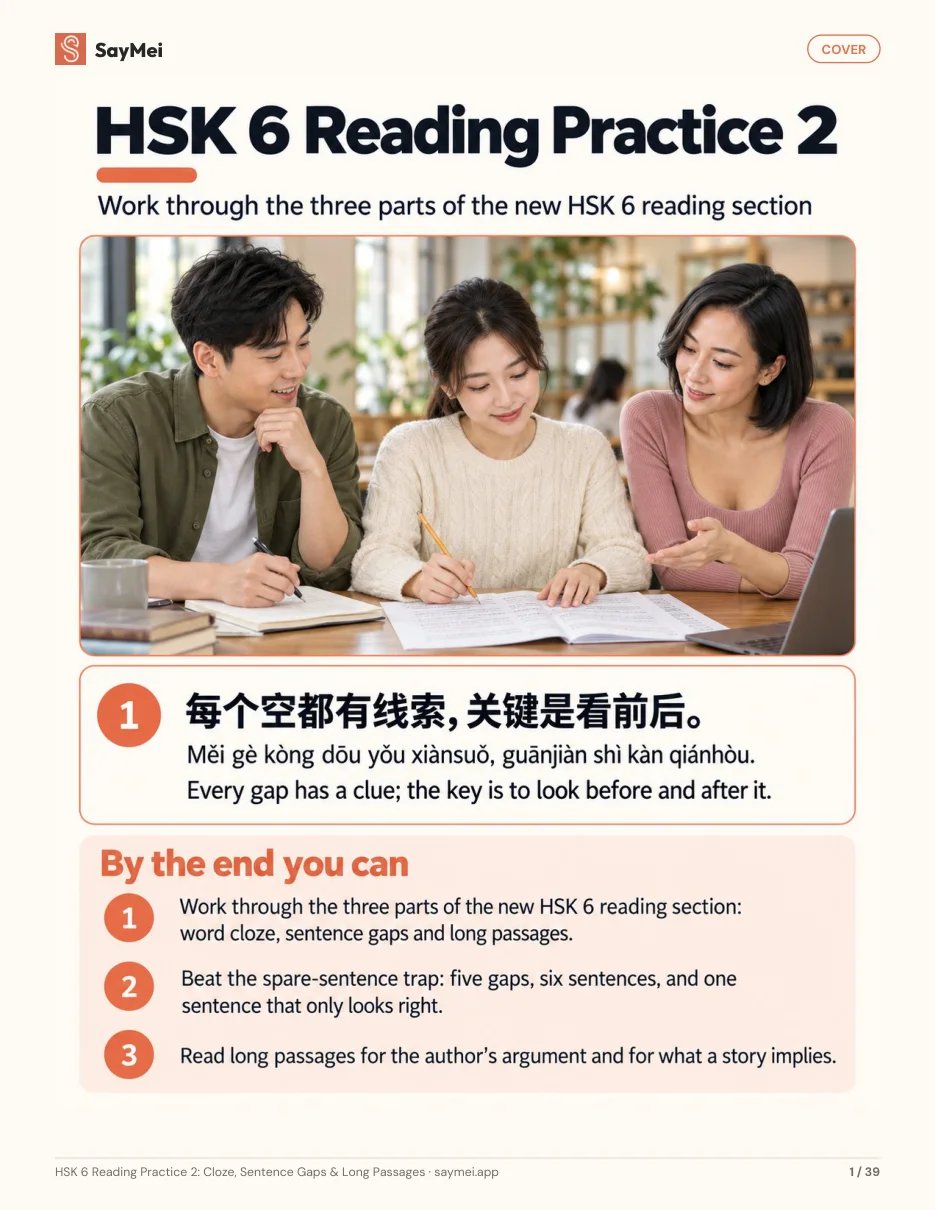
每个空都有线索,关键是看前后。 · Měi gè kòng dōu yǒu xiànsuǒ, guānjiàn shì kàn qiánhòu. · Every gap has a clue; the key is to look before and after it.
By the end you can
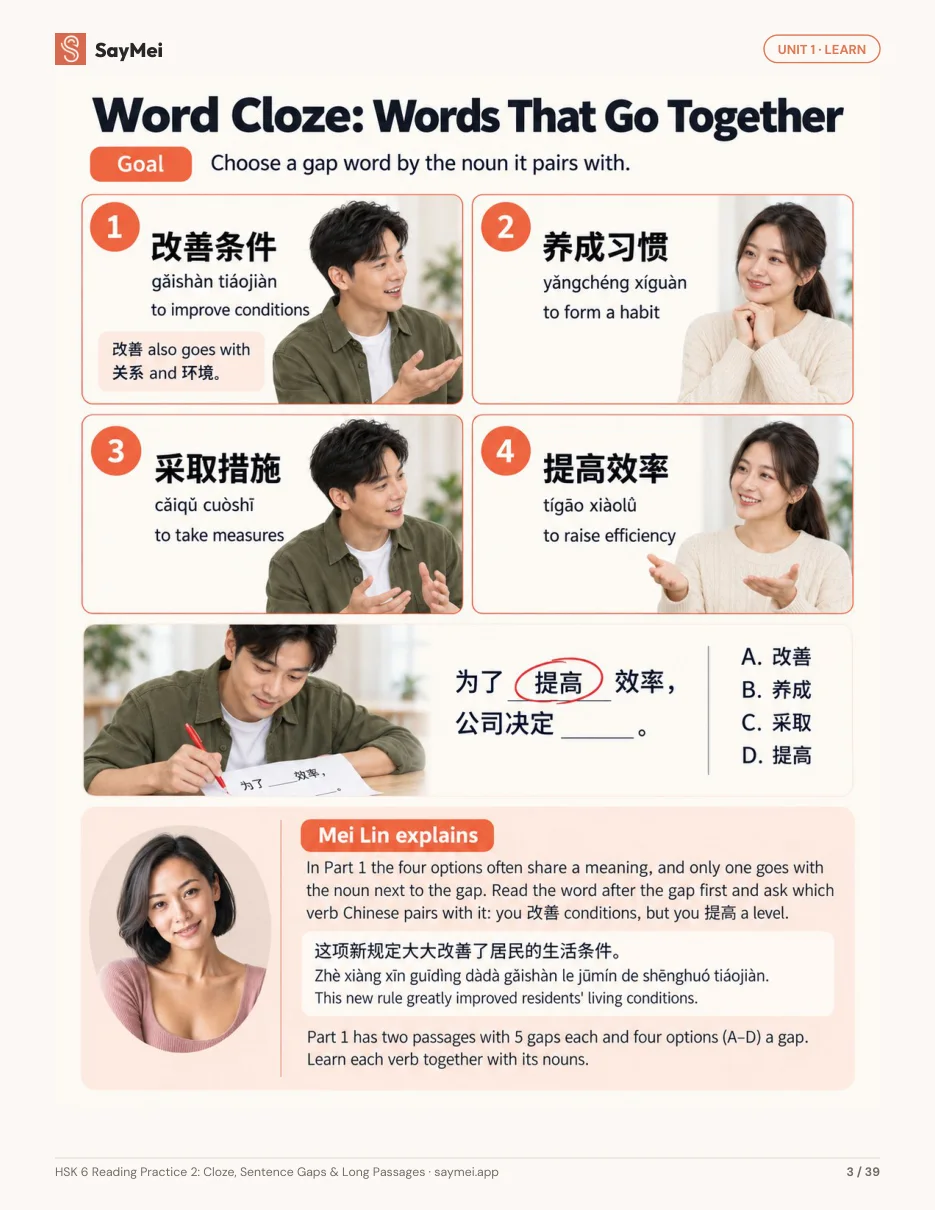
- Choose a cloze word by the noun it pairs with. Read the word after the gap first and ask which verb Chinese pairs with it: you 改善 conditions but 提高 a level. Part 1 has two passages of five gaps, with options A to D.
改善条件 · gǎishàn tiáojiàn · to improve conditions - Tell near-synonyms apart in a cloze gap. Test two close options three ways: where the word can stand, the words it goes with, and its colour. 后果 is almost always bad; 结果 is neutral.
她居然一个人修好了电脑。 · Tā jūrán yí gè rén xiūhǎo le diànnǎo. · Amazingly, she fixed the computer by herself. - Fill sentence gaps and beat the spare-sentence trap. Five gaps, six sentences, one spare. Check the sentence before and after each gap, and remember a choice starting with 这 or 此 points back, so it can't open a passage.
原因很简单 · yuányīn hěn jiǎndān · the reason is simple - Place missing sentences in a story by time and person. A sentence with 后来 or 从那以后 must follow the event it comes after, and one with 当时 sits inside it. Practised on a story about a courtyard grandfather built.
直到……才…… · zhídào……cái…… · not until … - Separate the author's view from the views quoted. Argument passages state the other side with 有人认为, then turn with 其实 or 然而. Practised on an argument about whether cities should keep old factories.
其实不然 · qíshí bùrán · in fact, that is not so - Read what a story implies and how a science text is built. Answer from actions in a story about a violin left in a taxi, then track reasons, an experiment and a limit in a text on why songs stick and lists don't.
光靠……是不够的 · guāng kào …… shì bú gòu de · … alone is not enough - Sit a timed mini test and plan your 40 minutes. A 20-minute mini test over two pages, a Fix-It page on spare sentences and near-synonyms, eight word cards, and a time plan for 40 questions in 40 minutes.
我第二部分错了两个,下次要先看空后面的句子。 · Wǒ dì èr bùfen cuò le liǎng gè, xià cì yào xiān kàn kòng hòumian de jùzi. · I got two wrong in Part 2; next time I'll read the sentence after the gap first.
What’s inside
- Unit 1: Learn: Word Cloze: Words That Go Together · Text: Bees on the Office Roof · Practice: Collocation Cloze
- Unit 2: Learn: Word Cloze: Near-Synonyms · Text: The Library the Teenagers Run · Practice: Near-Synonym Cloze
- Unit 3: Learn: Sentence Gaps: Read Both Sides · Text: Why the Other Queue Moves Faster · Text: The Other Queue (Continued) · Practice: Sentence Gaps: The Other Queue
- Unit 4: Learn: Sentence Gaps: Follow the Story · Text: The Courtyard Grandfather Built · Text: The Courtyard (Continued) · Practice: Sentence Gaps: The Courtyard
- Reference: Signals for a Missing Sentence
- Unit 5: Learn: Long Passages: The Author's View · Text: Should Cities Keep Old Factories? · Text: Old Factories (Continued) · Practice: The Author's View: Old Factories
- Unit 6: Learn: Long Passages: What Stories Imply · Text: The Violin in the Back Seat · Text: The Violin (Continued) · Practice: Reading the Taxi Driver's Story
- Unit 7: Learn: Long Passages: Popular Science · Text: Why Songs Stick and Lists Don't · Text: Songs and Lists (Continued) · Practice: Songs and Memory: Questions
- Mini Test: Parts 1–2: Mini Test: Cloze and Sentence Gaps · Parts 2–3: Mini Test: Gaps and a Long Text
- Fix-It: Fix-It: Spares and Near-Synonyms
- Word Cards: Word Cards: Article Words
- Review: Review: Planning Reading Time
How to use this book
Seven units in the order of the new HSK 6 reading section. Each unit starts with one strategy, then a new text to read without a dictionary, then exam-style questions.
- Units 1–2: Word cloze. Collocations first, then near-synonyms. Learn each verb together with its nouns.
- Units 3–4: Sentence gaps. An article and a story, five gaps and six sentences each. Cross out each sentence once you use it, then check the signal phrases on page 17.
- Units 5–7: Long passages. An argument, a story and a popular science text. Read the four questions before the passage so you know which part to read slowly.
- Pages 30–31: Mini test. Set a 20-minute timer, do both pages in one sitting, and score one point an item with the key at the back.
- Pages 32–34: Fix-It and timing. Mark your mistakes, do the Fix-It page, review the word cards, then plan your own 40 minutes part by part with Mei Lin's class.
Who it’s for
Advanced learners preparing for the reading section of new HSK 6 (HSK 3.0) who want new passages for all three parts and a timed mini test.
Before you start: Read comfortably at HSK 5 level. Every text is new, so you can use it before or after the first HSK 6 Reading Practice book. Key words are on phrase cards with pinyin and English.
Frequently asked questions
What's inside?
Seven units in the order of the new HSK 6 reading section. Units 1 and 2 are word cloze, on bees on an office roof and a library run by teenagers. Units 3 and 4 are sentence gaps, on why the other queue moves faster and a courtyard grandfather built. Units 5 to 7 are long passages: an argument, a story and a popular science text.
Are these real HSK 6 exam questions?
No. SayMei wrote every text and question. They are practice questions in the new HSK format, following the three parts of the new HSK 6 reading section, not official papers.
Do I need the first HSK 6 Reading Practice book?
No. Every text in this book is new, so you can use it before or after volume 1. This one follows the exam's three parts in order and ends with a timed mini test.
How should I plan my time?
The reading section has 40 questions in 40 minutes, so aim for about one minute a question. Pages 30 and 31 are a 20-minute mini test done in one sitting, and page 34 helps you plan your own 40 minutes part by part.
Is there an answer key?
Yes, at the back of the book, with one point an item for the mini test. Mark your mistakes, then try the Fix-It page on spare sentences and near-synonyms on page 32.
Do I need a SayMei account?
Yes, to download the PDF, and the account is free: sign up with Google, Apple or your email address. With it we email you a copy of the workbook, keep every workbook you download on your account on all your devices, save your place in the free online practice, and you can practise speaking with Mei Lin, SayMei's AI tutor.
How do I print it?
The PDF is US Letter size. On A4 paper, choose "Fit to page" (or "Scale to fit") in the print dialog so nothing is cut off. Print the whole workbook or only the pages you need; colour looks best, and black and white works too.
Keep going
HSK 6 Reading Practice: Structure, Implication & Author Purpose · HSK 6 Synthesis & Extended Writing · HSK 6 Vocabulary Workbook: Precise Words, Register & Recall · HSK 6 Mock Test: Practice Test in the New HSK Format · Browse all 294 workbooks
Version 2026-11 · Updated Nov 1, 2026 · Report a correction