Pronunciation · Total beginner
Mandarin Pronunciation Guide for English Speakers
You feel the puff of air in p, smile for j, q and x, and lift your tongue for zh, ch and sh. For English speakers starting from zero, or learners who read pinyin like English.
- Level:
- Total beginner · HSK 1
- Format:
- Workbook · PDF · 27 pages · US Letter (prints on A4)
- Price:
- Free · free with a saymei account · updated Oct 8, 2026
Download the free PDF: create a free SayMei account on this page, and we'll email you a copy too.
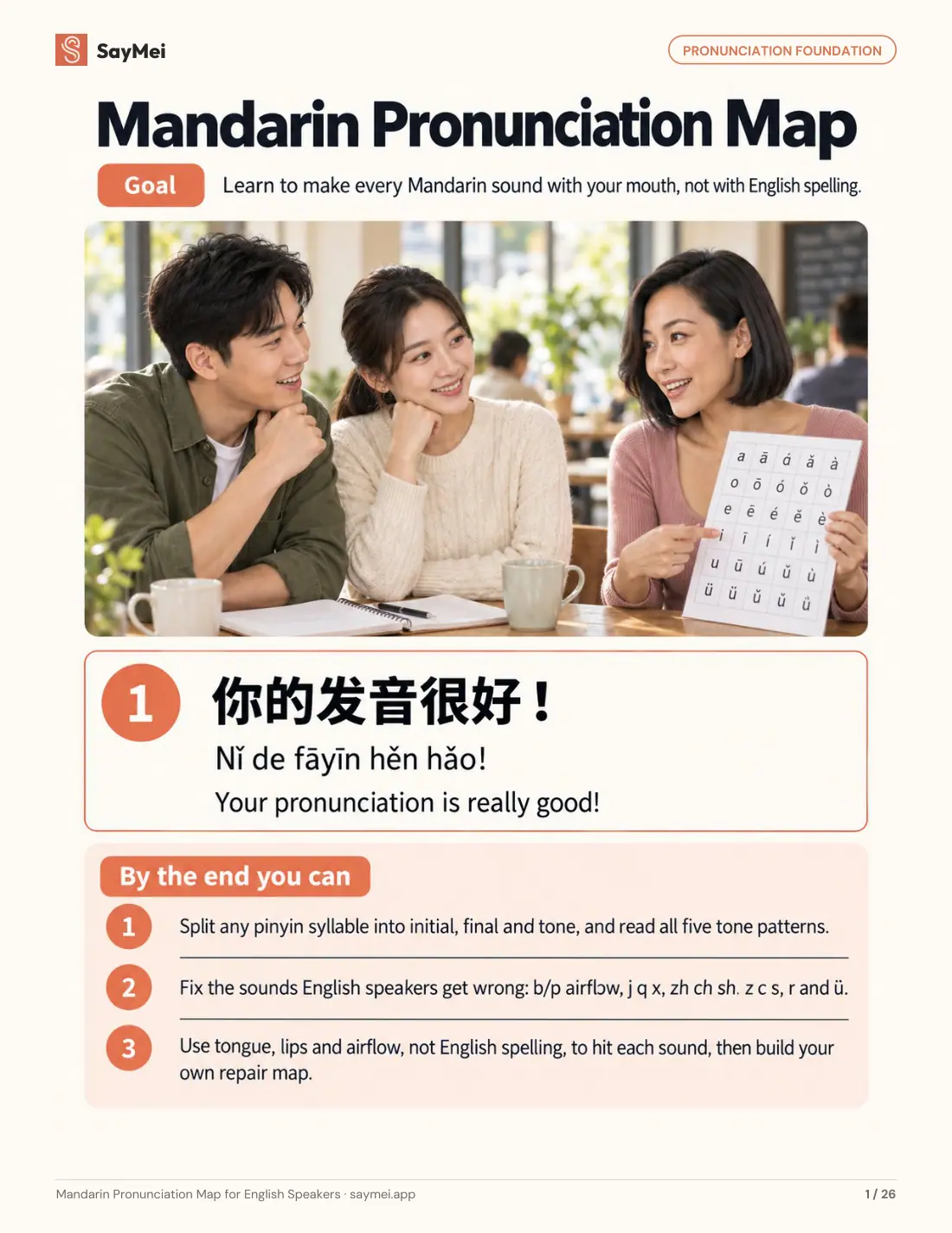
你的发音很好! · Nǐ de fāyīn hěn hǎo! · Your pronunciation is really good!
By the end you can
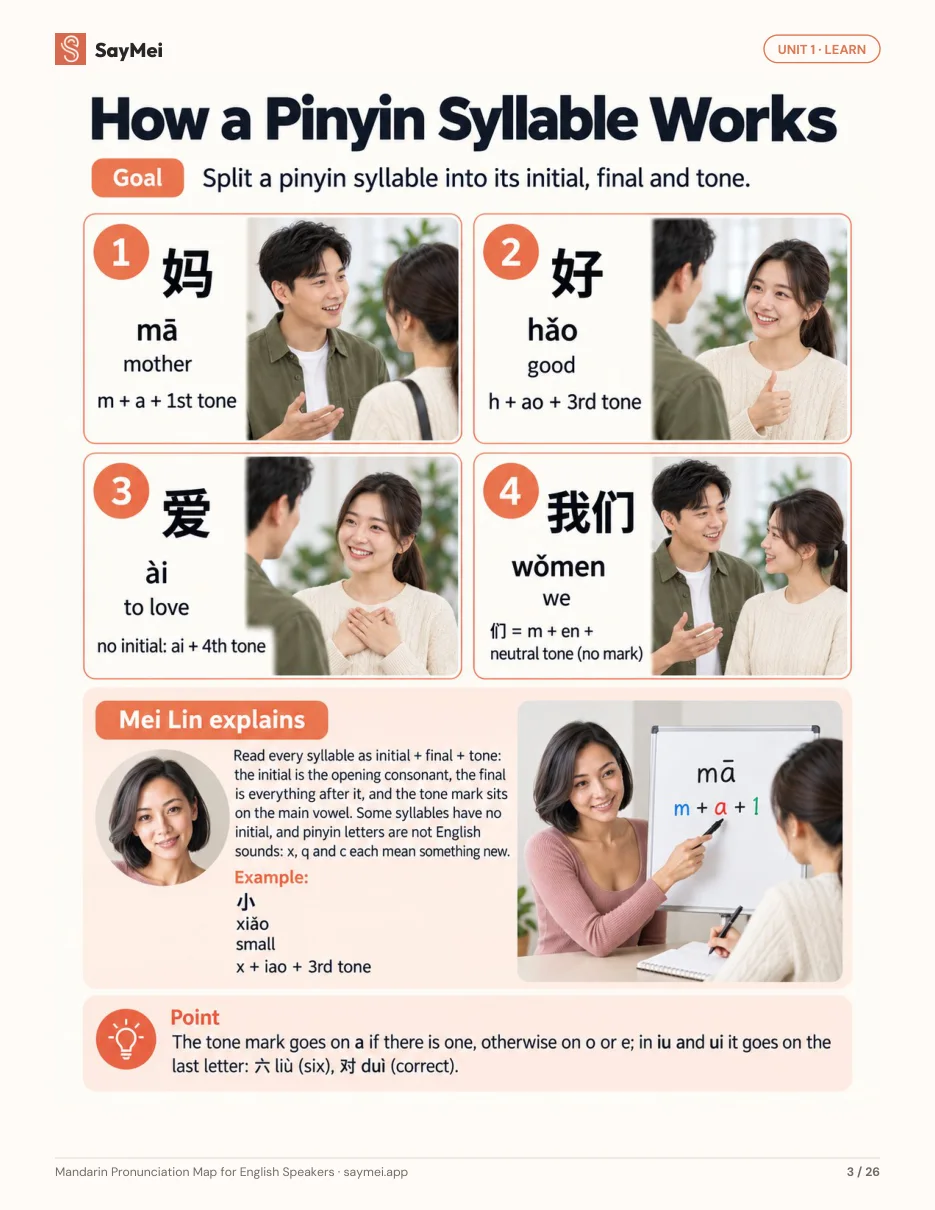
- Split any pinyin syllable into initial, final and tone. Read 妈 as m + a + first tone and 好 as h + ao + third tone, and learn where the tone mark sits: on a if there is one, otherwise on o or e.
我们 · wǒmen · we - Read the five tone patterns. Match each tone mark to a pitch movement and a hand gesture, including the unmarked neutral tone and two third tones in a row, where the first one rises.
你好 · nǐ hǎo · hello - Use a puff of air for p, t and k. Mandarin b, d and g are plain, with almost no air. P, t and k add a strong puff. A strip of paper in front of your lips shows the difference.
爸爸 · bàba · dad - Say j, q and x with the tongue tip down. Press the front of the tongue up with the tip behind your lower teeth and spread your lips, so q never sounds like English kw and x never like ks.
喜欢 · xǐhuan · to like - Keep zh, ch and sh apart from j, q and x. Lift the tongue tip up behind the ridge for zh, ch and sh, as in 知, 吃 and 师, and practise telling tip down from tip up in words and sentences.
- Say z, c and s behind the teeth. Read pinyin c as the ts in cats, with a puff, never as k or s, and keep 四 sì (four) apart from 十 shí (ten).
菜 · cài · dish; vegetables - Make a Mandarin r and a rounded ü. Start r from the sh position with relaxed lips and add voice. For ü, say ee, then round your lips, and spot ü when j, q, x and y hide its dots.
绿 · lǜ · green - Finish -n and -ng on purpose. End -n with the tongue tip on the ridge and -ng with the back of the tongue up, read e as an unrounded uh, and ian like yen, as in 天 tiān.
今 / 京 · jīn / jīng · today / capital - Perform a tea-shop dialogue and build your repair map. Read a dialogue that mixes every sound family, perform it with a partner, then choose two contrasts to keep repairing.
我说的是四,不是十! · Wǒ shuō de shì sì, bú shì shí! · I said four, not ten!
What’s inside
- Unit 1: Learn: How a Pinyin Syllable Works
- Unit 2: Learn: Map the Five Tone Patterns
- Units 1–2: Practice: Take Syllables Apart
- Unit 3: Learn: Feel the Puff of Air · Practice: Plain or Puff?
- Unit 4: Learn: Smile for J, Q and X · Practice: J, Q and X in Action
- Unit 5: Learn: Tongue Up for Zh, Ch and Sh · Practice: Tip Down or Tip Up?
- Unit 6: Learn: Z, C and S Behind the Teeth · Practice: Teeth, Down or Up?
- Unit 7: Learn: R Is Not an English R · Practice: Make R Buzz
- Unit 8: Learn: Round Your Lips for Ü · Practice: Find the Hidden Ü
- Unit 9: Learn: Finals That English Hides · Practice: Fix Your Finals
- Reference: Mouth Cue Grid
- Review: Review at the Tea Shop
- Repair Plan: My Pronunciation Repair Map
How to use this book
Nine short units, each a Learn page and a Practice page. One or two units a sitting works well, with a mirror nearby for the mouth cues.
- Units 1–2: Syllables and tones. Split syllables into initial, final and tone, and say each tone with its hand gesture before you move on.
- Units 3–4: Air and the smile. Test b and p with a strip of paper, then place your tongue for j, q and x and check it in a mirror.
- Units 5–7: The tongue families. Tip up for zh, ch and sh, behind the teeth for z, c and s, then r from the sh position. Practise sì and shí until they stay apart.
- Units 8–9: Ü and the finals. Round your lips for ü, find the hidden dots, then finish -n and -ng on purpose.
- Review: Grid, dialogue and repair map. Keep the Mouth Cue Grid handy, perform the tea-shop dialogue, then tick what you can do and pick two contrasts to keep repairing.
Who it’s for
English speakers starting Mandarin, and learners who already speak a little but keep getting q, x, zh, c, r or ü wrong because they read pinyin like English.
Before you start: Nothing. Every word is printed in characters, pinyin and English, and the book starts from how a syllable is built.
Frequently asked questions
Why do English speakers find pinyin hard to read?
Pinyin uses English letters for different sounds. Q is not kw, x is not ks, c is ts, and Mandarin r is not an English r. The book gives a tongue, lip or airflow cue for each one instead of an English spelling.
What's inside?
Nine short units, each a Learn page and a Practice page: syllables, tones, the puff of air, j q x, zh ch sh, z c s, r, ü and the finals. Then a Mouth Cue Grid, a tea-shop dialogue that mixes every sound family, and a repair map where you pick two contrasts to keep working on.
Is there audio?
No. The book teaches each sound by mouth position and airflow, with checks you can do yourself: a mirror for your tongue and lips, and a strip of paper in front of your lips for the puff of air.
Does it cover tones as well as sounds?
Yes. Unit 2 maps the five tone patterns with hand gestures, and the practice covers two third tones in a row. The rest of the book is about initials and finals.
How long does it take?
The book suggests one or two units a sitting, with a mirror nearby for the mouth cues, then a last sitting for the grid, the dialogue and your repair map.
What should I use next?
Mandarin Tongue Twisters: 20 Rhymes for Clearer Pronunciation drills many of the same sounds at speed, with free audio. The Chinese Alphabet: Pinyin Workbook for Beginners in 12 Lessons covers the spelling and tone-mark rules.
Do I need a SayMei account?
Yes, to download the PDF, and the account is free: sign up with Google, Apple or your email address. With it we email you a copy of the workbook, keep every workbook you download on your account on all your devices, save your place in the free online practice, and you can practise speaking with Mei Lin, SayMei's AI tutor.
How do I print it?
The PDF is US Letter size. On A4 paper, choose "Fit to page" (or "Scale to fit") in the print dialog so nothing is cut off. Print the whole workbook or only the pages you need; colour looks best, and black and white works too.
Keep going
Pinyin Chart with Pronunciation Cues: Initials, Finals and Spelling Rules · Zhuyin–Pinyin Bridge: Sounds, Symbols & Practice · The Chinese Alphabet: Pinyin Workbook for Beginners in 12 Lessons · Chinese Tone Pair Flashcards: 80 Cards for All 20 Tone Pairs · Read the pronunciation guide · Browse all 340 workbooks
Version 2026-10 · Updated Oct 8, 2026 · Report a correction