Traditional Chinese legend, retold in simple Mandarin
Chinese New Year Tales
过年的故事
Chinese New Year Tales (过年的故事, Guònián de gùshi) is a Chinese legend, retold in simple Mandarin as a 5-chapter story with audio for learners at about HSK 1 (Beginner).
Retold from Chinese New Year folk legends: on five nights of the festival, a grandmother tells two grandchildren why we hang the 福 upside down, guard doors with generals, and hang lanterns.
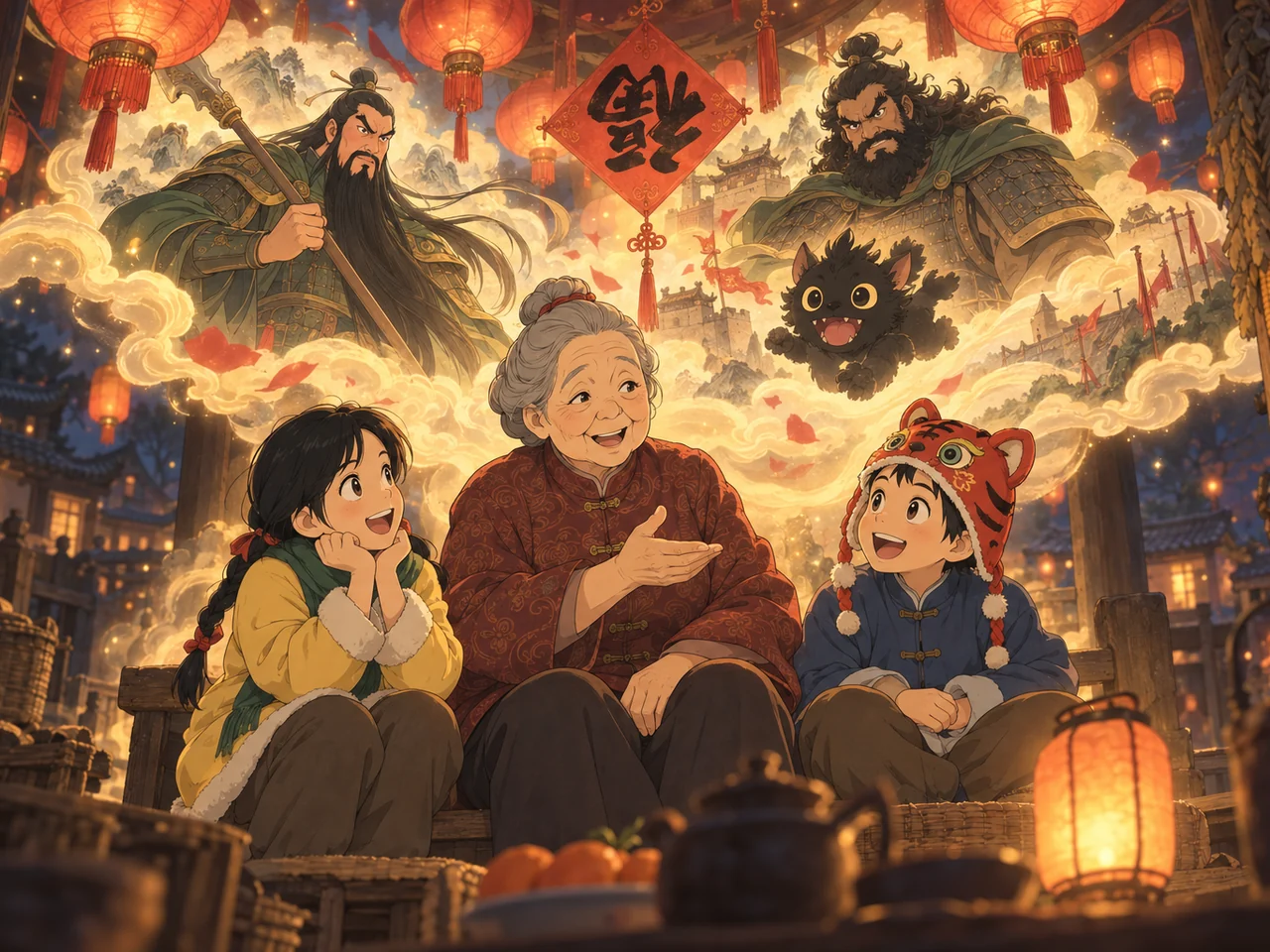
Meet the voices
- Narrator · 旁白 — A warm, older storyteller who opens each old tale.
- Grandma · 奶奶 — A kind grandmother who tells one New Year tale each night.
- Xiaoyu · 小雨 — A brave nine-year-old girl who loves stories.
- Mingming · 明明 — Her cheeky six-year-old brother who can never wait.
- Shentu · 神荼 — The calm older brother who guards the ghost gate.
- Yulei · 郁垒 — His younger brother who laughs at the ghosts.
- Ghost · 鬼 — A ghost who runs from the brothers.
- Master Qian · 钱老爷 — A rich man who fears bad luck.
- Chunmei · 春梅 — A quick-witted servant girl who cannot read.
- The Emperor · 皇帝 — A frightened emperor who cannot sleep.
- Qin Qiong · 秦琼 — A loyal general with a steady voice.
- Yuchi Gong · 尉迟恭 — A fierce, loud general who hates to admit he is tired.
- Sui · 岁 — A tiny sneaky black monster.
- Xiaobao's Mother · 妈妈 — A clever mother who protects her son.
- Xiaobao · 小宝 — A sleepy four-year-old boy.
- Dongfang Shuo · 东方朔 — A clever scholar with a sly plan.
- Yuanxiao · 元宵 — A palace maid who brings the bad news.
- Emperor of Heaven · 天上的皇帝 — The booming ruler of heaven.
5 chapters, one journey
Chapter 1: Peach Wood and Couplets
桃木和春联
Grandma has five New Year tales to tell. First: two brothers, a peach tree and the ghosts. Then Mingming sticks his lucky 福 on the door the wrong way up.
Free to read
Chapter 2: The Upside-Down Fu
福到了
A rich man is furious when his servant hangs the New Year 福 upside down. Then she says a few words that turn his anger into a laugh.
SayMei Stories
Chapter 3: The Two Door Gods
两个门神
An emperor cannot sleep because of scary noises outside. Two loyal generals stand at his door all night. But what happens when they get too tired?
SayMei Stories
Chapter 4: Sui and the Red Envelope
岁和红包
A tiny black monster touches sleeping children's heads on New Year's Eve. One mother has a clever plan with eight coins and a scrap of red paper.
SayMei Stories
Chapter 5: The Lantern Trick
灯笼的故事
On the last night of the festival, Grandma tells how a whole city fooled the Emperor of Heaven with nothing but red lanterns.
SayMei Stories
Key words in Chinese New Year Tales
Behind the story
过年 (guò nián) is Chinese New Year, the biggest holiday of the Chinese calendar. Almost every custom has an old story behind it, and grandparents have long told these stories to children during the festival.
Many of these customs are still easy to spot: red 春联 (spring couplets) beside the door, a 福 (good fortune) hung upside down, paintings of the 门神 (door gods), red envelopes of 压岁钱, and glowing lanterns on 元宵节, the last night of the festival.
Did you know?
- The character 福 (fú, good fortune) is often hung upside down because 倒 (dào, upside down) sounds just like 到 (dào, to arrive): fortune has arrived.
- Qin Qiong and Yuchi Gong were real generals of the Tang dynasty, and folk tradition later made them the guardians of the door.
- The Lantern Festival is on the fifteenth day of the first lunar month, and families eat sweet glutinous rice balls.