Stories retold in simple Mandarin
Even More Aesop's Fables
伊索寓言三
Even More Aesop's Fables (伊索寓言三, Yīsuǒ yùyán sān) is a set of fables by Aesop, retold in simple Mandarin as 6 short stories with audio for learners at about HSK 1 (Beginner).
Retold from Aesop's fables: on warm summer nights Grandpa Owl tells six more tales to Little Rabbit and Little Squirrel, about a fox, cats, a snake, a pail of milk and a donkey.
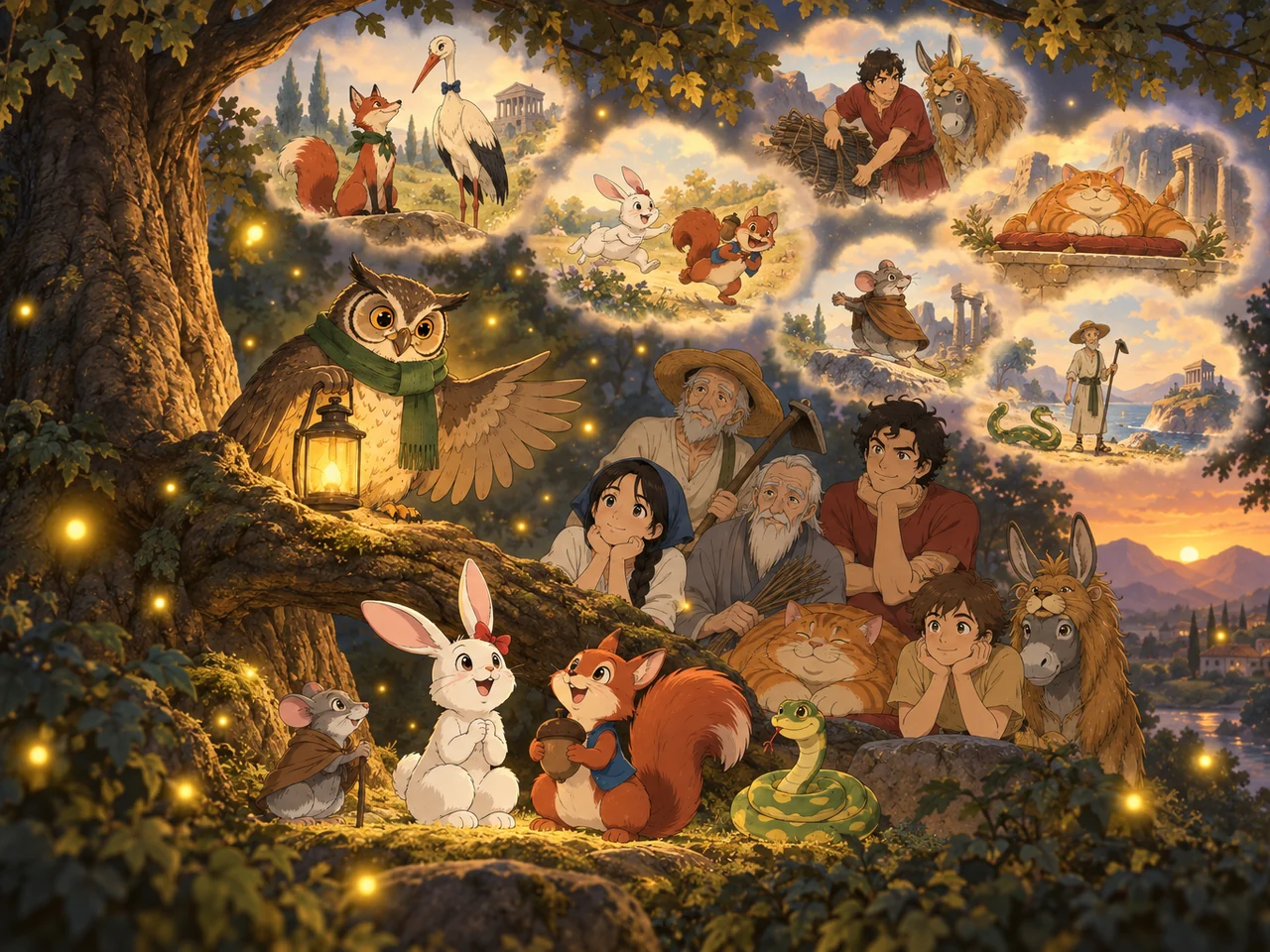
Meet the voices
- Narrator · 旁白 — An old storyteller who sets the scene each night under Grandpa Owl's tree and then lets the owl tell the tale.
- Grandpa Owl · 猫头鹰爷爷 — A wise, twinkly old owl who tells one Aesop fable a night and loves to keep his listeners waiting for tomorrow's story.
- Little Rabbit · 小兔子 — A quick, kind-hearted young rabbit who sees through every trick and loves to tease Squirrel.
- Little Squirrel · 小松鼠 — A cheeky young squirrel who never lets go of his acorn and always shouts that he knows how the story ends, usually wrongly.
- The Fox · 狐狸 — A sly, smooth-talking fox who plays a mean joke on his friend and then learns to be sorry.
- The Stork · 鹤 — A tall, polite stork who takes a mean trick calmly and answers it with a clever one.
- The Old Mouse · 老鼠爷爷 — A wise old mouse who asks the one question that nobody wants to answer.
- The Young Mouse · 小老鼠 — A bold young mouse full of big ideas and no plan to carry them out.
- The Big Cat · 大猫 — A huge, sleepy cat whose very shadow scares the mice.
- The Kind Farmer · 农夫 — A gentle farmer who cannot walk past a creature in trouble.
- The Snake · 蛇 — A cold-eyed snake who is only kind while it is cold.
- Xiao Mei the Milkmaid · 小梅 — A cheerful girl who dreams so hard that she forgets to watch her pail.
- The Old Father · 爸爸 — A patient old father who teaches his sons with a bundle of sticks.
- The Elder Son · 哥哥 — A strong, proud young man who is quick to shout.
- The Younger Son · 弟弟 — A hot-tempered younger brother who hates losing an argument.
- The Donkey · 驴 — A vain donkey who thinks a borrowed lion skin makes him a lion.
6 chapters, one journey
Chapter 1: The Fox and the Stork
狐狸和鹤
Little Squirrel tries to tell a story and gets it wrong, so Grandpa Owl tells one about a fox who serves soup on a flat plate to a long-beaked guest.
Free to read
Chapter 2: Belling the Cat
给猫挂铃铛
The mice have a brilliant plan to hang a bell on the cat. Everybody cheers, until one old mouse asks a very small question.
SayMei Stories
Chapter 3: The Farmer and the Snake
农夫和蛇
On a snowy morning a kind farmer finds a snake frozen stiff and warms it inside his coat. It is a famous story, and a sad one.
SayMei Stories
Chapter 4: The Milkmaid and Her Pail
小梅的牛奶
Xiao Mei carries her milk to market and dreams of eggs, chicks, a red dress and a dance. Her head tosses, and so does her pail.
SayMei Stories
Chapter 5: The Bundle of Sticks
一把树枝
Two brothers can't stop fighting, so their old father brings out a bundle of sticks and a test that neither one can pass alone.
SayMei Stories
Chapter 6: The Donkey in the Lion's Skin
穿狮子皮的驴
A donkey finds a lion's skin, puts it on and frightens the whole meadow. Then a clever fox hears something very familiar.
SayMei Stories
Key words in Even More Aesop's Fables
Behind the story
Aesop was a storyteller said to have lived in ancient Greece around twenty-six hundred years ago. Nobody wrote down his tales at the time; the fables were collected by others over many centuries, and every retelling changes them a little.
Chinese readers know the collection as 伊索寓言, and many meet it as children in school reading. Some of its stories feel very close to Chinese sayings, and 农夫与蛇, the tale of the farmer and the snake, is one of the best-known fables in China.
Did you know?
- People use the story of hanging a bell on the cat, 给猫挂铃铛, for a plan that sounds great but that nobody dares to carry out.
- The lesson of the bundle of sticks matches a famous Chinese slogan, 团结就是力量, which means that unity is strength.
- China has its own donkey story too: the idiom 黔驴技穷 comes from an old tale about a donkey whose few tricks ran out, and it now means running out of ideas.