World classic, retold in simple Mandarin
Goldilocks and the Three Bears
金发姑娘和三只熊
Goldilocks and the Three Bears (金发姑娘和三只熊, Jīnfà gūniang hé sān zhī xióng) is a fairy tale, retold in simple Mandarin as a 3-chapter story with audio for learners at about HSK 1 (Beginner).
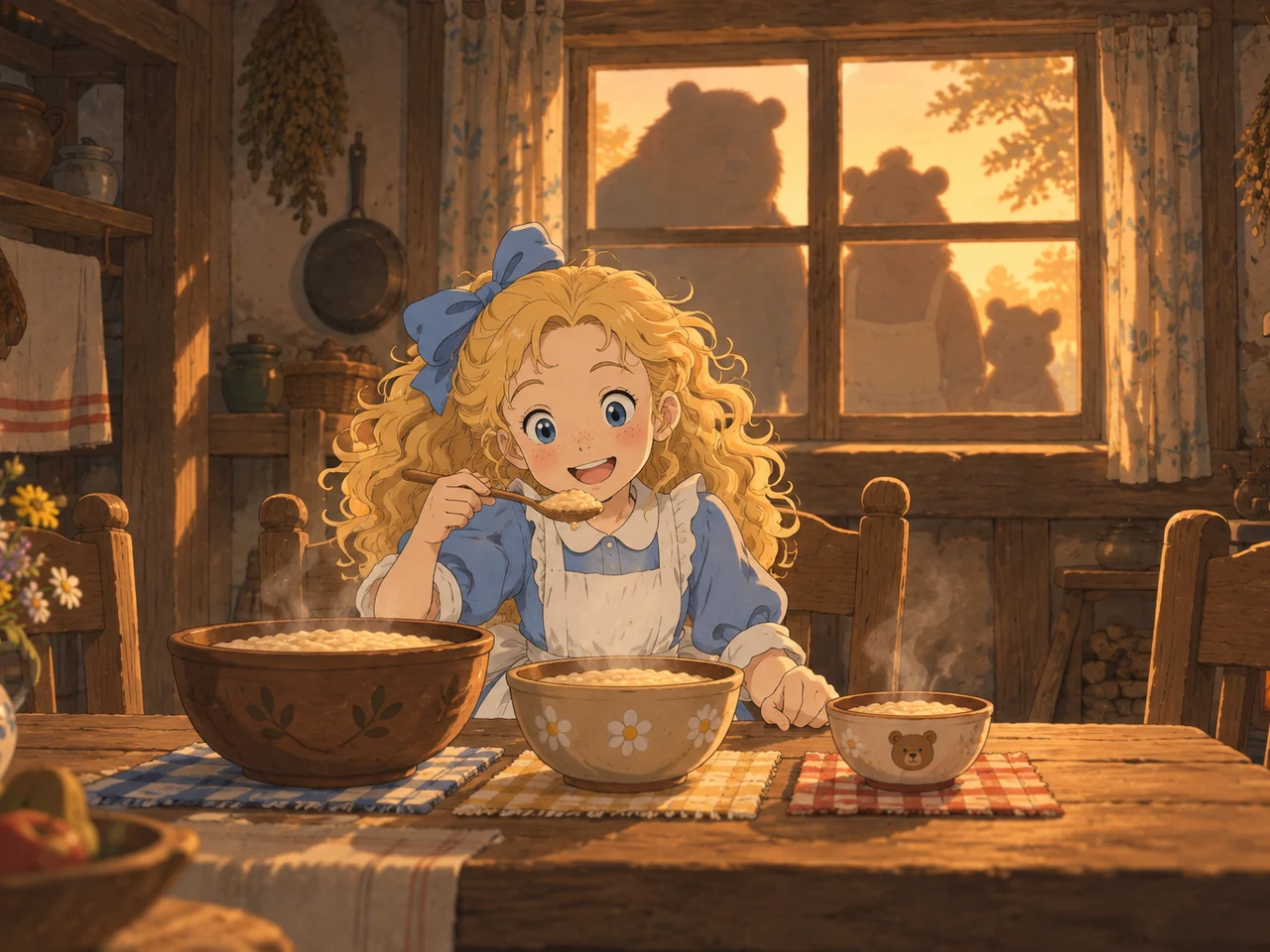
Retold from the English fairy tale: while three bears are out for a walk, a hungry girl with golden hair finds their open door, three bowls of porridge, and one that is just right.
Meet the voices
- Narrator · 旁白 — An old storyteller who tells the tale of the three bears slowly and warmly, like a grandfather at bedtime.
- Goldilocks · 金发姑娘 — A curious, hungry little girl with golden hair who can never stop at just one bite, but who has a good heart.
- Papa Bear · 熊爸爸 — A huge, booming bear who is always hungry and always in a hurry, and much kinder than he sounds.
- Mama Bear · 熊妈妈 — A calm, sensible bear who cooks the porridge and is forever telling everyone to take it slowly.
- Baby Bear · 小熊 — The smallest bear, with a squeaky voice and the same worried question about everything: “And mine?”
3 chapters, one journey
Chapter 1: Three Bowls of Porridge
三碗粥
Goldilocks wanders deep into the forest, lost and hungry. Not far away, three bears leave their porridge to cool and their front door wide open.
Free to read
Chapter 2: Who's Been Eating My Porridge?
谁吃了我的粥?
Full of porridge, Goldilocks tries out the bears' chairs and beds. Then the three bears come home, and they want to know who has been eating their porridge.
SayMei Stories
Chapter 3: Just Right
刚刚好
Goldilocks wakes up face to face with three bears and jumps out of the window. But that night she can't sleep, and in the morning she has something to do.
SayMei Stories
Key words in Goldilocks and the Three Bears
Behind the story
This English fairy tale was first printed by the poet Robert Southey in 1837, as The Story of the Three Bears. In his telling the bears are not yet Papa, Mama and Baby, just a great big bear, a middle-sized bear and a wee little one, and the stranger who walks into their house is a rude old woman. Later tellers made her a little girl and the bears a family. Early versions called her Silver-Hair; the name Goldilocks came later. Southey's intruder jumps out of the window and is never seen again, while this retelling lets her come back to say sorry.
In Chinese the tale is 金发姑娘和三只熊, “The Golden-Haired Girl and the Three Bears,” a familiar bedtime story in Chinese picture books. Its “just right” has even traveled into Chinese business news: an economy growing neither too hot nor too cold is called a 金发女孩经济, a “Goldilocks economy.”
Did you know?
- Porridge in Chinese is 粥, the same word as the rice congee many Chinese families eat for breakfast. British porridge, usually made from oats, is 燕麦粥, “oat congee.”
- Chinese has a ready-made word for a child like Goldilocks: 熊孩子, literally “bear kid,” is everyday slang for a naughty child who gets into everything. In this story, the bears are the well-behaved ones.
- Astronomers nickname the band around a star where a planet is neither too hot nor too cold for liquid water the “Goldilocks zone.” In Chinese its usual name is 宜居带, the “livable belt.”