Traditional Chinese legend, retold in simple Mandarin
Hou Yi and the Ten Suns
后羿射日
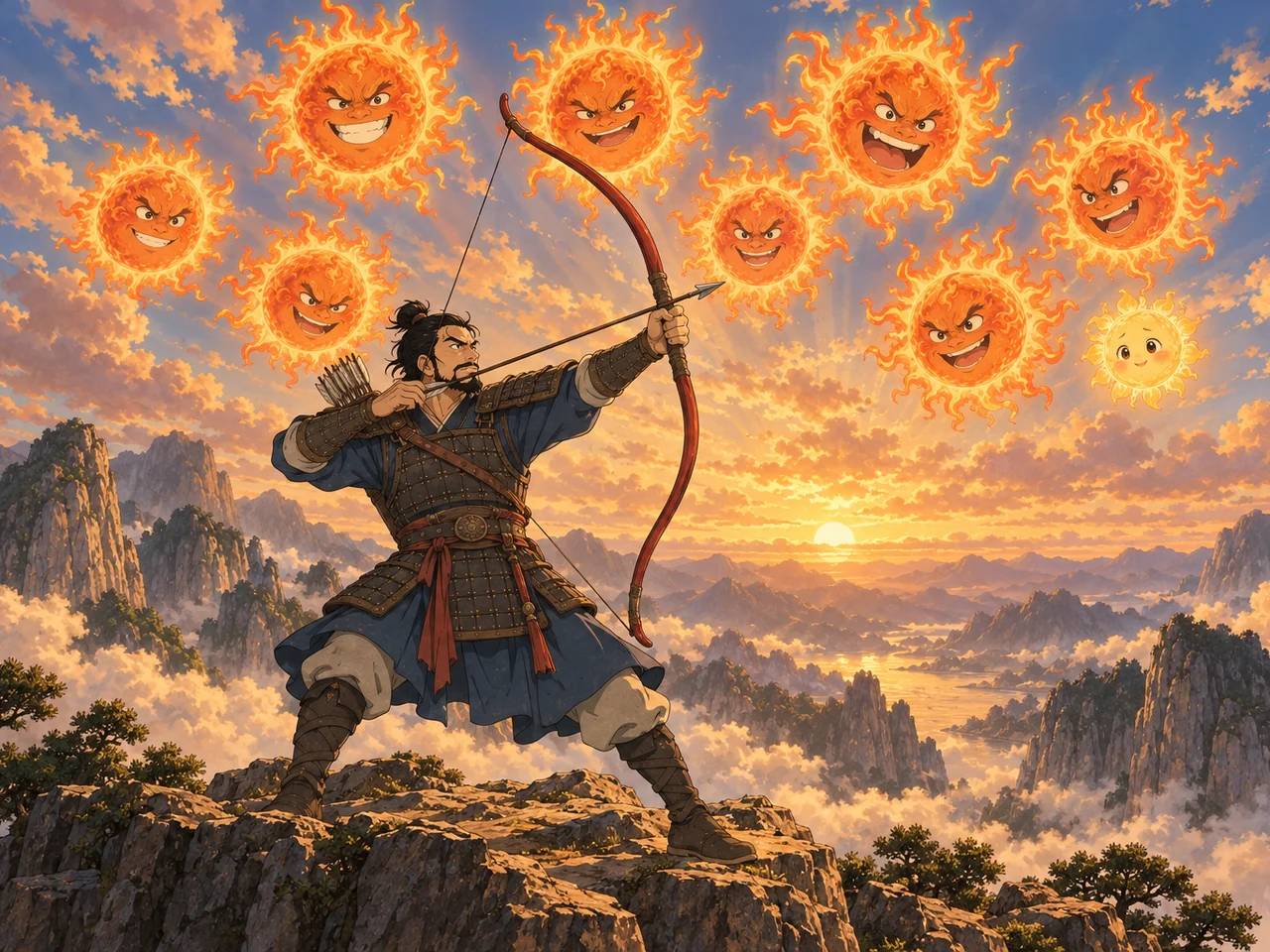
Hou Yi and the Ten Suns (后羿射日, Hòu Yì shè rì) is a Chinese legend, retold in simple Mandarin as a 4-chapter story with audio for learners at about HSK 1 (Beginner).
Retold from the ancient Chinese myth of the archer Hou Yi: ten sun brothers decide to rise all at once, the land begins to burn, and one man with a red bow has to set the sky right.
Meet the voices
- Narrator · 旁白 — An old storyteller who tells how the world came to have just one sun.
- Hou Yi · 后羿 — The finest archer in the land: kind and patient, until the suns leave him no choice.
- Miaomiao · 苗苗 — An eight-year-old farm girl who counts everything, loves her seedlings, and hates being called little.
- Little Ten · 小十 — The youngest of the ten sun brothers: gentle, a little shy, and the only one who cares about the people down below.
- Big Brother Sun · 大哥 — The eldest sun: loud, proud and bored, and sure that nobody can tell a sun what to do.
- Chang'e · 嫦娥 — Hou Yi's wife, who worries about him and believes in him more than anyone.
4 chapters, one journey
Chapter 1: Ten Sun Brothers
十个太阳兄弟
Ten sun brothers take turns lighting the sky, one a day, until the youngest makes two friends down below and his bored big brother hatches a very different plan.
Free to read
Chapter 2: Please Go Home
请你们回家
With ten suns blazing at once and the river running dry, Hou Yi politely asks the sun brothers to go home, and Big Brother Sun just laughs down at him.
SayMei Stories
Chapter 3: The Red Bow
红色的大弓
Hou Yi's wife Chang'e makes him promise to come home safe, and before dawn he climbs the highest mountain in the east, where he won't be alone for long.
SayMei Stories
Chapter 4: The Last Sun
最后一个太阳
Arrow after arrow flies into the sky until one frightened sun is left hiding behind a mountain, and Hou Yi must decide how many suns the world needs.
SayMei Stories
Key words in Hou Yi and the Ten Suns
Behind the story
Hou Yi shooting down the suns (后羿射日) is one of China's oldest myths. The ancient Classic of Mountains and Seas (山海经) tells of ten suns that rested in a giant tree called Fusang (扶桑) and took turns crossing the sky, and the Huainanzi (淮南子), from the second century BC, tells how they once rose all at once until the archer Yi shot them down.
Most tellings say he shot down nine and spared one, the sun we still have today. Chinese children read a version called 羿射九日, “Yi Shoots Down Nine Suns,” in their primary-school textbook. And the archer's story goes on: his wife is Chang'e (嫦娥), who flies to the moon in our book Chang'e and the Moon.
Did you know?
- In the old myths, a crow carried each sun across the sky, and Han-dynasty artists painted a three-legged crow inside the sun. In poetry, the sun is still called the golden crow (金乌).
- A bronze tree nearly four meters tall and about three thousand years old was dug up at Sanxingdui (三星堆) in Sichuan. Nine birds perch on its branches, and many scholars link it to the ten suns resting in the Fusang tree.
- Kings of the Shang dynasty counted time in ten-day weeks, naming each day with one of the ten heavenly stems (天干), and some historians think the story of ten suns taking turns grew out of that calendar.