Traditional Chinese legend, retold in simple Mandarin
Chinese Idiom Stories 3
成语故事三
Chinese Idiom Stories 3 (成语故事三, Chéngyǔ gùshi sān) is a set of traditional Chinese tales, retold in simple Mandarin as 6 short stories with audio for learners at about HSK 1 (Beginner).
Six more famous chengyu and the stories behind them: blind men and an elephant, a musician and a cow, a dragon painted on a wall, a snake in a cup. Retold from old Chinese and Buddhist tales.
Meet the voices
- Narrator · 旁白 — Tells six more very old stories the way a grandfather tells them by the fire, naming each idiom before its story begins.
- The king · 国王 — A cheerful king who loves his new elephant and a good lesson.
- Old Li · 老李 — A tall blind man who is sure the elephant is a tree.
- Old Zhao · 老赵 — A round blind man who never doubts his own hands.
- Old Zhou · 老周 — A blind man who ends up soaked by the elephant.
- Gongming Yi · 公明仪 — A proud young musician who plays his best song for the wrong listener.
- Xiao Hu · 小虎 — A cheeky cowherd boy who knows his cow better than any musician.
- The cow · 牛 — A sleepy cow who thinks only about grass, until she hears her calf.
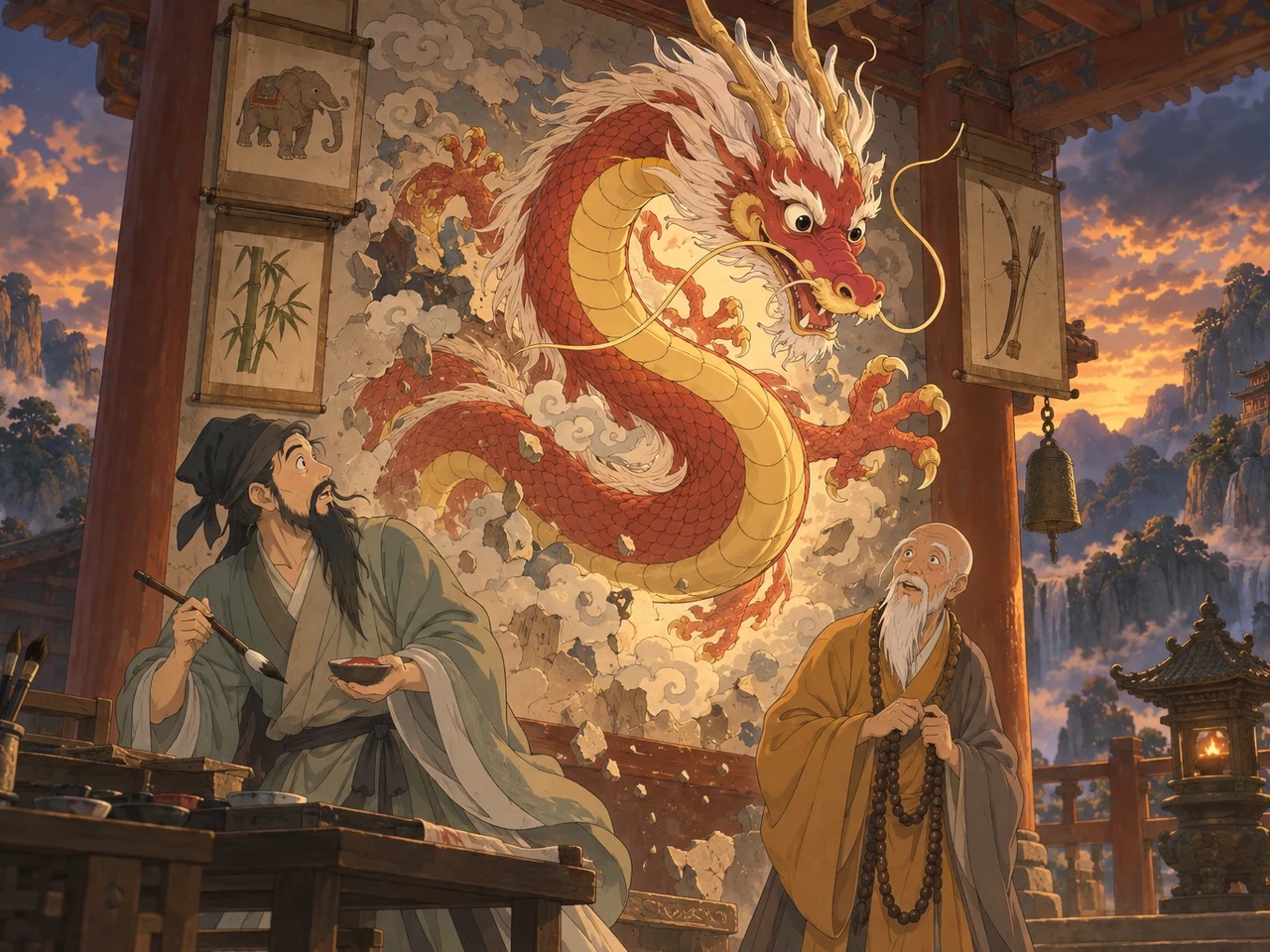
- Zhang Sengyao · 张僧繇 — A calm painter whose dragons are almost too real.
- The abbot · 方丈 — An old temple abbot who cannot resist asking for the dragons' eyes.
- The dragon · 龙 — A painted dragon that jumps to life as soon as it has eyes.
- Yue Guang · 乐广 — A kind, clever official who solves his friend's mystery.
- Old Xu · 老许 — A nervous friend who is too polite to leave his wine undrunk.
- Wen Tong · 文同 — A bamboo painter who looks and waits until the picture is inside him.
- Xiao Ming · 小明 — A restless student who thinks looking is not working.
- King Zhuang · 庄王 — A young king of Chu who plays for three years, then surprises everyone.
- Wu Ju · 伍举 — A brave minister who tells the king the truth with a riddle.
- The old minister · 老臣 — A worried old minister who is afraid to speak.
6 chapters, one journey
Chapter 1: The Blind Men and the Elephant
盲人摸象
Three blind men touch the king's new elephant, and each is sure he knows what it is. One says a tree, one a wall, one a snake. Who is right?
Free to read
Chapter 2: Music for a Cow
对牛弹琴
A young musician plays his best song for a cow, and the cow only wants to eat. What sound will finally make her look up?
SayMei Stories
Chapter 3: Eyes for the Dragon
画龙点睛
A great painter draws four dragons on a temple wall but leaves out their eyes. Then someone begs him to add just one pair.
SayMei Stories
Chapter 4: The Snake in the Cup
杯弓蛇影
Old Xu sees a little snake swimming in his wine and drinks it anyway. Now he is sick, and only his friend can work out where the snake came from.
SayMei Stories
Chapter 5: Bamboo in the Heart
胸有成竹
Every day a painter comes to stare at bamboo and never picks up a brush. His student thinks he is lazy, until a rainy afternoon shows what the painter sees.
SayMei Stories
Chapter 6: The Bird That Would Not Sing
一鸣惊人
For three years the king of Chu has done nothing but play, and anyone who scolds him is sent away. Then one minister walks in with a strange question about a bird.
SayMei Stories
Key words in Chinese Idiom Stories 3
Behind the story
Chengyu (成语) are short set phrases, usually four characters long, and each carries a little story. This third book retells six of them. The blind men and the elephant came to China with Buddhist teaching stories. The cow and the qin comes from an old Han-period text, the dragon with no eyes from the tales of the painter Zhang Sengyao, and the snake in the cup from the story of the official Yue Guang. The painter Wen Tong lived in the Song dynasty, and the silent-bird riddle belongs to King Zhuang of Chu, told in the Records of the Grand Historian (史记).
Chinese speakers use these phrases every day. 盲人摸象 warns against judging the whole from one small part. 对牛弹琴 is a joke about wasting words on someone who cannot follow. 画龙点睛 names the final touch that brings something to life, 杯弓蛇影 a fright caused by your own imagination, 胸有成竹 calm confidence because you are fully prepared, and 一鸣惊人 a quiet person who suddenly astonishes everyone.
Did you know?
- The qin (琴) is one of the oldest Chinese instruments, a long zither with seven strings, and scholars once played it for themselves as much as for guests.
- Bamboo, plum blossom, orchid and chrysanthemum are called the “four gentlemen” (四君子) in Chinese painting, and bamboo stands for an upright person.
- The king’s answer in the last story has a famous partner phrase, 一飞冲天, “one flight and it reaches the sky”.