Traditional Chinese legend, retold in simple Mandarin
Journey to the West: Havoc in Heaven
西游记:大闹天宫
Journey to the West: Havoc in Heaven (西游记:大闹天宫, Xīyóujì: Dà nào tiāngōng) is a story from Journey to the West, the Chinese classic by Wu Cheng'en, retold in simple Mandarin as an 8-chapter story with audio for learners at about HSK 2 (Elementary).
Retold from Wu Cheng'en's classic novel Journey to the West: invited up to heaven and handed its lowest job, the Monkey King eats the peaches of immortality, swallows Laozi's golden pills, and takes on all of heaven.
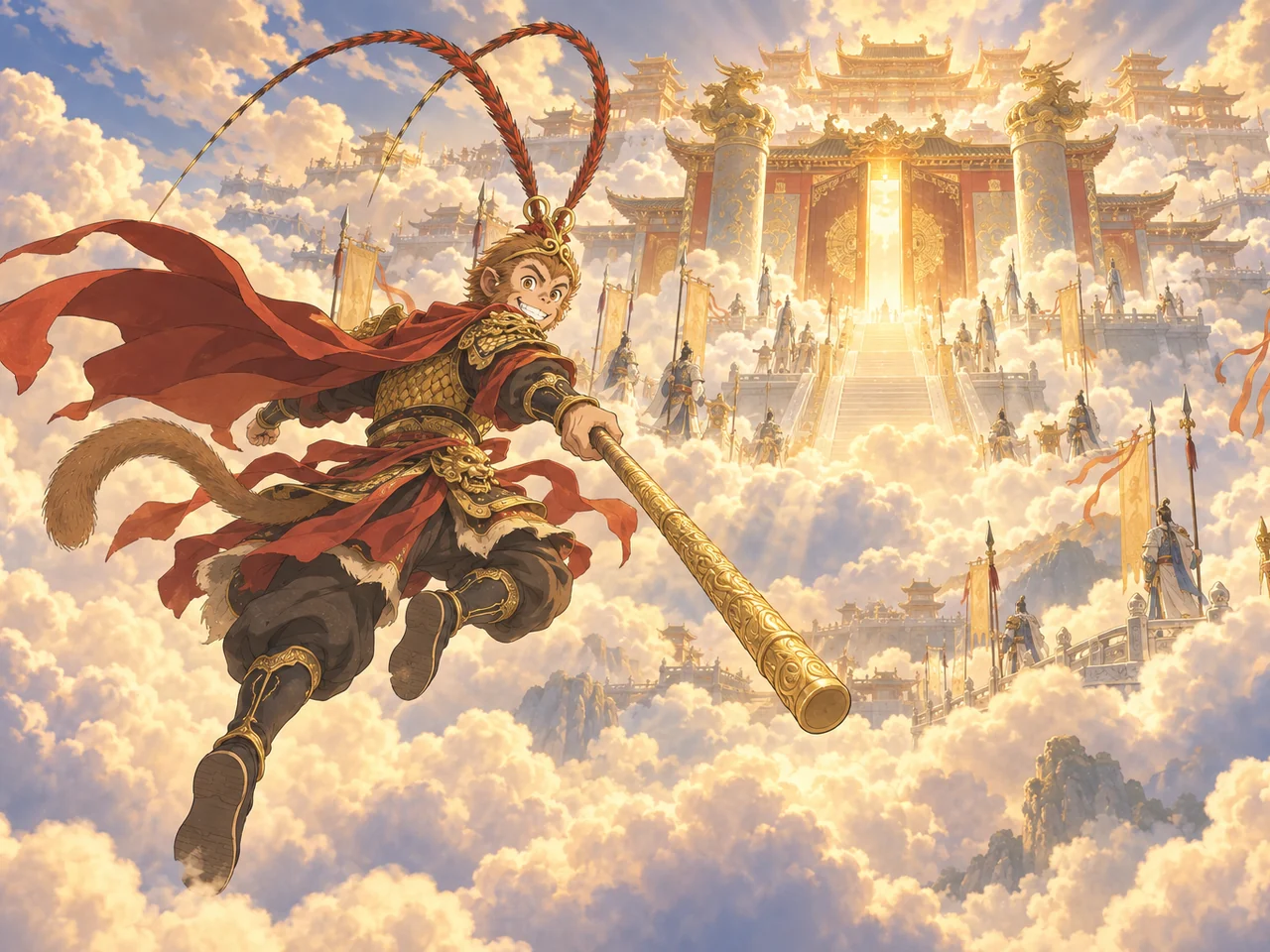
Meet the voices
- Narrator · 旁白 — Tells how one cheeky monkey turned the whole of heaven upside down.
- Sun Wukong · 孙悟空 — The Monkey King of Flower Fruit Mountain: brave, boastful, funny, and far too powerful to be told what to do.
- The Jade Emperor · 玉皇大帝 — The ruler of heaven, who would much rather keep the peace than fight a monkey.
- Taibai Jinxing · 太白金星 — A kindly old star god and the Jade Emperor's messenger, who always prefers a gentle word to a battle.
- Little Monkey · 小猴子 — One of the little monkeys of Flower Fruit Mountain, who is sure their king can do anything.
- Stable Hand · 马夫 — A timid groom in the heavenly stables who has to tell his new boss an awkward truth.
- Fairy in Red · 红衣仙女 — One of the Queen Mother's seven fairies, sent to pick peaches for the great banquet.
- Laozi, the Supreme Old Lord · 太上老君 — Heaven's great alchemist, keeper of the golden pills and the eight-sided furnace.
- Erlang Shen · 二郎神 — The Jade Emperor's nephew, a warrior god with a third eye who can match the monkey change for change.
- The Buddha · 如来佛祖 — The Buddha of the Western Heaven, calm and smiling, who ends the war without striking a single blow.
8 chapters, one journey
Chapter 1: An Invitation from Heaven
天上来的客人
Heaven has a monkey problem. The Jade Emperor's kindly old messenger has a plan, and it starts with a cloud landing on Flower Fruit Mountain.
Free to read
Chapter 2: Keeper of the Horses
弼马温
The Jade Emperor gives Wukong a grand-sounding title and heaven's horses to care for. Wukong loves the job, until someone tells him what it really is.
SayMei Stories
Chapter 3: Great Sage Equal to Heaven
齐天大圣
Back home, Wukong gives himself a title as big as the sky. Heaven's soldiers can't make him drop it, so Taibai Jinxing has another idea.
SayMei Stories
Chapter 4: The Peach Garden
蟠桃园
Putting a monkey in charge of heaven's magic peaches: what could go wrong? Then seven fairies arrive with news of a banquet.
SayMei Stories
Chapter 5: The Stolen Pills
老君的金丹
Uninvited, Wukong gets to the Peach Banquet before any of the guests. By the end of the night, he has done something even worse than eating their dinner.
SayMei Stories
Chapter 6: The Heavenly Army
十万天兵
A hundred thousand soldiers can't take Flower Fruit Mountain, so heaven sends a warrior with a third eye, and the two start a battle of magic changes.
SayMei Stories
Chapter 7: The Furnace
八卦炉
Knives and fire can't hurt the monkey, so Laozi shuts him in his eight-sided furnace for forty-nine days. What comes out is not what anyone expected.
SayMei Stories
Chapter 8: The Buddha's Palm
佛祖的手心
The Buddha offers the Monkey King a simple bet: jump out of his palm and win heaven. Easy, surely, for a monkey whose somersault covers a hundred and eight thousand li?
SayMei Stories
Key words in Journey to the West: Havoc in Heaven
Behind the story
Havoc in Heaven (大闹天宫) is the best-known part of Journey to the West (西游记), the 16th-century novel usually credited to Wu Cheng'en (吴承恩). This book retells chapters 3 to 7, which come after the Monkey King's birth and before his long journey west with a monk.
For Chinese readers, this is the Sun Wukong they meet first: in picture books, in Peking opera, and in Havoc in Heaven, the much-loved animated film made in Shanghai in the 1960s. The story also left everyday sayings. Eyes that can see through any trick are 火眼金睛, and someone who can never escape another's power “can't jump out of the Buddha's palm.”
Did you know?
- Many readers hear a pun in 弼马温, the stable job that insults Wukong: it sounds like 避马瘟, “keep horse sickness away,” and there was an old belief that a monkey in the stable kept horses healthy.
- In the novel, one day in heaven is a whole year on earth (天上一天,地上一年). That is why Wukong's half month in the stables lasts more than ten years for the monkeys at home.
- Chinese still call tourist graffiti 到此一游, “was here,” and many people trace the phrase back to Wukong's note: 齐天大圣到此一游.