Traditional Chinese legend, retold in simple Mandarin
The Night of the Nian
年兽来了
The Night of the Nian (年兽来了, Niánshòu lái le) is a Chinese legend, retold in simple Mandarin as a 3-chapter story with audio for learners at about HSK 2 (Elementary).
The New Year legend in simple Mandarin: a monster from the sea, an empty village, and a girl who refuses to leave her grandpa behind.
Meet the voices
- Narrator · 旁白 — Tells the story every Chinese child hears before New Year's Eve.
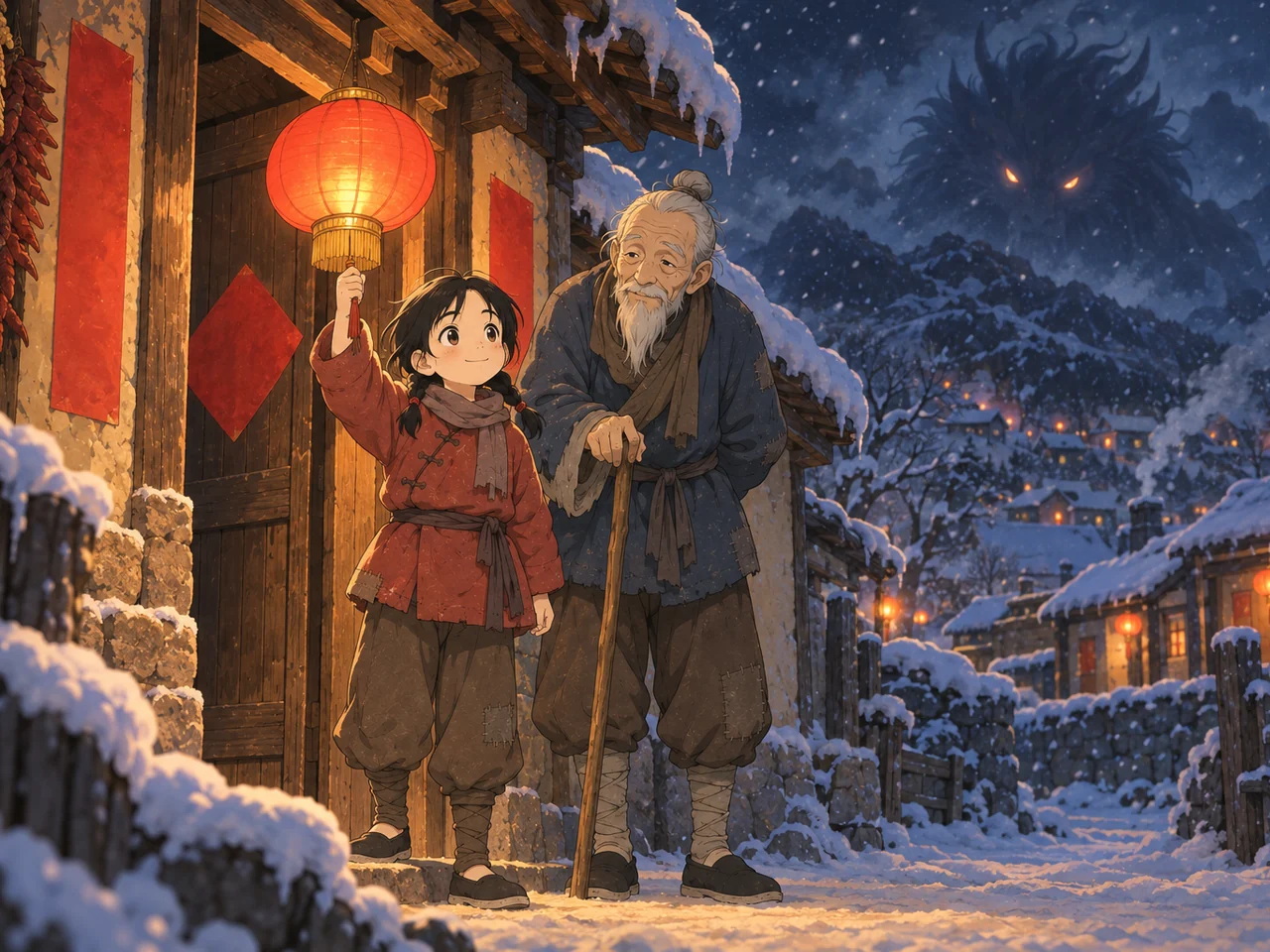
- Xiao Dong · 小冬 — A village girl who is scared of the dark — and more scared of leaving her grandpa alone.
- Grandpa · 爷爷 — Xiao Dong's grandpa. His legs are too weak for the mountain path.
- The old man · 老人 — A white-haired stranger who comes to the door on the most dangerous night of the year.
3 chapters, one journey
Chapter 1: The Village Empties
村子空了
On the last night of the year, the whole village runs from a monster, but Xiao Dong won't leave her grandpa, and a stranger comes to their door.
Free to read
Chapter 2: Red Paper and Fire
红纸和火
Red paper on the door, candles in Xiao Dong's hands, bamboo piled by the fire: the white-haired stranger seems to know something about Nian.
Free to read
Chapter 3: Why We Stay Up
守岁
The longest night of the year ends, but Xiao Dong still has questions: who was the stranger, and why do families stay up together?
Free to read
Key words in The Night of the Nian
Behind the story
The Nian (年兽) is the monster of Chinese New Year folklore, and its story explains the holiday's customs: red paper on the doors, lanterns and firecrackers, and staying up all night on New Year's Eve.
年 means “year,” and 过年, the everyday word for celebrating the New Year, can be read as “getting through the Nian.” In many tellings, a white-haired stranger teaches a village that the Nian fears red, fire and noise.
Did you know?
- 守岁 (shǒusuì), staying up to see the new year in, is still a family tradition on New Year's Eve.
- Red is everywhere at Spring Festival because, the story goes, the Nian is afraid of it.
- Unlike most legends in this library, the Nian has no ancient written source. It spread as a folk tale told to children.