Traditional Chinese legend, retold in simple Mandarin
Pangu and Nüwa: How the World Began
盘古和女娲
Pangu and Nüwa: How the World Began (盘古和女娲, Pángǔ hé Nǚwā) is a Chinese legend, retold in simple Mandarin as a 5-chapter story with audio for learners at about HSK 1 (Beginner).
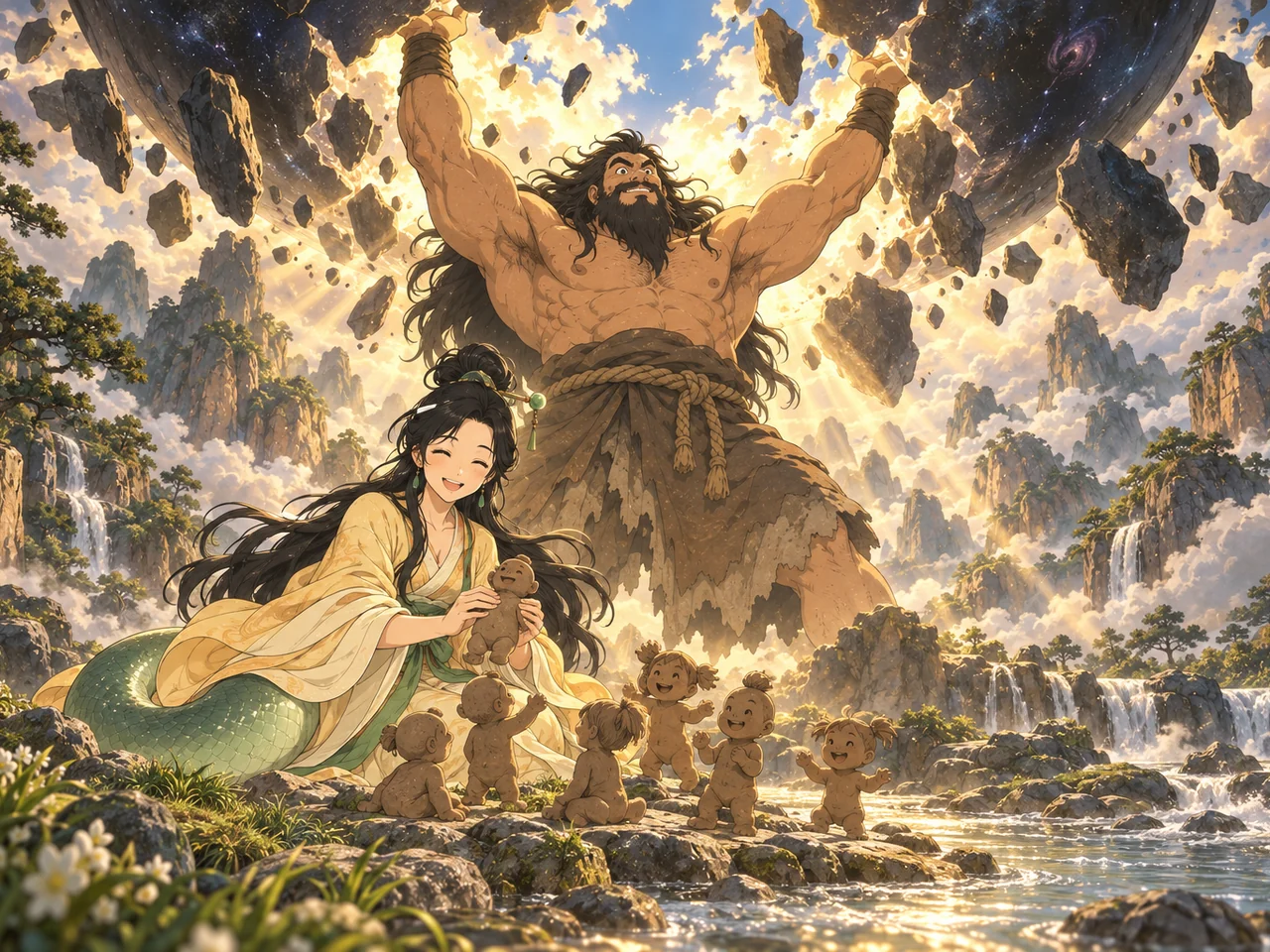
Retold from the classic Chinese creation myths: the giant Pangu breaks open the dark egg of the universe and holds up the sky, then the goddess Nüwa makes the first people from yellow clay and mends the broken sky.
Meet the voices
- Narrator · 旁白 — An old storyteller who tells how the world began, the way it has been told to Chinese children for centuries.
- Pangu · 盘古 — A gentle giant who wakes up inside the dark egg of the universe and gives everything he has to make room for the world.
- The Sky · 天空 — The light, airy half of the egg: chatty, jumpy and, to everyone's surprise, afraid of heights.
- The Earth · 大地 — The heavy half of the egg: slow, patient and never, ever done sleeping.
- Nüwa · 女娲 — A warm, funny goddess with a snake's tail who is lonely in the empty world until she makes children of her own from yellow clay.
- Number One · 老大 — The very first person Nüwa makes, and very proud of it: bossy, brave and always ready to take charge.
- Little Sister · 小妹 — Nüwa's second child, exactly one day younger than Number One and never shy about reminding him.
- Gonggong · 共工 — The hot-tempered god of water, who cannot stand to lose.
5 chapters, one journey
Chapter 1: The Giant in the Egg
大蛋里的盘古
Before there was a sky or an earth, a giant named Pangu woke up inside a huge, dark egg. It was far too small, and he was not alone in there.
Free to read
Chapter 2: Holding Up the Sky
顶天立地
Pangu holds the frightened Sky over his head, growing ten feet taller every day for eighteen thousand years. But can anyone, even a giant, hold up the sky forever?
Free to read
Chapter 3: A Child of Yellow Clay
黄泥做的孩子
The goddess Nüwa has the whole beautiful world to herself, and no one to talk to. Then she sees her face in the river and scoops up a handful of yellow clay.
Free to read
Chapter 4: It's Raining People
天上下小泥人
Nüwa sets out to make as many children as there are stars, one handful of clay at a time. Her hands get tired fast, until she spots a long rope.
Free to read
Chapter 5: Mending the Sky
女娲补天
Fire pours through the crack in the sky, and water rises from below. Nüwa has a plan to fix it, and for once, Number One really does get to be the boss.
Free to read
Key words in Pangu and Nüwa: How the World Began
Behind the story
Pangu (盘古) is the giant at the very beginning of Chinese mythology. The earliest known written version of his story comes from Xu Zheng, a third-century scholar, who wrote that heaven and earth were once a murky chaos shaped like a hen's egg. Pangu grew inside it for eighteen thousand years; then the light, clear part rose to become the sky, and the heavy, murky part sank to become the earth. Another early text tells how his body became the sun and moon, the mountains, the rivers and the stars.
Nüwa (女娲) appears in writing even earlier. Han-dynasty books tell how she shaped the first people from yellow earth, and how she melted stones of five colors to patch the sky when it broke. Ancient stone carvings and paintings show her with a human head and body and a long snake's tail. Chinese children still read both myths, 盘古开天地 and 女娲补天, in primary school.
Did you know?
- When something happens for the first time ever, Chinese people may call it 开天辟地, “splitting open the sky and the earth,” after what Pangu did.
- Dream of the Red Chamber (红楼梦), the great eighteenth-century novel, begins with Nüwa mending the sky: she makes 36,501 stones and uses all but one, and the whole story grows out of that one leftover stone.
- The Huainanzi (淮南子), a book from the second century BC, says that when Gonggong broke Mount Buzhou, the sky tipped toward the northwest and the earth sank in the southeast. That, it explains, is why the sun, moon and stars drift west, and why rivers run down to the southeast.