Traditional Chinese legend, retold in simple Mandarin
Qin Shi Huang: Unifying China
秦始皇:统一天下
Qin Shi Huang: Unifying China (秦始皇:统一天下, Qín Shǐhuáng: tǒngyī tiānxià) is a story from the Chinese classic by Sima Qian, retold in simple Mandarin as an 8-chapter story with audio for learners at about HSK 3 (Intermediate).
Retold from Sima Qian's Records of the Grand Historian: a merchant's bet, a dagger hidden in a map, one writing and one money, a long wall, a burned library and a clay army.
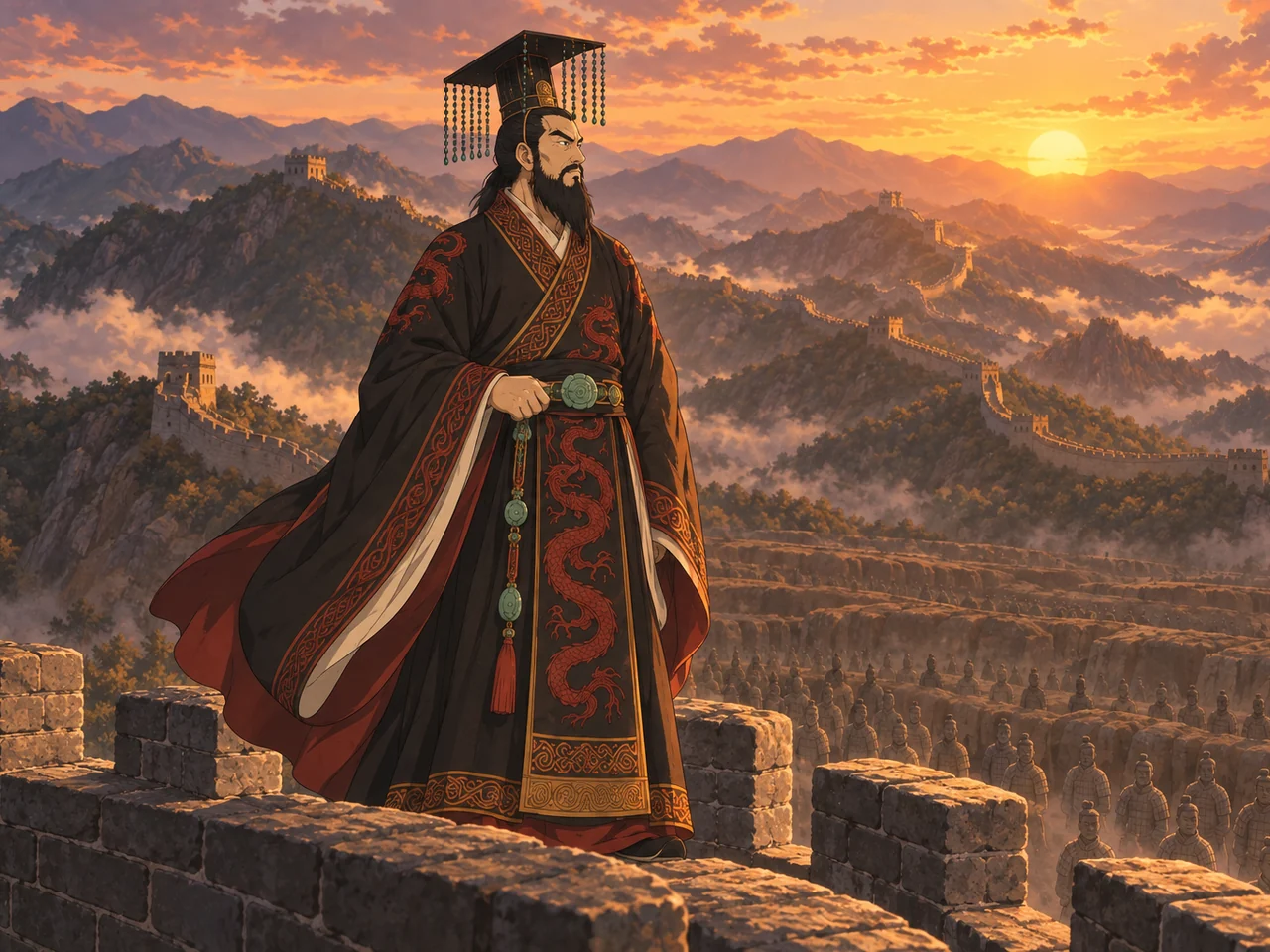
Meet the voices
- Narrator · 旁白 — A warm storyteller who sets the scene.
- Lao Yang · 老杨 — A kind old farmer who digs a well and finds a clay soldier.
- Xiao Lan · 小兰 — His curious, cheeky granddaughter.
- King Zheng · 嬴政 — The thirteen-year-old king of Qin with a very big dream.
- Li Si · 李斯 — The clever minister who helps make the plans.
- Qin Shi Huang · 秦始皇 — The First Emperor, proud and strong, and later old and afraid.
- Meng Tian · 蒙恬 — The general who builds the wall.
- Da Shan · 大山 — A tired young laborer who misses his mother.
- Xu Fu · 徐福 — A smooth magician who promises medicine that stops death.
- Lu Buwei · 吕不韦 — A smooth, rich merchant who bets on a forgotten prince.
- Zichu · 子楚 — A lonely Qin prince held far from home.
- Jing Ke · 荆轲 — The calm envoy from Yan who carries a map and a hidden dagger.
- Zhao Gao · 赵高 — The palace servant who keeps the emperor's death secret.
- Old Lord · 老大臣 — A pompous old noble who wants foreigners sent away.
- Old Scholar · 老学者 — A stubborn scholar who trusts old books.
- Rider · 送信人 — A messenger who rides in with urgent news.
- Guard · 卫兵 — A palace guard.
- Royal Doctor · 医生 — The palace doctor with a heavy medicine bag.
8 chapters, one journey
Chapter 1: The Well in the Dry Field
井里的泥兵
In a dry summer, a farmer and his granddaughter dig a new well and hit a clay head. It leads to a two-thousand-year-old story, and it starts with a merchant who bought a prince.
Free to read
Chapter 2: The Merchant Who Bought a Prince
买王子的商人
A rich merchant spots a forgotten prince and makes a bold plan. Years later, the prince's thirteen-year-old son sits on a throne that is far too big for him.
SayMei Stories
Chapter 3: The Guest Minister
被赶走的李斯
The king wants all foreigners sent away, even his clever minister Li Si. One letter changes his mind and starts a plan to join seven kingdoms into one.
SayMei Stories
Chapter 4: The Map and the Dagger
地图和短刀
A visitor from Yan kneels before the king with a gift map. But something is hidden inside it, and the king has only a pillar and a sword that is too long.
SayMei Stories
Chapter 5: One Emperor, One Way
皇帝的新名字
At last the seven lands are one, and the king wants a name bigger than king. Then come one writing, one money, and one width for cart wheels.
SayMei Stories
Chapter 6: The Long Wall
北方的长城
On a freezing mountain, a tired young worker and a kind general build the emperor's wall. Then a rider gallops in with news that no one understands.
SayMei Stories
Chapter 7: Fire and Medicine
火和仙药
An old scholar argues with the emperor, and books are burned. Years later the emperor, afraid of dying, trusts a magician with a promise of medicine that never ends life.
SayMei Stories
Chapter 8: The Last Road
最后一条路
The emperor travels east, weak and waiting for a ship that never comes. His ministers keep a secret on the road, and in 1974 a well finally answers a little girl's wish.
SayMei Stories
Key words in Qin Shi Huang: Unifying China
Behind the story
Qin Shi Huang (259-210 BC) was born Ying Zheng, king of Qin at thirteen. In 221 BC he joined seven warring countries into one and took a new title, huangdi (皇帝), "emperor." Our main source is the historian Sima Qian's 史记, written about a hundred years after his death, and it tells of the merchant Lü Buwei, the attack by Jing Ke, the minister Li Si and the search for a medicine of immortality.
His government standardized writing, money and the width of cart axles, and linked older walls into a long northern defense that later grew into the Great Wall (长城). It also burned many old books and punished scholars, and forced huge numbers of people to labor. That is why Chinese readers remember him as both a great unifier and a harsh ruler.
Did you know?
- The word 皇帝 (huángdì) was first used for him, and Chinese rulers kept it for over two thousand years, until 1912.
- In 1974, farmers digging a well near Xi'an found the first pieces of the clay army (兵马俑). Each soldier's face is different.
- Sima Qian says Xu Fu (徐福) sailed east with thousands of young people to look for the medicine of immortality and never came back.