World classic, retold in simple Mandarin
The Gift of the Magi
麦琪的礼物
The Gift of the Magi (麦琪的礼物, Màiqí de lǐwù) is a classic by O. Henry, retold in simple Mandarin as a 3-chapter story with audio for learners at about HSK 3 (Intermediate).
Retold from O. Henry's classic short story: on Christmas Eve in a 1930s Shanghai lane, a poor young couple each give up their greatest treasure to buy the other a gift.
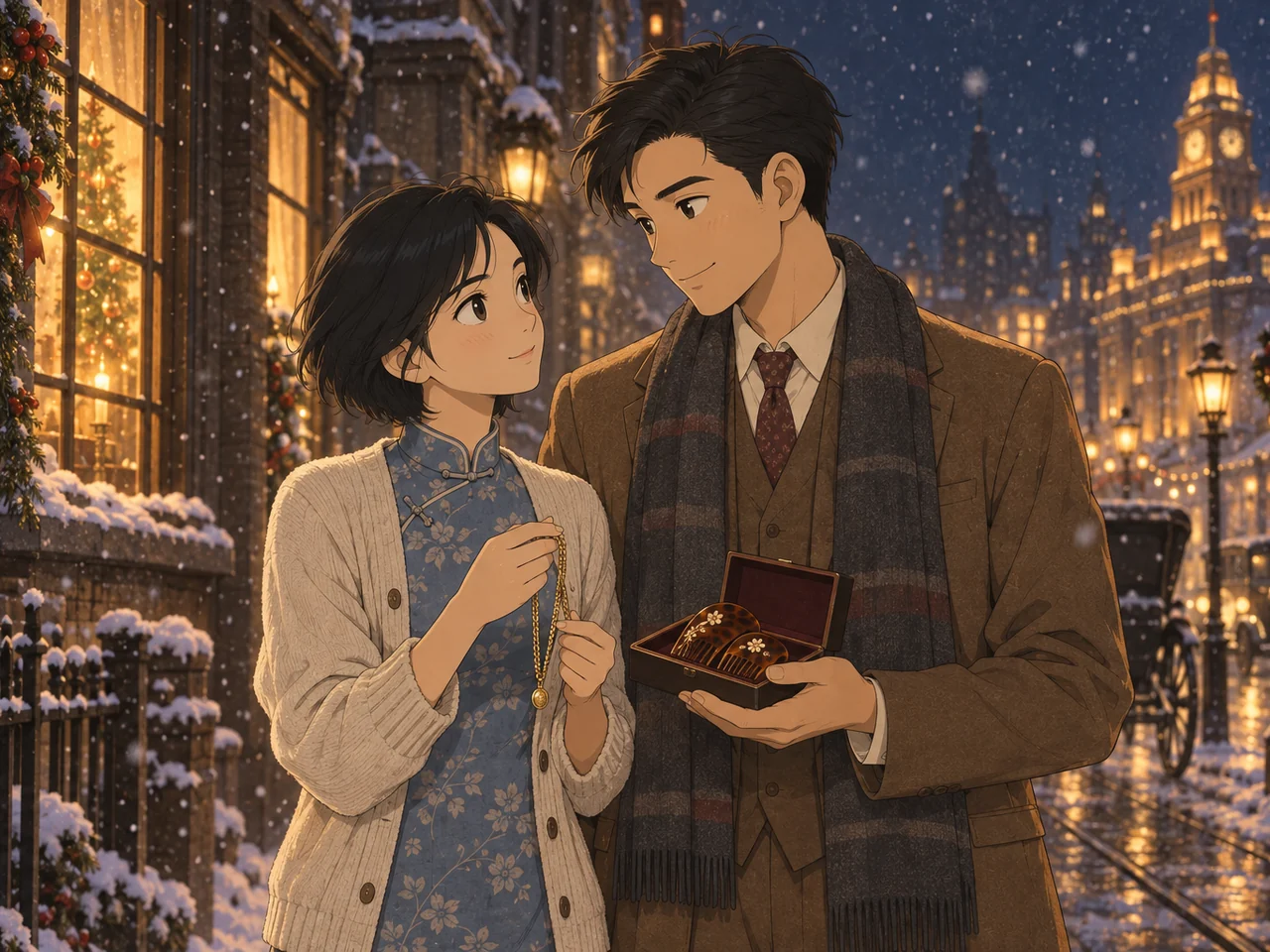
Meet the voices
- Narrator · 旁白 — The library's grandfatherly storyteller, who sets the scene in a cold Shanghai lane and has the last warm word about the Magi.
- Xiao Mei · 小美 — A young wife of about twenty-two with one yuan eighty-seven to her name, a big heart, and the longest hair in the lane.
- A Ming · 阿明 — Her husband, about twenty-four, honest and hardworking, whose one treasure is the gold watch his grandfather left him.
- Shop Owner · 老板娘 — A plump, brisk woman who runs the little hair shop at the mouth of the lane and knows fine hair when she sees it.
3 chapters, one journey
Chapter 1: One Yuan Eighty-Seven
一块八毛七
On Christmas Eve in a Shanghai lane, Xiao Mei has one yuan eighty-seven to buy her husband a present, and one treasure she could sell.
Free to read
Chapter 2: Her Long Hair
她的长头发
A little hair shop, a pair of big scissors, and twenty yuan. Then Xiao Mei hunts along Nanjing Road for a present worthy of A Ming.
SayMei Stories
Chapter 3: Two Gifts
两份礼物
A Ming comes home through the snow and stops dead in the doorway. Two presents are waiting, and a surprise neither of them saw coming.
SayMei Stories
Key words in The Gift of the Magi
Behind the story
The Gift of the Magi is a short story by the American writer O. Henry, first published in 1905. Chinese readers know it as 麦琪的礼物, and it is one of the best-known foreign short stories in China, famous for its twist ending and its warm heart.
This retelling moves the story from New York to a single rented room in a Shanghai lane (弄堂) in the 1930s, when families often shared one 石库门 lane house room by room. Shanghai was then China's most international city, and Christmas was already part of life there, especially in the foreign concessions.
Did you know?
- 麦琪 is not a person in the story. It is the Chinese sound-spelling of “Magi,” the wise men in the Christmas story who traveled far to bring gifts to the baby Jesus.
- 一块八毛七 is how you say ¥1.87 out loud: 块 is the everyday word for a yuan, 毛 is a tenth of a yuan, and the last number counts the fen.
- O. Henry's surprise endings are so famous in China that a twist which is unexpected but fits perfectly is often called an 欧·亨利式结尾, an “O. Henry-style ending.”