World classic, retold in simple Mandarin
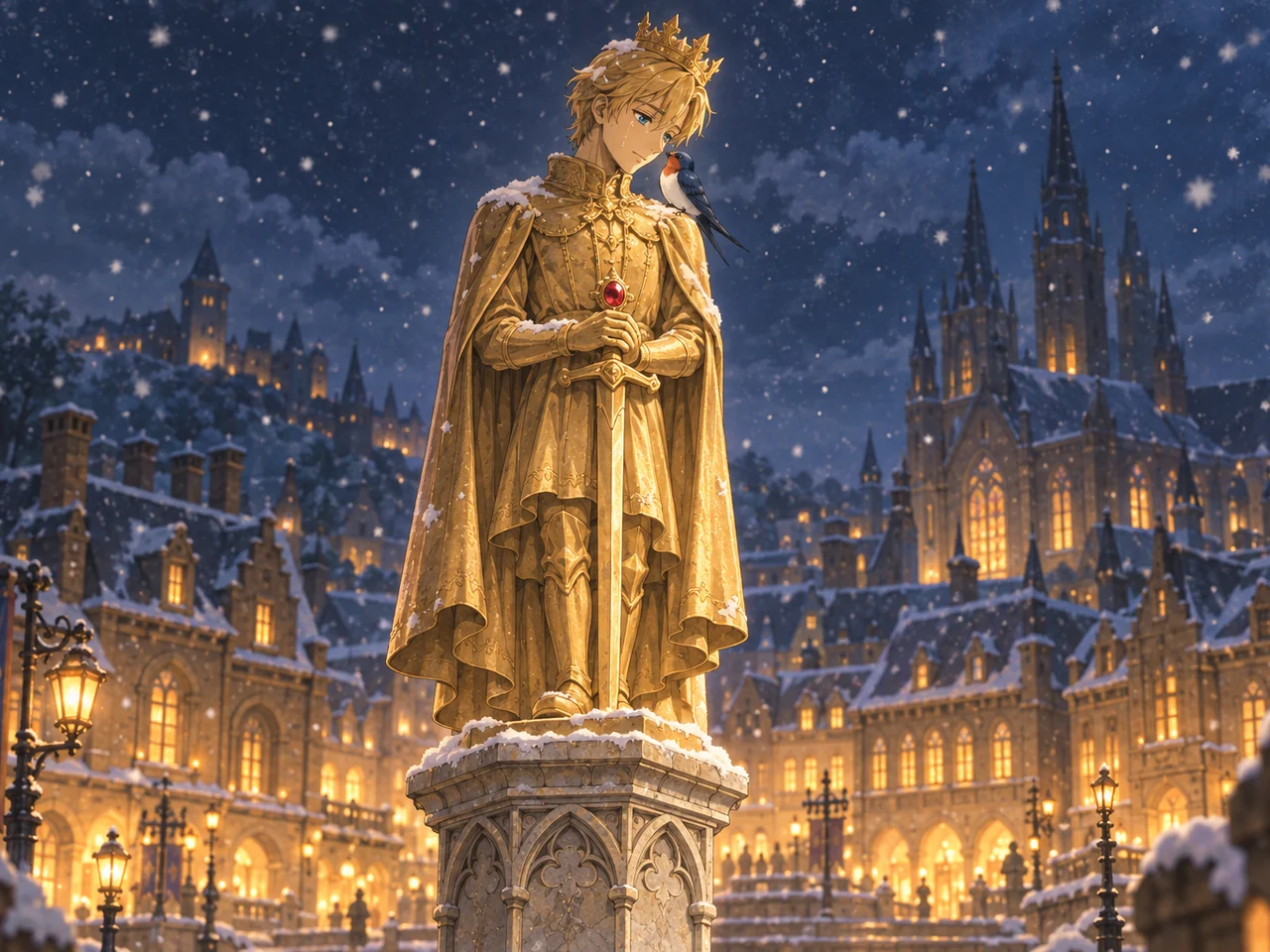
The Happy Prince
快乐王子
The Happy Prince (快乐王子, Kuàilè wángzǐ) is a fairy tale by Oscar Wilde, retold in simple Mandarin as a 4-chapter story with audio for learners at about HSK 2 (Elementary).
Retold from Oscar Wilde's 1888 fairy tale: a golden statue and a little swallow who stayed too late in autumn give away a ruby, two sapphires and every leaf of gold to the poor.
Meet the voices
- Narrator · 旁白 — An old storyteller who tells this gentle tale plainly, like a grandfather by the fire.
- The Happy Prince · 快乐王子 — A golden statue high on a column who cries for everyone in the city.
- The Little Swallow · 小燕子 — A chatty, proud little bird who complains a lot and has the biggest heart.
- The Sick Boy · 小男孩 — A feverish little boy who wants an orange.
- The Young Writer · 年轻人 — A cold, hungry young man in an attic who can't finish his story.
- The Match Girl · 小姑娘 — A tiny girl whose matches fell in the water.
- The Mayor · 市长 — A proud, pompous mayor who loves his own nose.
- The Worker · 工人 — A sooty, kind worker who hides his laughter and his pity.
- The Voice from Above · 天上的声音 — A deep and kind voice from the sky that chooses the most precious things.
4 chapters, one journey
Chapter 1: The Prince Who Cried
会哭的王子
A late little swallow lands at the feet of a golden statue and gets dripped on. Why is the Happy Prince crying, and what does he want from a bird in a hurry?
Free to read
Chapter 2: The Blue Eye
蓝宝石
The swallow is finally ready to leave for Egypt, but a freezing young writer needs one more thing from the prince. This time it is the prince's own eye.
SayMei Stories
Chapter 3: The Gold Leaves
金叶子
With one blue eye left, the prince asks for one more gift. The swallow makes a choice, and soon gold is falling on the poorest streets of the city.
SayMei Stories
Chapter 4: The Lead Heart
铅心
In the deep cold of winter, the little swallow says his last goodbye. Then the mayor sees a shabby statue and orders it melted, but a heart that cannot melt is found.
SayMei Stories
Key words in The Happy Prince
Behind the story
This story was written by the Irish author Oscar Wilde (王尔德 in Chinese) and published in 1888 in a book of fairy tales. Chinese readers know it as 快乐王子, and it is a favorite in translated collections of world stories, often read by children and adults alike.
Swallows (燕子) have a warm place in Chinese culture. They come back every spring and build their nests under the roofs of houses, and families have long seen them as a sign of good luck. That makes this small, loyal bird an easy friend to love.
Did you know?
- Many swallows that spend the summer in Europe really do fly south for the winter, crossing Africa on the way, which is why the swallow in the story dreams of Egypt.
- Lead is a heavy, soft, gray metal, so a heart made of lead is a heart that feels heavy with sadness.
- In China, swallows nesting under a family's roof has traditionally been welcomed as a sign of good luck.