World classic, retold in simple Mandarin
The Little Match Girl
卖火柴的小女孩
The Little Match Girl (卖火柴的小女孩, Mài huǒchái de xiǎo nǚhái) is a fairy tale by Hans Christian Andersen, retold in simple Mandarin as a 3-chapter story with audio for learners at about HSK 2 (Elementary).
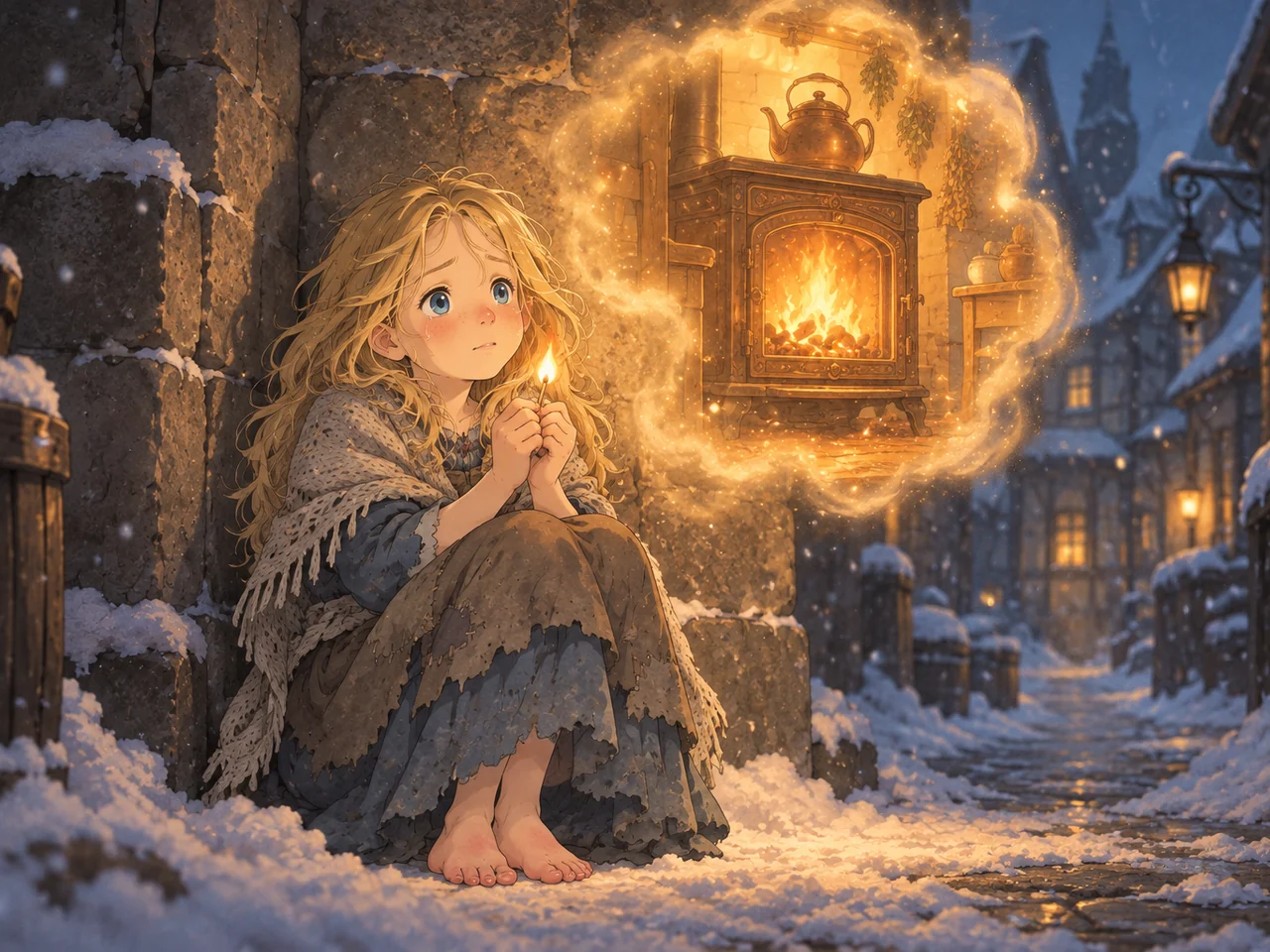
Retold from Hans Christian Andersen's fairy tale: on the last night of the year, a barefoot girl who can't sell a single match strikes one to warm her hands, and finds a wonder in its flame.
Meet the voices
- Narrator · 旁白 — Tells Andersen's winter tale quietly and simply, and lets the little girl's own voice carry it.
- The Little Match Girl · 小女孩 — A poor, barefoot girl selling matches on New Year's Eve, who talks to everything she sees and keeps promising herself “just one” match.
- The Boy · 小男孩 — A cheeky street boy who runs off with her mother's old shoe, and can't quite forget the girl he took it from.
- Grandma · 奶奶 — The girl's late grandmother, the only person who ever loved her, who appears in the light of a match.
- The Gentleman · 先生 — A busy man hurrying home on New Year's Eve, who has no time for a match seller until the next morning.
- The Lady · 太太 — A well-dressed lady in a hurry to get home to her roast goose.
3 chapters, one journey
Chapter 1: The Last Night of the Year
一年的最后一晚
On the last night of the year, a barefoot girl can't sell a single match, so she dares to strike one, and something warm and wonderful appears in the flame.
Free to read
Chapter 2: The Goose That Walked
会走路的烤鹅
With every match she strikes, the cold night opens onto something new: a feast, a Christmas tree, a falling star. But the next flame holds the biggest surprise of all.
SayMei Stories
Chapter 3: Grandma's Hand
奶奶的手
Grandma has come for her, but the match is burning down fast. This time, the little girl isn't going to light just one.
SayMei Stories
Key words in The Little Match Girl
Behind the story
The Danish writer Hans Christian Andersen (安徒生) wrote The Little Match Girl in 1845 while staying at Gråsten Castle. An almanac publisher had sent him three pictures and asked for a story to go with one of them. Andersen chose a drawing by the painter Johan Thomas Lundbye of a poor little girl with matches, and the story was printed that December.
In Chinese the story is called 卖火柴的小女孩, “the little girl who sells matches.” It is one of the best-loved of the 安徒生童话 (Andersen's Fairy Tales) in China, and in recent years it has been a lesson in the third-grade Chinese textbook used in schools across the country, so many Chinese children read it in class at about eight.
Did you know?
- Andersen's Danish title, Den lille Pige med Svovlstikkerne, means “The Little Girl with the Matches.” Svovlstikker, literally “sulfur sticks,” is an old Danish word for matches.
- The Chinese textbook version calls the night of the story 大年夜, the word many Chinese families use for the eve of Spring Festival. In Andersen's Denmark, it is simply December 31.
- In 2016, Cao Wenxuan (曹文轩) became the first Chinese writer to win the Hans Christian Andersen Award, often called the “Little Nobel Prize” of children's books.