Traditional Chinese legend, retold in simple Mandarin
The Magic Lotus Lantern
宝莲灯
The Magic Lotus Lantern (宝莲灯, Bǎolián dēng) is a Chinese legend, retold in simple Mandarin as a 6-chapter story with audio for learners at about HSK 2 (Elementary).
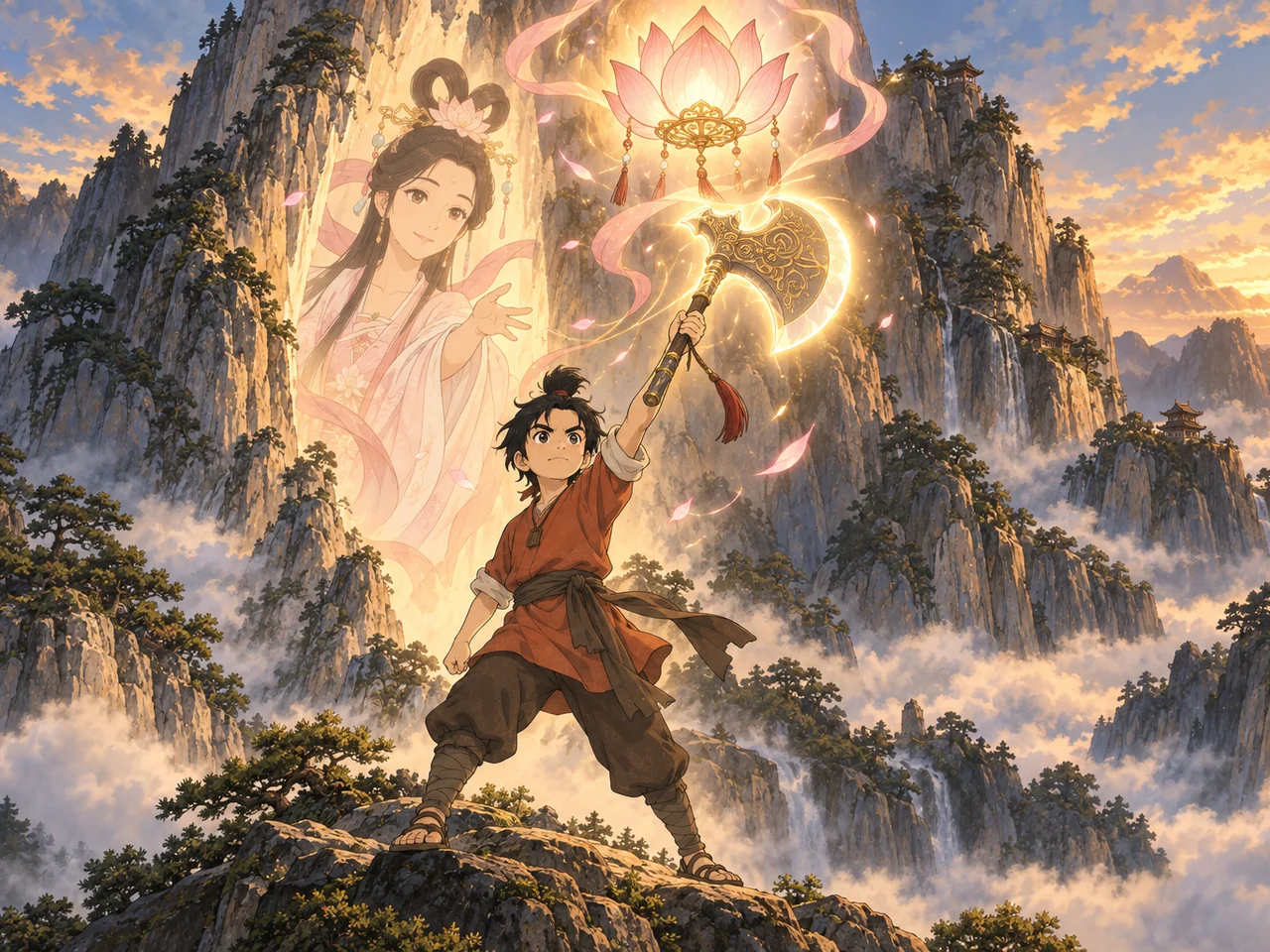
Retold from the Chinese legend of the Lotus Lantern: a goddess marries a poor scholar, her three-eyed brother traps her under Mount Hua, and fourteen years later their son comes back with an axe.
Meet the voices
- Narrator · 旁白 — An old storyteller who tells how a magic lantern, a bad poet and a boy with an axe brought one family back together.
- Sanshengmu · 三圣母 — The goddess of Mount Hua, whom her husband calls Sanniang: gentle and playful, she talks to her lotus lantern like an old friend and will give up anything for her family.
- Liu Yanchang · 刘彦昌 — A poor, kind-hearted scholar who writes terrible poems, worries about food, and is braver than he looks.
- Erlang Shen · 二郎神 — Sanshengmu's elder brother, a warrior god with a third eye, who believes that heaven's law is heaven's law.
- Chenxiang · 沉香 — The son of a goddess and a scholar, bold and quick with an answer, who sets out at fourteen to free his mother.
- Pili Daxian, the Thunder Immortal · 霹雳大仙 — A tiny old immortal with a voice like thunder and a soft heart he tries very hard to hide.
6 chapters, one journey
Chapter 1: A Poem on the Wall
墙上的诗
On a rainy night, a soaked young scholar stumbles into the temple of Sanshengmu, the lonely goddess of Mount Hua, who hasn't laughed in a hundred years.
Free to read
Chapter 2: The Third Eye
第三只眼睛
At their baby's hundred-day party, Sanshengmu makes the Lotus Lantern shine for her son, so brightly that someone high up in heaven notices.
Free to read
Chapter 3: Under Mount Hua
压在华山下
Without her lantern, Sanshengmu must face her brother alone and make a hard choice. Fourteen years later, a boy starts asking questions.
Free to read
Chapter 4: Mother's Voice
妈妈的声音
Chenxiang finally learns the truth and sets off for Mount Hua with a bag of buns. But can a boy's two hands open a mountain?
Free to read
Chapter 5: The Thunder Immortal
霹雳大仙
High above the clouds, a tiny old immortal with a voice like thunder agrees to teach Chenxiang, but his first lesson is not what Chenxiang expected.
Free to read
Chapter 6: Splitting the Mountain
劈开华山
At the foot of Mount Hua, Chenxiang faces his uncle, whose third eye sees every move. He has an axe, a bag of buns, and one idea.
Free to read
Key words in The Magic Lotus Lantern
Behind the story
The Magic Lotus Lantern (宝莲灯) is one of China's best-loved legends. A goddess of Mount Hua (华山), one of China's Five Great Mountains (五岳), marries a human scholar against heaven's law, and her son Chenxiang (沉香) grows up to split the mountain open and set her free. The story is often simply called 劈山救母, “splitting the mountain to save his mother.”
The legend has been told for centuries by storytellers and on the opera stage, and many Chinese people first met it in Lotus Lantern (宝莲灯), the 1999 animated film from the Shanghai Animation Film Studio. The story's stern uncle is Erlang Shen (二郎神), the same three-eyed god who fights the Monkey King in Journey to the West (西游记).
Did you know?
- The West Peak of Mount Hua is also called Lotus Peak (莲花峰). Near its summit lies a huge boulder cracked apart as if by an axe, known as Axe-Split Rock (斧劈石), and tradition says this is where Chenxiang swung his axe.
- Chenxiang (沉香) is also the Chinese word for agarwood, a rare, sweet-smelling wood that has been burned as incense in Chinese temples for many centuries.
- Erlang Shen's hunting dog is usually called 哮天犬, “the dog that howls at heaven.” In Journey to the West, it helps its master catch the Monkey King by biting him on the leg.