Traditional Chinese legend, retold in simple Mandarin
Three Kingdoms: Red Cliff
赤壁之战
Three Kingdoms: Red Cliff (赤壁之战, Chìbì zhī zhàn) is a story from Three Kingdoms, the Chinese classic by Luo Guanzhong, retold in simple Mandarin as an 8-chapter story with audio for learners at about HSK 4 (Upper intermediate).
Retold from the classic novel Romance of the Three Kingdoms: an outnumbered alliance, a brilliant strategist, one impossible wind and a river on fire. Chinese story with pinyin.
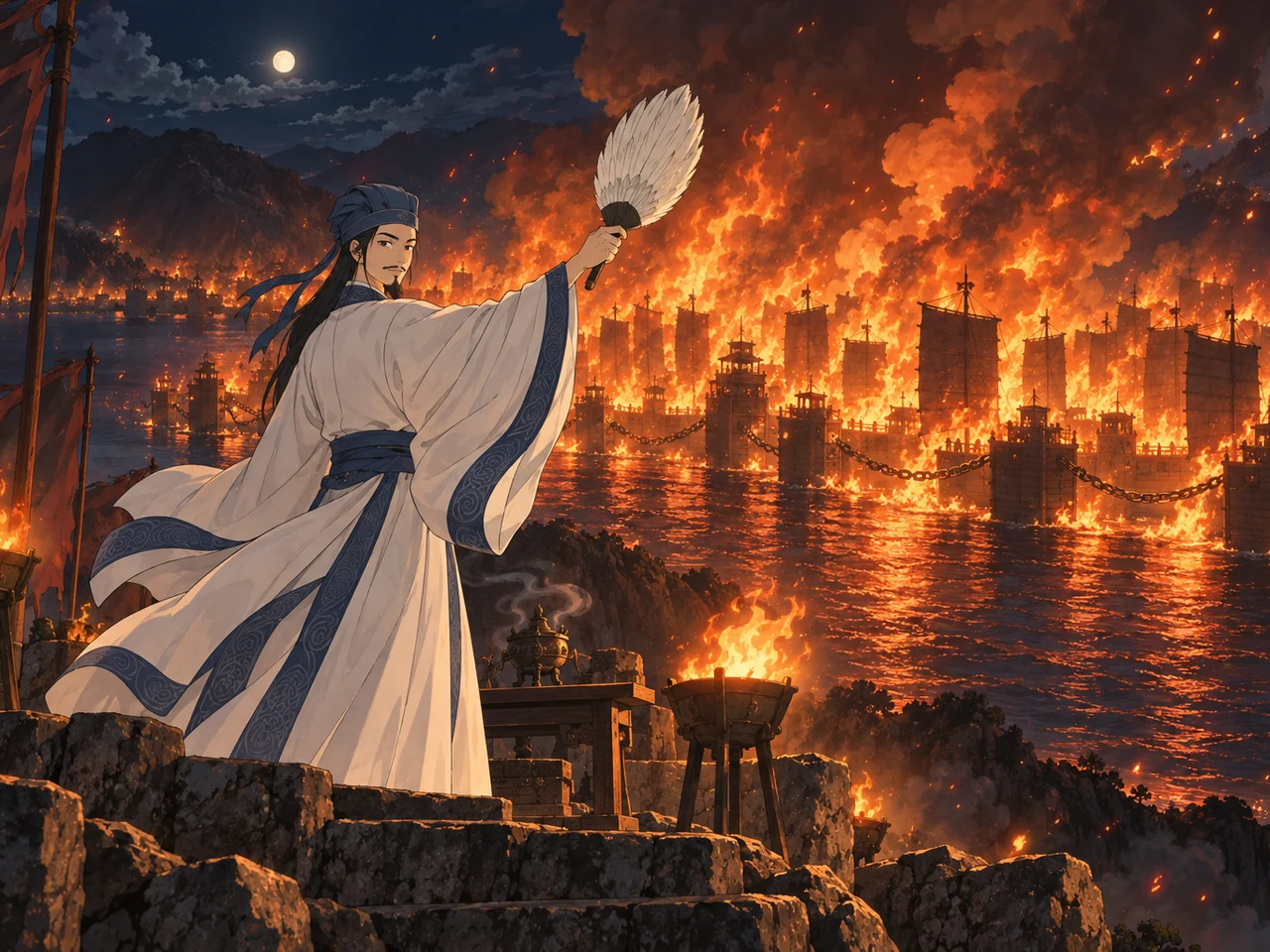
Meet the voices
- Narrator · 旁白 — A warm older storyteller who sets the scene.
- Zhuge Liang · 诸葛亮 — The calm young strategist who always seems one step ahead.
- Lu Su · 鲁肃 — Wu's kind, fretful adviser who is always sweating and asking what to do.
- Zhou Yu · 周瑜 — Wu's proud, brilliant commander who cannot stand being outshone.
- Cao Cao · 曹操 — The suspicious northern warlord with the biggest army in China.
- The Young Soldier · 小兵 — A cheerful teenage soldier in Cao Cao's army who gets seasick.
- Liu Bei · 刘备 — The gentle, patient leader whom ordinary people love to follow.
- Guan Yu · 关羽 — Liu Bei's red-faced sworn brother, loyal and honorable to the bone.
- Sun Quan · 孙权 — The young lord of Wu who must decide between surrender and war.
- Huang Gai · 黄盖 — Wu's white-bearded old general, tough and willing to take a beating for his side.
- Wu Scholar · 书生 — A proud scholar at Sun Quan's court who wants to surrender.
- Pang Tong · 庞统 — A wandering scholar with a very helpful, very dangerous idea.
- Sailor · 水手 — A young sailor on Huang Gai's fleet who reports what he sees.
- Cao Cao's Adviser · 谋士 — A careful adviser who notices what everyone else misses.
8 chapters, one journey
Chapter 1: The Scholars of Wu
吴国的书生们
Cao Cao's letter has Wu's scholars ready to surrender. Zhuge Liang teases them one by one, until Sun Quan walks in and hears a secret: half of Cao Cao's army is fake.
Free to read
Chapter 2: A Sword on the Table
桌子上的剑
Zhuge Liang convinces Sun Quan that Cao Cao's giant army is a hollow drum. But Wu's own commander, Zhou Yu, is already planning a deadly test for him.
SayMei Stories
Chapter 3: The Angry Old General
生气的老将军
To sneak fire ships past Cao Cao, old General Huang Gai offers to take a beating in public. Zhuge Liang sees the plan, and one thing it lacks.
SayMei Stories
Chapter 4: A Letter Across the River
江那边的信
Cao Cao chains his ships together and trusts a letter from a beaten old general. Zhou Yu is thrilled, until a banner shows him what he forgot.
SayMei Stories
Chapter 5: Borrowing the Wind
借东风
Zhou Yu falls ill with worry. Zhuge Liang cures him with one line of writing and promises to borrow the wind, and then plans a quiet escape.
SayMei Stories
Chapter 6: Ships That Came to Surrender
来投降的船
Cao Cao is finally comfortable on his linked ships, until the wind turns and Huang Gai's fleet sails toward him under a green flag.
SayMei Stories
Chapter 7: The River Burns
大火烧江
Wu's fire ships turn Cao Cao's chained fleet into a wall of flame. Zhuge Liang has slipped away, and now he sends the one man who owes Cao Cao a favor.
SayMei Stories
Chapter 8: Huarong Road
华容道
Cao Cao limps home in the rain, laughing at his enemies, until a red-faced general appears on the road. Old debts and honor decide the last move.
SayMei Stories
Key words in Three Kingdoms: Red Cliff
Behind the story
The Battle of Red Cliff took place in the winter of 208 AD, at the end of the Han dynasty. A much bigger northern army under Cao Cao was beaten on the Yangtze River by the smaller forces of Sun Quan and Liu Bei. It is one of the most famous battles in Chinese history.
Most people in China know it from the fourteenth-century novel Romance of the Three Kingdoms (三国演义), which adds wonderful stories to the real events: the eloquent debate, the borrowed east wind and the general who lets an enemy go. Red Cliff is taught in schools, retold in operas and games, and many students learn a famous poem about it.
Did you know?
- The novel says Cao Cao had eight hundred thousand men. Historians think the real number was closer to two or three hundred thousand.
- Chinese people still use the saying 万事俱备,只欠东风 (everything is ready except the east wind) when one last missing piece holds up a whole plan.
- The real Red Cliff is a stretch of the Yangtze River in Hubei province, and there are now several famous sites there that visitors can tour.