Traditional Chinese legend, retold in simple Mandarin
Wu Gang and the Moon Tree
吴刚伐桂
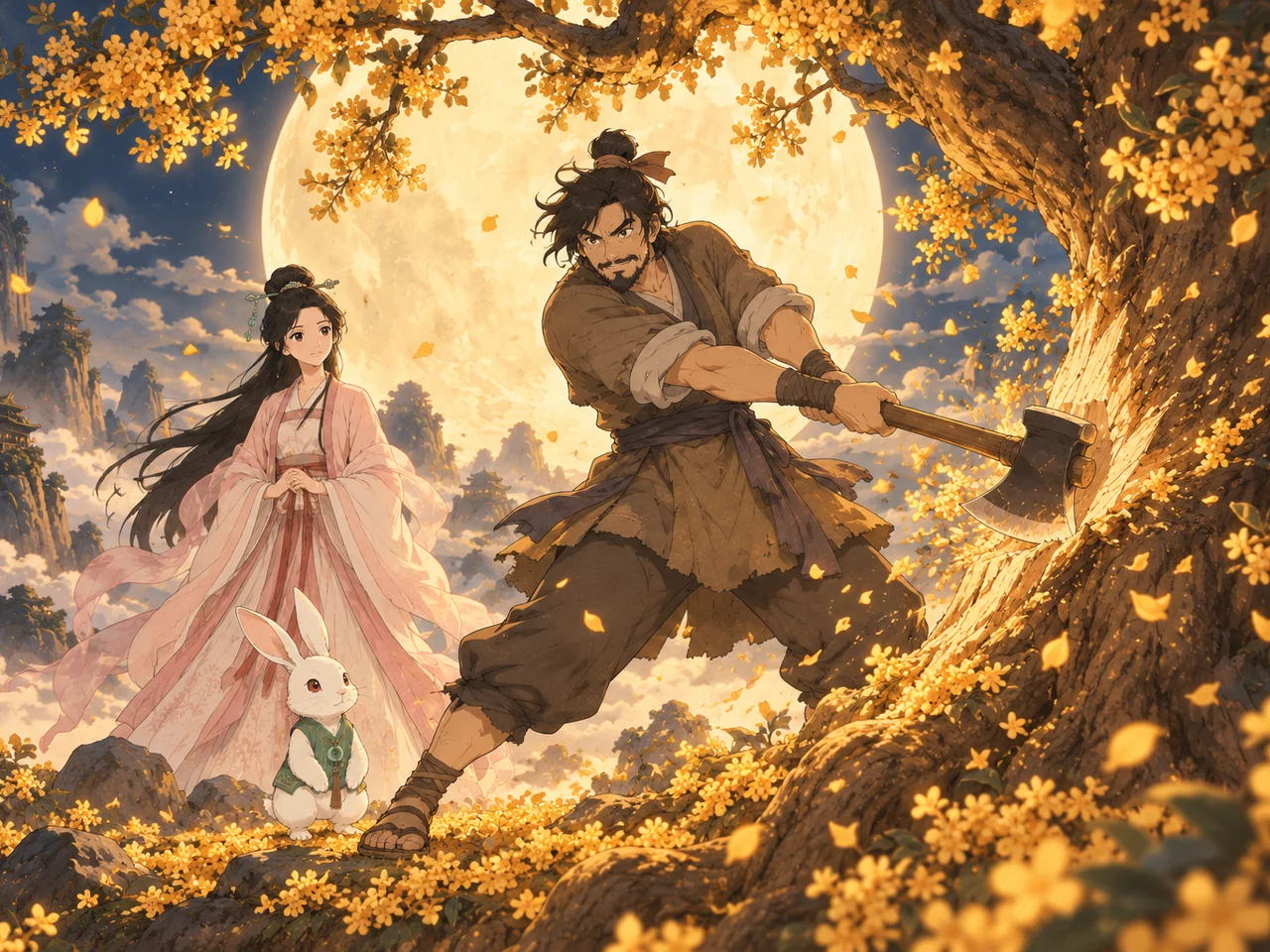
Wu Gang and the Moon Tree (吴刚伐桂, Wú Gāng fá guì) is a Chinese legend, retold in simple Mandarin as a 3-chapter story with audio for learners at about HSK 1 (Beginner).
Retold from a Tang dynasty legend: a lazy man is sent to the moon to chop a tree that heals after every cut, and finds out what his work gives the world below.
Meet the voices
- Narrator · 旁白 — Tells the old moon legend like a grandfather by the fire.
- Wu Gang · 吴刚 — A lazy man who always says he is tired, sent to chop the moon's tree.
- The Immortal · 师父 — An old immortal master with endless patience and a dry sense of humor.
- Chang'e · 嫦娥 — The lady of the moon, gentle and patient.
- Yutu · 玉兔 — The cheeky Jade Rabbit who has lived on the moon for three hundred years.
- The Child · 小孩 — A little girl on earth who smells the flowers.
- The Mother · 妈妈 — A warm mother telling her child the moon story.
3 chapters, one journey
Chapter 1: The Tree That Heals
吴刚去月亮
Wu Gang wants to fly without any work, so an old immortal sends him to the moon to chop one tree. But every cut he makes closes up again.
Free to read
Chapter 2: The First Flower
第一朵花
Wu Gang has chopped for thirty days and the tree is still whole. When he throws the axe away, Chang'e arrives and something small and golden falls.
SayMei Stories
Chapter 3: The Scent of Autumn
桂花香
It is Mid-Autumn night and the moon tree is covered in flowers. Wu Gang learns where the golden petals go, and who is waiting for them below.
SayMei Stories
Key words in Wu Gang and the Moon Tree
Behind the story
The legend of Wu Gang chopping the osmanthus tree (吴刚伐桂) was written down in the Tang dynasty in Duan Chengshi's collection Miscellaneous Morsels from Youyang (酉阳杂俎). A man who studied to become an immortal kept making mistakes, so he was sent to the moon to chop a tree that healed after every cut.
In China the moon's dark patches are said to be this tree, and the fragrant osmanthus (桂花) blooms in autumn, right around the Mid-Autumn Festival (中秋节). Families eat mooncakes, and many also enjoy osmanthus cakes (桂花糕) and osmanthus wine. This retelling adds a kinder ending, in which the falling flowers become the scent of autumn.
Did you know?
- The city of Guilin (桂林) is named for its forests of osmanthus trees.
- The phrase 折桂 (zhé guì, "to break off an osmanthus branch") is an old way of saying someone won a top prize, especially in the imperial exams.
- In Chinese stories the Jade Rabbit (玉兔) lives on the moon with Chang'e, and China named its moon rovers Yutu after it.