Traditional Chinese legend, retold in simple Mandarin
Wu Zetian and the Peonies
武则天与牡丹
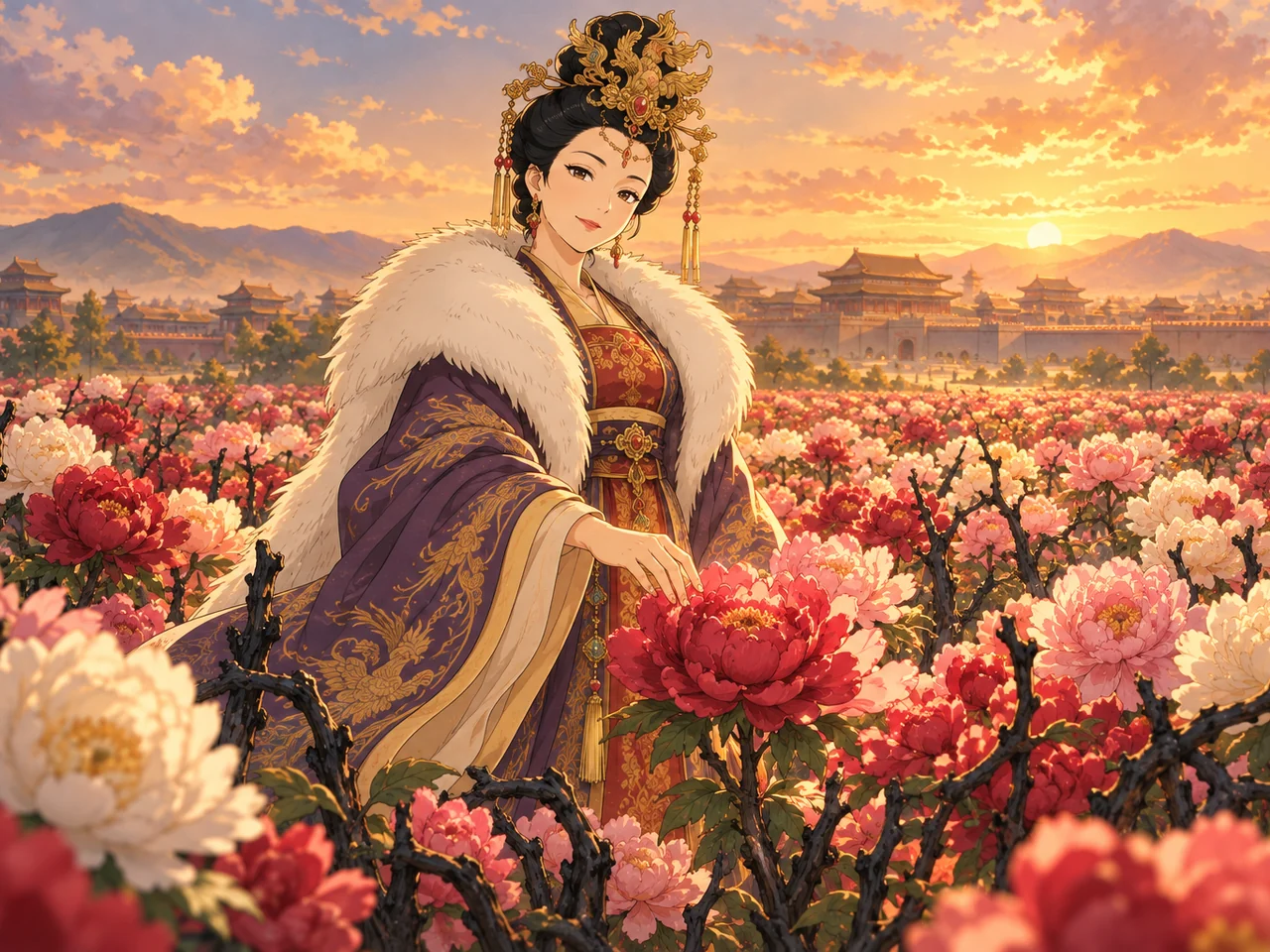
Wu Zetian and the Peonies (武则天与牡丹, Wǔ Zétiān yǔ mǔdan) is a Chinese legend, retold in simple Mandarin as a 4-chapter story with audio for learners at about HSK 2 (Elementary).
Retold from a Chinese folk legend (also in the Qing novel Flowers in the Mirror): an empress orders every flower to bloom in the snow, but one proud flower says no.
Meet the voices
- Narrator · 旁白 — A warm, older storyteller.
- Wu Zetian · 武则天 — The proud, clever empress who is used to being obeyed.
- Xiao Yue · 小月 — A cheerful young maid who jokes and worries.
- Old Fu · 福伯 — The kind old gardener who loves his flowers.
- Peony · 牡丹 — The proud peony fairy who will only bloom for spring.
- Plum Blossom · 梅花 — An eager plum flower who obeys quickly.
- Peach Blossom · 桃花 — A sleepy peach flower who wakes in a panic.
- Messenger · 士兵 — A messenger who brings the empress's order.
4 chapters, one journey
Chapter 1: The Snow Order
冬天的花园
On a snowy day in Chang'an, the empress sends a startling order to every flower in her garden. The proudest flower of all may not listen.
Free to read
Chapter 2: The Night the Flowers Woke
夜里的花园
In the night, the flowers hear the empress's order and rush to bloom. Only one refuses, and Xiao Yue hears everything.
SayMei Stories
Chapter 3: The Road to Luoyang
去洛阳的路
The peonies are sent far away to Luoyang, but the empress is not done with them. What is left after the night?
SayMei Stories
Chapter 4: April in Luoyang
四月的洛阳
April comes to Luoyang and the burned hillside wakes up. Will the empress ever admit she was wrong?
SayMei Stories
Key words in Wu Zetian and the Peonies
Behind the story
Wu Zetian (武则天, c. 624-705) is the only woman in Chinese history to rule as emperor in her own name. She first entered the Tang court as a young concubine, later became empress, and in 690 founded her own dynasty, the Zhou. She ruled until 705. Historians still argue about her, but few doubt how clever and hard-working she was.
The peony story is a folk legend, not recorded history. It appears in the Qing dynasty novel Flowers in the Mirror (镜花缘), and it helps explain why the peony (牡丹) and Luoyang (洛阳) go together in Chinese minds. Wu Zetian did make Luoyang her main capital, and today the city holds a peony festival every April.
Did you know?
- Chinese people often call the peony the "king of flowers", and its beauty is a symbol of wealth and good fortune.
- In the legend, the burned peonies come back with scorched black stems and bloom stronger than ever, so the story is told as a tale of courage.
- At Wu Zetian's tomb near Xi'an stands a huge stone tablet with no words on it, called the Wordless Stele (无字碑).