Du Chinese review: is the reading app worth paying for?
Our Du Chinese review: we counted its 3,814 readings and the free ones, read 100 App Store reviews and priced every plan, checked November 2026.

Du Chinese is on most lists of the best apps to learn Chinese. We counted every reading on its website, all 3,814 of them, and found only about one in 18 is free.
This review is for you if you're deciding whether to pay for Du Chinese, or choosing a way to read Chinese at your level. In November 2026 we checked its website, terms and store listings, counted its public library and read 100 recent App Store reviews.
Key takeaways
- The library is bigger than Du Chinese says. We counted 3,814 readings across six levels, from Newbie to Master.
- Little of it is free. About one reading in 18 is free, and more than half of those are story chapters.
- It's built for reading and listening. You tap any word for its meaning and hear every line read aloud, but nothing checks your speaking.
- Its levels track the new HSK. Each level's stories assume a set number of characters, close to the new exam's lists.
- New readings skip the Newbie level. The Newbie shelf hasn't had a new reading since April 2024.
- Wait for a sale if you can. Its Mid-Autumn Festival sale lists a year at $89.99, a quarter off the usual price.
Strong for reading and listening, missing for speaking
Du Chinese does one job, reading practice with audio, and it does that job well. We read its listings, website, release notes and terms, counted its library, then scored each part against what a learner needs:
What you need · Verdict · What Du Chinese gives you
Reading at your level
Strong
Thousands of stories, courses and articles in six levels
Help while you read
Strong
Tap a word for its meaning, a translation for every sentence, pinyin you can turn down
Listening
Strong
Every reading recorded by voice actors, with speed control and an audiobook mode
Remembering words
Strong
Flashcards that keep each word's sentence and audio
A path for beginners
Partly
Short courses that start at "hello", but the Newbie shelf has stopped growing
Exam preparation
Partly
HSK labels on words, moving to HSK 3.0, and an HSK 3.0 course path for levels 1 and 2
Speaking and tones
Missing
Audio to copy, but no recording and no feedback
Writing characters
Missing
Stroke-order animations, but no writing practice
Sources: Du Chinese's website, blog and terms, its App Store and Google Play listings and release notes, and our count of its public library on 5 November 2026. Each row is explained below.
If you want to read Chinese, we think Du Chinese is one of the best apps you can pay for. If you want to talk, plan on a second tool from day one.
Du Chinese has 3,814 readings, and adds about six a week
We counted every reading on Du Chinese's website and found 3,814, comfortably more than the "3000+" it advertises. We sorted them into three kinds:
- Stories: 99 stories in 1,408 short chapters. About half retell classics and folk tales, such as Romance of the Three Kingdoms, and a third are original.
- Courses and collections: 576 lessons in 37 courses and themed collections, such as the first Newbie course, which starts with "hello".
- Articles: 1,830 standalone pieces on daily life, culture, idioms and the news.
Du Chinese's founders, Peter and Yueyuan, started the app in 2015, and Yueyuan has written more than a thousand of its lessons herself. Their company, Sinamon, is based in Sweden and makes a sister app for Japanese.
A team of Chinese teachers writes the readings, and translators write the English. We found about one reading in five credited to partner schools such as GoEast and That's Mandarin, almost all of it from before 2025.
The library still grows, we found, though more slowly than it did. Here's how many readings it released each year:
Source: our count of the lessons, stories and courses listed on duchinese.net, by each reading's release date, 5 November 2026.
In the past year, Du Chinese released 304 readings, about six a week. That's close to its promise of new lessons every weekday. Most are now story chapters, where the early years were mostly articles.
So at most levels, we don't think you'll run out of reading. The question is whether there's enough at yours, and that depends on where you start.
New readings skip the Newbie level
Du Chinese now writes for every level except its first. Here's where the past year's new readings went, by level:
Source: our count of the readings on duchinese.net, by release date and level, 5 November 2026, including three new stories its lists leave out.
If you're a beginner, the Newbie shelf is fixed for now. The newest Newbie reading we found came out in April 2024. You still get 462 Newbie readings: four short courses, a long beginner series called Ben's Life in China, a dozen stories and a shelf of short articles.
Du Chinese says HSK 3.0 stories for levels 1 and 2 are coming. Until they arrive, we'd treat the Newbie level as practice alongside a course, not as your course.
At the top, it's the other way round. Master has 485 readings and got a steady stream of new ones, but only five stories, three of them 30 chapters or longer. In January 2024, one App Store reviewer read every Master lesson in six months and ran out. Past that point, real Chinese novels are your next step.
Each level is written for a set number of characters
Du Chinese grades its readings by how many characters you know, and it's strict about it. Almost every story states its number, and uses its level's exact figure: from 150 characters at Newbie to 2,500 at Master.
That made it easy for us to compare with the new HSK. The 2025 exam syllabus lists the characters you should recognise at each level, counted from zero. We set the two side by side:
| Du Chinese level | Its stories assume | New HSK list nearest |
|---|---|---|
| Newbie | 150 characters | HSK 1: 246 |
| Elementary | 300 characters | HSK 2: 371 |
| Intermediate | 600 characters | HSK 3: 655 |
| Upper Intermediate | 1,000 characters | HSK 4: 1,096 |
| Advanced | 1,500 characters | HSK 5: 1,527 |
| Master | 2,500 characters | Between HSK 6 and HSK 7–9 |
Source: the vocabulary each Du Chinese story states on its own page (90 of the 93 that give a number of characters use their level's figure), and the 2025 HSK syllabus's lists of characters to recognise, counted cumulatively in our HSK 3.0 guide.
So each level up to Advanced sits just below its HSK match, which is how we'd want a graded reader to work. You read comfortably at the level you're studying for, not above it.
Du Chinese's own guide to its levels maps them to the old HSK, from HSK 1 at Newbie to HSK 6 and beyond at Master. We think the same mapping works for the new exam.
The exam labels are changing too. In October, Du Chinese began switching the HSK tags on its words to HSK 3.0, matched to each meaning. Take "exit", 出口: as a noun it's tagged HSK 4, and as the verb "to export", HSK 5.
It has also set out an HSK 3.0 course path. Levels 1 and 2 string together its existing Newbie, Elementary and Intermediate courses, several less than a year old, and new courses for level 3 are coming.
Its first HSK 3.0 story, The Guardian's Diary, is out for level 3. It's written with about 650 characters, almost exactly the new list's 655. Stories for levels 1 and 2 are on the way.
We found the grammar thinner. Du Chinese's grammar library has 84 points, and all but two sit in the first four levels.
If you're reading for the exam itself, Du Chinese gives you the words in context but not the exam's question types. We'd add practice in the test's format before your date.
The reading tools are the best part
In the reviews we read, learners also praise how little the app gets in your way. Tap a word and you see its meaning in that sentence, and one more tap translates the whole sentence:
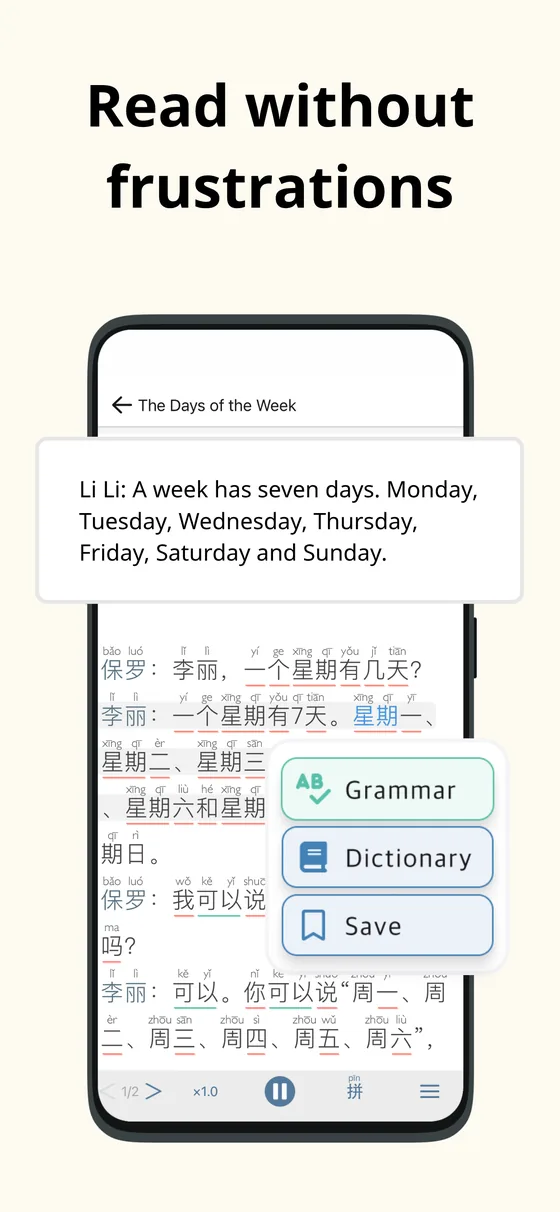
Those meanings are chosen by people, not pulled from a dictionary. Du Chinese says a translator checks every word's meaning in context, and every reading is edited at least three times.
Then you can take the help away, a little at a time:
- Pinyin your way. Show it over every character, only over difficult words, as tone marks alone, or as Zhuyin, Taiwan's phonetic script.
- Two scripts. Read in Simplified characters, used in mainland China, or Traditional, used in Taiwan and Hong Kong.
- Levels and tones in colour. Words can be marked by their HSK level, and tones by colour, so you can see what's above your level.
- Fonts. Premium lets you choose among four fonts, which some learners use to get used to different shapes.
You can read on a computer too. Du Chinese runs in a web browser as well as on iPhone, iPad and Android, and the App Store offers its iPad app on Macs with Apple's M1 chip or later.
Newer readings also list their key words and grammar points before you start, so you can preview the hard parts. Since June, a resource hub keeps those lists one tap away while you read.
If you lean on pinyin, plan to drop it. Reading the characters alone is the skill you're paying for, and "difficult words only" is a good halfway step.
Every line is recorded, and you can slow it down
Every Du Chinese reading comes with audio. Its method page says voice actors in China record them, and each has passed the official Mandarin speaking test at level 2A or above. China asks the same grade of the teachers who teach Chinese in its schools.
As the audio plays, each word lights up. You can slow the speed or repeat a chapter, and Premium adds an audiobook mode for listening with your phone in your pocket:
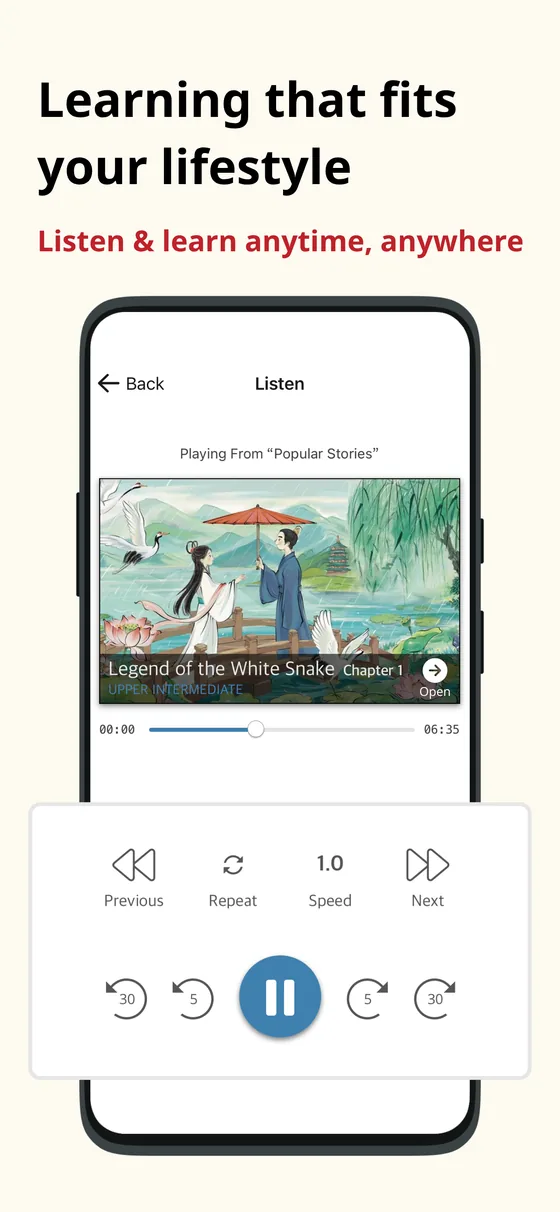
The release notes show the audio still getting better. In June, Premium users could start listening from any chapter of a story, and September's update added more speed choices.
Not everyone loves the voices. In June, one learner on Reddit called them "a bit artificial and not very fluid". In 2024, another cancelled because some recordings sounded poor. Far more App Store reviewers praise the audio than fault it, but we'd still listen to a free chapter before you pay.
We'd also use the audio more than once. One Reddit reply suggests reading first, then listening as you follow the text, then a last pass with the audio alone.
Speaking and writing are left to you
Du Chinese has no speaking practice. Neither its store listings nor its website describes any feature that records your voice or checks your tones. We looked through its release notes back to 2021 too, and found nothing.
Its Google Play listing does promise speaking and writing practice, but the method is your own: "listen and repeat" with the audio, and "summarize and rewrite stories". We think that's a good habit, but nobody tells you whether you got it right.
Tones are where that hurts. Say "to buy", 买, with a falling tone and you've said "to sell", 卖. Copying a recording trains your ear, but only feedback tells you which one came out.
Writing is the same. September's update added stroke-order animations, so you can watch how a character is written, but you don't practise writing it. Reviewers mention pairing Du Chinese with HelloChinese, Skritter, Pleco or a tutor for that.
Flashcards keep each word in its sentence
Save a word while you read, and Du Chinese makes a flashcard that keeps the sentence you met it in, with its audio. Reviews come back on a spaced-repetition schedule, which brings a word back just before you'd forget it:
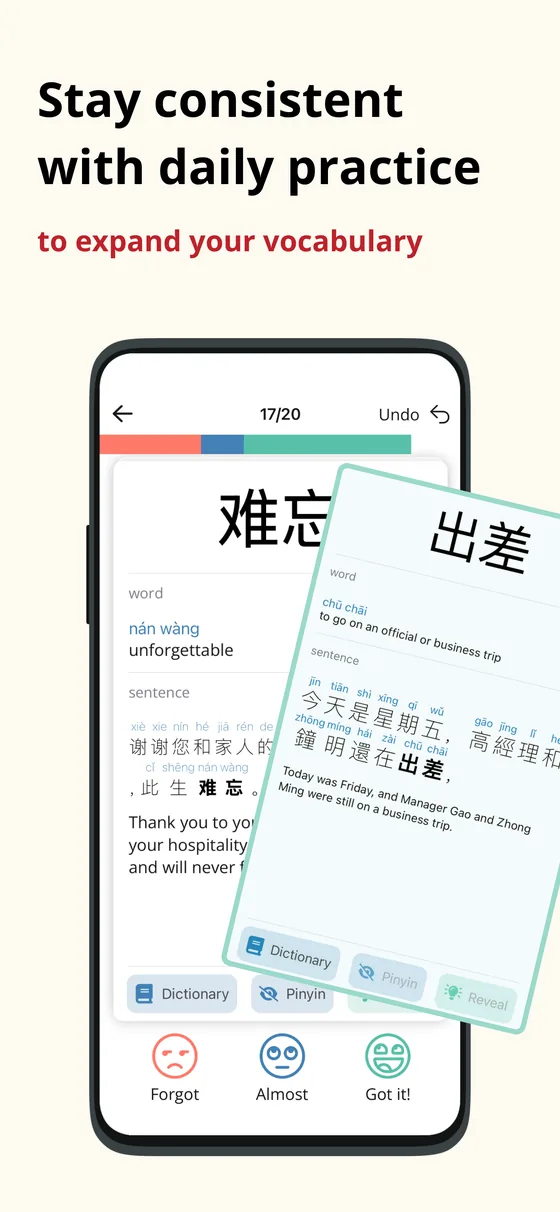
You rate each card as Forgot, Almost or Got it. In the reviews we read, learners like the sentence context most: you remember where you saw a word, not just its meaning.
The flashcards also travel. They sync to Skritter and Hack Chinese, and you can send words to Pleco, the dictionary app, or export them for Anki.
The limits come from the same design. In 2024, one Play reviewer noted you could export to Anki but not import, or add a word you hadn't met in a reading. Others ask for folders. So we'd treat it as a reading companion, not your only flashcard app.
Is Du Chinese free? Only a small part of it
Du Chinese is free to download, and you can read without making an account, its terms say. But most of the library is locked. Here's what we could read for free without signing in, level by level:
Source: our count of the lessons, stories and courses on duchinese.net, logged out, 5 November 2026, including three new stories its lists leave out. A reading is one article, course lesson or story chapter.
We counted 210 free readings in all. More than half are story chapters, since nearly three stories in four give away their first chapter.
We found a few things free in full. Beginners can read the first Newbie course, and all 12 chapters of the first I'm a Cat story. Two more stories are free from start to finish, at Intermediate and Advanced level.
A handful of lessons, some new and some old, are also free for a few days at a time. Finding the free ones can take a while: in early 2025, one App Store reviewer found no filter for them and spent five minutes hunting for one at their level.
The free part is enough to judge the app, and not enough to live in. At four readings a day, a Newbie learner would finish the free ones at their level in about two weeks.
Premium costs $119.99 a year, or $89.99 in a sale
Du Chinese has one paid plan, Premium, which opens every reading, offline reading and the audiobook mode. You choose how long to pay for: a month, six months or a year.
Its pricing page and the US App Store charge the same. A month costs $14.99 and a year $119.99, with a six-month plan in between. Here's what a year costs, by how you pay:
Source: Du Chinese's pricing page and US App Store listing; the sale price from its Mid-Autumn Festival sale page, a quarter off the yearly plan.
In November, Du Chinese's sale page still showed its Mid-Autumn Festival offer: a quarter off a year and a tenth off the shorter plans. It also says the discount lasts as long as you stay subscribed. Learners on Reddit report bigger sales around Black Friday and Lunar New Year, some at half price.
Outside the US, prices are set store by store: a year costs £105.99 in the UK App Store and A$179.99 in Australia.
Google Play doesn't name its plans, but lists purchases from $11.99 to $119.99, so check the price in the app before you pay.
A few more things we'd check before you pay:
- Refunds depend on where you buy. Du Chinese refunds subscriptions bought on its website within 15 days, but it can't refund App Store purchases, which go through Apple.
- Cancel a day early. Every plan renews automatically, and on the App Store its terms ask you to cancel at least a day before the period ends.
- A trial isn't on the pricing page. Some learners mention a trial of Premium in the app, but we found none on the pricing page or in the store listings.
- There's no lifetime plan. Neither its pricing page nor the App Store offers one, though a few learners say one appeared in past sales.
- Schools pay much less. Group plans for classes cost over 90% less than individual ones, with a free classroom trial.
If you're sure you'll read most days, we'd wait for a sale and buy a year. If you're not, we'd buy a month on the website, where the money-back guarantee covers you.
What learners say: the stories win, the redesign divides
Learners rate Du Chinese very highly. On the US App Store it averages 4.85 stars from 4,623 ratings.
Google Play shows 4.9 stars from about 11,800 ratings, and the UK, Canadian and Australian App Stores show much the same.
Ratings don't say why, though. So we read the 100 most recent written reviews on the US App Store, going back to early 2023, and counted the themes each one raised:
Source: Apple's public review feed for Du Chinese, US store, read 5 November 2026. A review can raise several themes; we coded each one by reading it. Also raised: worth the money, 11; not enough at their level, 5.
In our count, praise outnumbered complaints by far, and three reviews in four gave five stars. What learners reach for is the stories. In February 2025, one reviewer praised stories written to give "just the perfect amount of interesting content, useful words, and repetition".
The complaints are mostly about the app, not the content. The 2025 redesign moved things around, and a subscriber with almost 2,500 lessons read gave three stars because new stories had become hard to find. Others reported login trouble, reading progress that didn't sync and flashcard text they couldn't enlarge.
On Reddit, the price comes up more. In a June thread asking whether it's worth it, most replies said yes, and the main objection was the cost. One reply called it "way too much" at $120 a year, and two pointed to its Black Friday sale.
The three reviews Google Play shows first are all positive. One praises the hand-made translations and sentence flashcards but wants to import cards from Anki, and one praises the stories. The third describes using only the free part: drilling HSK 1 words, then rereading a free story until it flows.
A few found the stories dull and preferred whole novels or the news. So the risk isn't that you'll dislike the reading. It's that you'll pay for a year and not use it, which its keenest fans on Reddit warn about too.
Reviews from before April 2025 describe an older app
Du Chinese has changed a lot since early 2025, and most reviews of it haven't caught up. We dated each change from its own release notes and blog:
| When | What changed |
|---|---|
| April 2025 | A redesign of the app, to make finding the next reading easier |
| December 2025 | A weekly reading goal |
| January 2026 | Key words and grammar listed before each new reading |
| March 2026 | Reading reminders |
| June 2026 | A resource hub while you read; Premium listening from any chapter |
| September 2026 | Stroke-order animations and more listening speeds |
| October 2026 | HSK 3.0 labels on words, and an HSK 3.0 course path for levels 1 and 2 |
Source: Du Chinese's US App Store version history and its blog post on HSK 3.0, 13 October 2026.
When we searched "du chinese review", none of the top results mentioned HSK 3.0, and the newest was from February 2026. One gave Du Chinese's crossed-out "full price" as the yearly price, and others put the library at anything from a few hundred lessons to 2,500.
So if you're reading other reviews, we'd check their date first. Anything from before April 2025 describes an app that has since been redesigned.
How we'd use Du Chinese
Du Chinese gives you a library, not a lesson plan, so you'll get more from it with a routine. Here's the one we'd follow, built from Du Chinese's own advice and what learners describe:
- Pick your level with a one-minute test. Read for a minute and count the words that stop you. Du Chinese suggests two or three is about right, and four or more means step down.
- Read across three levels. Mix easy, slightly hard and hard readings, as its blog suggests, and do most of your reading at the easy end.
- Turn pinyin to "difficult words only". You'll read the characters you know, with help only where you need it.
- Read, then listen. Read a chapter, then play it while you follow the text, then once more without looking.
- Save five or ten words a chapter. Review the flashcards daily, and read the chapter again the next day.
- Choose longer stories. A long story brings the same words back again and again, which is how they stick.
The app helps with the habit, with a weekly reading goal, reminders and charts of how much you've read. One reviewer said the graph on the home page keeps them accountable, though a longtime subscriber wished they could hide the goal.
The whole routine fits into a short daily session. Keep it up for a month, and you'll know whether a year of Premium is worth it.
Heritage speakers are among its happiest readers
If you grew up speaking Chinese but never learned to read it, Du Chinese suits you unusually well. Of the 266 written reviews in Apple's US feed, we found nine from learners who grew up with Chinese, and all nine gave four or five stars.
The reason is the audio. You already know the words when you hear them, so reading along teaches you what they look like. One reviewer who grew up speaking Mandarin said they learned over 2,000 characters in 13 months.
Another, who spoke Chinese at home, found they could jump straight to Advanced readings. So we'd start where the audio makes sense to you, not where your reading is, and lean on "difficult words only" pinyin. Our guide for heritage speakers covers the speaking side.
Who should use Du Chinese
We'd pick Du Chinese if:
- You want to read Chinese, not just speak it. Thousands of readings at six levels give you more graded reading than you'll get through.
- You know some basics. Newbie stories assume about 150 characters, and the first Newbie course starts from "hello".
- You learn by listening too. Every line is recorded, with speed control and an audiobook mode.
- You grew up hearing Chinese but can't read it. Several reviewers who speak it at home used Du Chinese to finally learn to read.
- You read Traditional characters or Zhuyin. Both are built in, alongside Simplified and pinyin.
We'd skip it, or pair it with something else, if:
- You want to speak soon. Reading won't prepare you for a reply, and nothing checks your tones.
- You're starting from zero. A course will teach you pinyin and grammar faster, and the Newbie shelf has stopped growing.
- You need it free. The free part is enough to try, not to keep going.
- You want the news. Du Chinese has articles, but The Chairman's Bao is built around the news.
The best alternatives for each goal
No reading app does everything. If Du Chinese isn't the right fit, here's what we'd pick for each goal:
The news at your level
- Pick
 The Chairman's Bao
- Price
- $11 a month or $88 a year
- Why
- 10,500+ graded news lessons with audio
Graded reading for free
- Pick
- Mandarin Bean
- Price
- Free to read
- Why
- 900+ graded lessons, recorded by teachers
Stories inside a full course
- Pick
 HelloChinese
- Price
- $19.99 a month or $149.99 a year
- Why
- Premium+ adds 1,000+ graded stories to a course
Real novels, after graded readers
- Pick
 Readibu
- Price
- Free to read
- Why
- Web novels with pinyin and a tap dictionary
Cheap stories for HSK 1–3
- Pick
 SayMei Stories
- Price
- $2.99 a month
- Why
- 169 books, every line read aloud, in your browser
Speaking practice that answers back
- Pick
- SayMei
- Price
- $5.99 a month for 200 minutes
- Why
- Mei Lin replies and corrects your tones
Source: each company's pricing page or US App Store listing, checked 5 November 2026.
If you're choosing between reading apps, The Chairman's Bao is Du Chinese's closest rival. We'd pick it for the news and Du Chinese for stories.
Where SayMei fits, and where it doesn't
SayMei Stories is a smaller, cheaper library for the first three levels. It costs $2.99 a month for 169 books, for about HSK 1 to 3.
Every line is read aloud, with pinyin over every word, and you tap any word for its meaning. The first two chapters of every book are free, so you can compare them with Du Chinese's free stories before you pay for either.
We'll be plain about where SayMei loses. Du Chinese's library is about three times bigger, and it keeps going past HSK 3, all the way to Master. It has apps that work offline, Zhuyin, a grammar library and links to Pleco, Skritter and Hack Chinese. SayMei runs in a web browser, and its stories stop at intermediate.
Where SayMei goes further is speaking. In a lesson, Mei Lin, your AI teacher, asks you questions out loud and corrects your tones as you answer. SayMei Premium costs $5.99 a month for 200 minutes with her, and it includes every story.
We think many learners would do well with both kinds of tool: a deep reading app, and someone to talk to.
What to do next
- Read the free chapters first. Try a free story at your level, and use the audio both ways.
- Pick your level with a one-minute test. Read for a minute, and if four or more words stop you, step down a level.
- Buy a month, then a year. A month on the website shows whether you'll use it, and the guarantee covers you.
- Wait for a sale for the long plan. The yearly price drops by a quarter or more in sales.
- Add speaking from the start. Reading builds your vocabulary, but you need to use it out loud.
If you're comparing reading apps before you pay, read our guide to the best graded readers and story apps.
FAQ
Is Du Chinese worth it?
For a learner who will read most days, yes. Premium costs $119.99 a year, about $10 a month, for thousands of graded readings with audio, which is more reading than most learners get through. Its sales cut that by a quarter or more. It isn't worth it if you mainly want to speak, or if you'd open it only once or twice a week.
Is Du Chinese free?
Partly. The app is free to download and you can read without an account, but only about one reading in 18 is free.
We counted 210 free readings, more than half of them story chapters. The first Newbie course and the first I'm a Cat story are free in full, which is enough to judge the app before you pay.
How much does Du Chinese cost?
Premium costs $14.99 a month or $119.99 a year on Du Chinese's website and the US App Store.
A six-month plan costs $79.99. Its Mid-Autumn Festival sale takes a quarter off the yearly plan, to $89.99, and says the discount lasts while you stay subscribed.
In the UK App Store, a year costs £105.99. There is one paid plan, and it opens every reading.
Does Du Chinese have a lifetime subscription?
Not as a regular plan. Neither Du Chinese's pricing page nor its App Store listing offers one: you can pay for a month, six months or a year. A few learners say lifetime access appeared in past sales, but we found no current offer. If you'd rather pay once, The Chairman's Bao was selling lifetime access for $450 in November 2026.
Does Du Chinese follow HSK 3.0?
It's moving there. Du Chinese uses its own six levels, built on 150 to 2,500 characters. The first five sit just below the new HSK's character lists for levels 1 to 5.
In October 2026 it began switching its word labels to HSK 3.0 and grouped its courses into an HSK 3.0 path for levels 1 and 2. New level 3 courses and HSK 3.0 stories for levels 1 and 2 are on the way.
Du Chinese vs The Chairman's Bao: which is better?
Choose Du Chinese for stories and The Chairman's Bao for the news. Both grade their readings by level and record audio for each one.
The Chairman's Bao has the bigger library, with 10,500+ lessons, and it costs less: $88 a year. Try both free samples before you choose.
Du Chinese vs HelloChinese: which should I use?
They do different jobs, so many learners use both. HelloChinese is a course: it teaches pinyin, grammar and handwriting step by step, and Premium+ adds 1,000+ graded stories for $149.99 a year. Du Chinese is a reading app with a much deeper library and audio for every line. Start with a course, then add Du Chinese.
Does Du Chinese help with speaking?
Only indirectly. You hear every line read by a voice actor and can copy it, but the app never records you or checks your tones. Reading aloud along with the audio is good practice for your ear and mouth. For feedback, add a tutor, a language partner or an AI teacher that listens to you.
Sources
Checked 5 November 2026 unless noted. No accounts were created and nothing was bought.
Du Chinese
- Du Chinese on the App Store (US): description, in-app purchases, version history, ratings and the three images shown; the UK, Canadian and Australian listings for their prices and ratings
- Du Chinese on Google Play (US): description, ratings, downloads, in-app purchase range, reviews
- duchinese.net: pricing, sale page, privacy and terms, terms and conditions, about us, partners, for schools, grammar library, and the public lessons, stories and courses we counted
- Du Chinese's blog: the Du Chinese method (updated 14 May 2026), how to choose a reading (updated 21 June 2026), how to prepare for HSK 3.0 (13 October 2026)
- Apple's public review feed for Du Chinese, US store
Other apps
- The Chairman's Bao plans; Mandarin Bean pricing; HelloChinese and Readibu on the US App Store
- SayMei: pricing and Stories
HSK and the Mandarin speaking test
- The 2025 HSK syllabus, counted in our HSK 3.0 guide
- Chinese Wikipedia's page on the Putonghua proficiency test, for the grade Chinese teachers need
Learner reports on r/ChineseLanguage
- "Is the Du Chinese app worth it?" (June 2026); "Is the DuChinese subscription worth it?" (June 2026); "Is the Du Chinese subscription worth it?" (June 2024); "How to use Du Chinese (audio/read)?" (September 2026); "Should I buy DuChinese or Pleco?" (August 2025)
Methods
We read Du Chinese's website, blog, terms and store listings on 5 November 2026, and seven learner threads on r/ChineseLanguage from 2024 to 2026. We didn't subscribe, sign in or install the app, so a feature is either what Du Chinese says or what learners report, and we say which.
- The library count comes from the lists of lessons, stories and courses that Du Chinese's public web pages load, read without signing in. Three new stories, 35 chapters in all, were missing from those lists; we found their public pages by checking the unlisted addresses, and counted them too. A reading is one article, course lesson or story chapter. "Free" means marked free for a visitor who isn't signed in; a few lessons are free for a few days, and the app may differ.
- Release years and levels are each reading's release date and level in those lists. "The past year" runs from 5 November 2025 to 5 November 2026.
- The level table uses the vocabulary each story states on its page, against the 2025 HSK syllabus's characters to recognise, counted cumulatively.
- The review themes come from the 100 most recent written reviews in Apple's public feed, US store, 24 February 2023 to 30 October 2026. We read each one and noted every theme it raised.
- The routine in "How we'd use Du Chinese" combines Du Chinese's blog advice with routines learners describe; it isn't a tested study plan.
- Prices are US prices unless we say otherwise. Sale prices are those on Du Chinese's sale page, which showed its Mid-Autumn Festival offer on 5 November 2026.
- The scorecard is our judgment from those sources, not a test of the app.
- The screenshots are Du Chinese's own App Store images, shown unedited for review.
- The Mandarin examples were checked against the CC-CEDICT dictionary.
If you spot a mistake, tell us: we fix errors.