Mandarin vs Cantonese: how much do they really overlap?
We compared 100 core words, 1,004 Hong Kong sentences and 29,969 shared words. Half the basic words match; the speech mostly doesn't. Plus which to learn.

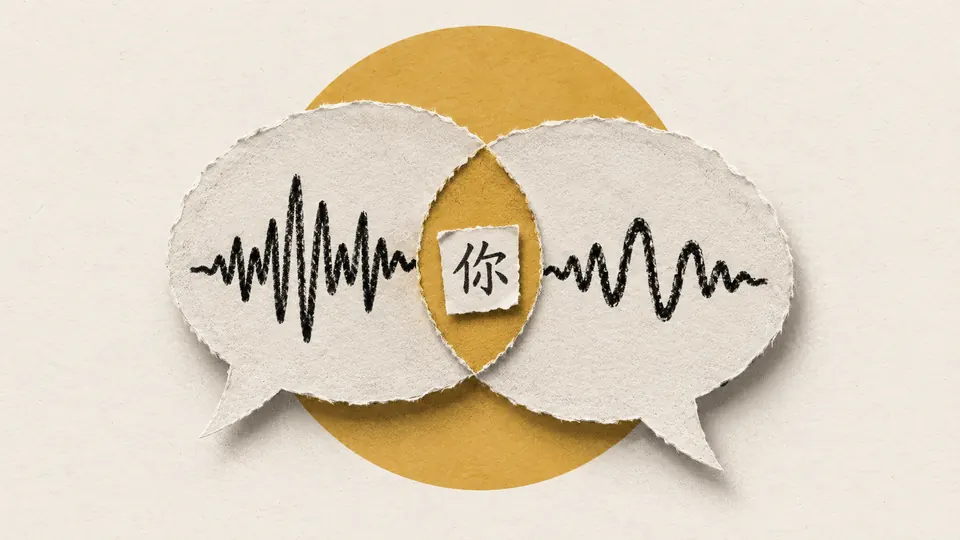
Hong Kong people speak one language and write another. That split explains most of the difference between Mandarin and Cantonese.
If you're choosing between the two, or wondering how much of one you'll get from the other, this guide gives you our counts, tools to explore them and a straight recommendation.
Key takeaways
- The writing is shared; the speech isn't. Hong Kong writes a Mandarin-based standard in Traditional characters, but it speaks Cantonese.
- About half the basic words match on paper. Of 100 core meanings, half are written with the same word in both languages.
- Understanding runs one way. Cantonese speakers caught 90% of the words in Mandarin sentences, mostly because they grow up hearing Mandarin.
- Speech and writing drift far apart. Only about a third of the words Hong Kong people say survive into the written version of the same sentence.
- The sounds shift by rule. One Cantonese syllable in six still ends in -p, -t or -k, endings Mandarin lost centuries ago.
- Choose by people, not difficulty. Officially, both take an English speaker the same time to learn, so let your family, city or favourite films decide.
Most articles on this question say the two are "not mutually intelligible" and stop there. We wanted numbers, so we counted. Our data came from open dictionaries, a Hong Kong corpus of transcribed speech and two digitised surveys of Chinese dialects.
The method and the data's licences are in How we did this. If you only want to know which to learn, skip to Should you learn Mandarin or Cantonese?
About half the basic words match on paper
How much the two overlap depends on which layer you compare. The formal writing standard is shared, and about half the most basic words are identical on paper. Everyday speech drifts much further apart.
To measure the words, we used the Leipzig–Jakarta list: 100 basic meanings that languages rarely borrow words for, like "fire", "eat", "he" and "not". For each meaning, we took the everyday Mandarin word, the most frequent candidate in a corpus of Mandarin film subtitles.
We paired it with the everyday Hong Kong Cantonese word, checked against words.hk, CC-Canto and Beijing University's 1964 survey of dialect vocabulary. Then we sorted the pairs.
Our verdict: 50 use the same written word, 21 a related one and 29 a different one. Here they are, side by side:
Same meaning, two languages: the 100 core words
50 of the 100 meanings use the same written word, 21 a related one and 29 a different one (10 known from written Mandarin, 4 false friends, 15 Cantonese-only). If every borderline call went the other way, "same" would be 47 to 52.
- 50 same written word
- 21 related (same root)
- 29 different word
Show
Each word: its meaning, then Mandarin (pinyin above) and Hong Kong Cantonese (Jyutping above). ≈ marks a borderline call.
Same written word
- fireMandarin: 火. Cantonese: 火
- to goMandarin: 去. Cantonese: 去
- waterMandarin: 水. Cantonese: 水
- mouth (a borderline call)Mandarin: 嘴. Cantonese: 嘴
- bloodMandarin: 血. Cantonese: 血
- you (one person)Mandarin: 你. Cantonese: 你
- rootMandarin: 根. Cantonese: 根
- breast (a borderline call)Mandarin: 胸. Cantonese: 胸
- rainMandarin: 雨. Cantonese: 雨
- IMandarin: 我. Cantonese: 我
- meatMandarin: 肉. Cantonese: 肉
- hand / armMandarin: 手. Cantonese: 手
- farMandarin: 远. Cantonese: 遠
- to do / makeMandarin: 做. Cantonese: 做
- stone (a borderline call)Mandarin: 石头. Cantonese: 石頭
- bitterMandarin: 苦. Cantonese: 苦
- toothMandarin: 牙. Cantonese: 牙
- hair (of the head)Mandarin: 头发. Cantonese: 頭髮
- bigMandarin: 大. Cantonese: 大
- oneMandarin: 一. Cantonese: 一
- to hitMandarin: 打. Cantonese: 打
- leg / footMandarin: 脚. Cantonese: 腳
- hornMandarin: 角. Cantonese: 角
- fishMandarin: 鱼. Cantonese: 魚
- blackMandarin: 黑. Cantonese: 黑
- navelMandarin: 肚脐. Cantonese: 肚臍
- to biteMandarin: 咬. Cantonese: 咬
- windMandarin: 风. Cantonese: 風
- smokeMandarin: 烟. Cantonese: 煙
- eggMandarin: 鸡蛋. Cantonese: 雞蛋
- newMandarin: 新. Cantonese: 新
- to burnMandarin: 烧. Cantonese: 燒
- goodMandarin: 好. Cantonese: 好
- to laughMandarin: 笑. Cantonese: 笑
- to hearMandarin: 听到. Cantonese: 聽到
- redMandarin: 红. Cantonese: 紅
- liverMandarin: 肝. Cantonese: 肝
- skin (a borderline call)Mandarin: 皮肤. Cantonese: 皮膚
- heavyMandarin: 重. Cantonese: 重
- oldMandarin: 老. Cantonese: 老
- thickMandarin: 厚. Cantonese: 厚
- longMandarin: 长. Cantonese: 長
- to blowMandarin: 吹. Cantonese: 吹
- ashMandarin: 灰. Cantonese: 灰
- dogMandarin: 狗. Cantonese: 狗
- to tieMandarin: 绑. Cantonese: 綁
- sweetMandarin: 甜. Cantonese: 甜
- saltMandarin: 盐. Cantonese: 鹽
- hardMandarin: 硬. Cantonese: 硬
- to grindMandarin: 磨. Cantonese: 磨
Related: same root
- noseMandarin: 鼻子. Cantonese: 鼻
- boneMandarin: 骨头. Cantonese: 骨
- to comeMandarin: 来. Cantonese: 嚟
- nameMandarin: 名字. Cantonese: 名
- louse (a borderline call)Mandarin: 虱子. Cantonese: 蝨
- fly (insect)Mandarin: 苍蝇. Cantonese: 烏蠅
- night (a borderline call)Mandarin: 晚上. Cantonese: 夜晚
- earMandarin: 耳朵. Cantonese: 耳仔
- back (of body)Mandarin: 背. Cantonese: 背脊
- to know (a fact)Mandarin: 知道. Cantonese: 知
- kneeMandarin: 膝盖. Cantonese: 膝頭
- sandMandarin: 沙子. Cantonese: 沙
- leafMandarin: 叶子. Cantonese: 葉
- antMandarin: 蚂蚁. Cantonese: 蟻
- woodMandarin: 木头. Cantonese: 木
- eyeMandarin: 眼睛. Cantonese: 眼
- tailMandarin: 尾巴. Cantonese: 尾
- to see (a borderline call)Mandarin: 看到. Cantonese: 見到
- ropeMandarin: 绳子. Cantonese: 繩
- shadowMandarin: 影子. Cantonese: 影
- starMandarin: 星星. Cantonese: 星
Different word, known from written Mandarin
- wingMandarin: 翅膀. Cantonese: 翼
- neckMandarin: 脖子. Cantonese: 頸
- houseMandarin: 房子. Cantonese: 屋
- to sayMandarin: 说. Cantonese: 講
- to drinkMandarin: 喝. Cantonese: 飲
- soil (a borderline call)Mandarin: 土. Cantonese: 泥
- to carry (on the shoulder) (a borderline call)Mandarin: 扛. Cantonese: 擔
- to eatMandarin: 吃. Cantonese: 食
- to fall (a borderline call)Mandarin: 掉. Cantonese: 跌
- wideMandarin: 宽. Cantonese: 闊
Different word: false friends
- to standMandarin: 站. Cantonese: 企
- to runMandarin: 跑. Cantonese: 走
- to cry (a borderline call)Mandarin: 哭. Cantonese: 喊
- smallMandarin: 小. Cantonese: 細
Different word, Cantonese-only
- tongueMandarin: 舌头. Cantonese: 脷
- who?Mandarin: 谁. Cantonese: 邊個
- he / sheMandarin: 他. Cantonese: 佢
- thisMandarin: 这. Cantonese: 呢
- yesterdayMandarin: 昨天. Cantonese: 尋日
- what?Mandarin: 什么. Cantonese: 咩
- child (son or daughter) (a borderline call)Mandarin: 孩子. Cantonese: 仔女
- to giveMandarin: 给. Cantonese: 畀
- notMandarin: 不. Cantonese: 唔
- to hide (something) (a borderline call)Mandarin: 藏. Cantonese: 收埋
- to suck (a borderline call)Mandarin: 吸. Cantonese: 啜
- to takeMandarin: 拿. Cantonese: 攞
- thighMandarin: 大腿. Cantonese: 大髀
- birdMandarin: 鸟. Cantonese: 雀仔
- in / atMandarin: 在. Cantonese: 喺
Nine everyday phrases
Have you eaten? (a greeting)
- Mandarin
- 你 吃饭 了 吗
- Cantonese
- 你 食 咗 飯 未 呀
- Note
- –
Thank you (for a gift)
- Mandarin
- 谢谢
- Cantonese
- 多謝
- Note
- For a small service, Cantonese says 唔該 m4 goi1 instead.
What is your name?
- Mandarin
- 你 叫 什么 名字
- Cantonese
- 你 叫 咩 名 呀
- Note
- –
Where is the bathroom?
- Mandarin
- 洗手间 在 哪里
- Cantonese
- 洗手間 喺 邊度 呀
- Note
- –
How much is this?
- Mandarin
- 这个 多少 钱
- Cantonese
- 呢個 幾多 錢 呀
- Note
- Dictionaries list 錢 as cin4; cin2 is the usual tone in this phrase.
He is taller than me.
- Mandarin
- 他 比 我 高
- Cantonese
- 佢 高 過 我
- Note
- Word order changes: Cantonese puts 過 after the adjective.
You go first.
- Mandarin
- 你 先 走
- Cantonese
- 你 行 先
- Note
- Cantonese puts 先 "first" after the verb.
Grandma (dad's mum), I miss you.
- Mandarin
- 奶奶 我 想 你
- Cantonese
- 嫲嫲 我 好 掛住 你
- Note
- –
They aren't coming tomorrow.
- Mandarin
- 他们 明天 不 来
- Cantonese
- 佢哋 聽日 唔 嚟
- Note
- –
Mandarin: the most frequent everyday word in SUBTLEX-CH film subtitles. Cantonese: the everyday Hong Kong word, checked against CC-Canto, words.hk and Beijing University's 1964 survey. Pinyin shows dictionary tones. Data: CC BY-SA 4.0, derived from CC-CEDICT (CC BY-SA 4.0), CC-Canto (Pleco Software, CC BY-SA 3.0) and words.hk analysis data (public domain).
Same on paper doesn't mean same in sound. Even the identical words are said differently, and the related ones usually just drop a Mandarin suffix:
| Meaning | Group | Mandarin | Cantonese |
|---|---|---|---|
| fire | Same word | 火 | 火 |
| water | Same word | 水 | 水 |
| I | Same word | 我 | 我 |
| nose | Same root | 鼻子 | 鼻 |
| eye | Same root | 眼睛 | 眼 |
| tail | Same root | 尾巴 | 尾 |
Source: our core-100 comparison, with readings checked against CC-CEDICT, words.hk and CC-Canto.
A Mandarin learner can usually guess the related words. Further down, you'll see why the sounds differ, and why they differ by rule.
The everyday words are the ones that change
The 29 different words include some of the most frequent in any conversation:
| Meaning | Mandarin | Cantonese |
|---|---|---|
| eat | 吃 | 食 |
| drink | 喝 | 飲 |
| look | 看 | 睇 |
| say | 说 | 講 |
| he or she | 他 | 佢 |
| not | 不 | 唔 |
| at | 在 | 喺 |
| give | 给 | 畀 |
| who | 谁 | 邊個 |
They split three ways:
- Ten are words a Mandarin reader knows from formal writing. Cantonese often keeps the older word that Mandarin now uses only in writing. Cantonese "eat" is the first character of Mandarin "food", 食物, and Cantonese "drink" is the first character of Mandarin "drinks", 饮料.
- Four are false friends: the same character with a different everyday meaning.
- Fifteen use characters or words standard Mandarin doesn't have, like the Cantonese words for "he or she", "not", "at" and "give" above.
Here are the four false friends:
| Character | In Cantonese | In Mandarin |
|---|---|---|
| 走 | zau2, "run" | zǒu, "walk" |
| 細 | sai3, "small" | 细 xì, "thin" |
| 喊 | haam3, "cry" | hǎn, "shout" |
| 企 | kei5, "stand" | qǐ, as in 企图 qǐtú, "attempt" |
Fourteen of our calls are borderline, meaning a native speaker might reasonably pick the other word. Mouth is one: Cantonese uses both 嘴, the same word as Mandarin, and 口.
If every borderline call went the other way, the "same word" count would land between 47 and 52. So "about half" is the honest summary.
Why other counts say 37% or 85%
Published word lists give very different answers, and the reason is useful. Here's how two expert surveys compare with our list:
Sources: our counts on the Lexibank editions of Beijing University's 1964 survey, 903 concepts, and Liu et al.'s 2007 survey, 203 basic words, and our core-100 list.
The low figure records speech. Beijing University's fieldworkers wrote down colloquial Guangzhou speech in the 1950s.
The high figure mixes in writing. Several of the 2007 survey's Guangzhou entries are formal written Chinese rather than speech. It gives the written words for "who" and "not", 誰 and 不, where people actually say the Cantonese words in the table above.
Count what people write, and Cantonese looks like Mandarin with a Southern accent. Count what they say, and it doesn't.
The grammar shifts too
Word order changes in some common patterns:
He is taller than me
- Mandarin
- 他比我高
- Cantonese
- 佢高過我
- What changes
- Literally "he tall-past me"
You go first
- Mandarin
- 你先走
- Cantonese
- 你行先
- What changes
- 先 "first" moves after the verb
The explorer above sets nine everyday phrases side by side, including "Have you eaten?" and "Grandma, I miss you."
Cantonese speakers understand Mandarin, not the reverse
Without study, a Mandarin speaker won't follow Cantonese. In a controlled test, Mandarin listeners caught 3% of the target words in Cantonese sentences, while Cantonese listeners caught 90% of Mandarin ones.
The test comes from a 2009 study in Lingua by Tang Chaoju and Vincent van Heuven. They recorded words and sentences in 15 Chinese varieties, played them to listeners from each one and collected 47,250 answers.
Listeners did two tasks:
- Words: sort a single spoken word into one of ten meaning categories. Guessing would score 10%.
- Sentences: write down the last word of a spoken sentence.
Here's how the two groups did:
Can they understand each other?
Mandarin listeners caught 3% of words in Cantonese sentences; Cantonese listeners caught 90% in Mandarin ones.
| Test | Isolated words (pick the meaning; chance 10%) | Words in sentences (write down the last word) |
|---|---|---|
| Cantonese listeners, Mandarin speech | 63% | 90% |
| Mandarin listeners, Cantonese speech | 34% | 3% |
| Cantonese listeners, own speech | 55% | 92% |
| Mandarin listeners, own speech | 83% | 98% |
Source: Tang & van Heuven (2009), Lingua 119(5), Tables 2 and 3. 15 rural listeners aged 40 to 65 per variety, with the Beijing dialect standing in for Standard Mandarin. 63% of all listeners said they could speak Standard Mandarin, which is why Cantonese listeners understood Mandarin far better than the reverse.
On single words, Cantonese listeners got 63% and Mandarin listeners 34%. In whole sentences, the gap became a cliff.
For comparison, each group scored 92–98% on sentences in its own variety.
Why: Cantonese speakers grow up hearing Mandarin
Exposure explains the gap, not similarity. The listeners were rural speakers, chosen to be as monolingual as possible. Even so, 63% of them said they could speak Standard Mandarin.
The authors put Mandarin's head start down to the standard language reaching every part of China through school and the media. That exposure keeps growing:
Sources: China's Ministry of Education for 2025 and 2020; Hong Kong's 2021 census, residents aged 5 and over.
Nothing comparable pushes Cantonese north. If you learn Mandarin, expect Cantonese to sound like a foreign language.
Hong Kong speaks Cantonese but writes standard Chinese
You can read Hong Kong's formal writing, because it follows Mandarin. Written colloquial Cantonese is another matter.
Hong Kong people mostly write Standard Written Chinese, the Mandarin-based standard, in Traditional characters. They speak Cantonese. Written Cantonese turns up in informal places: chat, some columns, ads and some subtitles.
To measure the gap, we used the Universal Dependencies Hong Kong treebanks. They pair 1,004 transcribed Cantonese sentences with their written versions, from three student films and a 2016 Legislative Council meeting.
Here's a typical pair. Both lines mean "What are you looking for?", and only the word for "you" survives:
| Text | Romanization | |
|---|---|---|
| Spoken | 你喺度搵乜嘢呀? | nei5 hai2 dou6 wan2 mat1 je5 aa3 |
| Written | 你在找些什麼? | nǐ zài zhǎo xiē shénme |
Only 34.0% of the 11,189 spoken words reappear in the written version of the same sentence. Explore eight real pairs, and the words that change most:
What Hong Kong people say vs what they write
Only 34.0% of 11,189 spoken Cantonese words reappear in the written version of the same sentence. 44.7% of characters do, and 4.7% of sentences are written exactly as spoken.
| Source | All 1,004 sentences | Student films | Legislative Council, 2016 |
|---|---|---|---|
| Sentences | 1,004 | 650 | 354 |
| Spoken words | 11,189 | 4,912 | 6,277 |
| Words kept | 34.0% | 32.4% | 35.2% |
| Characters kept | 44.7% | 40.3% | 47.8% |
| Written exactly as spoken | 4.7% | 6.5% | 1.4% |
Eight sentence pairs: spoken Cantonese and its written version
你 喺度 搵 乜嘢 呀
- Written version
- 你 在 找 些 什麼
- Meaning
- What are you looking for?
- Spoken words kept
- 20% (你)
今日 星期二 喎
- Written version
- 今天 星期二
- Meaning
- It's Tuesday today.
- Spoken words kept
- 33% (星期二)
關 你 咩 事 呀
- Written version
- 關 你 什麼 事
- Meaning
- None of your business.
- Spoken words kept
- 60% (關, 你, 事)
你 阿媽 唔 得閒 呀
- Written version
- 你 媽咪 沒 時間 呀
- Meaning
- Your mum is busy.
- Spoken words kept
- 40% (你, 呀)
應該 都 唔 係 楊千嬅
- Written version
- 應該 也 不 是 楊千嬅
- Meaning
- It's probably not Miriam Yeung either.
- Spoken words kept
- 40% (應該, 楊千嬅)
你 返去 做 你 嘅 功課 啦
- Written version
- 你 回去 做 你 的 功課 吧
- Meaning
- Go back and do your homework.
- Spoken words kept
- 57% (你, 做, 你, 功課)
屋企 仲 出現 咗 本 Yes!
- Written version
- 家 中 還 出現 了 一 本 Yes!
- Meaning
- A copy of Yes! even turned up at home.
- Spoken words kept
- 50% (出現, 本, Yes!)
坐 郵輪 去 睇 北極星
- Written version
- 坐 郵輪 去 看 北極星
- Meaning
- Take a cruise to see the North Star.
- Spoken words kept
- 80% (坐, 郵輪, 去, 北極星)
| Said in Cantonese | Written as | Meaning | Cantonese side only | Written side only |
|---|---|---|---|---|
| 係 | 是 | to be | 410 | 184 |
| 嘅 | 的 | possessive 's | 409 | 306 |
| 唔 | 不 | not | 232 | 167 |
| 咗 | 了 | completed action | 94 | 106 |
| 佢 | 他 | he / she | 108 | 62 |
| 喺 | 在 | at, in | 75 | 82 |
| 我哋 | 我們 | we | 103 | 62 |
| 冇 | 沒有 | don't have | 90 | 39 |
| 畀 | 給 | give | 75 | 37 |
| 講 | 說 | say | 56 | 46 |
| 嚟 | 來 | come | 44 | 26 |
| 咩 | 什麼 | what | 42 | 32 |
| 而家 | 現在 | now | 41 | 24 |
| 睇 | 看 | look, watch | 40 | 28 |
| 嗰 | 那 | that | 33 | 40 |
Data: the UD Cantonese-HK and UD Chinese-HK treebanks (Wong & Leung, City University of Hong Kong; CC BY-SA 4.0): three student films and a 2016 Legislative Council session. The written versions are subtitles and the official record, which also trim and reword speech, so these numbers measure the gap between speech and its written form, not vocabulary alone. Swap counts are how often each word appears on one side without a match on the other; the pairing comes from dictionaries, not automatic alignment.
One caveat: subtitles and the official record also trim and reword speech. The written side has 8,135 words to the spoken side's 11,189, so these numbers measure the distance from speech to its written form, not vocabulary alone.
The words that vanish most often are grammar words: "is", the possessive marker, "not", the completed-action marker, and "he or she".
Formal writing is mostly readable
A Mandarin reader can follow the news pages of a Hong Kong newspaper. Expect two hurdles:
- Traditional characters. They're easy to learn with Simplified as a base, and our guide to Simplified vs Traditional shows which ones change.
- Hong Kong vocabulary. Some words are local to Hong Kong.
SayMei can show its Mandarin lessons and stories in Traditional characters. It uses Taiwan's character forms, not Hong Kong's, which differ in a few characters.
Written Cantonese: 20 characters cover most of the gap
We counted how often written Cantonese uses characters outside Mandarin's 3,000 most common. Those cover 99.8% of Mandarin film subtitles, so anything outside them is rare for a Mandarin reader.
Here's how often each kind of text leaves that list:
Source: our counts over 15,428 characters of transcribed speech, 2.47 million characters of written Cantonese in the words.hk corpus, and 12,080 characters in the Standard Written Chinese version of the same sentences. Mandarin's top 3,000 come from the SUBTLEX-CH subtitle corpus.
The gap is concentrated. Twenty characters account for 81.2% of these Cantonese-only characters, so learning them buys a lot. Here they are, most common first:
The characters only Cantonese uses
In written colloquial Cantonese, 7.6% of characters fall outside Mandarin's 3,000 most common; 20 characters account for 81.2% of them.
Share: of all characters outside Mandarin's top 3,000 in the words.hk analysis corpus of written Cantonese (2,466,305 characters, public domain); the twenty add up to 81.2%. Mandarin's top 3,000 characters come from SUBTLEX-CH and cover 99.81% of character occurrences. Vulgar characters further down the list are left out.
The same character gets a predictable new sound
Both languages descend from Middle Chinese, and each changed in its own regular way. That means a Mandarin learner can predict many Cantonese sounds.
We lined up 29,969 words that appear in both an open Mandarin dictionary, CC-CEDICT, and a Hong Kong one, words.hk. Then we compared them syllable by syllable and counted the patterns:
Same character, different sound: the rules
We lined up 29,969 words that both CC-CEDICT and words.hk list (67,241 syllables). The sounds shift in regular ways: Mandarin r is Cantonese j in 98.2% of syllables.
Count
| Mandarin tone | ||||
|---|---|---|---|---|
| Cantonese tone | Tone 1 | Tone 2 | Tone 3 | Tone 4 |
| Tone 1 | 82.5% | 1.3% | 0.8% | 0.7% |
| Tone 2 | 0.7% | 2.3% | 65.3% | 3.6% |
| Tone 3 | 1.3% | 0.1% | 1.2% | 33.9% |
| Tone 4 | 1.9% | 75.0% | 1.1% | 0.4% |
| Tone 5 | 0% | 0.2% | 23.9% | 2.7% |
| Tone 6 | 0.1% | 0.6% | 1.5% | 37.9% |
| Entering 1 | 7.4% | 3.6% | 1.7% | 6.3% |
| Entering 3 | 5.4% | 4.3% | 4.0% | 3.3% |
| Entering 6 | 0.6% | 12.2% | 0.4% | 11.1% |
- 5–15%
- 15–35%
- 35% or more
- Cantonese keeps -p, -t and -k endings. 16.4% of syllables in 29,969 shared words end in -p, -t or -k in Cantonese (12.1% of the syllables you hear, weighted by Mandarin frequency). Mandarin lost these endings. Example: 十 shí → sap6.
- Cantonese -m is Mandarin -n. 99.2% of 2,660 Cantonese syllables ending in -m end in -n in Mandarin. Example: 三 sān → saam1.
- Mandarin r- is Cantonese j- (sounds like English y). 98.2% of 1,654 syllables. Example: 人 rén → jan4.
- Mandarin zh, ch, sh become z, c, s. 99.5% of 11,651 syllables. Cantonese has no retroflex (curled-tongue) sounds. Example: 中 zhōng → zung1.
- Mandarin j, q, x split two ways. Of 12,277 j/q/x syllables, 56.9% start with g, k or h in Cantonese and 38.4% with z, c or s. Example: 京 jīng → ging1.
- Many Mandarin w- syllables start with m-. 52.6% of 2,274 Mandarin w- syllables start with m- in Cantonese; 29.9% keep w-. Example: 文 wén → man4.
- Mandarin k- is usually h- or f-. 80.3% of 1,444 syllables; only 18.3% keep a k sound. Example: 口 kǒu → hau2.
- Mandarin hu- is w- or f-. Of 1,854 Mandarin h- syllables before u, 56.1% start with w- and 43.1% with f-. Example: 花 huā → faa1.
"Entering" tones are the three on syllables ending in -p, -t or -k. Data: CC BY-SA 4.0, derived from CC-CEDICT (CC BY-SA 4.0), CC-Canto (Pleco Software, CC BY-SA 3.0) and words.hk analysis data (public domain). Word frequencies for weighting come from SUBTLEX-CH.
Cantonese kept the endings Mandarin lost
About one Cantonese syllable in six ends in -p, -t or -k. Across the words, that's 16.4% of syllables; weighted by how often you hear each word, it's 12.1%.
Cantonese also keeps an -m ending: 99.2% of its syllables that end in -m end in -n in Mandarin. Here are five common words that show both:
| Meaning | Mandarin | Cantonese | Cantonese ending |
|---|---|---|---|
| ten | 十 | 十 | -p |
| study | 學 | 學 | -k |
| eat | 食 | 食 | -k |
| three | 三 | 三 | -m |
| heart | 心 | 心 | -m |
Mandarin lost the stop endings centuries ago and moved those syllables into its four tones. They landed everywhere:
Source: our alignment of the 29,969 words in CC-CEDICT and words.hk.
So Mandarin gives you no clue which words have them. You learn them word by word.
Consonants shift by rule
Cantonese has no curled-tongue sounds, so Mandarin zh, ch and sh become z, c and s almost every time. Mandarin r becomes j, said like English y, in 98.2% of syllables: "person", 人, is 人.
Some shifts even keep a distinction Mandarin merged. "Capital", 京, and "essence", 精, sound the same in Mandarin. In Cantonese they're 京 and 精.
The sound map above lists every rule, with its share and an example.
Tones line up, mostly
Each Mandarin tone has a usual Cantonese partner, as the tone grid above shows. Tone 1 stays tone 1 in 82.5% of syllables, and tone 2 becomes tone 4 in 75.0%.
Tones 3 and 4 split two ways, but the first sound of the syllable sorts most of them out:
| Mandarin syllable | Usual Cantonese tone | Share |
|---|---|---|
| Tone 3, starting with m, n, l, r, y, w or a vowel | Tone 5 | 84.8% |
| Tone 3, starting with any other sound | Tone 2 | 93.2% |
| Tone 4, starting with m, n, l, r, y or w | Tone 6 | 73.9% |
| Tone 4, starting with any other consonant | Tone 3 or 6, about evenly | – |
Source: our alignment of CC-CEDICT and words.hk.
So "I", 我, is 我, and "bitter", 苦, is 苦. The tone 4 split follows a distinction Mandarin lost.
These are tendencies, not rules to apply blind. But they make Cantonese pronunciation far less random than it first sounds.
How many tones does Cantonese have: 6 or 9?
Six that change meaning, or nine by the traditional count. The traditional count treats three tones on -p, -t and -k syllables as separate. The Linguistic Society of Hong Kong's Jyutping table shows both views.
The six tones are clearest on one syllable, si:
| Character | Jyutping | Meaning |
|---|---|---|
| 詩 | si1 | poem |
| 史 | si2 | history |
| 試 | si3 | try |
| 時 | si4 | time |
| 市 | si5 | market |
| 事 | si6 | matter |
The "entering" tones are the three on syllables ending in -p, -t or -k:
| Character | Jyutping | Meaning |
|---|---|---|
| 識 | sik1 | know |
| 洩 | sit3 | leak |
| 蝕 | sik6 | erode, lose money |
They use the same pitches as tones 1, 3 and 6 but are cut short, which is why Jyutping gives them the same numbers. Count them separately, and you get nine.
Mandarin has four tones plus a light neutral tone: "mother", 妈; "hemp", 麻; "horse", 马; "scold", 骂; and the question particle 吗.
For Mandarin practice, our tone-pair trainer drills the pairs that trip learners up. Our guide to learning Mandarin tones has a tone lab.
Jyutping, the Cantonese pinyin
Jyutping does for Cantonese what pinyin does for Mandarin. The Linguistic Society of Hong Kong published it in 1993, and it writes tones as numbers after each syllable.
So "eat" is 食, and "he or she" is 佢. Most current dictionaries use Jyutping, including words.hk and CC-Canto. Some older textbooks use Yale romanization instead.
Who speaks each language, and where
Mandarin is China's national language, and almost nine in ten people on the mainland could use it by 2025. Cantonese is the home language of most Hong Kongers. It's also spoken across much of Guangdong, in Macau and in older Chinese communities abroad.
Here's what the counts say:
Hong Kong
- What the data say
- 88.2% usually speak Cantonese at home and 93.7% can speak it; only 2.3% use Putonghua at home
- Source
- 2021 census, residents aged 5 and over
United States
- What the data say
- 3.73 million speak Chinese at home (2024), split not reported. In the last split, 2009–2013, 458,840 wrote in Cantonese, 487,250 Mandarin and 1.87 million just "Chinese"
- Source
- ACS 2024, ACS 2009–2013
England and Wales
- What the data say
- 55,555 residents name Cantonese as their main language, 30,820 Mandarin (2021)
- Source
- ONS Census 2021
Worldwide
- What the data say
- About 990 million first-language Mandarin speakers (2022) and 85.2 million for the whole Yue group, which includes Cantonese and Taishanese
- Source
- Ethnologue, as cited by Wikipedia
Worldwide totals for Cantonese alone are guesses. The articles we read gave anything from 70 to 100 million, mostly without a source.
What language do they speak in Hong Kong?
Cantonese, overwhelmingly: 88.2% of residents usually speak it at home. Hong Kong's Basic Law makes "the Chinese language" and English official, without naming a spoken variety.
In practice, spoken Chinese there means Cantonese, and written Chinese means the Mandarin-based standard in Traditional characters. Mandarin is rising, as the chart above shows. English is the usual home language of 4.6% of residents.
Should you learn Mandarin or Cantonese?
Learn the language of the people you want to talk to. If that's a Cantonese-speaking family or a life in Hong Kong, learn Cantonese. Four quick questions will point you one way or the other:
Which should you learn first?
Four questions, and an answer that changes as you go. It says plainly when Cantonese is the better choice.
| If you want | Then |
|---|---|
| Cantonese-speaking family or friends, life in Hong Kong or Macau, or Hong Kong films and Cantopop | Learn Cantonese first |
| People across mainland China, Taiwan or Singapore, an exam (HSK or TOCFL), or no one in particular yet | Learn Mandarin first |
| Answers that point both ways, such as Cantonese-speaking family but a life elsewhere in China | Either works: pick the one you'll use with real people |
The weights are our judgment, not research: treat the answer as a starting point. Places to learn Cantonese are listed further down this page.
When Cantonese is the right first choice
- Your family speaks it. A grandparent who grew up in Hong Kong or Guangzhou will feel the difference immediately. Mandarin won't get you there: remember the 3% sentence score. If you already understand some Cantonese from home, you're building on it, not starting over.
- You live, or will live, in Hong Kong. Office jobs often run in English, but daily life runs in Cantonese. A survey of 2,260 Hong Kong employers in 2012–13 found Cantonese was the default spoken language with local colleagues and customers. Putonghua was the default for dealings with mainland China.
- You love Hong Kong films, Cantopop or TVB. They're in Cantonese.
When Mandarin is the better start
- Your people are in mainland China, Taiwan or Singapore, or you don't have specific people in mind yet.
- You want a certificate. The main exams, HSK and TOCFL, test Mandarin.
- You want choice. Mandarin has far more learning resources: courses, apps, graded readers and tutors.
Mandarin also gives you the writing standard that Hong Kong uses for formal text. If you add Cantonese later, about half the core words and many sound patterns carry over.
Difficulty won't decide it for you. The US Foreign Service Institute puts both in its hardest category: about 88 weeks of full-time study, or 2,200 class hours, to reach professional speaking and listening.
Where to learn Cantonese, and where SayMei fits
SayMei teaches Mandarin only: we have no Cantonese course, no Jyutping and no Cantonese voice. If the tool pointed you to Cantonese, these are reasonable places to start. We haven't tested them, and we checked them in October 2026.
- Dictionaries:
- Pronunciation: jyutping.org, which teaches Jyutping with audio.
- Courses:
- CantoneseClass101, with audio and video lessons.
- Pimsleur Cantonese, for audio-first speaking.
- LingQ, for learning from real Cantonese media.
- People:
- online tutors, such as those on Preply
- university courses, such as the Yale-China Chinese Language Centre at the Chinese University of Hong Kong
Duolingo's Cantonese course is offered only to people who already speak Mandarin, says Duolingo's blog, updated in June 2026.
What to do next
- Name the people you want to talk to. Family, city and favourite films should decide this, not difficulty.
- Start with Mandarin if no one comes to mind. It has the most courses, the main exams and the formal writing standard.
- Start with Cantonese for Cantonese-speaking family or Hong Kong. Mandarin won't carry a conversation there.
- Lean on the sound rules if you add the other language. Many shared words arrive with a predictable pronunciation.
- Learn the common Cantonese-only characters before reading Cantonese chat. A short list does most of the work.
FAQ
Does Duolingo teach Cantonese?
Only to people who already speak Mandarin. Duolingo's blog, updated in June 2026, lists Mandarin courses for English, Japanese and Vietnamese speakers. Cantonese, in Traditional characters, is offered only to Mandarin speakers. English speakers who want Cantonese need another course or a tutor. Free dictionaries such as words.hk and CC-Canto are good starting points.
Is Cantonese harder than Mandarin?
Officially they're equal. The US Foreign Service Institute rates both at about 88 weeks of full-time study, or 2,200 class hours, to reach professional speaking and listening. Cantonese has six tones to Mandarin's four, keeps -p, -t and -k endings, and has far fewer courses. Mandarin has curled-tongue sounds that Cantonese lacks.
Is Cantonese a dialect or a language?
Both labels are used. In Chinese, Cantonese is usually called "regional speech", 方言, and Hong Kong's Basic Law names only "the Chinese language." By the usual linguistic test, whether speakers understand each other, it behaves like a separate language. In one study, Mandarin listeners caught 3% of words in Cantonese sentences.
Is Cantonese dying?
Not in Hong Kong, though its share is slipping slowly. At the 2021 census, 88.2% of residents usually spoke it at home, against 89.5% ten years earlier. Over the same decade, the share able to speak Putonghua rose to 54.2%. We found no comparable official figures for Guangdong.
Is Mandarin enough to live or work in Hong Kong?
For many office jobs, English plus Mandarin works. Daily life runs in Cantonese, which 88.2% speak at home. A survey of 2,260 employers found Cantonese is the default spoken language with local colleagues and customers, and Putonghua the default for dealings with mainland China. If you're staying more than a year, learn some Cantonese.
Is Taishanese the same as Cantonese?
No, though they're related. Taishanese, also called Toisanese or Hoisan-wa, is a Yue language from Guangdong's Siyi area, and it was widely spoken among early Chinese immigrants to the US. One estimate puts it at about 70% mutually intelligible with standard Cantonese. If your grandparents speak Taishanese, standard Cantonese will help, but it isn't the same.
Can I learn Mandarin and Cantonese at the same time?
You can, but we found no research comparing that with learning one first. Starting with one has a practical upside: the regular sound patterns make the second easier. Mandarin r is Cantonese j in 98% of words, and Cantonese -m is Mandarin -n 99% of the time, so many shared words arrive with a predictable pronunciation.
Is Cantonese older than Mandarin?
Neither is older: both descend from Middle Chinese and changed in parallel. Cantonese kept more of the old sound system, including the -p, -t, -k and -m endings that Mandarin lost. About one Cantonese syllable in six still ends in -p, -t or -k, by our count.
How we did this
Data, all open:
| Dataset | Licence | What we used it for |
|---|---|---|
| CC-CEDICT, release of 2026-10-06, 125,208 entries | CC BY-SA 4.0 | Mandarin forms and pinyin |
| CC-Canto and its CC-CEDICT Cantonese readings, by Pleco Software | CC BY-SA 3.0 | Jyutping |
| words.hk analysis data | Public domain; the full words.hk dictionary is non-commercial and was not used | Word list with Jyutping, corpus counts |
| Universal Dependencies Hong Kong treebanks, Wong & Leung, City University of Hong Kong | CC BY-SA 4.0 | 1,004 parallel sentences |
| Lexibank editions of Beijing University 1964 and Liu et al. 2007 | CC BY 4.0 | Expert-coded comparison |
| SUBTLEX-CH, Cai & Brysbaert 2010 | Distributed with the article | Mandarin frequencies from 6,243 film subtitles |
| OpenCC | Apache 2.0 | Traditional-to-Simplified mapping |
| Unihan 18.0 | Unicode License | Cross-check |
Core 100. The meanings come from the Leipzig–Jakarta list. The Mandarin word is the most frequent everyday candidate in SUBTLEX-CH. The Cantonese word is the everyday Hong Kong word, chosen from CC-Canto, words.hk's corpus counts and English index, and Beijing University's 1964 Guangzhou forms. We verified every romanization against the dictionaries above, then sorted each pair into one of three classes:
- Same: identical characters after mapping Simplified to Traditional.
- Related: a shared root, differing only by a suffix, a doubled syllable or a colloquial character for the same word, like "come", Mandarin 來 and Cantonese 嚟.
- Different: no shared root.
Speech vs writing. For each of the 1,004 sentence pairs, we counted the spoken word tokens that also appear in the written version, matched word for word, leaving out punctuation. One known limit: the written versions are edited subtitles and an official record.
Cantonese-only characters. A character counts as rare in Mandarin if, after mapping Traditional to Simplified, it falls outside SUBTLEX-CH's 3,000 most frequent characters, which cover 99.81% of character occurrences. The words.hk corpus isn't documented in detail. We left three vulgar characters in the top 40 off this page.
Sounds. We took the words that CC-CEDICT and words.hk both list with exactly one reading each: 29,969 words and 67,241 syllables. We aligned their syllables one to one and counted them, weighting the "how often you hear it" figures by SUBTLEX-CH word frequency. Hong Kong's changed tones are included as words.hk records them.
Cross-checks. We tested our results four ways:
| Check | Result |
|---|---|
| Borderline rows, flagged | 14, giving a "same" range of 47–52 |
| Our Cantonese picks against Beijing University 1964's Guangzhou forms | Match for 34 of 47 shared meanings |
| Our Cantonese picks against Liu et al. 2007 | Match for 38 of 70 shared meanings |
| Sounds by single characters, over the 3,000 most frequent | Same picture: 17.1% of the characters have -p, -t or -k, and 97.7% of -m maps to -n |
Limitations.
- Every Chinese example was checked against the dictionaries above, but none has yet been reviewed by a native speaker.
- The two expert surveys describe Guangzhou, not Hong Kong.
- The intelligibility numbers come from one study of rural listeners aged 40 to 65.
- We did not test any app.
Data licence. The comparison data behind the tools on this page, the core words, the sentence counts and the character readings, is shared under CC BY-SA 4.0, with the credits above.
How to cite: SayMei (2026). Mandarin vs Cantonese: how much do they really overlap? saymei.app/guides/mandarin-vs-cantonese.
Sources
The main primary sources, linked where they're used:
- Tang & van Heuven (2009), Lingua 119(5): 709–732
- Hong Kong Census and Statistics Department, 2021 Population Census
- China's Ministry of Education, announcements of 2021 and 2026
- US Foreign Service Institute
- US Census Bureau, ACS 2009–2013 and 2024
- UK Office for National Statistics, Census 2021
- The Linguistic Society of Hong Kong, Jyutping
- Hong Kong Basic Law
- Duolingo blog
- SCOLAR workplace study (2012)
Methods
This guide and its analysis use the open datasets above, and every example was checked against the linked sources and dictionaries: CC-CEDICT, CC-Canto and words.hk. It has not yet been reviewed by a native Cantonese speaker. If you spot a mistake, tell us: we fix errors.
We tested no apps and used no SayMei learner data. There is no Cantonese audio on this page: SayMei has no Cantonese voice, and we won't use a Mandarin voice for Cantonese.