Exams · AP® (about HSK 3-4)
AP® Chinese Speaking Practice: Project Presentation and Q&A (2027 Format)
How the new AP® Chinese speaking tasks are scored, three model projects with outlines, and Q&A drills with 40-second model answers, with audio for every line
- Level:
- AP® (about HSK 3-4)
- Format:
- Workbook · PDF · 17 pages · US Letter (prints on A4)
- Price:
- Free · free with a saymei account · updated Nov 4, 2026
Listening audio: play every track free, no account needed.
Download the free PDF: create a free SayMei account on this page, and we'll email you a copy too.
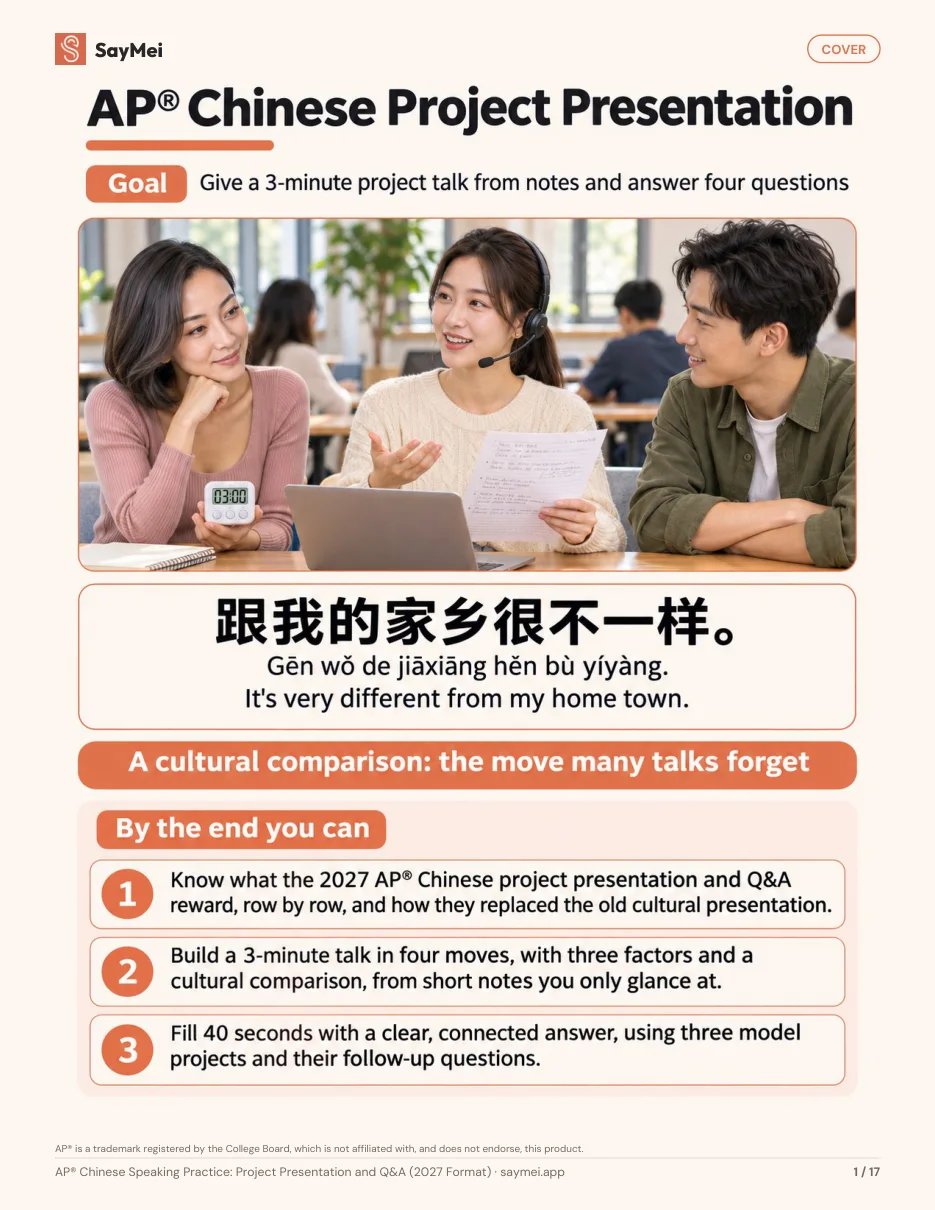
跟我的家乡很不一样。 · Gēn wǒ de jiāxiāng hěn bù yíyàng. · It's very different from my home town.
By the end you can
- Know how the 2027 AP® Chinese speaking tasks work. A 3-minute project talk after 3 minutes to prepare, then four follow-up questions, each heard twice, with 40 seconds per answer. These tasks replaced the old Conversation and Cultural Presentation.
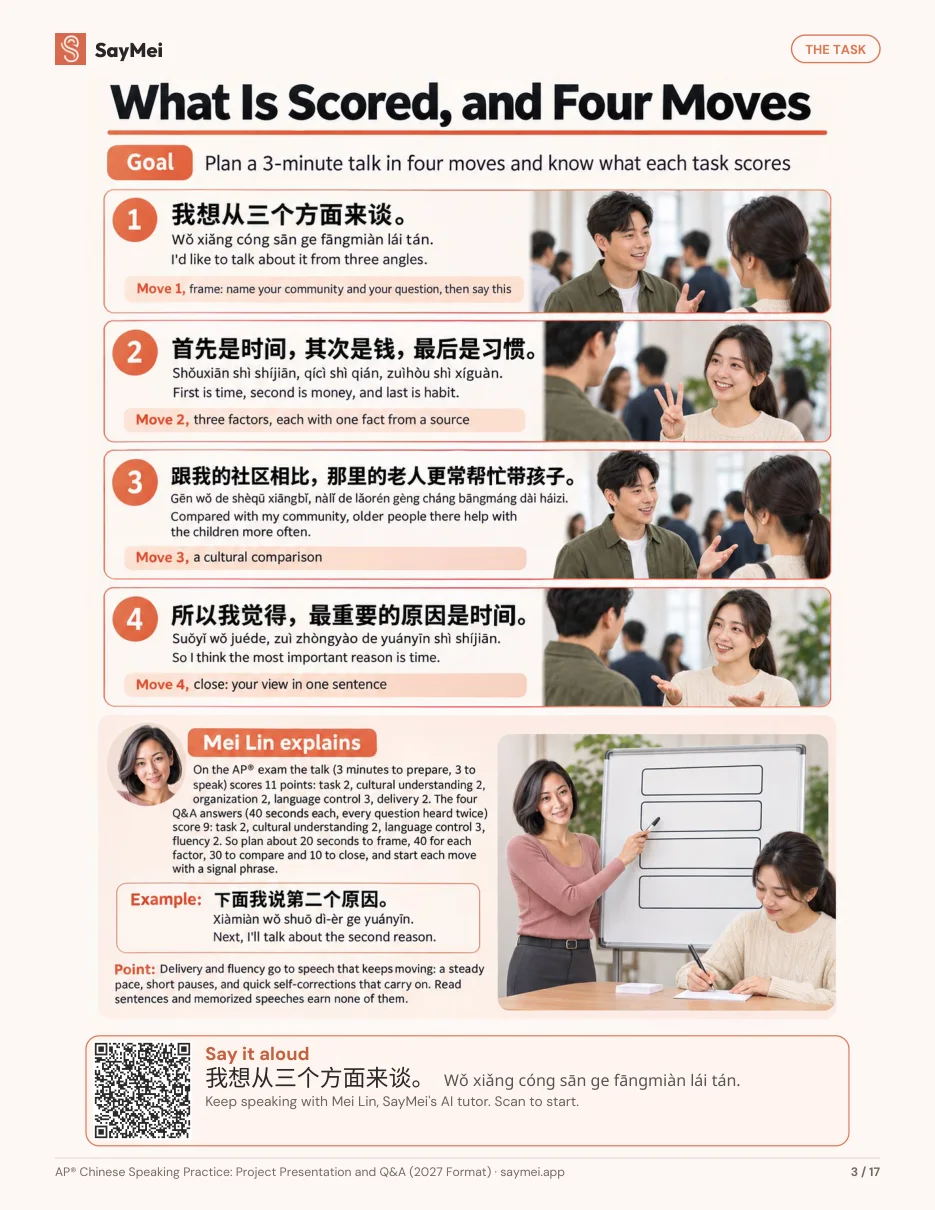
- Plan a 3-minute talk in four moves. Frame your community and your question, give three factors with one fact from a source each, make a cultural comparison and close with your view: about 20 seconds, 2 minutes, 30 seconds and 10.
我想从三个方面来谈。 · Wǒ xiǎng cóng sān ge fāngmiàn lái tán. · I'd like to talk about it from three angles. - Order your factors and compare with signal words. One reference page of ten model lines with 首先, 其次, 最后, 跟…相比, 根据, 由此可见 and 总的来说, so every move starts with a clear signal.
跟我的家乡相比,这里的冬天更冷。 · Gēn wǒ de jiāxiāng xiāngbǐ, zhèlǐ de dōngtiān gèng lěng. · Compared with my home town, winters here are colder. - Speak from short notes, never a script. Turn each move into a few words on one card and build every sentence live from a note. A talk that sounds read or memorized does poorly on delivery, so every practice page ends with a speak-from-notes task.
第一个原因是时间,因为父母都要上班。 · Dì-yī ge yuányīn shì shíjiān, yīnwèi fùmǔ dōu yào shàngbān. · The first reason is time, because both parents work. - Give every factor a point, a fact and what it means. Project 2, on phone payment in small shops, shows how one factor grows from the point to one fact from a source to the "so what" sentence where your own thinking shows.
- Make a cultural comparison that gives a reason. Add one clause with 因为 to say why two places differ or match, and keep it about one place rather than a whole people, as Project 3 on plastic waste in Shanghai shows.
跟上海不一样,我们那儿不用按时扔垃圾,因为垃圾车每周只来一次。 · Gēn Shànghǎi bù yíyàng, wǒmen nàr búyòng ànshí rēng lājī, yīnwèi lājīchē měi zhōu zhǐ lái yí cì. · Unlike Shanghai, we don't have set times to put rubbish out, because the garbage truck only comes once a week. - Fill 40 seconds in the Q&A. Answer in your first sentence, then give a reason and an example. Sixteen model answers across three projects and a final timed run, plus new questions to answer from a three-word note.
你为什么选这个题目? · Nǐ wèishénme xuǎn zhège tímù? · Why did you choose this topic?
What’s inside
- The task: What Is Scored, and Four Moves · Words That Link and Compare
- Project 1: Model: Who Does the Housework? · Build: Build an Outline: Neighbours · Q&A: Four Questions on Housework
- Project 2: Model: Phones, Cash and Small Shops · Build: Build an Outline: Food Delivery · Q&A: Four Questions on Phone Payment
- Project 3: Model: Cities and Plastic Waste · Build: Build an Outline: City Bikes · Q&A: Four Questions on Plastic
- Timeline: Your 12 Weeks to 13 May 2027
- Final practice: One Full Timed Run
How to use this book
Two pages on the task, then three model projects, each with a Model, a Build and a Q&A page. Play the free audio for every line, and finish each practice page by speaking from notes against a timer. One project a week leaves time for your own.
- Week 1: The task and the signal words. Pages 3 and 4. Learn the four moves and their timing, and say the ten lines on page 4 until they come without thinking.
- Week 2: Project 1: housework. Pages 5 to 7. Study the model outline, build the Neighbours outline and talk for 3 minutes from it, then answer four questions in 40 seconds each.
- Week 3: Project 2: phone payment. Pages 8 to 10. Give every factor a point, a fact and a meaning, and build a talk on food delivery.
- Week 4: Project 3: plastic waste. Pages 11 to 13. Add a reason to every comparison, and build a talk on city bikes.
- From January: Your own project. Follow the 12-week timeline on page 14, from the project packet to 13 May 2027. Use the same moves on your own sources, in your own words.
- Every two weeks: A full timed run. Page 15: 3 minutes to prepare, a 3-minute talk, then four new questions at 40 seconds each. The answers to the drills are on pages 16 and 17.
Who it’s for
Students preparing for the AP® Chinese Language and Culture exam in the 2027 format, and their teachers, who want to practise the project presentation and its Q&A.
Before you start: Chinese at about HSK 3-4. Every line has characters, pinyin and English, with free audio. Your exam project must be your own work: the three projects here practise the skill, and none is on the 2026-27 theme.
Frequently asked questions
Does this cover the AP® Chinese cultural presentation?
In the 2027 format, the project presentation and its Q&A replaced the old Conversation and Cultural Presentation tasks, so this book practises those. The cultural comparison is still part of every talk, and the book shows how to give it a reason.
Can I use these projects for my own exam project?
No. Your exam project must be your own work, in your own words. The three model projects (housework, phone payment and plastic waste) and the three you build (neighbours, food delivery and city bikes) are there to practise the skill, and none is on the 2026-27 theme.
Is there audio?
Yes, free on the book's page on saymei.app. Every Chinese line is recorded, including all the model Q&A answers, with a pause to say each one back.
Is this workbook free?
Yes. The whole 17-page PDF is free, and you can look through its pages here before you download. There's no card and nothing to pay.
Do I need a SayMei account?
Yes, to download the PDF, and the account is free: sign up with Google, Apple or your email address. With it we email you a copy of the workbook, keep every workbook you download on your account on all your devices, save your place in the free online practice, and you can practise speaking with Mei Lin, SayMei's AI tutor.
How do I print it?
The PDF is US Letter size. On A4 paper, choose "Fit to page" (or "Scale to fit") in the print dialog so nothing is cut off. Print the whole workbook or only the pages you need; colour looks best, and black and white works too.
Can I print copies for my class?
Yes. Print as many copies as you like for your own class or family. To share it, send this page: everyone can download their own copy.
Keep going
AP® Chinese Story Narration and Email Response Practice: 10 Prompts with Model Answers · AP® Chinese Listening Practice: 35 Questions in the 2027 Exam Format, with Audio · AP® Chinese Reading Practice: 35 Questions in the 2027 Exam Format, with Answers · GCSE Chinese Speaking Practice: Role Plays, Picture Tasks and Conversation Questions · More exam practice · Browse all 294 workbooks
AP® is a trademark registered by the College Board, which is not affiliated with, and does not endorse, this product.
Version 2026-11 · Updated Nov 4, 2026 · Report a correction