Exams · College (about HSK 3-4)
BYU FLATS Mandarin Practice: Listening, Reading and Grammar for College Credit
Multiple-choice listening, reading and grammar practice in the FLATS Mandarin style, with answers and audio
- Level:
- College (about HSK 3-4)
- Format:
- Workbook · PDF · 18 pages · US Letter (prints on A4)
- Price:
- Free · free with a saymei account · updated Nov 4, 2026
Listening audio: play every track free, no account needed.
Download the free PDF: create a free SayMei account on this page, and we'll email you a copy too.
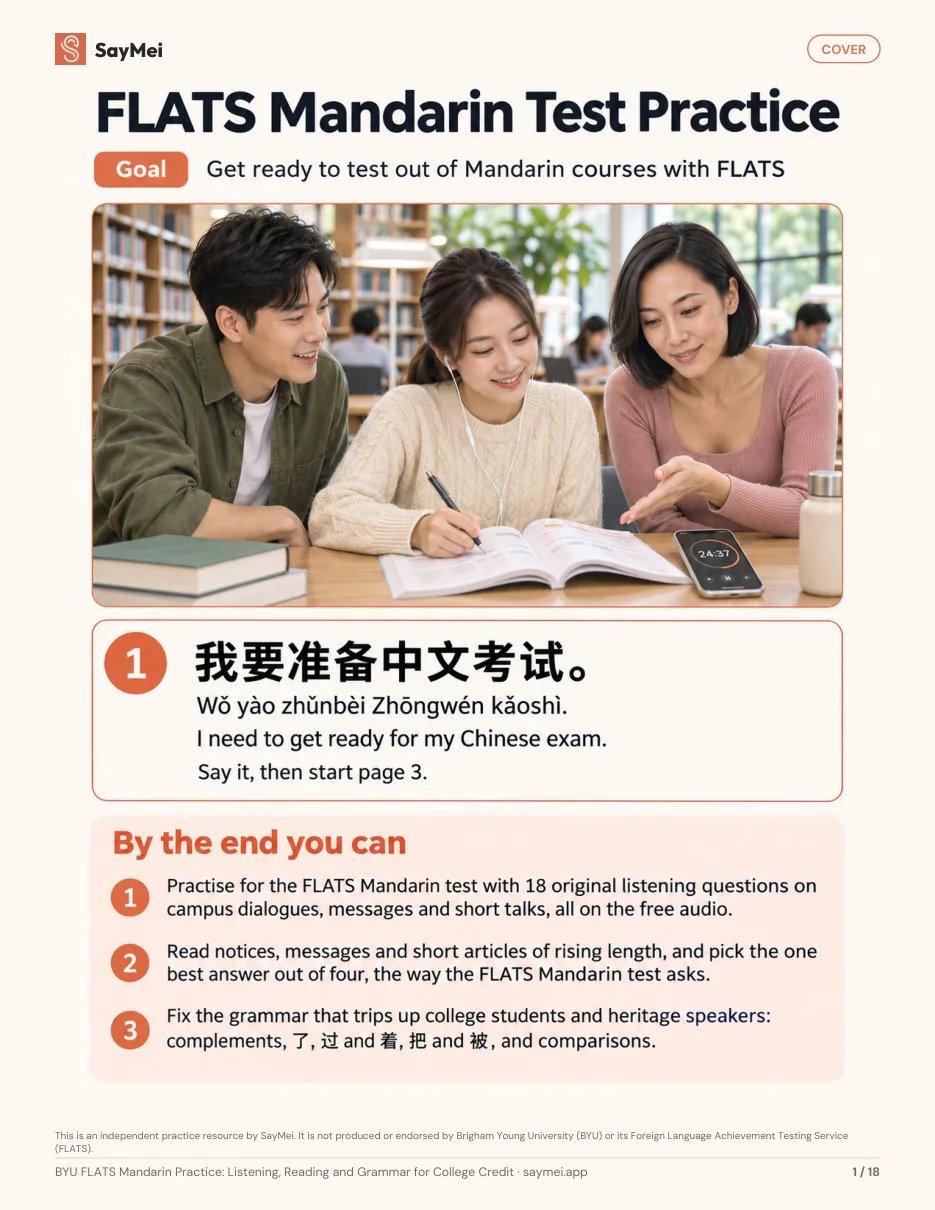
我要准备中文考试。 · Wǒ yào zhǔnbèi Zhōngwén kǎoshì. · I need to get ready for my Chinese exam.
By the end you can
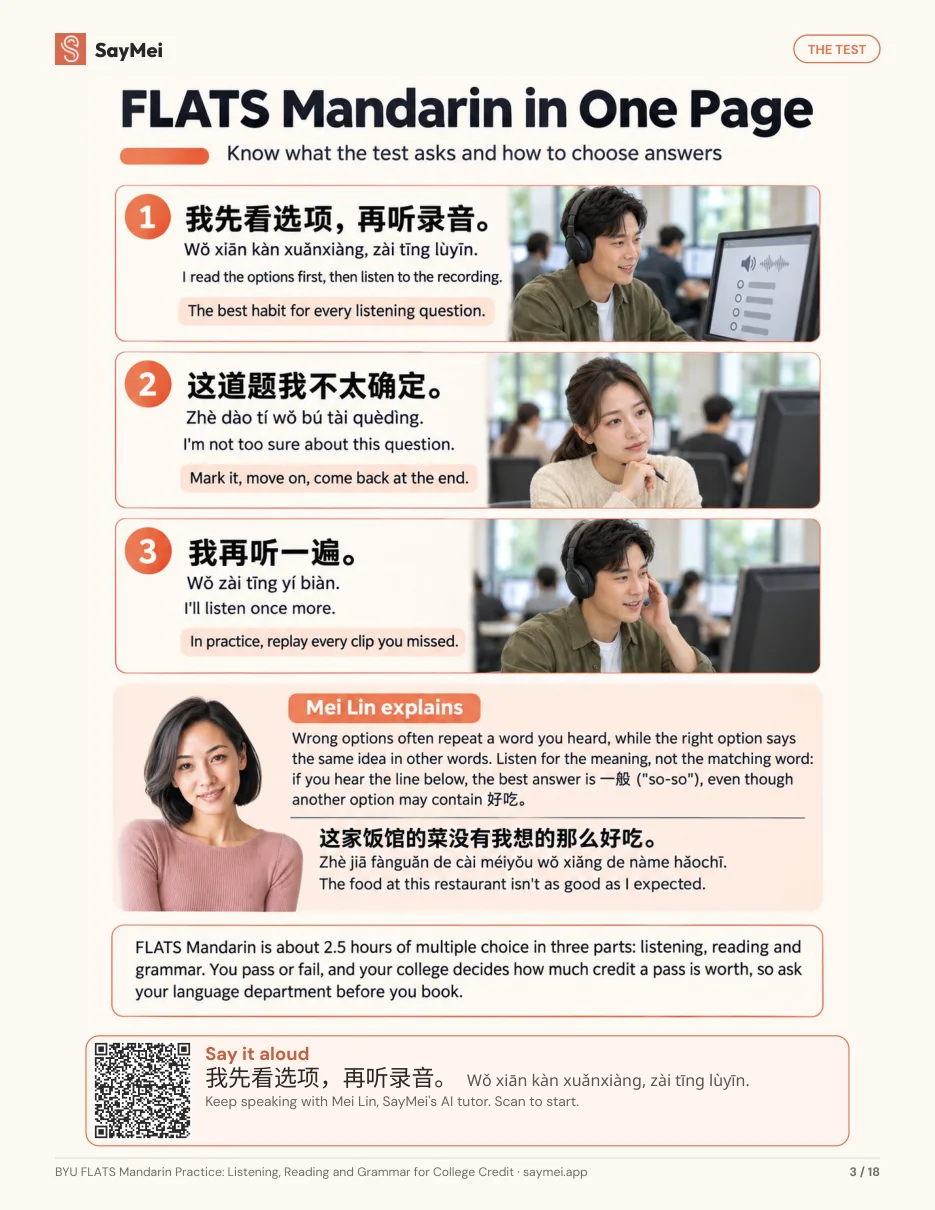
- Know the FLATS Mandarin test and how to choose answers. About 2.5 hours of multiple choice in listening, reading and grammar, pass or fail. Read the options first, and listen for the meaning, since wrong options often repeat a word you heard.
我先看选项,再听录音。 · Wǒ xiān kàn xuǎnxiàng, zài tīng lùyīn. · I read the options first, then listen to the recording. - Answer questions on campus dialogues and class notices. Work out when two students can study together, which room Friday's class moved to and why a history class keeps Lin Hao up late.
明天下午我要去打工,三点以后才有空。你等我一下吧。 · Míngtiān xiàwǔ wǒ yào qù dǎgōng, sān diǎn yǐhòu cái yǒu kòng. Nǐ děng wǒ yíxià ba. · Tomorrow afternoon I'm working my part-time job, and I'm only free after three. Wait for me a bit. - Catch times, prices and changes of plan. Follow a voice message, a sale price at 打八折 and a station announcement, then work out the train's first departure time from how late it is.
各位旅客,开往上海的火车晚点四十分钟,十一点二十出发。 · Gèwèi lǚkè, kāiwǎng Shànghǎi de huǒchē wǎndiǎn sìshí fēnzhōng, shíyī diǎn èrshí chūfā. · Attention, passengers: the train to Shanghai is forty minutes late and will leave at 11:20. - Follow longer talks and find the main point. Listen to Lin Hao on what he finds hardest now, two friends moving a hike twice and a short talk on sleeping well before an exam.
天气预报说星期六有大雨,我们改到星期天吧。 · Tiānqì yùbào shuō xīngqīliù yǒu dàyǔ, wǒmen gǎidào xīngqītiān ba. · The forecast says heavy rain on Saturday. Let's move it to Sunday. - Find facts fast in notices, messages, emails and posts. Read library hours, a note about a borrowed book, a room-to-rent ad, a Chinese corner email and a post about living off campus, and choose what phrases like 大多了 mean.
我在教室门口等你。 · Wǒ zài jiàoshì ménkǒu děng nǐ. · I'll wait for you at the classroom door. - Read a longer article for the main idea and the best title. Follow a student who grew up speaking Chinese at home but read little, answer questions on details and words like 两回事, and pick the title that fits.
对我来说,读比说难,因为汉字太多了。 · Duì wǒ lái shuō, dú bǐ shuō nán, yīnwèi Hànzì tài duō le. · For me, reading is harder than speaking, because there are so many characters. - Pick the right complement and 了, 过 or 着. Choose the complement for 看 or 跑, choose 了, 过 or 着 for 去 and 开, and make sentences negative with 不 or 没.
我听不清楚,请再说一遍。 · Wǒ tīng bu qīngchu, qǐng zài shuō yí biàn. · I can't hear clearly; please say it again. - Build 把 and 被 sentences and compare things. Choose between 把 and 被, finish a 把 sentence with 做完了, compare with 比, 没有 … 那么 and 跟 … 一样, and spot the one correct sentence out of four.
这门课比那门课难多了。 · Zhè mén kè bǐ nà mén kè nán duō le. · This class is much harder than that one.
What’s inside
- The test: FLATS Mandarin in One Page
- Listening: Listening 1: Campus Life · Listening 2: Messages and Errands · Listening 3: Longer Talks
- Reading: Reading 1: Notices and Messages · Reading 2: Emails and Posts · Reading 3: A Longer Article
- Grammar: Grammar 1: Complements and 了, 过, 着 · Grammar 2: 把, 被 and Comparisons
- Plan: Your Four-Week FLATS Plan
How to use this book
Time each page with a phone timer: about 6 minutes for a listening page, 8 for reading and 5 for grammar. Play each clip once, answer, then play it again to check, and mark each page with the key before you turn it.
- Week 1: Listening. Do the three listening pages with the timer. Replay every clip you missed and write down the word that tricked you. Listen to 15 minutes of slow, clear Chinese a day and say each line back in the pause.
- Week 2: Reading. Do the three reading pages and underline the sentence that proves each answer. Read one short Chinese text a day, a notice, a message or a news story, and note five new characters.
- Week 3: Grammar. Do both grammar pages and make a card for each point you missed. Write five sentences a day with the patterns you got wrong, then read them out loud.
- Week 4: Redo and check the rules. Redo your weakest pages, then do one listening, one reading and one grammar page in a row. Check the test day, place and rules with your college's language department and at flats.byu.edu.
- Test day: Answer every question. Read the options before each clip, choose one answer for every question, and come back to the ones you marked.
Who it’s for
College students and heritage speakers getting ready to test out of Mandarin courses, or earn credit, with BYU's FLATS Mandarin test, at about HSK 3 to 4.
Before you start: Chinese at about HSK 3 to 4 in Simplified characters. Questions and texts are in characters, and the line to say at the end of each page has pinyin. The audio script at the back writes out every clip.
Frequently asked questions
How close is the book to the FLATS Mandarin test?
It practises the test's three parts, listening, reading and grammar, as multiple choice with four options. SayMei wrote every question, clip and text, so it contains no FLATS test questions. Your college decides how much credit a pass is worth, so ask your language department before you book.
Is it useful for heritage speakers?
Yes. The grammar pages target the points that trip up college students and heritage speakers: complements, 了, 过 and 着, 把 and 被, and comparisons. Reading 3 follows a student who spoke Chinese at home growing up and found reading was the harder skill.
Where is the audio?
Free on this book's page on saymei.app: the clips for all 18 listening questions and every other Chinese line in the book. On the listening pages the clips are heard, not printed, and the audio script at the back writes them out for checking.
Is this workbook free?
Yes. The whole 18-page PDF is free, and you can look through its pages here before you download. There's no card and nothing to pay.
Do I need a SayMei account?
Yes, to download the PDF, and the account is free: sign up with Google, Apple or your email address. With it we email you a copy of the workbook, keep every workbook you download on your account on all your devices, save your place in the free online practice, and you can practise speaking with Mei Lin, SayMei's AI tutor.
How do I print it?
The PDF is US Letter size. On A4 paper, choose "Fit to page" (or "Scale to fit") in the print dialog so nothing is cut off. Print the whole workbook or only the pages you need; colour looks best, and black and white works too.
Can I print copies for my class?
Yes. Print as many copies as you like for your own class or family. To share it, send this page: everyone can download their own copy.
Keep going
AP® Chinese Speaking Practice: Project Presentation and Q&A (2027 Format) · AP® Chinese Story Narration and Email Response Practice: 10 Prompts with Model Answers · GCSE Chinese Speaking Practice: Role Plays, Picture Tasks and Conversation Questions · O Level Chinese Oral Practice: Reading Aloud and Video Conversation with Model Answers · More exam practice · Browse all 294 workbooks
This is an independent practice resource by SayMei. It is not produced or endorsed by Brigham Young University (BYU) or its Foreign Language Achievement Testing Service (FLATS).
Version 2026-11 · Updated Nov 4, 2026 · Report a correction