Exams · ILR 1 to 2+ (about HSK 3-5)
DLPT Chinese Mandarin Practice: Reading and Listening from ILR 1 to 2+
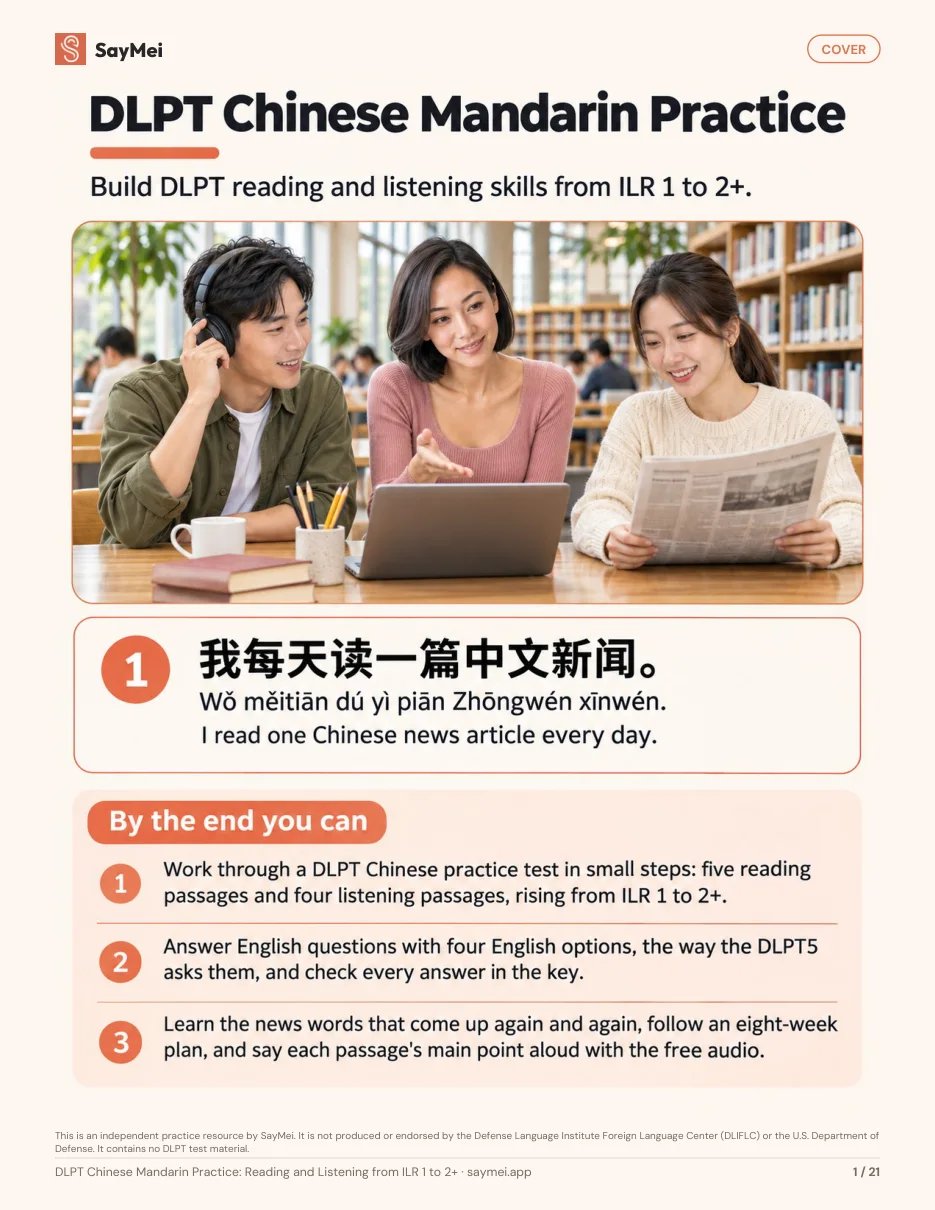
Original reading and listening passages in the DLPT5 style, with English questions, answers and audio, rising from ILR 1 to 2+
- Level:
- ILR 1 to 2+ (about HSK 3-5)
- Format:
- Workbook · PDF · 21 pages · US Letter (prints on A4)
- Price:
- Free · free with a saymei account · updated Nov 4, 2026
Listening audio: play every track free, no account needed.
Download the free PDF: create a free SayMei account on this page, and we'll email you a copy too.
我每天读一篇中文新闻。 · Wǒ měitiān dú yì piān Zhōngwén xīnwén. · I read one Chinese news article every day.
By the end you can
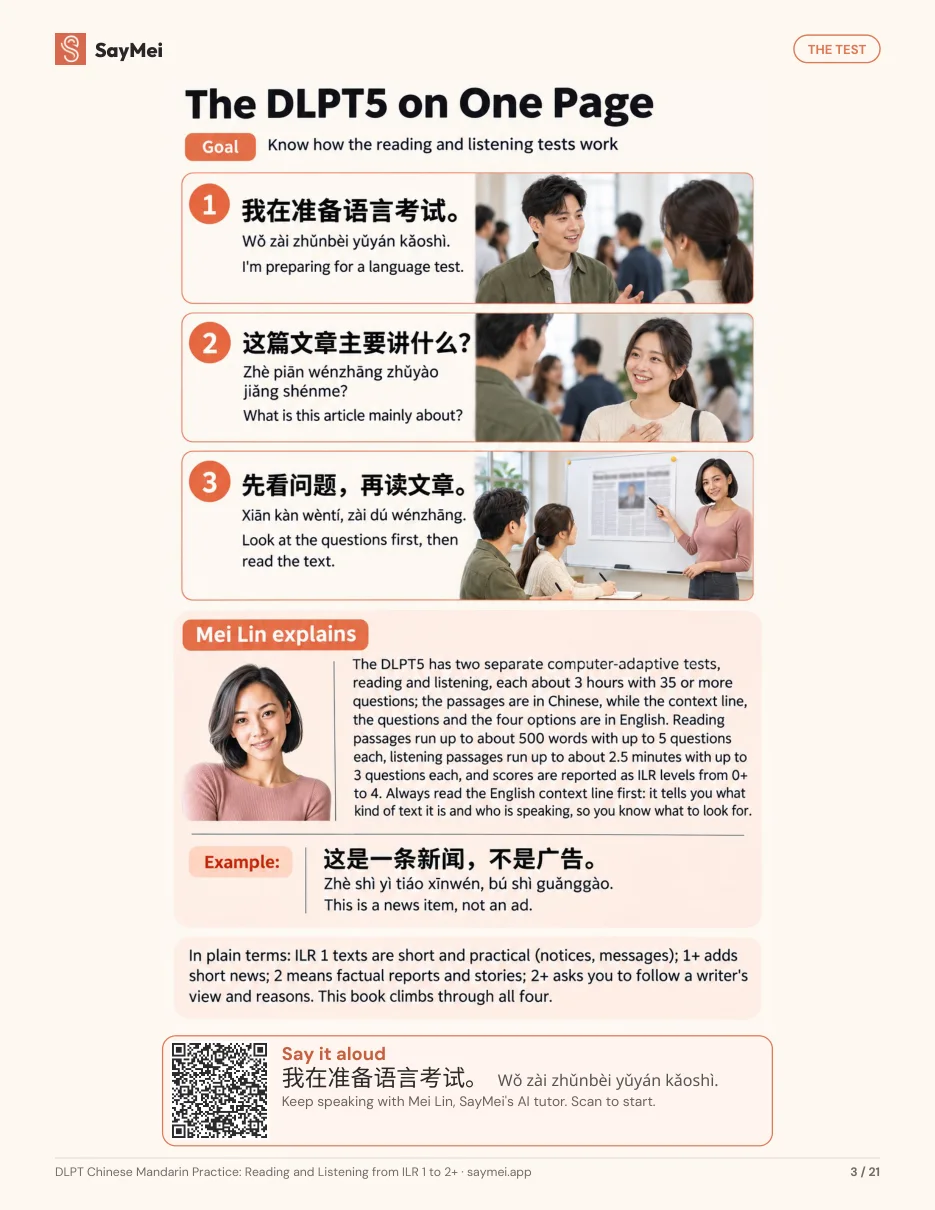
- Know how the DLPT5 reading and listening tests work. Two separate computer-adaptive tests with Chinese passages and an English context line, English questions and four English options, scored as ILR levels. Read the context line and questions first.
先看问题,再读文章。 · Xiān kàn wèntí, zài dú wénzhāng. · Look at the questions first, then read the text. - Pick out the key facts in notices, messages and a news brief. Read a water-cut notice and a text asking a coworker to cover a meeting (ILR 1), then a city news brief on later subway hours with words like 延长 and 据统计 (ILR 1+).
周末地铁开到晚上十二点。 · Zhōumò dìtiě kāi dào wǎnshang shí'èr diǎn. · On weekends the subway runs until midnight. - Follow a feature story to its turning point. Read about a young woman who left Shanghai to sell her hometown's tea online, find where the story turns and work out what she means about how her life has changed (ILR 2).
她回老家在网上卖茶。 · Tā huí lǎojiā zài wǎngshàng mài chá. · She went back to her hometown and sells tea online. - Find a writer's view, reasons and tone in an opinion column. Read a column on takeout packaging waste, find the view the writer rejects after 我不同意, follow the answer to the cost argument and judge the tone of the last line (ILR 2+).
我觉得外卖应该少用塑料。 · Wǒ juéde wàimài yīnggāi shǎo yòng sùliào. · I think takeout should use less plastic. - Follow a problem, its causes and the way forward in a report. Read an analytical report on community canteens for older people, find both causes after 一是 and 二是, the new approaches and the experts' conclusion (ILR 2+/3).
老年食堂很受欢迎,但很难赚钱。 · Lǎonián shítáng hěn shòu huānyíng, dàn hěn nán zhuàn qián. · Senior canteens are popular but find it hard to make money. - Catch times, places and choices in an announcement and a phone call. Hear a delayed train with a platform change and a cancelled service (ILR 1), then a call to move a dental appointment and the two times offered (ILR 1+).
我能不能改个时间? · Wǒ néng bu néng gǎi ge shíjiān? · Could I change the time? - Follow radio news and a radio interview. Catch the cause after 受……影响, the advice and the school change in a cold-weather report (ILR 2), and a library director's reasons, doubts and main point (ILR 2+).
明天降温,多穿点衣服。 · Míngtiān jiàngwēn, duō chuān diǎn yīfu. · It's turning cold tomorrow, so wear warm clothes. - Recognise the news words that come back again and again. Ten phrases from news, economy, science and safety texts, such as 据报道, 专家认为, 同比增长 and 一方面……另一方面, with notes on how each one works.
据报道,今年物价上涨了。 · Jù bàodào, jīnnián wùjià shàngzhǎng le. · According to reports, prices have risen this year.
What’s inside
- The test: The DLPT5 on One Page
- Reading: Reading 1: A Notice and a Message · Reading 2: A City News Brief · Reading 3: A Feature Story · Reading 4: An Opinion Column · Reading 5: An Analytical Report
- Listening: Listening 1: Station Announcement · Listening 2: A Phone Call · Listening 3: A Radio News Item · Listening 4: A Radio Interview
- News words: News Words That Come Back
- Plan: Eight Weeks from ILR 1+ to 2+
How to use this book
Go in order: the passages climb from ILR 1 on page 4 to ILR 2+ on page 12. Give each reading page 10 minutes and each listening passage two plays at most, then check the key. Page 14 turns this into eight weeks.
- Weeks 1–2: Short texts and news briefs. Read one notice, sign or text message a day and redo page 4 in under 10 minutes. Then read one short news brief a day and write its main point in one English sentence.
- Week 3: Announcements and calls. Listen to one announcement or phone call a day. Answer after one play, then read the script.
- Week 4: Features. For each feature, note who, what and why, and circle the time phrase where the story turns.
- Week 5: Radio-style news. Listen for 10 minutes a day. Note numbers, dates and causes (受……影响).
- Weeks 6–7: Opinion, reports and interviews. Mark each writer's view, reasons and tone. In interviews and reports, find where the weight falls (不只是……更是……, 不在于……而在于……).
- Week 8: Against the clock. Redo pages 4 to 12 against the clock, then retell each passage aloud in Chinese in two sentences.
Who it’s for
US service members, government linguists and other learners preparing for the DLPT5 in Chinese Mandarin, who want reading and listening practice that climbs from ILR 1 to 2+ on civilian topics.
Before you start: Chinese at about HSK 3 for the first pages, rising to about HSK 5. Passages are in characters; the context lines, questions and options are in English. The key has every answer and the full audio script.
Frequently asked questions
Where do the passages come from?
SayMei wrote every passage and question, following only the publicly described format: a Chinese passage, an English context line, English questions and four English options. The topics are civilian: building notices, city news, a feature, an opinion column, a report, a station, a phone call, radio news and an interview.
Which ILR levels does it cover?
Five reading and four listening passages climb from ILR 1 (notices and messages) through 1+ (short news) and 2 (factual reports and stories) to 2+ (a writer's view and reasons). The last reading, an analytical report, is marked ILR 2+/3. The book is a practice set, so it gives no level or score for your answers.
Where is the audio?
Free on this book's page on saymei.app, through the QR code in the book. Listening passages are heard, not printed, and every Chinese line is recorded with a pause to say it back. The full audio script is at the back for checking after you answer.
Is this workbook free?
Yes. The whole 21-page PDF is free, and you can look through its pages here before you download. There's no card and nothing to pay.
Do I need a SayMei account?
Yes, to download the PDF, and the account is free: sign up with Google, Apple or your email address. With it we email you a copy of the workbook, keep every workbook you download on your account on all your devices, save your place in the free online practice, and you can practise speaking with Mei Lin, SayMei's AI tutor.
How do I print it?
The PDF is US Letter size. On A4 paper, choose "Fit to page" (or "Scale to fit") in the print dialog so nothing is cut off. Print the whole workbook or only the pages you need; colour looks best, and black and white works too.
Can I print copies for my class?
Yes. Print as many copies as you like for your own class or family. To share it, send this page: everyone can download their own copy.
Keep going
AP® Chinese Speaking Practice: Project Presentation and Q&A (2027 Format) · AP® Chinese Story Narration and Email Response Practice: 10 Prompts with Model Answers · GCSE Chinese Speaking Practice: Role Plays, Picture Tasks and Conversation Questions · O Level Chinese Oral Practice: Reading Aloud and Video Conversation with Model Answers · More exam practice · Browse all 294 workbooks
This is an independent practice resource by SayMei. It is not produced or endorsed by the Defense Language Institute Foreign Language Center (DLIFLC) or the U.S. Department of Defense. It contains no DLPT test material.
Version 2026-11 · Updated Nov 4, 2026 · Report a correction