Reading · Intermediate
Intermediate Chinese Short Stories: 8 Stories to Read Without Pinyin
Eight stories in characters only, with new words glossed, inference questions and summary writing
- Level:
- Intermediate · HSK 3
- Format:
- Workbook · PDF · 39 pages · US Letter (prints on A4)
- Price:
- Free · free with a saymei account · updated Oct 27, 2026
Download the free PDF: create a free SayMei account on this page, and we'll email you a copy too.
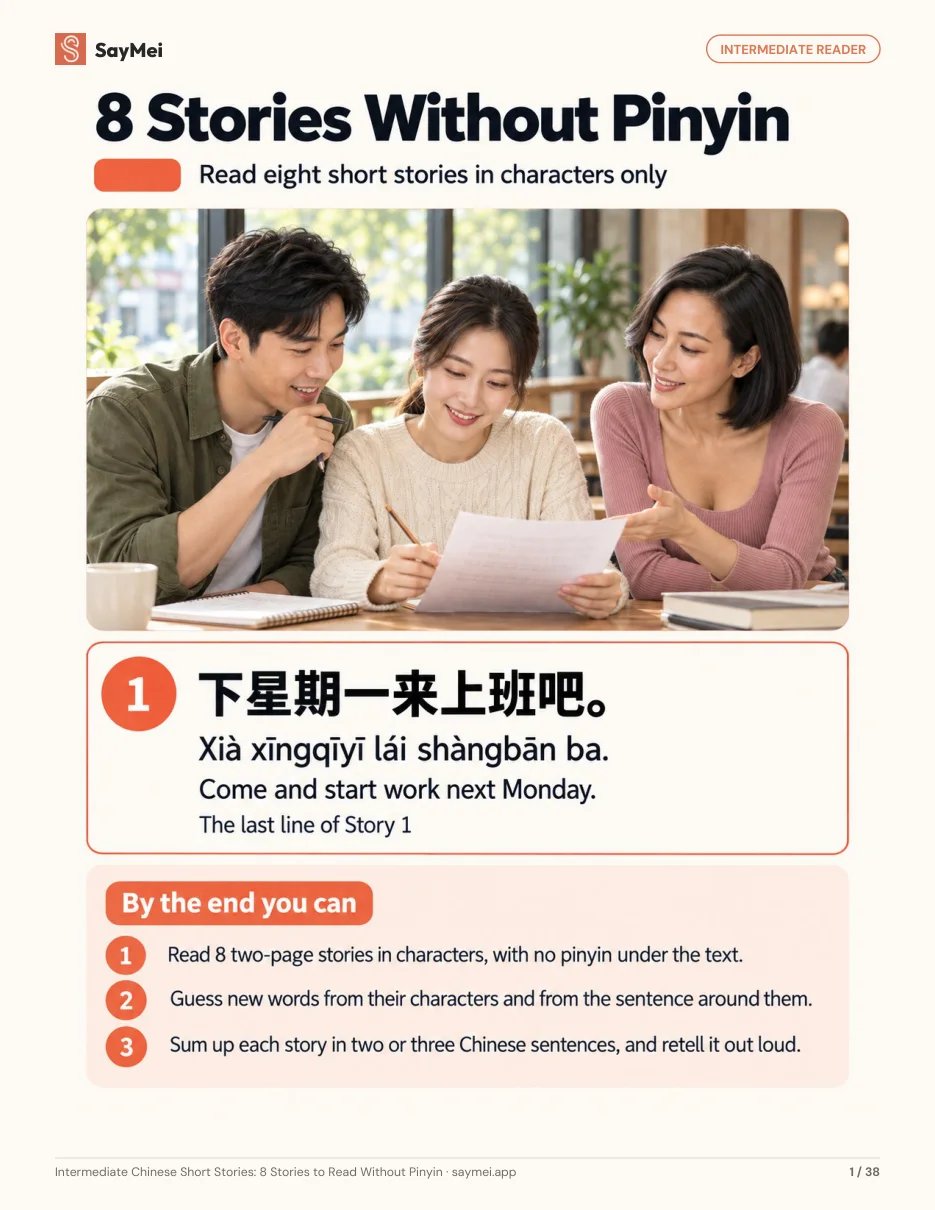
下星期一来上班吧。 · Xià xīngqīyī lái shàngbān ba. · Come and start work next Monday.
By the end you can
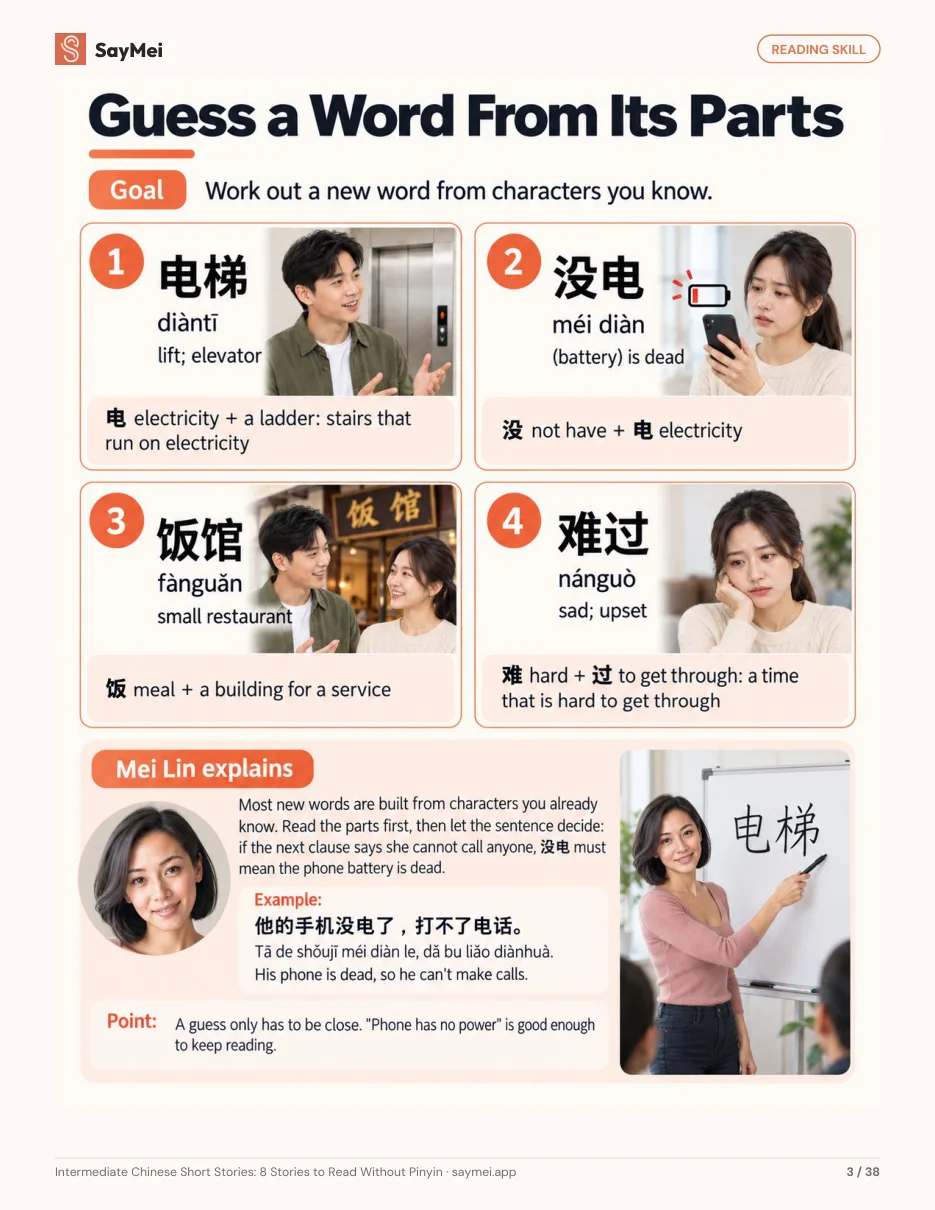
- Work out a new word from characters you know. The opening skill page shows how 电 plus a ladder makes a lift, and 饭 plus a building makes a small restaurant. A guess only has to be close enough to keep reading.
电梯 · diàntī · lift; elevator - Let the sentence around a word confirm your guess. When the next clause says someone can't call anyone, 没电 must mean the battery is dead. A warm-up page practises both kinds of guess.
他的手机没电了,打不了电话。 · Tā de shǒujī méi diàn le, dǎ bu liǎo diànhuà. · His phone is dead, so he can't make calls. - Read eight two-page stories in characters only. No pinyin under the text. Each part glosses four new words with pinyin and English, from 经理 and 担心 in Story 1 to 一边…一边… in Story 5.
下星期一来上班吧。 · Xià xīngqīyī lái shàngbān ba. · Come and start work next Monday. - Answer questions in Chinese about what happened. Each practice page starts with plain questions on the facts, like what time someone went to bed or what went wrong downstairs.
- Read between the lines and answer why. Then think about why a character did something and answer in one Chinese sentence, often with 因为, as in the example answer 因为她怕晚了.
- Find the word in the story that means the same. Match an English meaning to a word from the text, such as 认真 for careful or 发现 for noticed, so the new words stay with you.
- Sum up each story in two Chinese sentences. The first sentence says the problem and the second says how it ended. Then retell the story aloud in four or five sentences without looking.
小雨很担心,可是她回答得很认真。 · Xiǎoyǔ hěn dānxīn, kěshì tā huídá de hěn rènzhēn. · Xiaoyu was worried, but she answered carefully. - Recommend a story and say why. The review is a chat about which story to read first. You match lines to stories, then recommend your favourite with two reasons.
你觉得我应该先看哪个? · Nǐ juéde wǒ yīnggāi xiān kàn nǎge? · Which one should I read first?
What’s inside
- Reading skill: Guess a Word From Its Parts
- Warm-up: Guess-the-Word Warm-up
- Story 1: Part 1: The Morning of the Meeting · Part 2: The Old Man in the Lift · Practice: The Morning of the Meeting
- Story 2: Part 1: Twelve Boxes of Books · Part 2: Where Is the Cat? · Practice: Twelve Boxes of Books
- Story 3: Part 1: The Train Has Gone · Part 2: Three Hours to Wait · Practice: The Train Has Gone
- Story 4: Part 1: The Empty Chair · Part 2: The Late Cake · Practice: The Empty Chair
- Story 5: Part 1: Mum's Noodles · Part 2: The Secret Is Sugar · Practice: Mum's Noodles
- Story 6: Part 1: The Phone in the Taxi · Part 2: A Call at Last · Practice: The Phone in the Taxi
- Story 7: Part 1: An Old Photo · Part 2: The Girl Under the Tree · Practice: An Old Photo
- Story 8: Part 1: Noise Upstairs · Part 2: The Dancer Upstairs · Practice: Noise Upstairs
- Review: Which Story Should I Read?
- Word cards 1: Words Worth Keeping (1)
- Word cards 2: Words Worth Keeping (2)
- Word list 1: Words by Story: 1–4
- Word list 2: Words by Story: 5–8
How to use this book
Each story is three pages: Part 1, Part 2 and a practice page. Read a story in one sitting if you can, so you know how it ends before you check yourself.
- First: Learn to guess. Do the skill page and the warm-up on pages 3 and 4. They teach the habit the whole book relies on.
- Each story: Read without stopping. Read Part 1 straight through, guessing any word you don't know. Check the four glossed words only after.
- Each story: Read Part 2 and check. Find the surprise in Part 2, then answer the questions, the why question and the word matches.
- Each story: Sum up and retell. Write your two-sentence summary, then retell the story aloud without looking at the page.
- After Story 8: Review and words. Do the review on page 29, then use the word cards and the word lists by story on pages 30–33.
Who it’s for
Intermediate learners who can read short texts with pinyin and want to move to characters only, with stories long enough to have a twist.
Before you start: Comfortable reading everyday characters, and basic grammar like 了, 得 and 因为. New words are glossed under each part, so you won't need a dictionary for every line.
Frequently asked questions
Is there any pinyin at all?
Not under the stories. The four new words glossed under each part have pinyin and English. The questions on the practice pages have English beside them, and the word lists at the back give pinyin.
What level is it?
Intermediate. If the pinyin in Elementary Chinese Short Stories felt like a crutch you no longer needed, this is the next step.
What are the stories about?
Everyday life with a twist: a first meeting with a new manager, moving house with a cat, a missed train, a birthday, Mum's noodle recipe, a phone left in a taxi, an old photo and noise from upstairs.
Is this workbook free?
Yes. The whole 39-page PDF is free, and you can look through its pages here before you download. There's no card and nothing to pay.
Do I need a SayMei account?
Yes, to download the PDF, and the account is free: sign up with Google, Apple or your email address. With it we email you a copy of the workbook, keep every workbook you download on your account on all your devices, save your place in the free online practice, and you can practise speaking with Mei Lin, SayMei's AI tutor.
How do I print it?
The PDF is US Letter size. On A4 paper, choose "Fit to page" (or "Scale to fit") in the print dialog so nothing is cut off. Print the whole workbook or only the pages you need; colour looks best, and black and white works too.
Can I print copies for my class?
Yes. Print as many copies as you like for your own class or family. To share it, send this page: everyone can download their own copy.
Keep going
Read Chinese News: Headlines, Summaries & Fact–Opinion Practice · Guess the Sound: Chinese Phonetic Components in Practice · Read Chinese Without Pinyin: A Guided Transition Workbook · Weather & Seasons: Read Forecasts and Make Plans · Browse all 294 workbooks
Version 2026-10 · Updated Oct 27, 2026 · Report a correction