Culture · Beginner
Learn Chinese with C-Dramas: 100 Phrases You Hear in Every Drama
The lines that come up again and again in Chinese dramas, what they really mean and how to use them in real life, with audio
- Level:
- Beginner · HSK 1
- Format:
- Workbook · PDF · 25 pages · US Letter (prints on A4)
- Price:
- Free · free with a saymei account · updated Nov 4, 2026
Listening audio: play every track free, no account needed.
Download the free PDF: create a free SayMei account on this page, and we'll email you a copy too.
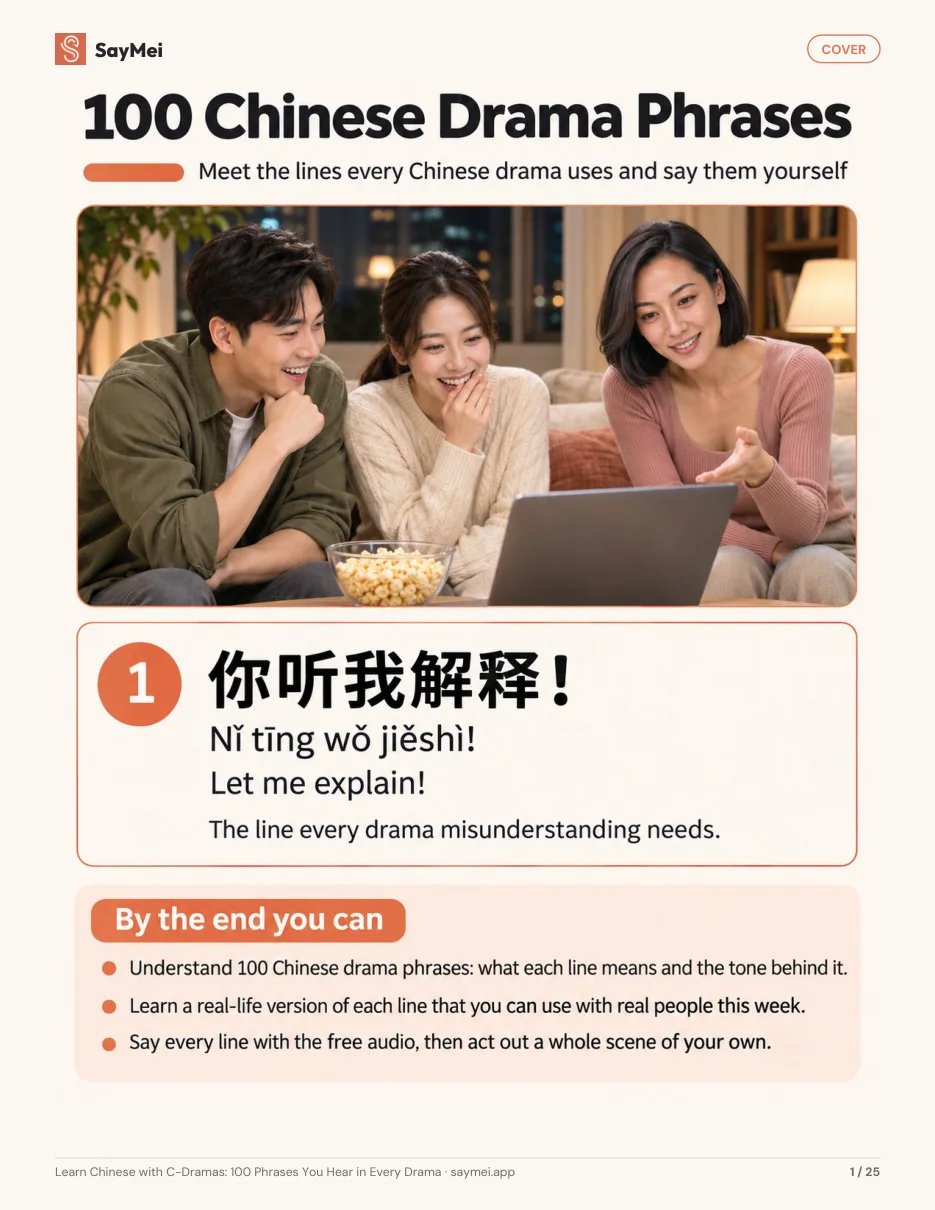
你听我解释! · Nǐ tīng wǒ jiěshì! · Let me explain!
By the end you can
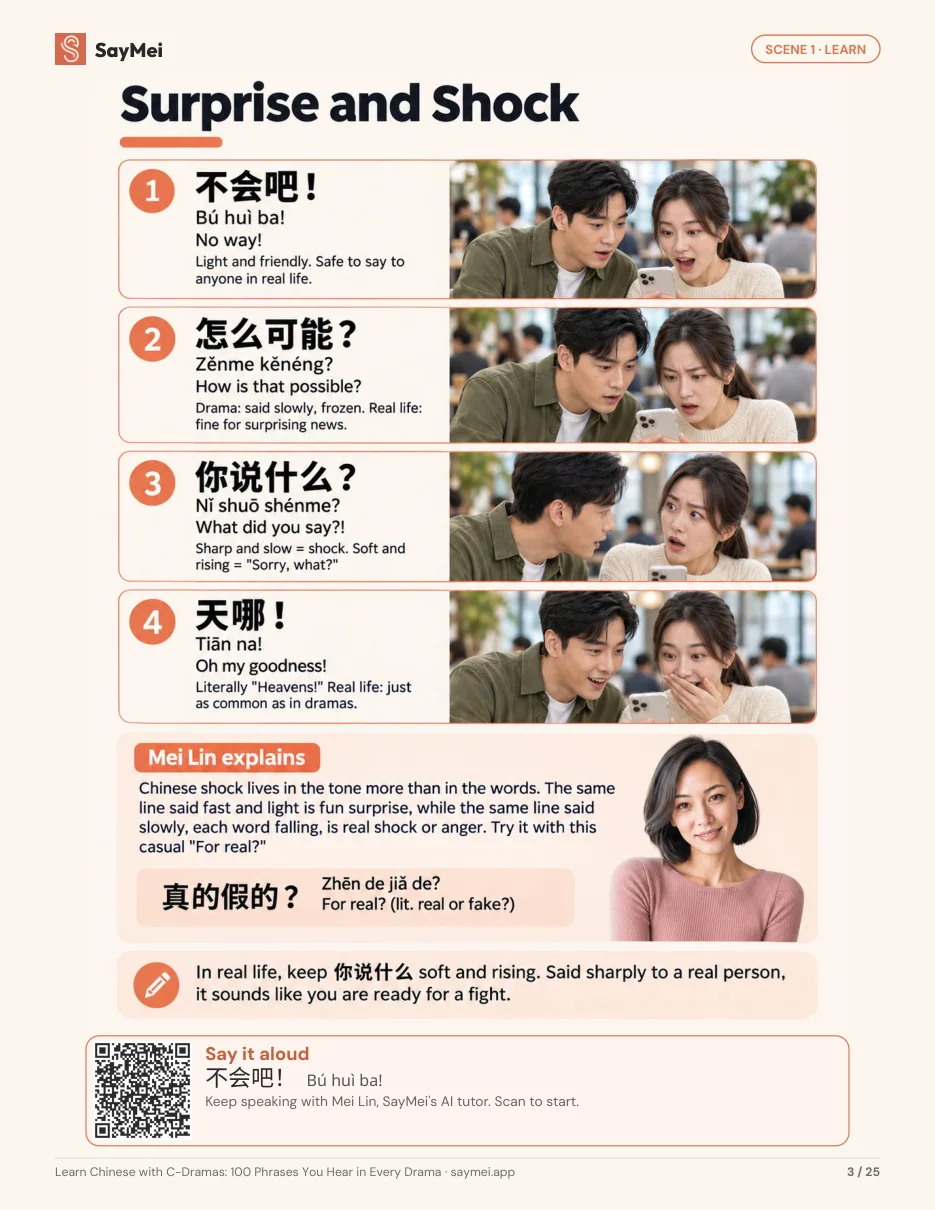
- React to big news like a drama character, or like a friend. Say 不会吧, 天哪 and 怎么可能 and hear how tone turns fun surprise into real shock. Keep 你说什么 soft and rising with real people.
真的假的? · Zhēn de jiǎ de? · For real? (lit. real or fake?) - Say the sweet lines from drama romances. Say 我想你了 with the 了 that makes it warm, confess with 我喜欢你很久了, and tease someone close with 你是不是傻.
我想你了。 · Wǒ xiǎng nǐ le. · I miss you. - Follow a drama argument and apologise for real. Know 你听我解释 and its answer 我不想听, ask with 到底 when you need a clear answer, and keep 对不起 for real mistakes and 不好意思 for small ones.
对不起,是我不好。 · Duìbuqǐ, shì wǒ bù hǎo. · I'm sorry, it's my fault. - Answer the family questions every New Year episode has. Hear 你什么时候结婚? and parents comparing you with 人家, then answer calmly with 我有自己的打算 or a smiling 还早呢.
我有自己的打算。 · Wǒ yǒu zìjǐ de dǎsuàn. · I have my own plans. - Speak up at work like a drama office worker. Offer help with 这件事交给我吧, where 吧 keeps it friendly, and tell drama-only lines like 你被开除了 from what real colleagues say.
这件事交给我吧。 · Zhè jiàn shì jiāo gěi wǒ ba. · Leave this to me. - Comfort a friend with words and with food. Stand by a friend with 别怕,我陪你 and a warm 呢, answer 吃饭了吗 as the greeting it often is, and offer a bowl of noodles, drama style.
有我在呢。 · Yǒu wǒ zài ne. · I'm here for you. - Understand palace dramas and the words fans use. Know why palace characters say 本宫 or 奴婢 instead of 我, turn their lines into modern Mandarin, and learn twenty fan and plot words like 男主, 追剧 and 甜.
本宫累了,退下吧。 · Běngōng lèi le, tuìxià ba. · I am tired. You may go.
What’s inside
- Scene 1: Learn: Surprise and Shock · Practice: Practise: Surprise and Shock
- Scene 2: Learn: Love Lines · Practice: Practise: Love Lines
- Scene 3: Learn: Arguments and Apologies · Practice: Practise: Arguments and Apologies
- Scene 4: Learn: Family Pressure · Practice: Practise: Family Pressure
- Scene 5: Learn: Office Drama · Practice: Practise: Office Drama
- Scene 6: Learn: Friends Through Everything · Practice: Practise: Friends Through It All
- Scene 7: Learn: Words from Palace Dramas · Practice: Practise: Palace Drama Words
- Scene 8: Learn: Comfort and Food · Practice: Practise: Comfort and Food
- Drama words: Twenty Words Every Drama Uses
- Review: Act Out a Short Scene
How to use this book
Eight scenes, each a Learn page and a Practice page, then a page of drama words and a scene to act out. Play the free audio, say each line in the pause, and read its note for the tone and the real-life version. A scene a day takes about ten days.
- Days 1–2: Surprise and love lines. Scenes 1 and 2. Say 不会吧 fast and light, then slow and shocked, to hear what tone does. Then leave someone a voice message with 我想你了.
- Days 3–4: Arguments and family. Scenes 3 and 4. Act out 你听我解释 and 我不想听 for fun, then learn the real apology and a calm 还早呢 for nosy relatives.
- Days 5–6: The office and friends. Scenes 5 and 6. Offer help with 这件事交给我吧 and comfort a friend with 有我在呢, hearing how 吧 and 呢 make a line kinder.
- Days 7–8: Palace words and food. Scenes 7 and 8. Play the empress for a laugh and turn each palace line into modern Mandarin, then answer 吃饭了吗? the way people really do.
- Days 9–10: Drama words and your own scene. Learn the twenty words on page 19, act out the scene on page 20 with a friend, change one line to make it yours, and check your answers at the back.
Who it’s for
Adult beginners who watch Chinese dramas and want to understand the lines they keep hearing, then use the real-life versions with Chinese friends, partners or colleagues. Every line is written for this book, so you don't need to know any particular show.
Before you start: Nothing. Every line has characters, pinyin and English, with a note on its tone and when it's safe to use. The free audio reads each line with a pause to say it back, and the answers and audio script are at the back.
Frequently asked questions
Can I use these lines with real people?
Most of them, yes. Each line has a note on its tone and a real-life version: 我想你了 and 有我在呢 work just as they do on screen, while 你说什么 needs a soft, rising voice or it sounds like you want a fight. Lines marked drama-only, like most of Scene 7, are for a laugh with friends.
Are the lines taken from real dramas?
Every line is written for this book. They're the kinds of lines that come up again and again in modern and historical dramas: the misunderstanding, the confession, the family dinner, the office, the palace hall. You'll start to hear them in the dramas you watch.
What do 本宫 and 奴婢 mean?
Palace characters rarely say 我. They use a title for "I" instead: 朕 for the emperor, 本宫 for a high-ranking palace lady and 奴婢 for a maid. Scene 7 teaches these and other palace words, and shows how people use them today: only as a joke, like 本宫今天不想上班.
Is this workbook free?
Yes. The whole 25-page PDF is free, and you can look through its pages here before you download. There's no card and nothing to pay.
Do I need a SayMei account?
Yes, to download the PDF, and the account is free: sign up with Google, Apple or your email address. With it we email you a copy of the workbook, keep every workbook you download on your account on all your devices, save your place in the free online practice, and you can practise speaking with Mei Lin, SayMei's AI tutor.
How do I print it?
The PDF is US Letter size. On A4 paper, choose "Fit to page" (or "Scale to fit") in the print dialog so nothing is cut off. Print the whole workbook or only the pages you need; colour looks best, and black and white works too.
Can I print copies for my class?
Yes. Print as many copies as you like for your own class or family. To share it, send this page: everyone can download their own copy.
Keep going
Chinese Wishes for Every Occasion: Birthdays, Weddings and Get Well · Mid-Autumn, Dragon Boat and Other Chinese Festivals: What to Say and Do · Chinese Sayings for Beginners: 40 Everyday Expressions and Easy Chengyu · Chinese Tea in Mandarin: Order, Taste and Talk About Tea · Browse all 294 workbooks
Version 2026-11 · Updated Nov 4, 2026 · Report a correction