Culture · Beginner
Chinese Sayings for Beginners: 40 Everyday Expressions and Easy Chengyu
You say 加油 before a friend's test, 说曹操,曹操到 when the person you mention walks in, and use 人山人海 as one word in your own sentence. For learners with beginner Chinese who want to sound more natural.
- Level:
- Beginner · HSK 1
- Format:
- Reference guide · PDF · 11 pages · US Letter (prints on A4)
- Price:
- Free · free with a saymei account · updated Nov 4, 2026
Listening audio: play every track free, no account needed.
Download the free PDF: create a free SayMei account on this page, and we'll email you a copy too.
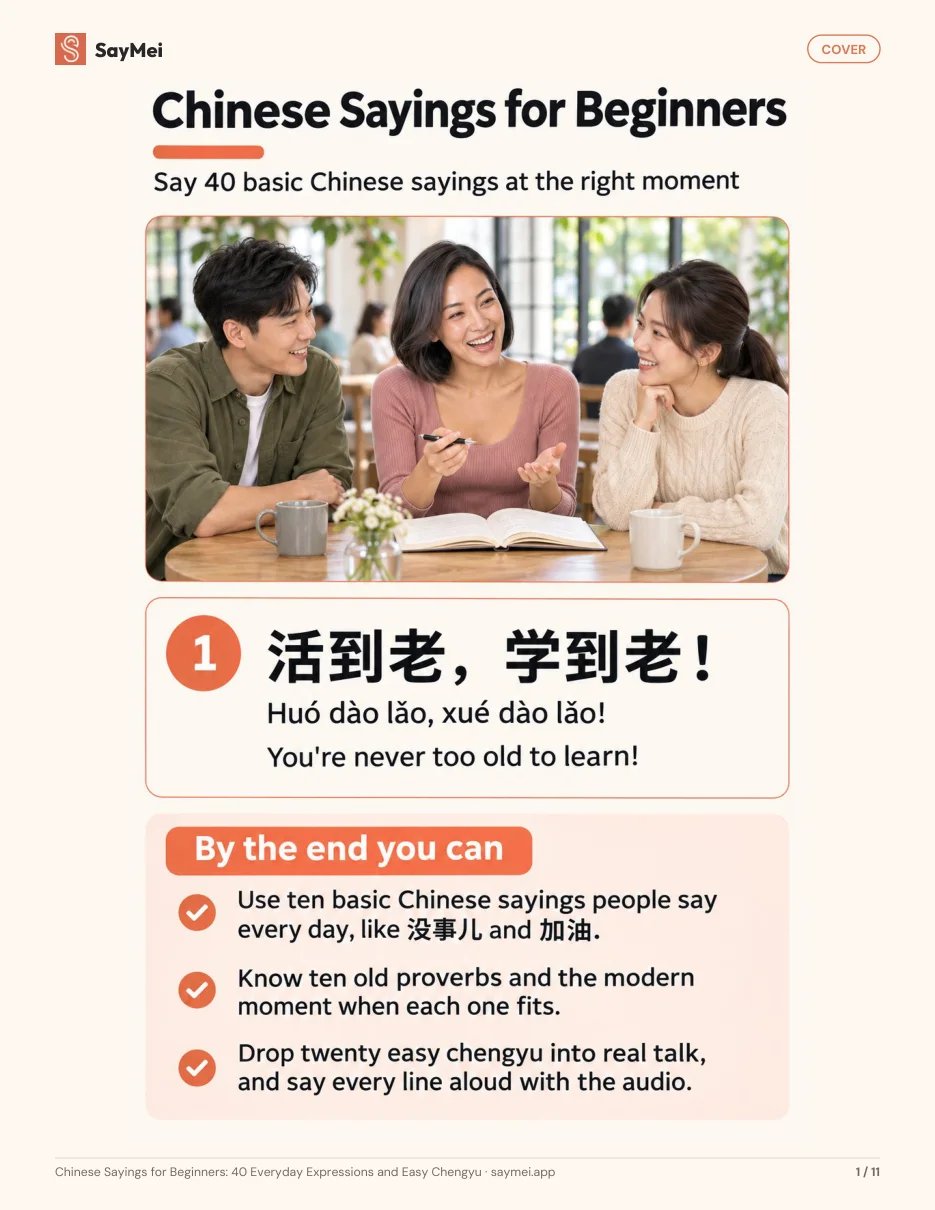
活到老,学到老! · Huó dào lǎo, xué dào lǎo! · You're never too old to learn!
By the end you can
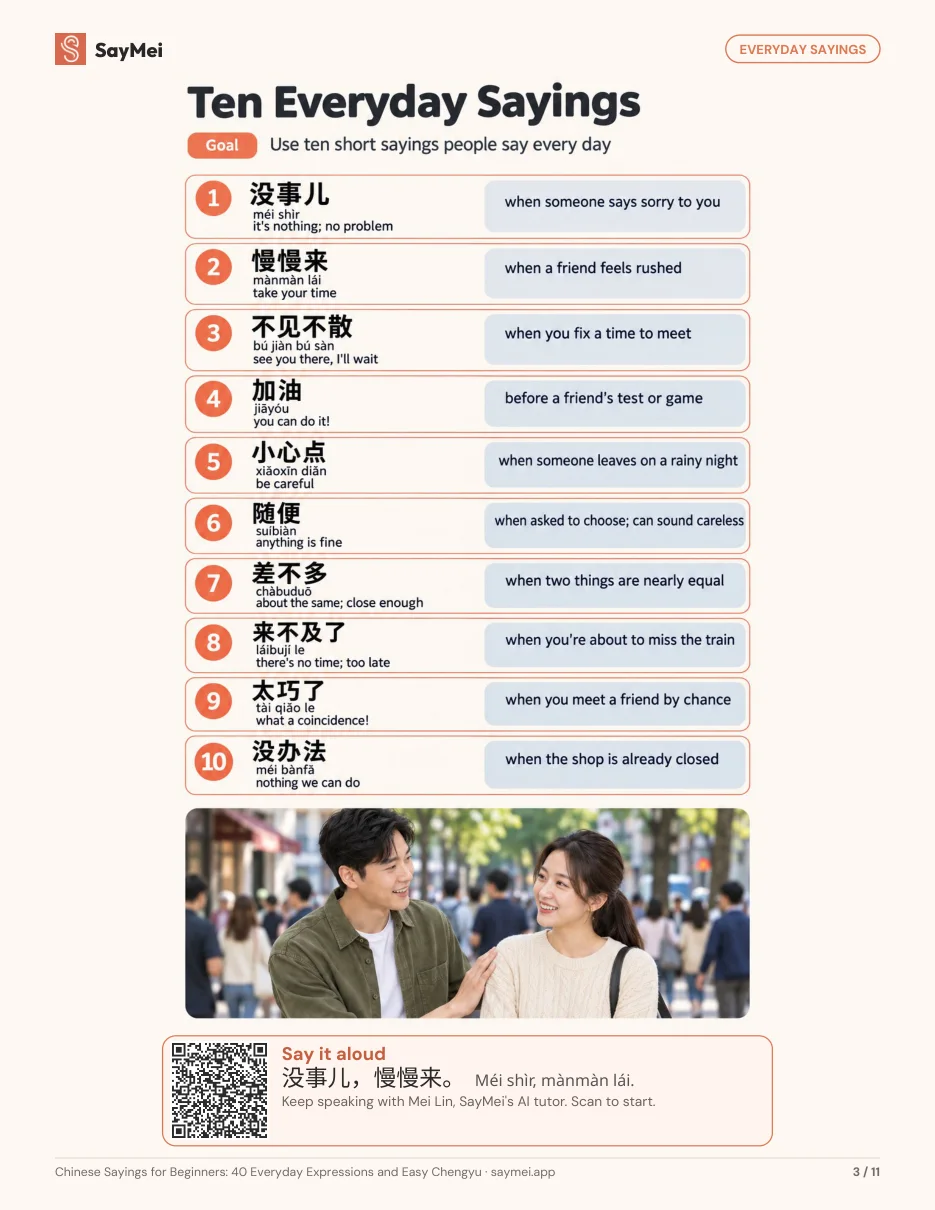
- Use ten everyday sayings at the right moment. Say 没事儿 when someone says sorry, 加油 before a friend's test, 太巧了 when you meet by chance and 来不及了 when you're about to miss the train.
没事儿,慢慢来。 · Méi shìr, mànmàn lái. · It's fine, take your time. - Use a saying as a whole, friendly reply. Say it fast, with no 我 or 你, and with the feeling of the moment. Add a warm second half where one sounds short alone: 随便 by itself can sound like "I don't care".
随便,你喜欢就好。 · Suíbiàn, nǐ xǐhuan jiù hǎo. · Anything's fine, whatever you like. - Know ten old proverbs and the modern moment for each. Say 说曹操,曹操到 when the person you mention walks in, 一分钱一分货 when something cheap breaks, and 百闻不如一见 after finally seeing a famous place.
活到老,学到老! · Huó dào lǎo, xué dào lǎo! · You're never too old to learn! - Keep yourself going with the proverbs about slow progress. 不怕慢,就怕站 for when you want to stop studying, 一口吃不成胖子 for when progress feels slow, and one for the first day of something big.
千里之行,始于足下 · qiān lǐ zhī xíng, shǐ yú zú xià · a thousand-mile trip starts with one step - Use a chengyu as one word. A chengyu is four fixed characters, often from an old story. Never swap or split them, and put no 很 in front. Try 人山人海, 一言为定 and 自由自在 in your own sentences.
这件事千真万确。 · Zhè jiàn shì qiān zhēn wàn què. · This is absolutely true. - Describe colours, numbers and feelings with chengyu. Ten chengyu built on numbers, colours and feelings: 一清二楚 when you remember every detail, 七嘴八舌 at a noisy family meeting, 手忙脚乱 when guests arrive early.
五颜六色 · wǔ yán liù sè · colourful, of many colours - Make a plan with a friend and seal it with two sayings. Set a time and place, agree with 一言为定 and 不见不散, then use sayings across a week of short scenes.
好,一言为定,不见不散! · Hǎo, yì yán wéi dìng, bú jiàn bú sàn! · OK, it's a deal. See you there!
What’s inside
- Everyday Sayings: Ten short sayings like 没事儿, 加油 and 随便, each with the moment to say it, then how to use them as whole replies. Ten Everyday Sayings · Sayings as Quick Replies
- Old Sayings: Ten proverbs, from 活到老,学到老 to 说曹操,曹操到, with their meaning and a modern everyday moment for each. Ten Old Sayings
- Easy Chengyu: What a chengyu is and how to use one, then twenty easy ones for everyday talk, numbers, colours and feelings. What Is a Chengyu? · Ten Chengyu for Everyday Talk · Numbers, Colours and Feelings
- Practice: Pick the saying for each moment, finish the old sayings, then a week of short scenes between two friends. Pick the Saying, Say It · A Week of Sayings
How to use this book
Each row gives the saying, its pinyin, what it means and the moment to say it. Read the moment first, then the saying. The book's own advice: pin up pages 3, 5, 7 and 8 and try one new saying a day, out loud, with a real person if you can.
- Day 1: Learn how the rows and the audio work. Read page 2, then play the first track and say each everyday saying back in the pause, in one breath and with feeling.
- Days 2–10: Everyday sayings. One saying a day from page 3. Use page 4 to turn them into full replies, like 没事儿,慢慢来。
- Days 11–20: Old sayings. One proverb a day from page 5. Wait for its moment, like a friend walking in just as you mention them.
- Days 21–40: Twenty easy chengyu. Read the rule on page 6, then one chengyu a day from pages 7 and 8, used as one word in a sentence of your own.
- Then: Practise and review. Pick the saying for each moment on page 9, then act out the week of scenes on page 10 and plan your own meet-up.
Who it’s for
Adult beginners who want to sound natural in everyday Chinese and understand the short sayings, proverbs and easy chengyu that Chinese speakers use all the time.
Before you start: Beginner Chinese is enough. Every saying has pinyin, a plain English meaning and the moment to use it, and the free audio reads each line once with a pause to say it back.
Frequently asked questions
What's inside?
Forty expressions: ten everyday sayings like 没事儿 and 太巧了, a page on using them as quick replies, ten old sayings like 一分钱一分货, and twenty easy chengyu, ten for everyday talk and ten built on numbers, colours and feelings. Two practice pages end with a week of short scenes.
What's the difference between a saying, a proverb and a chengyu?
Everyday sayings are short lines people say every day, like 没事儿 and 加油. Old sayings are proverbs, many in two halves, like 活到老,学到老. A chengyu is a fixed set of four characters, often from an old story, and you use it as one word.
Can I change the words in a chengyu?
No. Never swap or split the four characters, and put no 很 in front. Page 6 explains the rule, and pages 7 and 8 have you use 人山人海, 一言为定 and others in sentences of your own.
Can a saying sound rude?
A few can if they stand alone. 随便 on its own can sound like I don't care, so add a warm second half that hands the choice back: 随便,你喜欢就好. 白日做梦 (daydreaming) is best said gently, about a plan that can't happen.
How long does it take?
The book's plan is one new saying a day, out loud and with a real person if you can: everyday sayings first, then the old sayings, then the twenty chengyu. Pin up pages 3, 5, 7 and 8 where you'll see them.
Is there audio?
Yes, free on the book's audio page: one track each for the everyday sayings, the old sayings, the chengyu and the practice pages. Each line is read once, then a pause gives you time to say it back.
Do I need a SayMei account?
Yes, to download the PDF, and the account is free: sign up with Google, Apple or your email address. With it we email you a copy of the workbook, keep every workbook you download on your account on all your devices, save your place in the free online practice, and you can practise speaking with Mei Lin, SayMei's AI tutor.
How do I print it?
The PDF is US Letter size. On A4 paper, choose "Fit to page" (or "Scale to fit") in the print dialog so nothing is cut off. Print the whole workbook or only the pages you need; colour looks best, and black and white works too.
Keep going
Learn Chinese with C-Dramas: 100 Phrases You Hear in Every Drama · Chinese Wishes for Every Occasion: Birthdays, Weddings and Get Well · Mid-Autumn, Dragon Boat and Other Chinese Festivals: What to Say and Do · Chinese Tea in Mandarin: Order, Taste and Talk About Tea · Browse all 294 workbooks
Version 2026-11 · Updated Nov 4, 2026 · Report a correction