Travel · Beginner
Read a Chinese Menu: 120 Dishes, Drinks and Menu Words
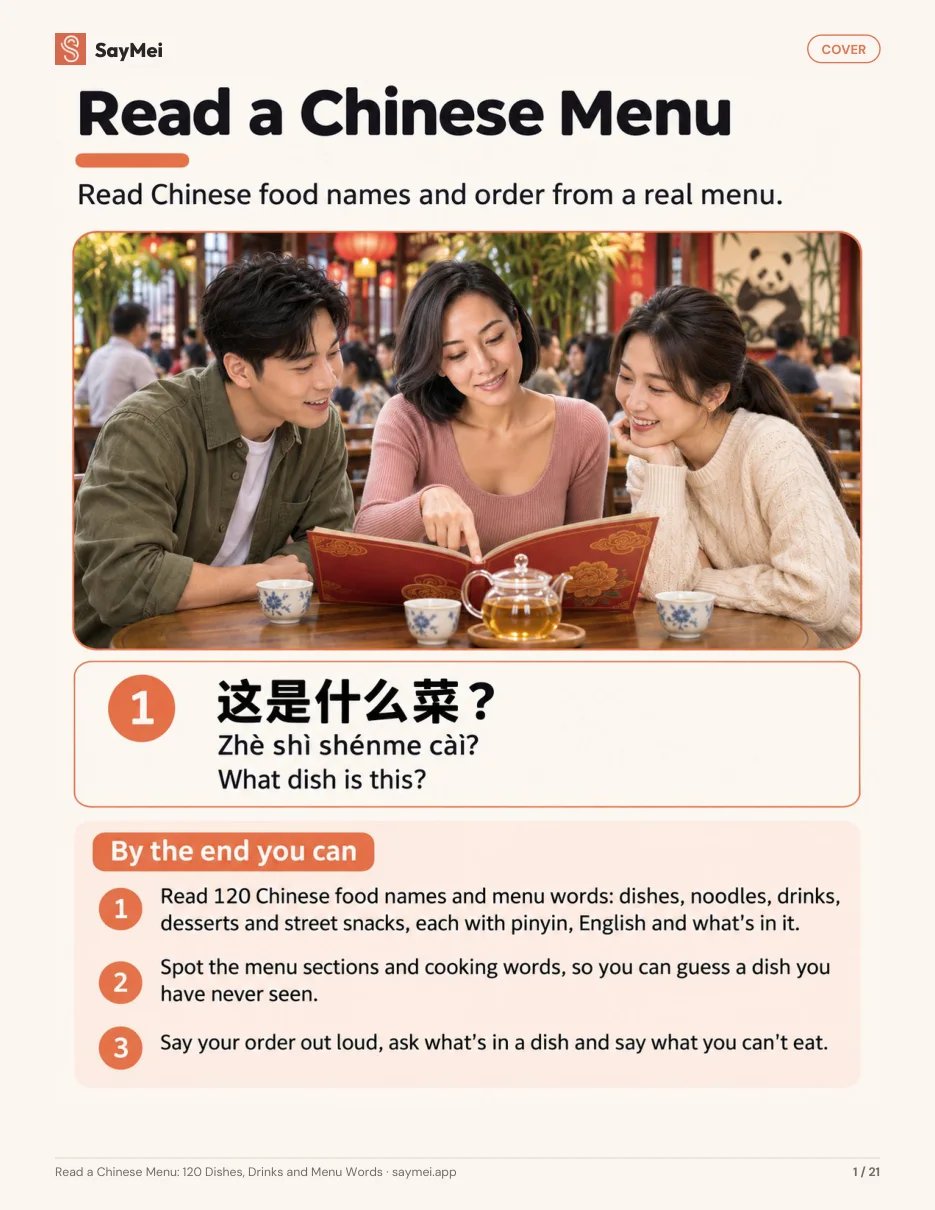
You spot 凉菜 and 主食 on a menu, read 红烧 or 麻辣 at the start of a dish name and check a tofu dish for minced pork. For learners starting from zero, with free audio for every dish.
- Level:
- Beginner · HSK 1
- Format:
- Workbook · PDF · 21 pages · US Letter (prints on A4)
- Price:
- Free · free with a saymei account · updated Nov 4, 2026
Listening audio: play every track free, no account needed.
Download the free PDF: create a free SayMei account on this page, and we'll email you a copy too.
这是什么菜? · Zhè shì shénme cài? · What dish is this?
By the end you can
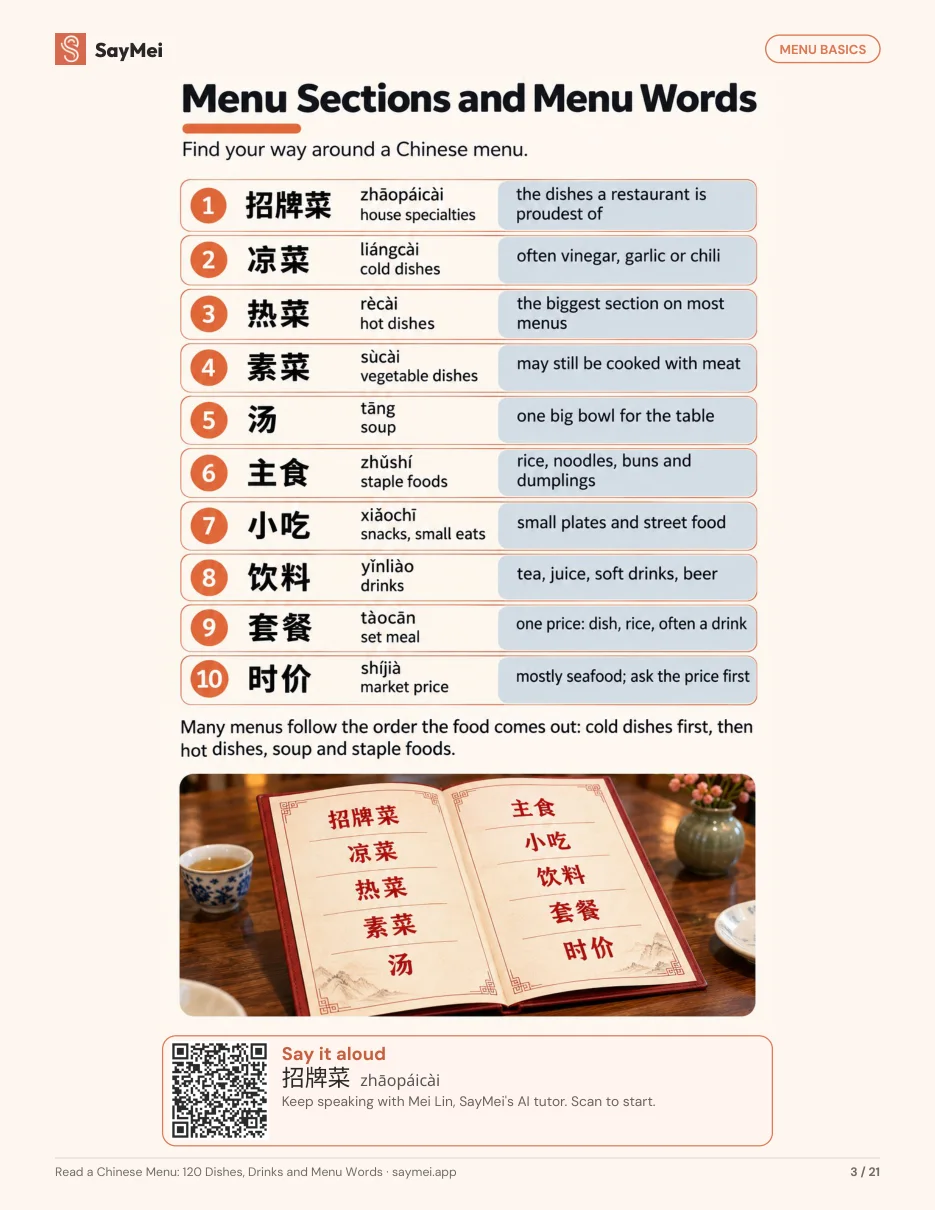
- Find your way around a Chinese menu. Spot the sections most menus use, from 凉菜 cold dishes and 热菜 hot dishes to 主食 staple foods, and know to ask the price when you see 时价.
招牌菜 · zhāopáicài · house specialties - Read how a dish is cooked from its name. Ten cooking words like 炒, 蒸, 红烧, 麻辣 and 糖醋 start many dish names, so 红烧 + 肉 gives you red-braised pork before it reaches the table.
红烧肉 · hóngshāoròu · red-braised pork belly - Read 60 meat, fish, tofu and regional dishes. Pork and beef, chicken and duck, fish and seafood, tofu and vegetables, famous regional dishes, soups and cold dishes, each with a note on what's in it and whether it's spicy.
鱼香肉丝 · yúxiāng ròusī · "fish-fragrant" shredded pork (it has no fish) - Choose noodles, dumplings, rice and breakfast. Tell 牛肉面 from 担担面 and 饺子 from 锅贴, order rice by the bowl, and read a breakfast stall's 包子, 粥 and 油条.
小笼包 · xiǎolóngbāo · soup dumplings - Order drinks, desserts and street snacks. Read a tea shop board and choose 全糖, 半糖 or 无糖, then pick a night-market snack like 羊肉串 or 糖葫芦 from its sign.
珍珠奶茶 · zhēnzhū nǎichá · bubble tea - Ask about a dish and order for the table. Ask for the house specialty and how many people a dish feeds, read the cut from the last character (丁 diced, 丝 shredded, 片 sliced), then point and say 我要这个.
这个菜够几个人吃? · Zhège cài gòu jǐ ge rén chī? · How many people does this dish feed? - Say what you can't eat. Ask if a dish is spicy or has meat, choose 微辣 for mild, and say you're vegetarian or allergic. Many tofu dishes, like 麻婆豆腐, have minced pork in them.
我对花生过敏。 · Wǒ duì huāshēng guòmǐn. · I'm allergic to peanuts.
What’s inside
- Menu Basics: The ten section names on a menu, from 招牌菜 to 时价, and ten cooking words that start many dish names. Menu Sections and Menu Words · Cooking Words and Flavors
- Dishes: 60 dishes on six pages: pork and beef, chicken and duck, fish and seafood, tofu and vegetables, famous regional dishes, soups and cold dishes. Dishes 1-10: Pork and Beef · Dishes 11-20: Chicken and Duck · Dishes 21-30: Fish and Seafood · Dishes 31-40: Tofu and Vegetables · Dishes 41-50: Famous by Region · Dishes 51-60: Soups, Cold Dishes
- Noodles and Rice: Noodles and dumplings, then rice dishes, buns and breakfast foods, from 牛肉面 to 油条. Noodles and Dumplings · Rice, Buns and Breakfast
- Drinks: Tea, coffee and bubble tea with sugar levels, then desserts, fruit and night-market snacks. Tea, Coffee and Bubble Tea · Desserts, Fruit and Street Snacks
- Ordering: Ask for the house specialty and what's in a dish, then read a short menu and order for two. Order from the Menu · Read the Menu and Order
- Your Needs: Ask if a dish is spicy or has meat, say you're vegetarian or allergic, and choose dishes for each person. Say What You Can't Eat · Order for Your Needs
- Review: A whole dinner for four as one dialogue: the house specialty, a dish without peanuts, and the bill. Dinner for Four
How to use this book
Pages 3 to 14 are a menu reader to dip into; pages 15 to 19 put it to work. Play the free audio and say each name in the pause. Learn 鸡, 牛, 鱼 and 辣 first: you'll see them all over a menu. At a page or two a day, that's about a week.
- Day 1: Menu sections and cooking words. Pages 3 and 4. Learn the ten section names, then read the cooking word at the start of a dish: 红烧 + 肉 = 红烧肉.
- Days 2–4: Two dish pages a day. Pages 5 to 10. Say each dish with the audio and mark the spicy ones. Watch for 鱼香: it has no fish.
- Day 5: Noodles, rice and drinks. Pages 11 to 14. Choose what you'd order at a noodle shop, at a breakfast stall and at a bubble tea shop, with 半糖 or 无糖.
- Day 6: Ask and order. Pages 15 and 16. Ask for the house specialty and what's in a dish, then order for two from the menu on page 16, out loud.
- Day 7: Your needs and dinner for four. Pages 17 to 19. Practise the line for what you can't eat, act out the dinner on page 19, and check your answers at the back.
Who it’s for
Adult beginners who want to read a Chinese menu: travellers in China, anyone eating at a Chinese restaurant at home, and people who are tired of pointing at a picture and hoping. Each dish has a note on what's in it and whether it's spicy.
Before you start: Nothing. Every dish and line has characters, pinyin and English, and the free audio reads each one with a pause to say it back. The answers and the audio script are at the back.
Frequently asked questions
What's in the book?
Pages 3 to 14 are a menu reader of 120 food names and menu words, ten a page: menu sections, cooking words, 60 dishes from pork and beef to regional and cold dishes, noodles and dumplings, breakfast, tea and bubble tea, desserts and street snacks. Pages 15 to 19 put it to work: order, ask what's in a dish, say what you can't eat and share a dinner for four.
Will this help me avoid spicy food?
Yes. Every dish has a note saying whether it's spicy, and page 9 explains that Sichuan, Chongqing and Hunan dishes are often spicy while Cantonese and Jiangnan dishes are usually mild. Page 17 gives 这个辣不辣? and the spice levels 微辣, 中辣 and 特辣, with a warning that 微辣 in a Sichuan or Hunan restaurant can still be quite hot.
Is it useful for vegetarians or people with allergies?
Yes. Page 17 teaches 我吃素 and 我对花生过敏, and warns that 麻婆豆腐, 家常豆腐 and 干煸四季豆 often have minced pork in them, so ask 这个菜里有肉吗? before you order. The dish notes also flag things like the peanuts in 宫保鸡丁 and the oyster sauce in 蚝油牛肉.
Is there audio?
Yes, free on the book's page on saymei.app. All 120 dish, drink and menu words are read once with a pause to say them back, along with the ordering lines, the waiter's lines for the listening questions on pages 16 and 18, and the dinner dialogue on page 19.
How long does it take?
At a page or two a day, about a week. The book suggests learning 鸡, 牛, 鱼 and 辣 first, since you'll see them all over a menu.
What should I use for ordering basics?
The book points to Order Food and Drinks in Mandarin for the basics: ordering a drink or a dish, the right measure word, one change like not spicy, and paying.
Do I need a SayMei account?
Yes, to download the PDF, and the account is free: sign up with Google, Apple or your email address. With it we email you a copy of the workbook, keep every workbook you download on your account on all your devices, save your place in the free online practice, and you can practise speaking with Mei Lin, SayMei's AI tutor.
How do I print it?
The PDF is US Letter size. On A4 paper, choose "Fit to page" (or "Scale to fit") in the print dialog so nothing is cut off. Print the whole workbook or only the pages you need; colour looks best, and black and white works too.
Keep going
Directions in Chinese: Left, Right, Taxis and the Subway · China Trip Survival Mandarin: Pay, Ride, Eat and Check In · Taiwan Mandarin Phrasebook: Traditional Characters, Zhuyin and Pinyin · Mandarin for Travel: A 14-Day Speaking Plan Before Your Trip to China · Browse all 294 workbooks
Version 2026-11 · Updated Nov 4, 2026 · Report a correction