Exams · Higher (about HSK 3-4)
Higher Mandarin Practice: Talking, Reading, Listening and Directed Writing (Scotland)
Discussion questions with model answers in all four contexts, reading, listening and directed writing practice for Higher Mandarin, with audio
- Level:
- Higher (about HSK 3-4)
- Format:
- Workbook · PDF · 16 pages · US Letter (prints on A4)
- Price:
- Free · free with a saymei account · updated Nov 4, 2026
Listening audio: play every track free, no account needed.
Download the free PDF: create a free SayMei account on this page, and we'll email you a copy too.
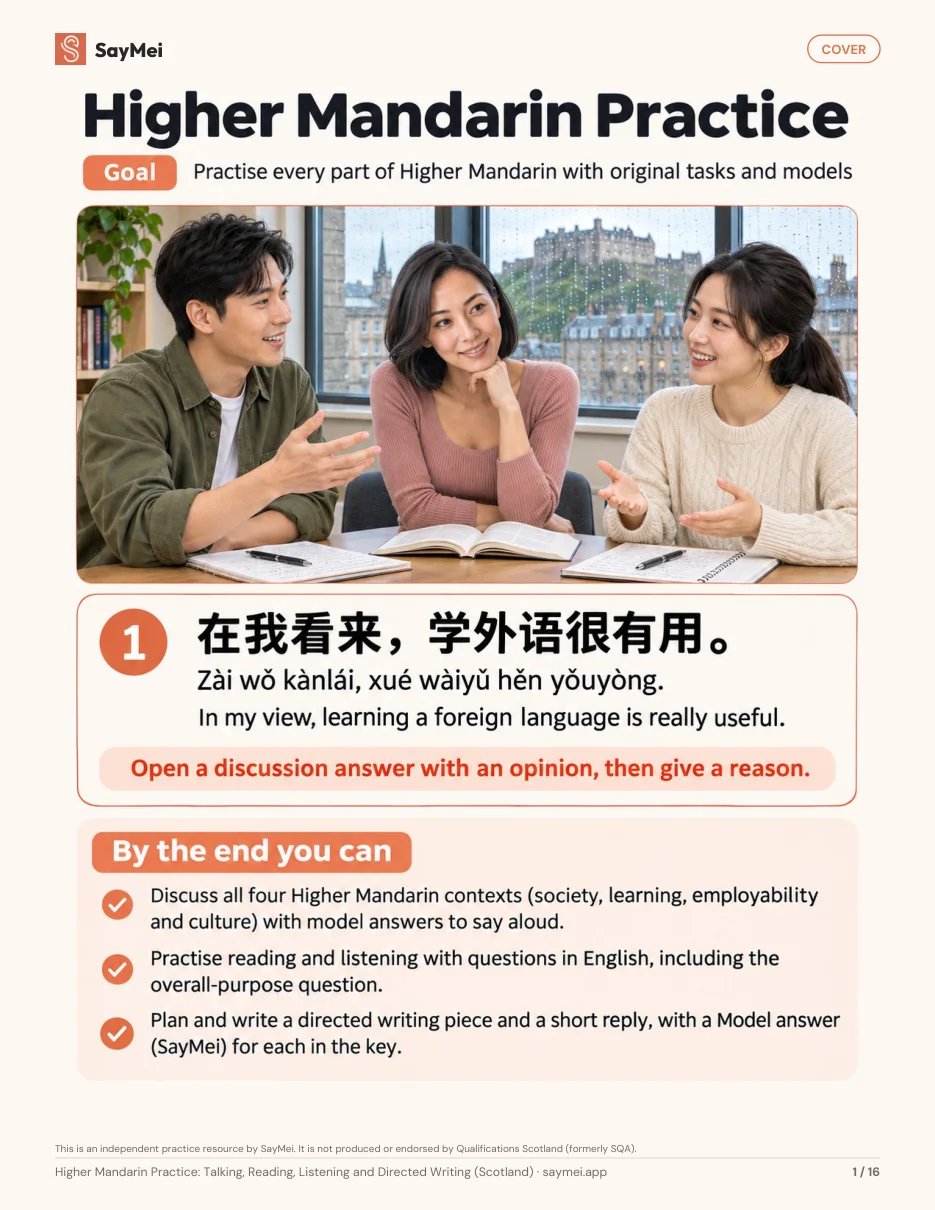
在我看来,学外语很有用。 · Zài wǒ kànlái, xué wàiyǔ hěn yǒuyòng. · In my view, learning a foreign language is really useful.
By the end you can
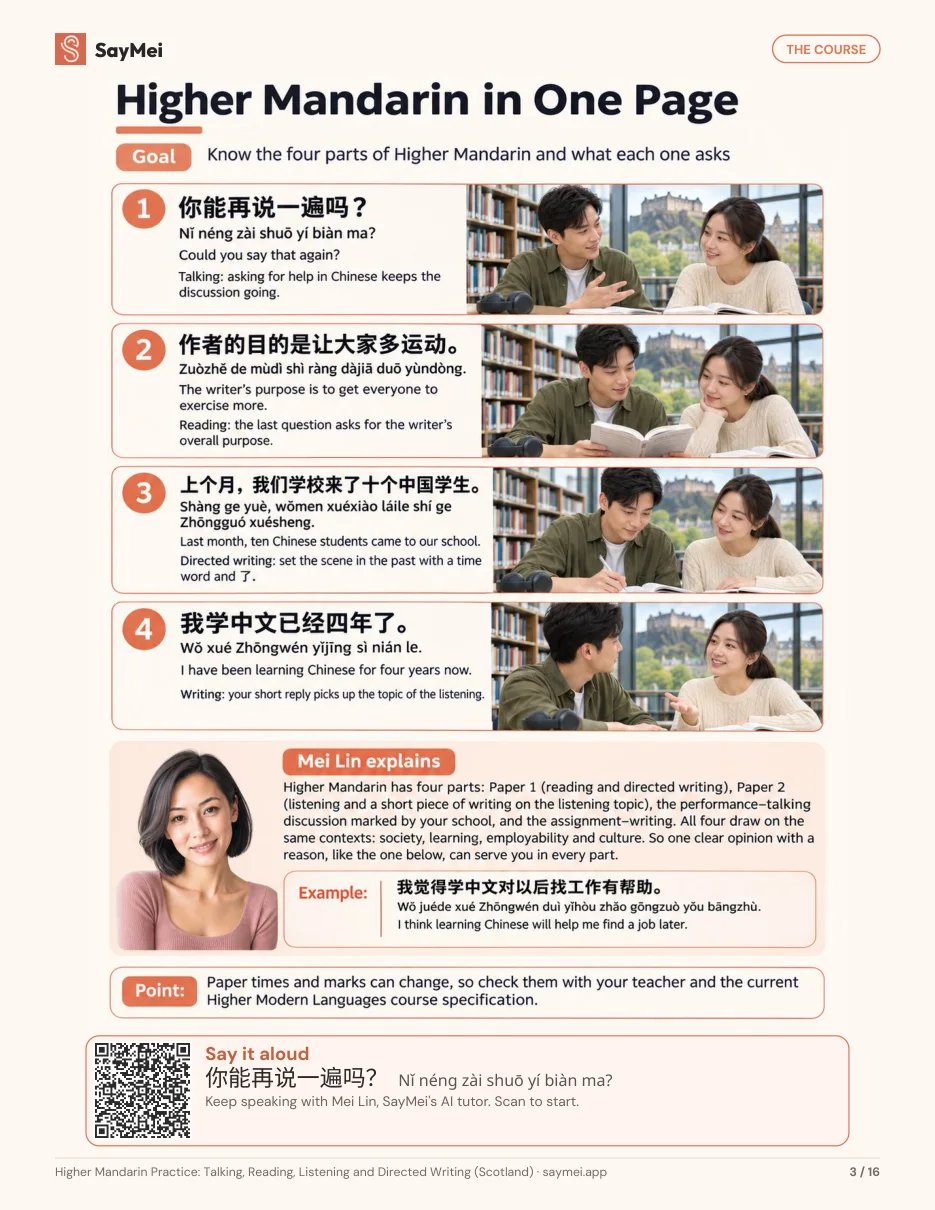
- Know the four parts of Higher Mandarin and what each one asks. Paper 1 is reading and directed writing, Paper 2 is listening and a short reply, plus the talking discussion and the assignment–writing. All four draw on society, learning, employability and culture.
你能再说一遍吗? · Nǐ néng zài shuō yí biàn ma? · Could you say that again? - Discuss phones and family life with both sides of the argument (society). Weigh the good and the bad with 一方面…另一方面, and choose the right pair of connectives: 虽然…但是, 如果…就 or 不但…而且.
我觉得有好处,也有坏处。 · Wǒ juéde yǒu hǎochu, yě yǒu huàichu. · I think there are good points and bad points. - Talk about school, part-time work and your plans (learning and employability). Say what you find hardest about Chinese and what you do about it, move between past, present and future, and use 挣钱, 经验, 实习 and 交流 to talk about work.
我想当工程师。 · Wǒ xiǎng dāng gōngchéngshī. · I want to be an engineer. - Compare a festival or a food in China and Scotland (culture). Describe a Spring Festival you went to with 了, then compare it with New Year in Scotland using 跟…不一样, 比 and 都.
我觉得中国菜跟苏格兰菜很不一样。 · Wǒ juéde Zhōngguó cài gēn Sūgélán cài hěn bù yíyàng. · I think Chinese food is very different from Scottish food. - Read a longer text and find the writer's overall purpose. Answer questions in English with the marks in brackets, find Chinese phrases in the text, and back up the overall-purpose answer with details from the last lines.
作者想让年轻人多陪老人。 · Zuòzhě xiǎng ràng niánqīngrén duō péi lǎorén. · The writer wants young people to spend more time with older people. - Plan and write a directed writing report that covers every bullet point. Write about a Chengdu exchange week in about 200 characters: one sentence per bullet point, time words, 了 in the right place for past events, and a model in the key.
我带他参观了我们学校。 · Wǒ dài tā cānguānle wǒmen xuéxiào. · I showed him around our school. - Answer a listening paper in English, then write a reply on the same topic. Hear a talk and a conversation about studying abroad twice, answer in English, then write a reply of about 100 to 120 characters that answers every question.
我学中文已经四年了。 · Wǒ xué Zhōngwén yǐjīng sì nián le. · I have been learning Chinese for four years now.
What’s inside
- The course: Higher Mandarin in One Page
- Talking 1: Society: Phones and Family Life
- Talking 2: Learning: School and Next Steps
- Talking 3: Employability: Jobs and Work
- Talking 4: Culture: Festivals, Food and Film
- Reading: Reading: Helping Older Neighbours
- Directed writing: Directed Writing: Exchange Week
- Listening: Listening: Studying Abroad
- Writing: Writing: Studying Abroad and You
- Plan: Your Six-Week Plan
How to use this book
Work in order: pages 4 to 7 build your discussion, pages 8 to 11 practise the two papers, and page 12 is a six-week plan. On the free audio, say each Chinese line back in the pause before you look at the pinyin.
- Week 1: Society and learning. Learn the models on pages 4 and 5, then answer the same questions about yourself with a phone timer, for about a minute each.
- Week 2: Employability and culture. Do pages 6 and 7, record yourself once, and add a 虽然…但是 sentence to every answer.
- Week 3: Reading. Redo page 8, then try a new text from class. Answer in full English and always attempt the overall-purpose question.
- Week 4: Directed writing. Write the report on page 9, check it against the model in the key, then write a second piece with a different scenario and tick off every bullet point.
- Week 5: Listening and writing. Listen to Chinese for ten minutes a day. Do page 10 twice before you read the script in the key, then write your reply on page 11.
- Week 6: Mixed practice. Do one timed practice for each paper. Read your page of best sentences for each context aloud the night before the talking and before each paper.
Who it’s for
Students in Scotland taking Higher Mandarin, getting ready for the talking discussion and both papers, and teachers who want practice tasks with audio across all four contexts.
Before you start: The Mandarin from National 5 and your Higher course so far, at about HSK 3 to 4. The talking models and the lines to say have pinyin and English, and the answers, model answers and listening script are in the key.
Frequently asked questions
Which parts of Higher Mandarin does it cover?
The talking discussion, with a model and a task in each of the four contexts, the reading and directed writing of Paper 1, and the listening and short reply of Paper 2. There is no assignment–writing practice. SayMei wrote every text and question, and paper times and marks are best checked with your teacher.
How long should my directed writing be?
The book's practice task asks for about 200 characters covering six bullet points, and the Paper 2 reply asks for about 100 to 120 characters. Both have a model answer in the key. Check the current lengths with your teacher.
Should I learn my discussion answers by heart?
The book suggests speaking from short notes, never from a script. Use a phone timer: think for a few seconds, then answer each question for about a minute, with an opinion, a reason and an example from your own life.
Is this workbook free?
Yes. The whole 16-page PDF is free, and you can look through its pages here before you download. There's no card and nothing to pay.
Do I need a SayMei account?
Yes, to download the PDF, and the account is free: sign up with Google, Apple or your email address. With it we email you a copy of the workbook, keep every workbook you download on your account on all your devices, save your place in the free online practice, and you can practise speaking with Mei Lin, SayMei's AI tutor.
How do I print it?
The PDF is US Letter size. On A4 paper, choose "Fit to page" (or "Scale to fit") in the print dialog so nothing is cut off. Print the whole workbook or only the pages you need; colour looks best, and black and white works too.
Can I print copies for my class?
Yes. Print as many copies as you like for your own class or family. To share it, send this page: everyone can download their own copy.
Keep going
AP® Chinese Speaking Practice: Project Presentation and Q&A (2027 Format) · AP® Chinese Story Narration and Email Response Practice: 10 Prompts with Model Answers · GCSE Chinese Speaking Practice: Role Plays, Picture Tasks and Conversation Questions · O Level Chinese Oral Practice: Reading Aloud and Video Conversation with Model Answers · More exam practice · Browse all 294 workbooks
This is an independent practice resource by SayMei. It is not produced or endorsed by Qualifications Scotland (formerly SQA).
Version 2026-11 · Updated Nov 4, 2026 · Report a correction