Exams · VCE Year 12 (about HSK 3-4)
VCE Chinese Second Language Practice: Oral Exam and Written Exam
Conversation questions, a Detailed Study discussion and written-exam practice for VCE Chinese Second Language, with model answers and audio
- Level:
- VCE Year 12 (about HSK 3-4)
- Format:
- Workbook · PDF · 19 pages · US Letter (prints on A4)
- Price:
- Free · free with a saymei account · updated Nov 4, 2026
Listening audio: play every track free, no account needed.
Download the free PDF: create a free SayMei account on this page, and we'll email you a copy too.
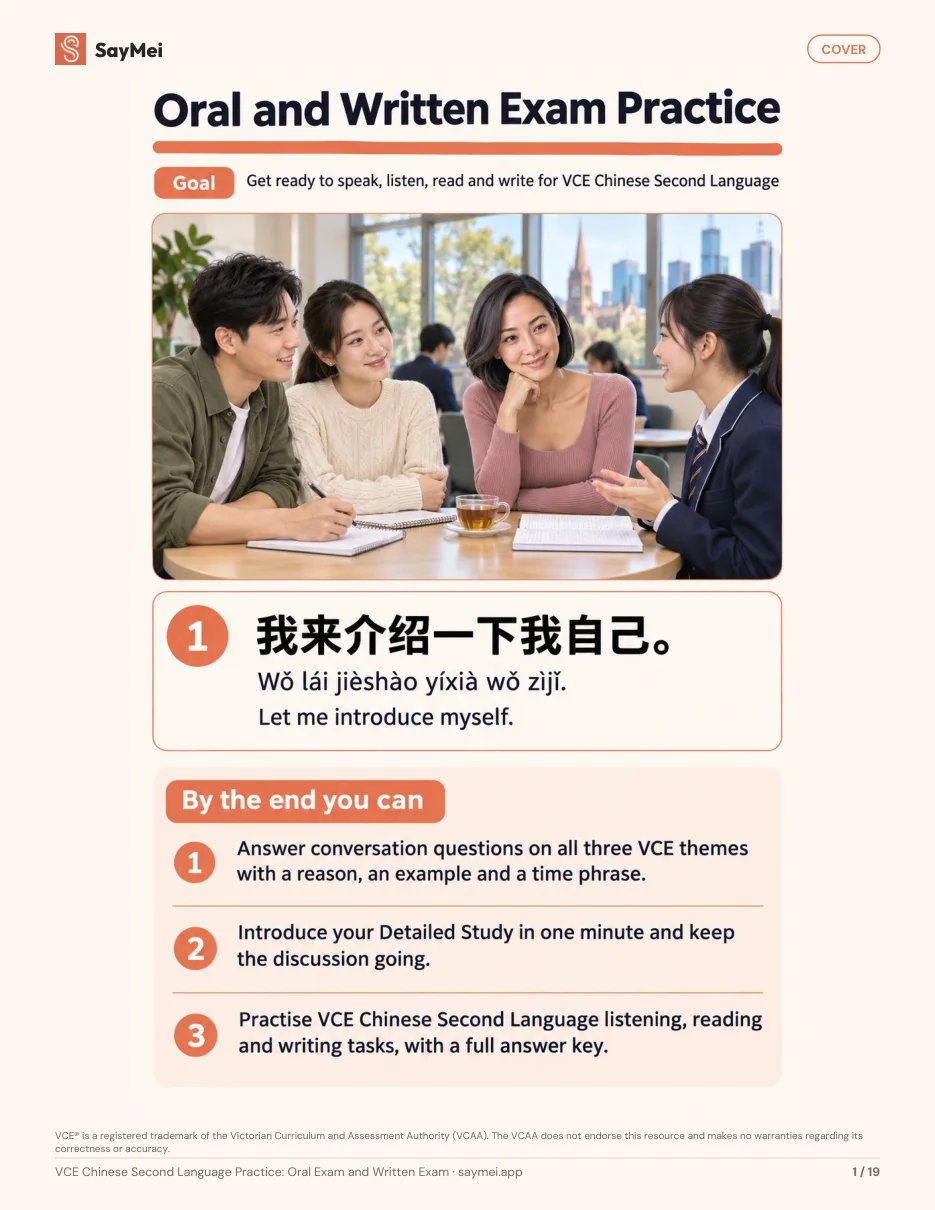
我来介绍一下我自己。 · Wǒ lái jièshào yíxià wǒ zìjǐ. · Let me introduce myself.
By the end you can
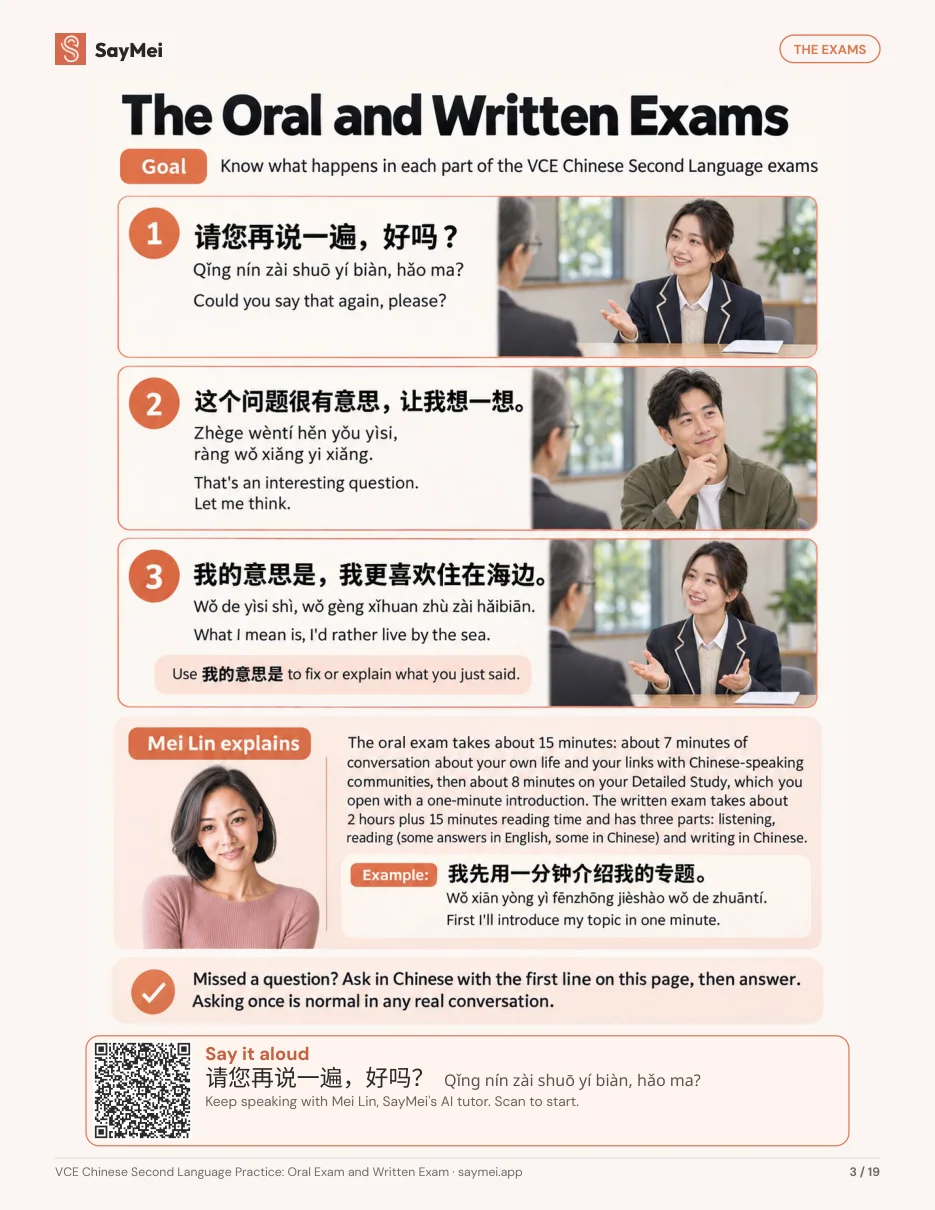
- Know how each part of the oral and written exams runs. One page sets out the conversation, the Detailed Study discussion and the three parts of the written exam, with polite lines for when you miss a question.
请您再说一遍,好吗? · Qǐng nín zài shuō yí biàn, hǎo ma? · Could you say that again, please? - Talk about yourself, your family, school and plans. Five questions on the Individual with model answers, then practice with 如果, 因为, 除了 and 虽然, past events with 了, and answers that give a reason.
我在墨尔本出生长大。 · Wǒ zài Mò'ěrběn chūshēng zhǎngdà. · I was born and grew up in Melbourne. - Talk about Chinese-speaking communities and compare them with Australia. Festivals, food, travel and Chinese communities in Australia, with comparisons using 比 and experiences with 过 and 没……过.
我对中国文化很感兴趣。 · Wǒ duì Zhōngguó wénhuà hěn gǎn xìngqù. · I'm very interested in Chinese culture. - Give opinions on phones, the environment, volunteering and work. Show both sides with 一方面……另一方面……, weigh 好处 and 坏处, and make suggestions with 应该 and a reason.
我觉得保护环境很重要。 · Wǒ juéde bǎohù huánjìng hěn zhòngyào. · I think protecting the environment is very important. - Get ready for the Detailed Study discussion. The assessors open with questions, so have four answers ready: your subtopic, the texts, your main finding and why it matters to you. The sample subtopic, Chinese tea culture, is the book's own: swap in yours.
我主要看了三个材料。 · Wǒ zhǔyào kànle sān ge cáiliào. · I mainly studied three texts. - Keep the Detailed Study discussion going. A model discussion on tea and bubble tea shows how to explain, compare and give your view, with openings such as 说实话, 对我来说 and 跟以前比起来.
我同意一部分,但是不完全同意。 · Wǒ tóngyì yí bùfen, dànshì bù wánquán tóngyì. · I partly agree, but not completely. - Practise listening and reading with answers in English and in Chinese. A phone message and a school radio notice on the audio, then a job notice and an exchange student's blog post, each with questions and a full answer key.
- Plan and write a personal email and a persuasive article. About 150 characters each: an email to a host family in Chengdu and a newsletter piece on phones at lunchtime, then fix common slips with 了, 比 and word order.
What’s inside
- The exams: What happens in the oral and the written exam, and lines for asking the examiner to repeat or for buying time to think. The Oral and Written Exams
- Conversation 1: The Individual: family, study and rest, friends, why you chose Chinese and your plans after school. The Individual: Model Answers · The Individual: Your Answers
- Conversation 2: Chinese-speaking communities: festivals, Chinese food, a school trip to Shanghai and Chinese communities in Australia. Chinese-Speaking Communities · Communities: Your Answers
- Conversation 3: The world around us: phones, the environment, volunteering, part-time work and social media. The World Around Us: Models · The World Around Us: Your Turn
- Detailed Study: Four answers to have ready and a model discussion on a sample subtopic, Chinese tea culture. Your Detailed Study Discussion · A Model Detailed Study Discussion
- Written exam: Two listening texts, two reading texts and two writing tasks of about 150 characters, with models. Listening and Responding · Reading and Responding · Writing in Chinese
- Plan: Six weeks of speaking, listening, reading and writing, ending with two full run-throughs of the oral. Your Six-Week VCE Plan
How to use this book
Six weeks, following the planner on page 15. Say each model with the free audio, then cover it and answer about your own life. Speak from notes, never from a script.
- Week 1: The Individual. Say the models on page 4 with the audio, do the practice on page 5, then record your own five answers.
- Week 2: Chinese-speaking communities. Pages 6 and 7. Add one comparison with Australia to each answer.
- Week 3: The world around us. Pages 8 and 9. Give both sides with 一方面……另一方面…… in every opinion answer.
- Week 4: Your Detailed Study. Say your four Detailed Study answers aloud without notes, three times a day. List ten questions an examiner could ask and answer each in about 40 seconds.
- Week 5: Listening, reading and writing. Do one listening and one reading task a day and mark them with the key. Write two 150-character tasks and check measure words, 了 and word order.
- Week 6: Run the whole oral. Twice, with a friend or teacher as the examiner: about 7 minutes of conversation, then about 8 minutes of Detailed Study.
Who it’s for
Victorian Year 12 students of VCE Chinese Second Language preparing for the oral and written exams, and teachers who want practice in the VCE Chinese Second Language format, with audio, for a class.
Before you start: The book is at about HSK 3-4 and uses simplified characters. The models come with pinyin and English, and the answer key is at the back.
Frequently asked questions
Who wrote the questions and model answers?
SayMei wrote every question, text and model answer, as practice in the VCE Chinese Second Language format: the oral examination (conversation and Detailed Study discussion) and the written examination (listening, reading and writing).
What Detailed Study subtopic does the book use?
A sample subtopic of its own, Chinese tea culture, from morning tea in Guangzhou to bubble tea in Australia. Use it to learn the four answers to have ready and the kinds of follow-up questions, then build the same notes for your own subtopic.
Where is the audio?
Free on this book's page on saymei.app. Every Chinese line is read with a pause for you to say it back, and the two listening texts for page 12 are on the same track.
Is this workbook free?
Yes. The whole 19-page PDF is free, and you can look through its pages here before you download. There's no card and nothing to pay.
Do I need a SayMei account?
Yes, to download the PDF, and the account is free: sign up with Google, Apple or your email address. With it we email you a copy of the workbook, keep every workbook you download on your account on all your devices, save your place in the free online practice, and you can practise speaking with Mei Lin, SayMei's AI tutor.
How do I print it?
The PDF is US Letter size. On A4 paper, choose "Fit to page" (or "Scale to fit") in the print dialog so nothing is cut off. Print the whole workbook or only the pages you need; colour looks best, and black and white works too.
Can I print copies for my class?
Yes. Print as many copies as you like for your own class or family. To share it, send this page: everyone can download their own copy.
Keep going
AP® Chinese Speaking Practice: Project Presentation and Q&A (2027 Format) · AP® Chinese Story Narration and Email Response Practice: 10 Prompts with Model Answers · GCSE Chinese Speaking Practice: Role Plays, Picture Tasks and Conversation Questions · O Level Chinese Oral Practice: Reading Aloud and Video Conversation with Model Answers · More exam practice · Browse all 294 workbooks
VCE® is a registered trademark of the Victorian Curriculum and Assessment Authority (VCAA). The VCAA does not endorse this resource and makes no warranties regarding its correctness or accuracy.
Version 2026-11 · Updated Nov 4, 2026 · Report a correction