Traditional Chinese legend, retold in simple Mandarin
Journey to the West: Journey's End
西游记:取经归来
Journey to the West: Journey's End (西游记:取经归来, Xīyóujì: qǔjīng guīlái) is a story from Journey to the West, the Chinese classic by Wu Cheng'en, retold in simple Mandarin as a 6-chapter story with audio for learners at about HSK 3 (Intermediate).
Retold from Wu Cheng'en's classic novel: the pilgrims cross the bottomless boat, get blank scrolls for no gift, and face one last trial on the road home.
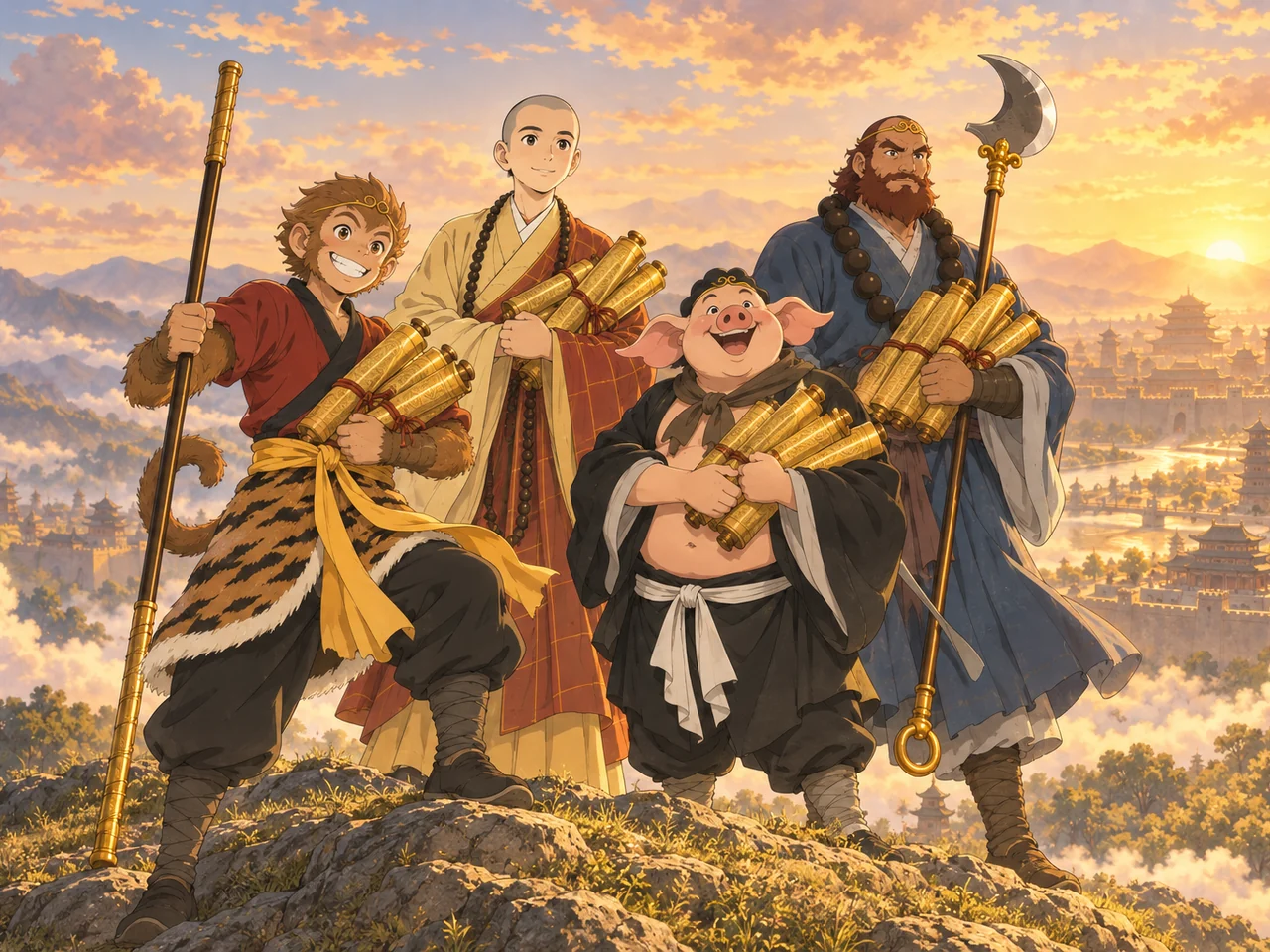
Meet the voices
- Narrator · 旁白 — An old storyteller who follows the pilgrims all the way to the end of their road.
- Sun Wukong · 孙悟空 — The Monkey King, who has learned to be a loyal disciple and now discovers he no longer wears his golden band.
- Tang Seng · 唐僧 — The gentle monk who has walked fourteen years for the scriptures and forgets one small promise on the way home.
- Zhu Bajie · 猪八戒 — The pig-faced second disciple, who is afraid of water, always hungry, and finally gets the job of his dreams.
- Sha Wujing · 沙悟净 — The quiet third disciple, who carries the load and notices what others miss.
- Guanyin · 观音菩萨 — The gentle Bodhisattva who counts the pilgrims' trials and finds one missing.
- The Buddha · 佛祖 — The Buddha of Vulture Peak, who laughs at Wukong's anger and then makes things right.
- Ananda · 阿难 — A young, sweet-talking monk of Vulture Peak who hints for a gift.
- Kashyapa · 迦叶 — An older, sly monk who agrees with his friend's sneaky plan.
- The Old Turtle · 老乌龟 — An ancient river turtle who waited fourteen years for one small answer.
- The Emperor · 皇帝 — The Emperor of Tang, who waits at Chang'an's gate to welcome his old friend home.
- The Boatman · 船夫 — The calm old ferryman of the bottomless boat.
- The Guardian · 守护神 — One of eight heavenly guardians who carry the pilgrims home.
6 chapters, one journey
Chapter 1: The Bottomless Boat
无底船
The pilgrims reach the river below Vulture Peak and must cross in a boat with no bottom. Then two smiling monks meet them on the far shore.
Free to read
Chapter 2: The Blank Scrolls
白纸经书
The pilgrims wait years for scriptures, and leave with a horse-load of empty paper. Wukong storms off to find the Buddha.
SayMei Stories
Chapter 3: The Golden Bowl
金钵
The Buddha laughs at Wukong's anger, then makes it right. Tang Seng pays with the golden bowl, and Guanyin counts something that does not add up.
SayMei Stories
Chapter 4: The Eighty-First Trial
最后一次苦难
Flying home on a cloud, the pilgrims stop at a river where an old friend has waited fourteen years for a promise to be kept.
SayMei Stories
Chapter 5: The Scrolls Dry
晒经书
Soaked and stranded, the four spread the scriptures on a rock to dry, argue, joke, and one page is torn. Then a bell rings far away.
SayMei Stories
Chapter 6: Home to Chang'an
回到长安
The emperor welcomes his old friend home. At Vulture Peak the Buddha names each pilgrim, and Wukong feels something missing from his head.
SayMei Stories
Key words in Journey to the West: Journey's End
Behind the story
The end of the pilgrimage comes from 西游记 (Journey to the West), the sixteenth-century novel by Wu Cheng'en, one of China's four great classical novels. Its last chapters take Tang Seng and his disciples to Vulture Peak, back to Chang'an and up to the Buddha's hall.
The novel was inspired by the real monk Xuanzang, who walked to India in the seventh century and brought Buddhist scriptures back to Chang'an. In the story he becomes a gentle hero, and the trip is filled with magic, jokes and eighty-one trials.
Did you know?
- In the novel the number eighty-one is a lucky, complete number: nine times nine. That is why the pilgrims need exactly eighty-one trials.
- In the novel, Wukong's headband simply vanishes after the Buddha names him a Buddha, and Tang Seng no longer needs the spell.
- Zhu Bajie's final title, 净坛使者, means roughly "altar cleanser": the one who gets to eat the offerings left on the altar.