Traditional Chinese legend, retold in simple Mandarin
Journey to the West: The Flaming Mountains
西游记:火焰山
Journey to the West: The Flaming Mountains (西游记:火焰山, Xīyóujì: Huǒyàn Shān) is a story from Journey to the West, the Chinese classic by Wu Cheng'en, retold in simple Mandarin as a 6-chapter story with audio for learners at about HSK 2 (Elementary).
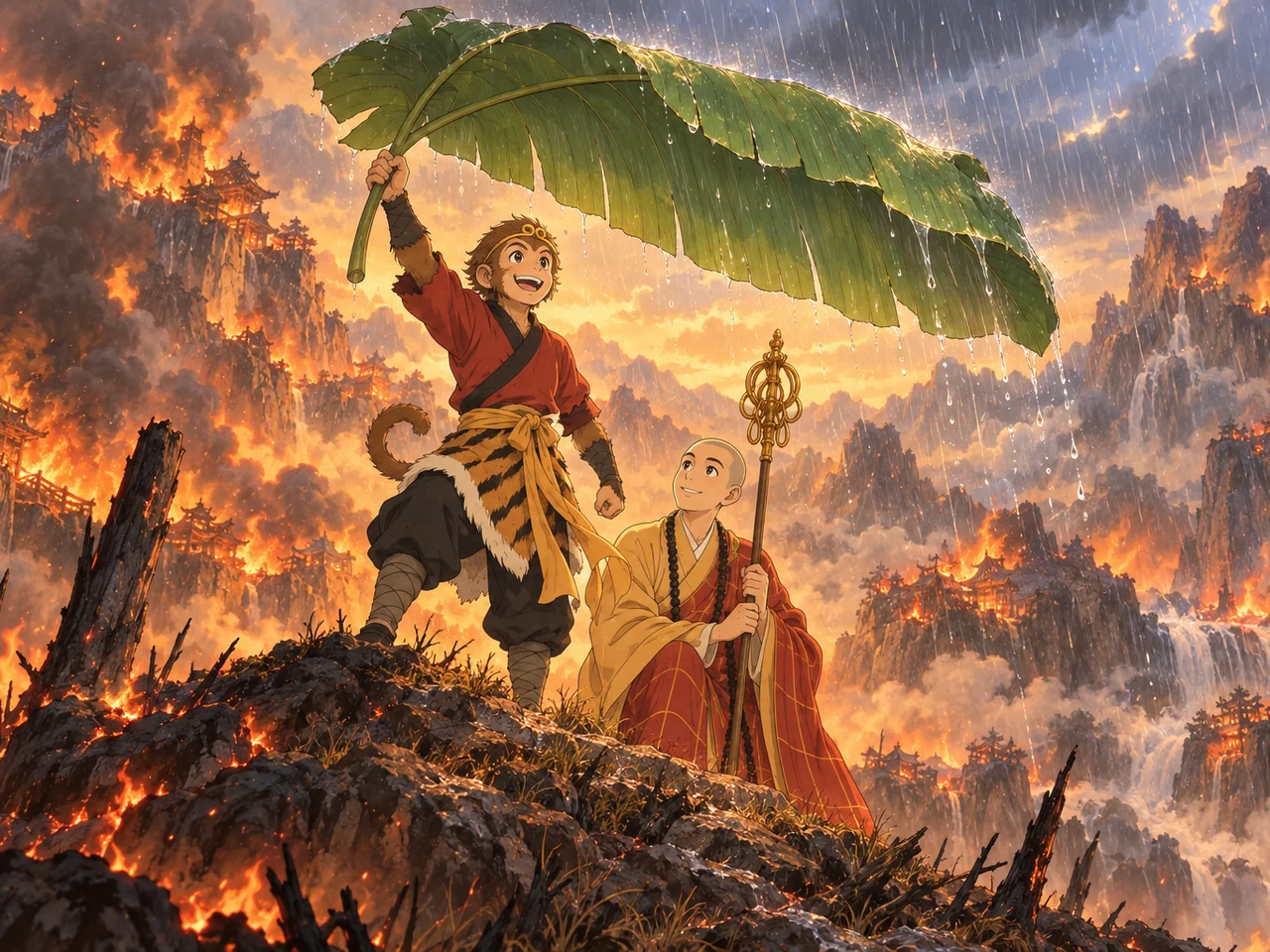
Retold from Wu Cheng'en's classic novel: a mountain of real flames blocks the road, and Wukong must borrow Princess Iron Fan's magic fan, by tea, by trickery and by a bull-shaped disguise.
Meet the voices
- Narrator · 旁白 — An old storyteller who tells how the Monkey King borrowed a fan to put out a mountain of fire.
- Sun Wukong · 孙悟空 — The Monkey King, Tang Seng's first disciple: his golden eyes see through any disguise, and he loves a clever trick.
- Tang Seng · 唐僧 — A gentle, soft-hearted monk on the long road west, who cannot bear to see anyone hurt.
- Zhu Bajie · 猪八戒 — The pig-faced second disciple: lazy, greedy, always hungry and always complaining.
- Sha Wujing · 沙悟净 — The quiet third disciple, steady and loyal, who says little and sees a lot.
- Old Cake Seller · 卖饼老人 — A friendly old man who bakes cakes on the hot rocks and secretly knows a great deal.
- Princess Iron Fan · 铁扇公主 — Red Boy's proud, sharp-tongued mother, who owns the magic banana-leaf fan and has never forgiven Wukong.
- The Maid · 丫头 — The princess's nervous young maid at Banana Cave.
- Lingji Bodhisattva · 灵吉菩萨 — A kind old monk who keeps a magic pill for Wukong and dryly doubts he will be careful.
- Bull Demon King · 牛魔王 — Red Boy's huge, proud father and Wukong's old sworn brother, who loves a fight and a drink.
- Wukong as the Bull Demon King · 假牛魔王 — Wukong in disguise, booming like a father but forgetting to hide his monkey tail.
- The Bull as Bajie · 假八戒 — The Bull Demon King disguised as Bajie, a sly copy with two tiny horn tips.
- Heavenly General · 天将 — A stern general from heaven who arrives when the Bull will not stop fighting.
6 chapters, one journey
Chapter 1: The Mountain of Fire
火焰山
Autumn should be cool, but the road ahead is on fire. A cake seller knows the only cure, and the person who owns it hates the Monkey King.
Free to read
Chapter 2: One Wave of the Fan
一扇五万里
Wukong knocks politely at Banana Cave, but the princess has not forgiven him. One wave of her fan sends him flying, and an old monk seems to be expecting him.
SayMei Stories
Chapter 3: The Monkey in the Teacup
茶杯里的猴子
With a magic pill, Wukong cannot be blown away. So he becomes a tiny bug, hops into the princess's tea, and kicks up a fuss inside her. But has he really won?
SayMei Stories
Chapter 4: The Fan That Fed the Fire
更大的火
Wukong waves the fan and the fire roars up bigger than ever. Then the cake seller shows who he really is, and Wukong goes looking for an old friend.
SayMei Stories
Chapter 5: Two Bull Kings
两个牛魔王
Wukong turns into the Bull Demon King and tricks the princess out of her real fan. But on the road home, someone else has a trick ready too.
SayMei Stories
Chapter 6: Forty-Nine Waves
扇四十九下
The Monkey King and his brothers fight the Bull Demon King in a storm of changing shapes, until heaven steps in. Then forty-nine waves of one great fan change the mountain.
SayMei Stories
Key words in Journey to the West: The Flaming Mountains
Behind the story
The Flaming Mountains episode comes from Wu Cheng'en's sixteenth-century novel 西游记 (Journey to the West), one of the Four Great Classical Novels of Chinese literature. Tang Seng and his three disciples must cross a range of burning mountains, and the only cure is a magic banana-leaf fan.
Chinese readers know this story as 三调芭蕉扇, "three times borrowing the banana-leaf fan", and it is a favorite in school books, opera and cartoons. The fire mountain is a real place too: the Flaming Mountains near Turpan in Xinjiang glow red in the summer heat, and travelers still link them to this tale.
Did you know?
- A li is an old Chinese measure of distance, about half a kilometer today, so fifty thousand li is a very long flight indeed.
- Wukong's trick of shrinking into a bug and going inside an enemy is one of his favorite moves in the novel.
- In Chinese, "老孙" (Old Sun) is how Wukong proudly refers to himself.