World classic, retold in simple Mandarin
The Ugly Duckling
丑小鸭
The Ugly Duckling (丑小鸭, Chǒu xiǎoyā) is a fairy tale by Hans Christian Andersen, retold in simple Mandarin as a 5-chapter story with audio for learners at about HSK 1 (Beginner).
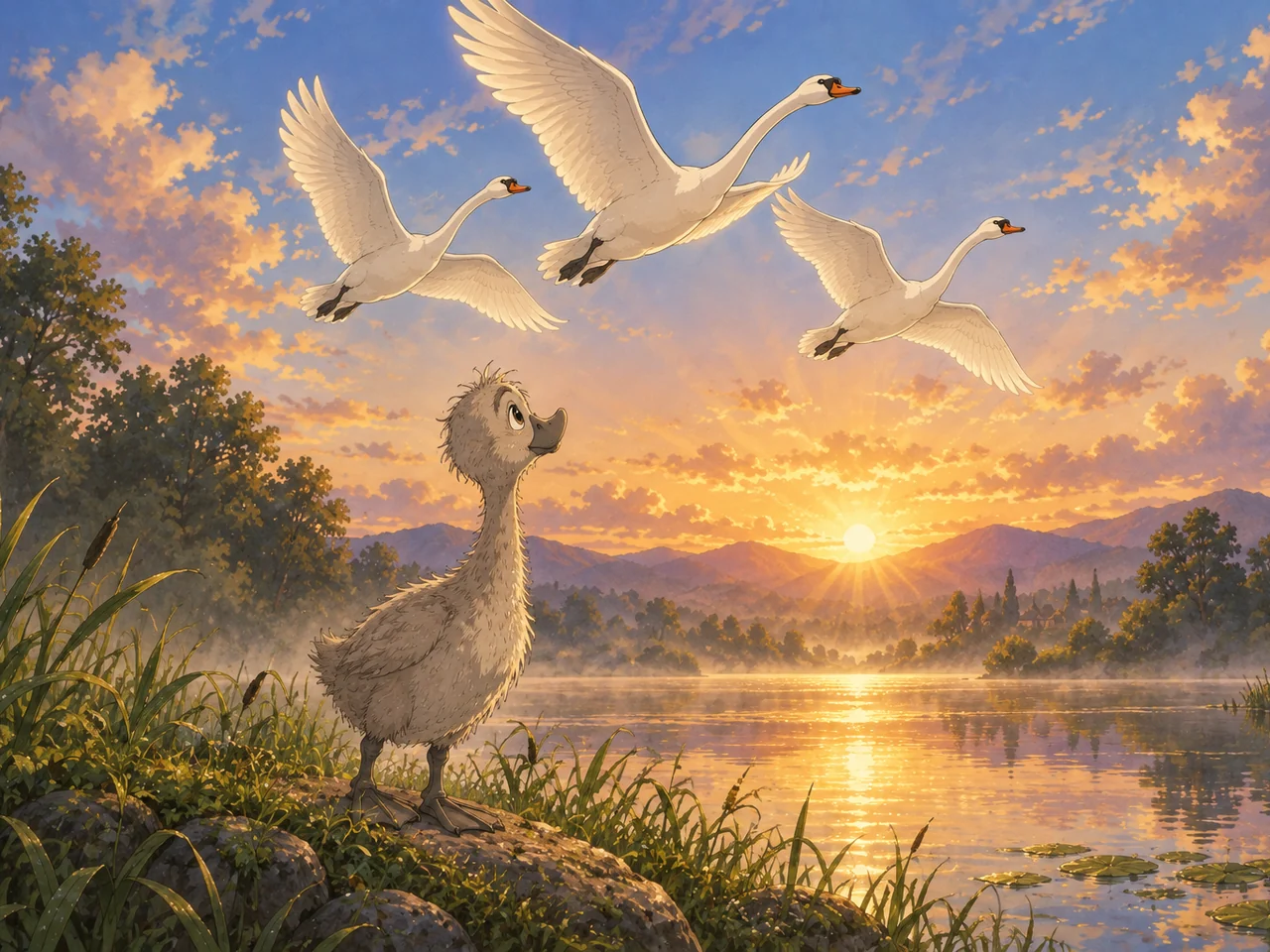
Retold from Hans Christian Andersen's fairy tale: a big gray duckling, laughed out of the farmyard, runs away into a long, lonely winter, and finds out who he really is when spring comes.
Meet the voices
- Narrator · 旁白 — An old storyteller who tells Andersen's tale gently, from the first summer to the last spring.
- The Ugly Duckling · 丑小鸭 — A big, clumsy gray chick from the biggest egg, who says sorry for everything and wants only to swim and to be loved.
- Mother Duck · 鸭妈妈 — A proud, fussy mother who counts her children wherever she goes and stands up for her odd son, until the farmyard wears her down.
- Granny Duck · 鸭奶奶 — The grandest duck in the farmyard, who wears a red cloth on her leg and is always sure she knows best.
- Big Sister · 鸭姐姐 — The first duckling to hatch, who never lets anyone forget it and is embarrassed by her strange little brother.
- The Turkey · 火鸡 — A puffed-up turkey who thinks he is king of the farmyard and turns red in the face whenever he is cross.
- The Old Woman · 老奶奶 — A poor old woman with weak eyes, who takes the duckling for a big duck that will lay her eggs.
- The Cat · 猫 — The old woman's pampered tomcat, who thinks arching his back is the finest skill in the world.
- The Hen · 母鸡 — The old woman's short-legged hen, who lays very good eggs and thinks everyone else should too.
- The Farmer's Boy · 小男孩 — A farmer's little son who only wants to play with the half-frozen bird his father carries home.
- The Swan · 天鹅 — A beautiful white swan, calm and kind, who knows exactly what the lonely gray bird really is.
- The Little Girl · 小女孩 — A little girl who comes into the spring garden with bread for the swans.
5 chapters, one journey
Chapter 1: The Biggest Egg
最大的蛋
Mother Duck's biggest egg just won't hatch, and when it finally does, the chick inside is big, gray and nothing like the others. Is he even a duck?
Free to read
Chapter 2: The Farmyard
大院子里
In the farmyard, everyone has something to say about the big gray duckling, from grand old Granny Duck to a turkey who thinks he's king.
Free to read
Chapter 3: The Cat and the Hen
猫和母鸡
The runaway duckling finds a warm little house, but the cat and the hen who rule it are sure the only skills worth having are their own.
Free to read
Chapter 4: The Long Winter
长长的冬天
Winter closes in on the lonely duckling, the lake starts to freeze, and a farmer's warm kitchen turns into a storm of milk, butter and flour.
Free to read
Chapter 5: The Bird in the Water
水里的鸟
Spring comes, and the duckling at last meets the white birds he dreamed of all winter, and sees something in the water he never expected.
Free to read
Key words in The Ugly Duckling
Behind the story
Hans Christian Andersen (安徒生) published The Ugly Duckling in 1843. He was the son of a poor shoemaker in Odense, Denmark, a gangly boy who was often teased, and at fourteen he set off for Copenhagen with almost nothing. He grew up to be one of the most famous writers in the world, and many readers see his own life in the duckling's journey.
In Chinese the story is called 丑小鸭, and it has long been taught in Chinese schools. Many Chinese readers first met Andersen through Ye Junjian (叶君健), who translated all of his fairy tales straight from the Danish.
Did you know?
- 丑小鸭变白天鹅, “the ugly duckling turns into a white swan,” is an everyday Chinese way to describe someone overlooked who blossoms, from a shy student to an underdog athlete.
- April 2, Andersen's birthday, is celebrated around the world as International Children's Book Day.
- In 2016 the novelist Cao Wenxuan (曹文轩) became the first Chinese writer to win the Hans Christian Andersen Award, the highest international prize for children's books.