Duolingo vs HelloChinese: which is better for learning Chinese?
Free Duolingo or paid HelloChinese? HSK word coverage, speaking and tones, characters, free versions and US prices, checked October 2026, plus alternatives.


HelloChinese costs about $70 a year, and Duolingo's Chinese course is free. Here's the surprise: the free one teaches about twice as many words.
This guide is for you if you're choosing between the two, or wondering whether to leave Duolingo for HelloChinese. We matched both courses against the official HSK word lists and checked every price and feature on the companies' own pages.
Key takeaways
- Duolingo's course is the bigger one. Its word list covers 82% of the new HSK 4 words, against about half for HelloChinese's.
- HelloChinese sticks to the exam lists. Its course is built from an HSK word list, while a quarter of Duolingo's words aren't on the HSK lists at all.
- HelloChinese teaches more of Chinese itself. Handwriting, a pinyin course, grammar lessons, graded stories and Traditional characters are all built in.
- Free means different things. Duolingo's whole course is free, while learners say HelloChinese's free lessons run out early in HSK 1.
- Neither will get you talking. Both mostly have you repeat set lines, and neither has shown its tone checks are accurate.
Which is better, Duolingo or HelloChinese?
For a beginner who'll pay, HelloChinese. For anyone who won't, Duolingo, used well. The two apps differ most on price, depth and what they practise.
Here's how they compare on the things learners ask about most:
Built for
 Duolingo
- 40+ languages; Chinese is one course
 HelloChinese
- Chinese only
US price
- Duolingo
- Course free; Super lines from $9.99
- HelloChinese
- Premium $11.99 a month or $69.99 a year
Free version
- Duolingo
- The whole course, with ads and an energy limit
- HelloChinese
- A few lessons; the paywall comes early in HSK 1, learners say
Course size
- Duolingo
- About 6,000 words in 310 units
- HelloChinese
- 2,500+ words and 430+ grammar points
HSK levels
- Duolingo
- Not mapped to HSK; content up to B2
- HelloChinese
- Built on HSK levels
Speaking
- Duolingo
- Read-aloud lines you can skip; paid Video Call, listed for iPhone
- HelloChinese
- Speech recognition on set lines; AI speaking advertised
Characters
- Duolingo
- Simplified only; a Hanzi tab for reading; no handwriting we could find
- HelloChinese
- Simplified or Traditional; handwriting practice
Reading
- Duolingo
- Single sentences in its Chinese screens
- HelloChinese
- 1,000+ graded stories; all of them with Premium+
Where it runs
- Duolingo
- iPhone, Android and the web
- HelloChinese
- iPhone, iPad and Android; no web version
Sources: each app's US App Store listing and website, checked 11 October 2026; Duolingo's blog; our word-list count below. Duolingo's App Store page doesn't name its plan lengths.
The rest of this guide shows the evidence for each row. If you'd rather jump to an answer, tell the picker your goal, your target level and whether you'll pay:
Duolingo, HelloChinese or both?
Pick your goal, how far you want to go and whether you'll pay. You get our pick, what it costs and how much of your level's words each app covers.
What's your goal?
How far do you want to go?
Will you pay?
Our pick
HelloChinese
Built for Chinese: a pinyin course, grammar lessons and handwriting. Its list covers 91% of the words HSK 3 expects.
HelloChinese Premium: $69.99 a year or $11.99 a month on the US App Store.
Add: Train your ear for tones on its own; neither app's speech check is proven. How to learn tones
All 988 words up to HSK 3
Together: 99%
Word shares: Duolingo's community word list and the 2021 standard's levels 1–3, the list HelloChinese's team says its course covers, against the 2025 HSK syllabus. US App Store prices, checked 11 October 2026. The rules behind each pick are in the article's sections.
For most goals, the answer is HelloChinese if you'll pay and Duolingo if you won't. Conversation is the exception: neither app is enough on its own.
Duolingo goes further up the HSK lists
Duolingo's Chinese course is bigger than its reputation, and bigger than HelloChinese's. From HSK 3 up, it covers more of every level's words.
Neither company publishes its word list, so we used the closest public data. For Duolingo, that's a community copy of its course from duome.eu, about 6,000 words.
For HelloChinese, it's the list its team says the new course is built to cover: levels 1 to 3 of the 2021 HSK standard, about 2,200 words. Its August update says the course now has 2,500+.
We matched both against the 2025 HSK syllabus, the word lists the new exam uses from 13 December. Here's how much of each level's words each one covers:
Both cover most words to HSK 3; after that, Duolingo pulls ahead
HelloChinese's list covers about half of HSK 4's own words and Duolingo four in five. A quarter of Duolingo's 5,960 words aren't on the new HSK lists at all.
Share of each level's own words in the 2025 HSK syllabus · number of words
- HelloChinese: the list its course is built on (2021 standard, levels 1–3)
- Duolingo: its course word list
| List | Share · words |
|---|---|
| HSK 1 · 300 words | |
| HelloChinese | 98% · 294 |
| Duolingo | 90% · 271 |
| HSK 2 · 197 words | |
| HelloChinese | 97% · 192 |
| Duolingo | 91% · 180 |
| HSK 3 · 491 words | |
| HelloChinese | 83% · 409 |
| Duolingo | 88% · 430 |
| HSK 4 · 990 words | |
| HelloChinese | 55% · 544 |
| Duolingo | 82% · 808 |
| HSK 5 · 1,579 words | |
| HelloChinese | 30% · 476 |
| Duolingo | 75% · 1,185 |
| HSK 6 · 1,777 words | |
| HelloChinese | 3% · 54 |
| Duolingo | 48% · 853 |
| HSK 7–9 · 5,562 words | |
| HelloChinese | 0.2% · 12 |
| Duolingo | 13% · 705 |
Sources: Duolingo's word list as published by duome.eu (community data, 10 September 2026); the 2021 HSK standard's levels 1–3, 2,204 words, which HelloChinese's team says its course is built to cover; the 2025 HSK syllabus. Each word counted once, at its lowest level; exact matches. Our count, 11 October 2026.
Up to HSK 3, both cover most of the words. From HSK 4, HelloChinese's list falls away and Duolingo's doesn't.
The reason is that "HSK 3" changed size. The new syllabus spreads most of the older standard's level 1 to 3 words across HSK 1 to HSK 5. So HelloChinese's list covers new HSK 1 and 2 almost completely, but only about half of HSK 4.
Some chatbots get this backwards. In 17 answers we sampled from four chatbots on 6 October, five put Duolingo's ceiling at about HSK 2 or 3, below HelloChinese.
Two caveats. A word in a course means you met it, not that you can use it. And HelloChinese's real course may teach words beyond its target list, which would lift its numbers a little.
HelloChinese sticks closer to the exam
Word for word, HelloChinese's list is the more exam-focused one. Nine in ten words on its list are on the new exam lists; on Duolingo's, it's three in four.
That's by design. Duolingo builds units around situations, such as ordering drinks or seeing a doctor, and maps its course to the European CEFR scale, up to B2. HelloChinese builds its courses on HSK levels.
So Duolingo needs more words to cover the same ground. It takes about 3,500 of its words to cover as much of HSK 1 to 4 as HelloChinese's 2,200-word list does.
Duolingo also lets you place yourself. When you add Chinese, it asks how much you know, then suggests where to start:
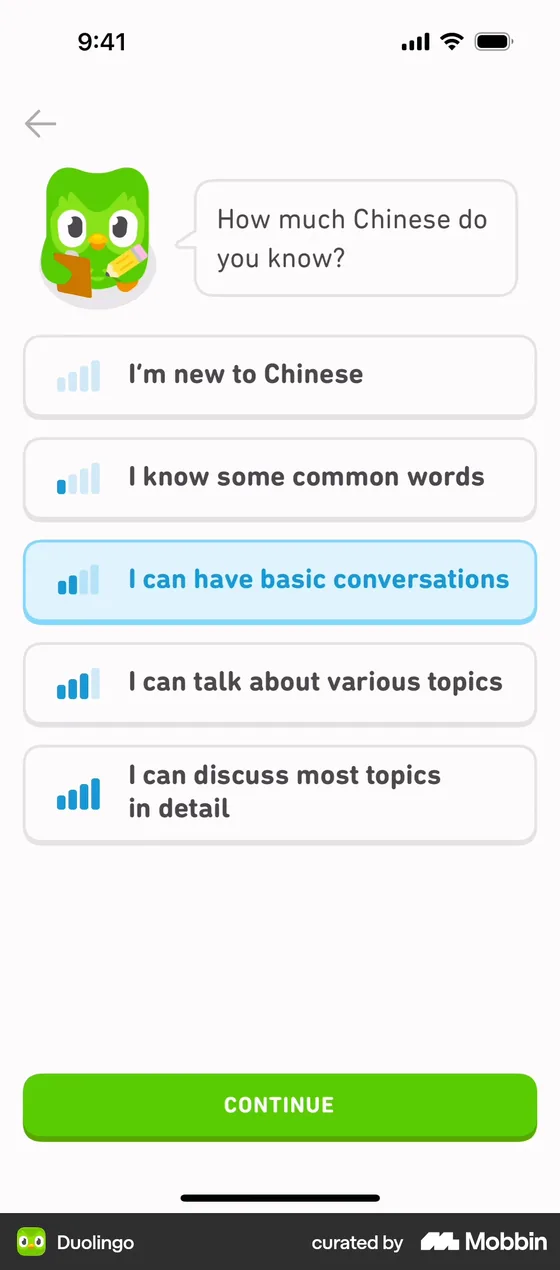
If you're studying for an exam, HelloChinese's words are more likely to be exam words. If you want the widest vocabulary, Duolingo has more.
HelloChinese teaches more of Chinese itself
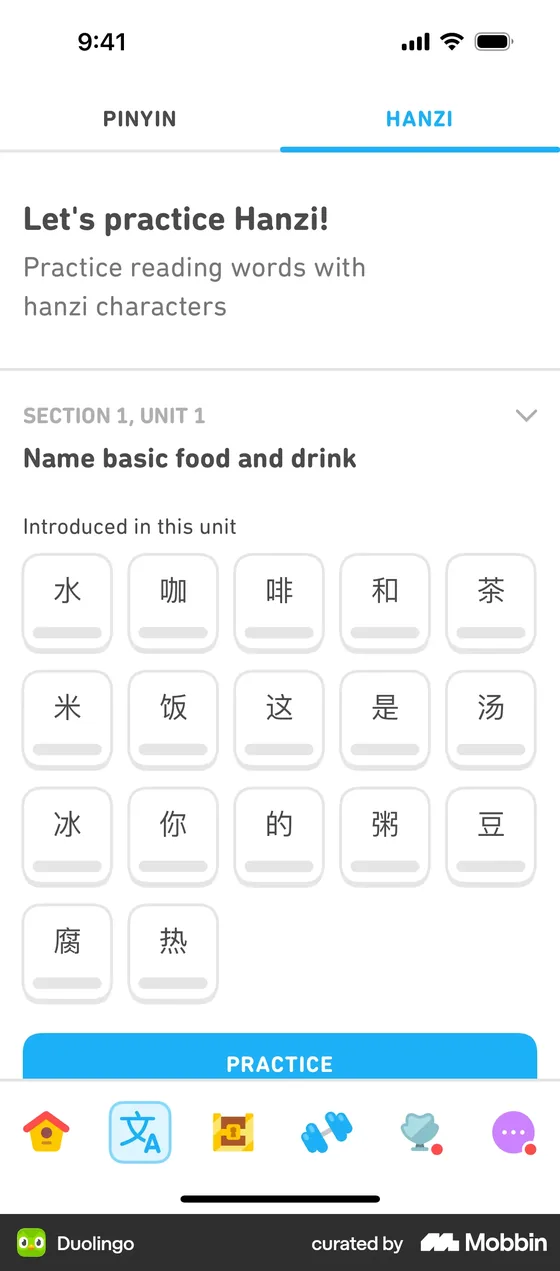
Duolingo has two tabs just for Chinese, one for pinyin and one for characters. HelloChinese, built only for Chinese, still goes further in what you practise.
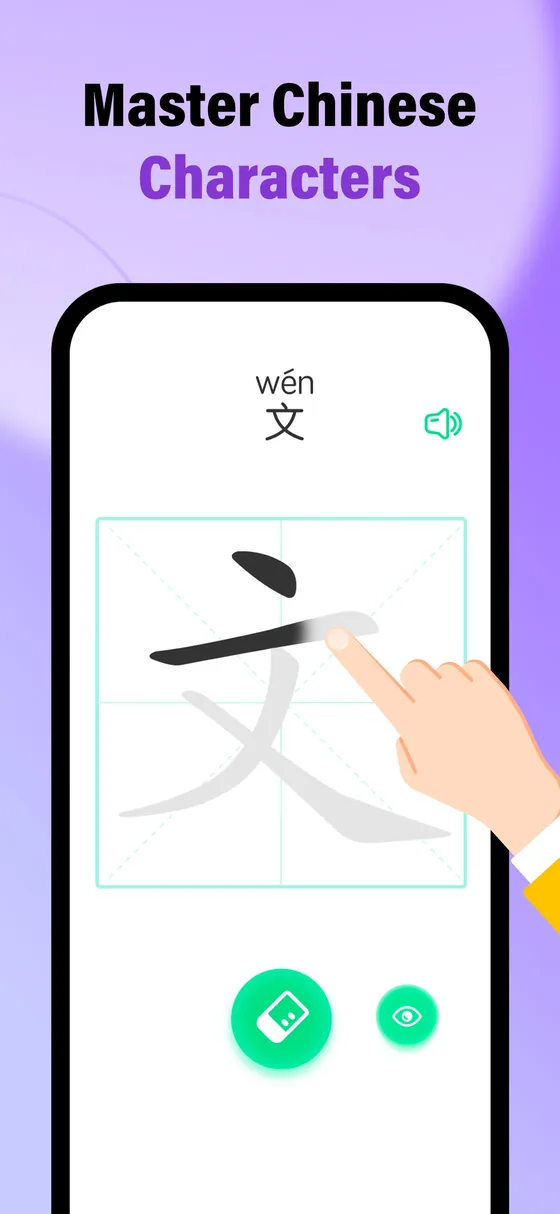
The clearest gap is writing. HelloChinese has you write characters by hand, stroke by stroke, in Simplified or Traditional characters. Duolingo teaches Simplified only, and on most phones you type through pinyin.
Duolingo's Hanzi tab practises reading the characters each unit introduces. HelloChinese's listing shows what its handwriting practice looks like:
The rest of the gap shows up across the course:
- Grammar. HelloChinese counts 430+ grammar points, and Premium adds Teacher Talk lessons on grammar and culture. Duolingo teaches patterns implicitly, with optional tips; explaining your mistakes takes its top plan, Max.
- Reading. HelloChinese has 1,000+ graded stories with audio. Duolingo's Chinese reading is mostly single sentences.
Learners who switched say the same in the r/ChineseLanguage threads we read. One put it simply: "It feels made by actual chinese teachers."
If you want to read and write Chinese, HelloChinese is the better teacher.
Speaking and tones: both stop at set lines
Both apps listen to you, but mostly to check lines they wrote. Open conversation is a paid extra on Duolingo, and HelloChinese doesn't say how much it offers.
On Duolingo, most speaking items have you read a sentence aloud, and "Can't speak now" skips them for 15 minutes. Duolingo grades Chinese speech phonetically and doesn't say whether a wrong tone fails.
Its AI conversation, Video Call, came to Chinese on iPhone in January 2026, for Max subscribers. In August, Duolingo said most new Super subscribers get it. Roleplay, its other AI feature, isn't offered for Chinese.
HelloChinese uses speech recognition to check your pronunciation of set lines. Its App Store images now promise AI speaking practice, without saying what it covers:
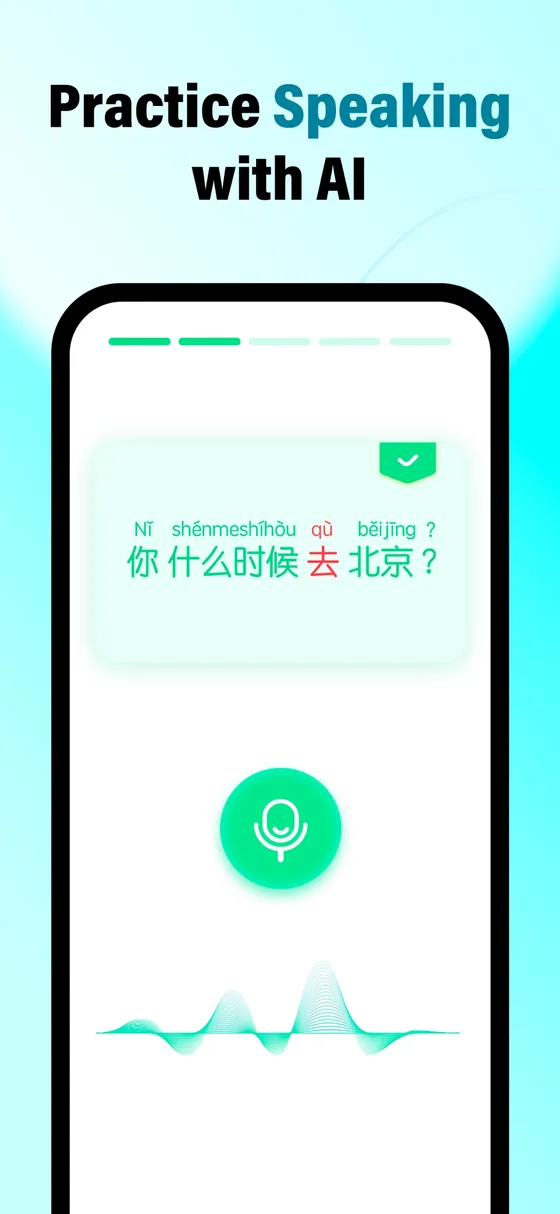
Its team has been careful here. In 2025, it said it needed to check how accurately AI can judge spoken answers before letting you reply by speaking.
Both apps teach the tones themselves. HelloChinese has a pinyin course for beginners, and Duolingo's Pinyin tab introduces the five tones and the sounds of pinyin:
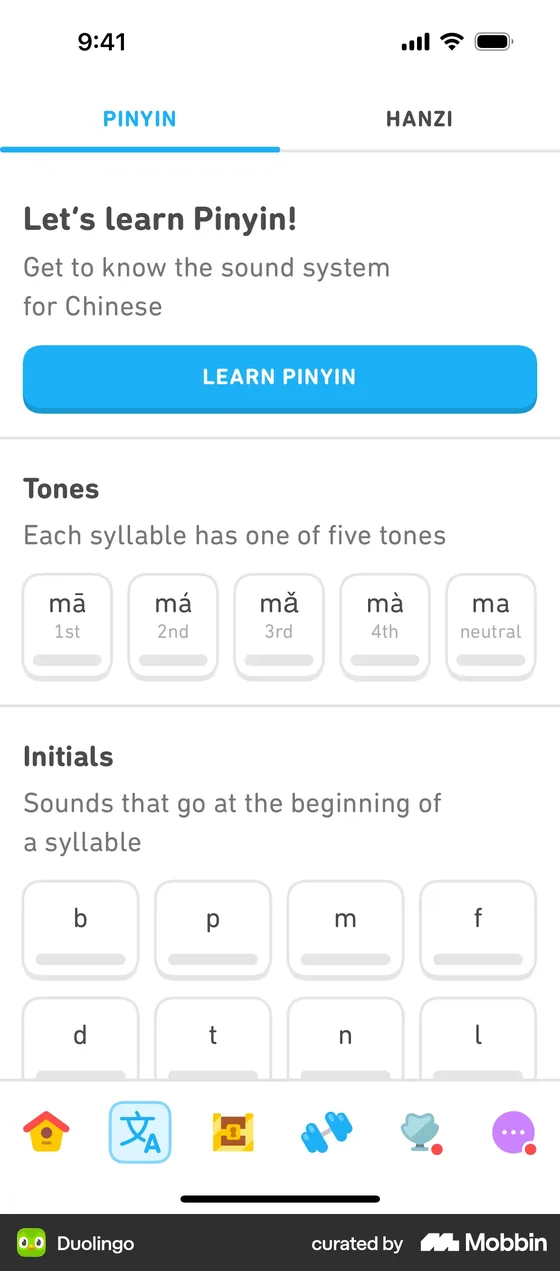
What neither has shown is that its feedback on your tones is accurate. Neither publishes how well it judges them, and a review of 15 studies found speech-recognition practice helps individual sounds a lot but pitch, which carries tones, only a little. A learner using both apps said it plainly: "I find the tones are hard to learn through duo."
Use either app's speaking drills as practice. For feedback, train your ear with a tone trainer, then talk to someone who answers back.
Free means very different things
Duolingo gives away its whole course. HelloChinese gives away a taste.
On Duolingo, every learner gets the same lessons. Paying for Super removes ads and the energy limit and adds extra practice. Its own paywall puts "Learning content" in both columns:
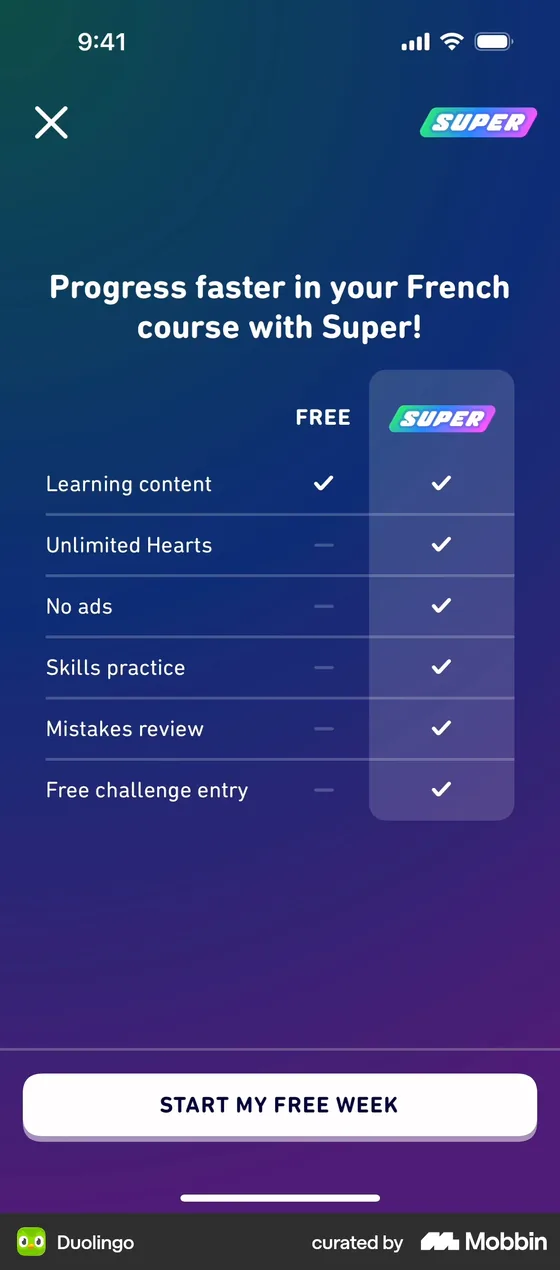
Super has a two-week free trial on iPhone. Duolingo doesn't publish a price list: its US App Store page lists Super from $9.99 to $119.99 without naming plan lengths.
HelloChinese is free to download, but the lessons run out fast. In a September thread, learners confirmed the paywall arrives after a few lessons; switching to the older course buys a few more.
Here's what each plan gives you, and what it costs:
Duolingo, free
- What you get
- The whole course, with ads and an energy limit
- US price
- $0
Super Duolingo
- What you get
- No ads, unlimited energy and extra practice; Video Call for most new subscribers. Max adds explanations
- US price
- From $9.99; plan lengths not shown
HelloChinese, free
- What you get
- A few lessons, then a paywall
- US price
- $0
HelloChinese Premium
- What you get
- The whole course and Teacher Talk lessons
- US price
- $11.99 a month, $25.99 for 3 months or $69.99 a year
HelloChinese Premium+
- What you get
- Premium, plus every graded story and a characters course
- US price
- $19.99 a month or $149.99 a year
Sources: each app's US App Store page, checked 11 October 2026; Duolingo's Help and its paywall screens on Mobbin; FluentU's review for what Premium+ adds and its plan lengths; learner reports for the free lessons.
HelloChinese also runs sales: its team says it usually holds them around holidays, and its App Store page lists a $48.99 Premium price.
If money decides it, Duolingo is the only full course you can finish for free. If you'll pay for a year, HelloChinese costs under $6 a month.
Pick by your goal, not the brand
Each app wins different jobs. Here's where we'd send you:
- Best for a free start: Duolingo. The whole course is free, and its streaks and reminders are hard to beat for building a habit.
- Best for a structured beginner course: HelloChinese. Grammar lessons, a pinyin course and a gentle pace, if you'll pay.
- Best for reading and writing: HelloChinese. Graded stories, handwriting and both scripts.
- Best for the widest vocabulary: Duolingo. It covers more of every HSK level from HSK 3 up.
- Best for HSK 4: both together. Between them they cover 95% of the words HSK 4 expects.
- Best for speaking: neither. See the alternatives below.
Habit counts more than people think. Duolingo says learners who reach a week-long streak are 3.6 times as likely to complete their course, though that's a correlation. HelloChinese added its own streaks and achievements in April 2026.
Using both works, and it's cheap: Duolingo costs nothing. Some learners in the threads we read keep Duolingo for a light daily review and use HelloChinese as their main course.
Alternatives to both
If neither fits, pick by what's missing. Most alternatives cost $5 to $15 a month, about what HelloChinese does, and two full courses cost a little less over a year.
Here's what each one costs a month in the US, from the yearly price spread over 12 months to paying monthly:
Most alternatives cost $5 to $15 a month; Duolingo costs nothing
Left end: the yearly plan divided by 12. Right end: paying month by month. US App Store prices.
| App | US$ a month | Best for |
|---|---|---|
| Duolingo | 0 | A free daily habit |
 SuperChinese PLUS SuperChinese PLUS | 5.00–11.99 | A longer course with speaking scores |
| ChineseSkill Premium | 5.00–11.99 | Mandarin, Taiwan Mandarin or Cantonese |
| HelloChinese Premium | 5.83–11.99 | The gentlest full course |
 SayMei SayMei | 5.99 | Spoken lessons with an AI teacher |
 Speak Speak | 7.00–17.99 | AI speaking practice |
 Skritter Skritter | 8.33–14.99 | Handwriting |
 Du Chinese Du Chinese | 10.00–14.99 | Graded reading |
Sources: each app's US App Store listing, checked 11 October 2026; SayMei's pricing page. SayMei's $5.99 buys 200 minutes of lessons a month. Speak added Mandarin in June 2026.
The cheapest ways to fill each gap:
- A cheaper course than HelloChinese. SuperChinese PLUS and ChineseSkill Premium cost $59.99 a year on the US App Store, $10 less. SuperChinese also sells PLUS for life; our HelloChinese vs SuperChinese guide compares the two.
- Free tools. Pleco is a free dictionary, and Anki is free flashcards on Android and computers. Our flashcard comparison covers both.
- Speaking. A tutor is the classic fix: italki's Chinese tutors charge a median of about $20 an hour, by our tutors guide's count. Our AI apps comparison covers Speak, SuperChinese's CHAO plan and SayMei.
- Reading. Du Chinese and our graded readers comparison cover stories at your level.
- Audio on the go. Pimsleur's lessons are audio-first; our Pimsleur review checks what they teach.
For the whole field in one place, see the best apps to learn Chinese.
Where SayMei fits
SayMei is built for the gap both apps leave: speaking. Its lessons are spoken conversations with Mei Lin, your AI teacher, in your browser, with a transcript in pinyin, characters or both.
You can try it free first. After a week's trial, which needs a card, Premium is $5.99 a month for 200 minutes.
We want to be plain about the limits. SayMei won't replace a course app: it has no app or offline mode, no writing course and no pronunciation score, and its minutes are capped. Pair it with Duolingo or HelloChinese if you want both.
What we couldn't check
- We didn't sign up for or subscribe to either app. Features are what each company says, plus Duolingo screens on Mobbin and what learners report.
- HelloChinese's own word list isn't public. Its numbers here are for the list its team says the course is built on.
- Duolingo's word list is community data. Duolingo doesn't publish one, and duome.eu is a fan site.
- Duolingo's paid prices aren't labelled. Both companies also run sales, so the price you see may differ.
- Nobody has published how accurately either app judges tones.
What to do next
- Decide what you'll pay. If nothing, use Duolingo; if about $70 a year, HelloChinese.
- Try HelloChinese's free lessons first. A few lessons will show whether its pace suits you.
- Use the HSK lists as your map. Our HSK word lists show what your app skipped at your level.
- Train tones on their own. Neither app's speech check is proven for tones; our tones guide shows how.
- Talk to someone who answers back. Repeating set lines won't make you conversational.
When you're ready to talk, try a lesson with Mei Lin.
FAQ
Is HelloChinese better than Duolingo for learning Chinese?
For a main course, yes, if you'll pay. HelloChinese is built only for Chinese, with handwriting, a pinyin course, grammar lessons, graded stories and Traditional characters. Duolingo is free and its course is bigger: its word list covers 82% of the new HSK 4 words, against about half for HelloChinese's list. Some learners keep Duolingo as a free daily extra alongside HelloChinese.
Is HelloChinese free?
Only a little of it. HelloChinese is free to download, but learners report the new course stops being free after its first lessons, early in HSK 1, and the older course gives a few more. To keep going, Premium costs $11.99 a month or $69.99 a year on the US App Store. Duolingo is the one whose whole Chinese course is free.
How much does HelloChinese cost?
On the US App Store in October 2026, Premium costs $11.99 a month or $69.99 a year. Premium+, which adds every graded story and a characters course, costs $149.99 a year. The listing also shows lower sale prices, and prices in other countries differ.
What HSK level does HelloChinese reach?
Its team says the new course covers levels 1 to 3 of the 2021 HSK standard, about 2,200 words. On the word lists the new exam uses, that covers almost all of HSK 1 and 2, most of HSK 3 and about half of HSK 4. Duolingo's list goes further. Our HSK 3.0 guide explains the new levels.
Can you use HelloChinese on a computer?
Not in a web browser. HelloChinese's website links only to its iPhone, iPad and Android apps, and an Android download. Its App Store page says the iPad app can run on Macs with Apple's M1 chip or later, though it isn't verified for macOS. Duolingo, by contrast, also runs on the web at duolingo.com.
Should I use Duolingo and HelloChinese together?
You can, and it costs nothing extra, because Duolingo is free. They overlap a lot: Duolingo teaches about four in five of the words on HelloChinese's target list. The pair pays off for HSK 4, where together they cover 95% of the words the exam expects. For speaking, you'll still need a person or an AI teacher.
Is there a cheaper alternative to HelloChinese?
Yes. On the US App Store, SuperChinese PLUS and ChineseSkill Premium cost $59.99 a year, $10 less than HelloChinese Premium, and SuperChinese also sells PLUS for life. Duolingo's course is free. For speaking practice, SayMei costs $5.99 a month, and you can try it free first.
What's the best free alternative to Duolingo for Chinese?
There's no other free full course like it: HelloChinese and SuperChinese give away only samples. A free set that covers most gaps is Pleco for the dictionary, Anki for flashcards, free graded stories and our tone trainer. You can also try SayMei's spoken lessons free first.
Sources
Checked 11 October 2026 unless noted. No accounts were created and nothing was bought.
HelloChinese
- HelloChinese on the App Store: prices, features, release notes (2,500+ words and 430+ grammar points, August 2026; streaks, April 2026), listing images
- HelloChinese on Google Play: 4.8 stars from about 412,000 ratings, 10M+ downloads
- hellochinese.cc: download links (no web version)
- HelloChinese team's comments on Reddit, including its 2025 AMA: the course target, speaking plans and HSK 3.0
- FluentU's HelloChinese review (updated 21 January 2025): what Premium and Premium+ include
Duolingo
- Duolingo on the App Store: Super price lines and its 14-day trial; Duolingo on Google Play: "Contains ads"
- Duolingo blog: improving how Duolingo teaches Chinese (2020; modified 18 September 2026); advanced content (22 April 2026); Video Call with Falstaff (14 January 2026); Duolingo Max; streaks
- Duolingo Q2 2026 earnings call (5 August 2026, transcript on Webull)
- Freeman et al., The Duolingo Method (Duolingo research report, 2023)
- Screens: Mobbin, © Duolingo: Chinese course placement; Chinese Pinyin and Hanzi tabs; Super paywall, French course, December 2024
- Is Duolingo good for Chinese?, our screen-by-screen guide, with its sources
Word lists
- duome.eu, Duolingo's "Chinese from English" vocabulary (unofficial; dated 10 September 2026, unchanged on 11 October)
- Ministry of Education, HSK standard GF 0025-2021 (PDF): the 2021 lists, which we read from Chinese Testing International's public database
- CLEC, 2025 HSK exam syllabus; Chinese Testing International on the 13 December 2026 start
Alternatives and SayMei
- US App Store listings: SuperChinese, ChineseSkill, Speak, Skritter, Du Chinese, Pleco, AnkiMobile; Speak's Mandarin launch (2 June 2026)
- SayMei pricing and first lesson
Research and learner reports
- Ngo, Chen & Lai, "The effectiveness of automatic speech recognition in ESL/EFL pronunciation: a meta-analysis", ReCALL, 2024: 15 studies of English learners
- r/ChineseLanguage threads: Duolingo vs HelloChinese vs SuperChinese (September 2026); is HelloChinese only free up till here? (September 2026); is HelloChinese really better than Duolingo? (December 2025); HelloChinese and Duolingo (December 2025); HelloChinese alternatives (February 2026)
Methods
We compared the two apps from public sources read on 11 October 2026: each app's US App Store and Google Play listings, the companies' websites and blogs, HelloChinese's team comments on Reddit, Duolingo screens captured by Mobbin, and threads on r/ChineseLanguage. We didn't create accounts or test either app. Prices are US App Store prices; plans bought elsewhere may cost more or less.
For the word lists, we matched Duolingo's community word list, 5,960 words in 310 units, and the 2021 standard's levels 1 to 3, 2,204 distinct written forms, against the 2025 syllabus's 11,000 words, each counted once at its lowest level. We counted exact matches only, so Duolingo's numbers equal those in our Duolingo guide; a 2021 word also counted when the 2025 list spells it slightly differently. Learner reports are labelled as such and never used as facts about features. The chatbot sample is 17 answers to "HelloChinese vs Duolingo vs SuperChinese: which one should I use?", collected on 6 October 2026 from ChatGPT, Claude, Gemini and Perplexity with web search on. If you spot a mistake, tell us: we fix errors.
Duolingo and HelloChinese are trademarks of their owners. SayMei isn't affiliated with either.